investigation
Whodunnit, and why? All about criminal investigations and the forensic methods used to search for clues and collect evidence to get to the bottom of the crime.
Why Czar Nicholas II and the Romanovs Were Murdered
When Nicholas Romanov was crowned czar of Russia in 1894, he seemed bewildered. “What is going to happen to me…to all Russia?” he asked an advisor when he assumed the throne. “I am not prepared to be Czar. I never even wanted to become one.”
By Kristen Orkoshneliabout a year ago in Criminal
Why I Think My Neighbor Is a Serial Killer
I live in a quiet neighborhood where nothing ever happens—at least that’s what people like to believe. Rows of identical houses, tidy lawns, and the occasional barbecue. It’s the kind of place where everyone waves but no one truly knows each other. That illusion of peace shattered for me the night I began watching Mr. Derren.
By MUHAMMAD JALALabout a year ago in Criminal
“Watching the Back: A Hostage Nightmare in Henry County”
Chapter 1: The Silence That Spoke Volumes It was just past 11 a.m. on April 4, 2019, when Anetria White pulled into her sister’s driveway in Stockbridge, Georgia. She had been trying to reach her pregnant sister, Sandra White, since the night before—but calls had gone unanswered. So had texts. Sandra wasn’t the type to just “go quiet.”
By 🕵️♂️ True Crime Enthusiast | Storyteller of the Dark Side 🔍about a year ago in Criminal
10 Ways Family Courts Hide Misconduct
Introduction While family courts claim to act in the best interests of children and families, a growing chorus of parents, whistleblowers, and legal advocates say otherwise. Beneath the surface of closed courtrooms and sealed records lies a troubling reality: misconduct is often ignored, minimized, or actively concealed. Judges, attorneys, and court-appointed professionals can operate with little to no accountability—leaving families, especially pro se parents, at the mercy of a system that often protects its own.
By Michael Phillipsabout a year ago in Criminal
Ashes in the Rain: A Brother’s Brutal Hunt for the Truth Behind His Sister’s Death
The rain had been falling for four days when Claire Wade disappeared. Her brother, Daniel, figured she just needed space. Nurses worked too hard for too little, and life had a way of grinding people down. But when her ten-year-old daughter, Emma, showed up at his garage alone, soaked and shivering, Daniel knew something was wrong. The police said overdose. No foul play. No case. Daniel had seen dead people before. Too many, actually. Back when he was doing things he never talks about, in places he’ll never name. And Claire didn’t look like an overdose. Her face was too calm. Too clean. Like someone had laid her down gently, wiped the panic from her mouth, and walked away. Three days after the funeral, he found her phone. Tucked inside a cereal box under the sink. Almost missed it. Typical Claire—always one step ahead. Inside were voice memos. Fragments of conversations. Shaky recordings of hushed meetings in break rooms. Files she’d copied from hospital records. People with no ID, no discharge, no trail. She’d been helping someone escape. A woman with bruises who spoke no English. After that night, the woman was never seen again. It wasn't an overdose. It was a message. Daniel brought it to the police. They nodded politely. Said they’d look into it. One officer literally yawned while Daniel spoke. So he went back to the man he used to be—the one he had buried under tools, oil, and ordinary days. --- The first man he found was a paramedic. Smooth uniform, bad hands. Daniel followed him from the hospital to a dive bar near the shipyards. Waited until he staggered out, drunk and humming to himself. A wrench pressed against the spine is a great way to encourage conversation. The man talked. They always did. More names followed. A cleaner who scrubbed records. A night nurse who signed off on “phantom” discharges. A logistics guy who handled transport—of people, not supplies. Each lead peeled back another layer. Each name darker than the last. At the edge of it all stood Marcus Shaw—hospital director, charity speaker, community face. Public hero. Private monster. Daniel tracked him to a warehouse on the river—converted shipping containers with modified locks. Inside, he found three women. Two were conscious. One wasn’t. He left them with Mia, an old medic friend who owed him favors. Then he grabbed his crowbar and Emma’s stuffed rabbit—the one she dropped the night Claire died. --- He found Shaw alone in his office at the docks, pouring himself a drink like it was just another day. “I knew you’d come,” Shaw said. “Family’s a powerful thing.” Daniel didn’t answer. Just smashed the glass table in front of him with one clean swing. The fight was fast, but it was ugly. Shaw was stronger. Younger. But Daniel had grief behind him—and grief doesn’t let go. They wrecked the office. Bookshelves, chairs, blood on the wall. Shaw hit him with a lamp. Daniel drove him into the floor. "She begged me," Shaw gasped, coughing up blood. "All she had to do was shut up." Daniel raised the crowbar again. His hands trembled. But he didn’t swing. Instead, he pressed play on Claire’s final recording. Her voice filled the room, shaky but fierce. Naming names. Telling the truth. And now it was going live—streamed to every contact she had. By morning, Shaw was in handcuffs. Half the city was watching. The rest couldn’t look away. --- A week later, the rain finally stopped. Daniel sat on the porch of his garage, holding the rabbit Emma had asked him to fix. She curled beside him, small and silent. “Did you hurt them?” she asked. He paused. “I stopped them.” Emma looked up. “Is Mum proud?” He didn’t answer. Just pulled her close and held her. Inside, the radio played a quiet song. One Claire used to hum when Emma was small. Outside, puddles reflected a sky trying to remember how to be blue. The storm had passed. But Daniel knew some storms live inside you. And some never leave.
By Ubaid Ur Rehmanabout a year ago in Criminal
African American Serial Killers Part 4
In the late eighties early nineties, the Crack Era had police departments involved in bringing hustlers “to justice.” In fact, the War on Drugs, or battle from an inanimate object, sapped the resources of other departments dedicated to solving actual crimes.
By Skyler Saundersabout a year ago in Criminal
How did prisoners escape from the most powerful prison in human history (Alcatraz)?. Content Warning.
In 2013, a letter arrived at the San Francisco Police Department. The sender claimed to be the mastermind behind the infamous escape from Alcatraz prison and offered to turn himself in—on one condition: he would receive proper medical treatment, as he was now over 80 years old and seriously ill. Strangely, the police responded within just one hour, accepting his offer and stating that they were waiting for him, promising to provide the best care possible. However, the man never contacted them again. Whether it was just a game or he died, no one knows. The escape remains one of the most brilliant and daring in human history. Alcatraz Prison, often referred to as “Hell on Earth,” was established in 1934 and designed to be the most secure facility in the world—not only to prevent escape but also to break the spirits of inmates. Those sent there had committed additional crimes while already imprisoned in other U.S. facilities. Located on a desolate island about 2 kilometers off the coast of San Francisco, the prison was surrounded by freezing waters, strong currents, and, according to popular belief, sharks—rumors spread by authorities to discourage escape attempts. Life inside was pure torment: tiny cells, constant surveillance, one shower per week, limited meal and recreation time, and forced labor. Even the guards were among the worst—officers who had behaved badly elsewhere were sent to Alcatraz as punishment. This created a deeply hostile environment between prisoners and guards. Despite all this, the impossible happened. The story began in 1961, when an inmate named Allen West noticed a ventilation duct above his cell that seemed to lead to the prison’s roof. He realized he would need a team to pull off an escape, so he partnered with another inmate, Frank Morris, a man with an exceptional IQ of 133. They also brought in two brothers, John and Clarence Anglin, whose cell was nearby. The four began secretly digging through the back walls of their cells using smuggled spoons and forks. Behind their cells, they discovered an unused corridor filled with drainage pipes, which could lead them to the roof. They covered the holes in their walls with cardboard and plaster structures painted to match the wall color and hung clothes to conceal them further. Since guards never entered the cells, the ruse worked perfectly. They dug each night at 9 PM—during the daily hour when prisoners were allowed to sing and play music to lift their spirits. The noise masked the sound of digging. Over six months, they slowly widened the holes, disposing of the debris through the ventilation openings into the corridor. Meanwhile, Frank developed a plan for escape by sea. Using old prison magazines, he had memorized instructions on how to build a raft and life vests from household materials. They gathered 22 stolen raincoats from the prison’s storage during the summer months when such coats weren’t needed, stitched them together, and created a rubber raft and vests. They even built an air pump using parts from a discarded accordion. To cover their absence during nightly work on the roof, they crafted realistic dummy heads made from soap, paper, toothpaste, and real hair collected from the prison barber. Each night, they placed the heads on their pillows and climbed through the ventilation holes. After two months of preparing the raft and cutting the metal bars covering the final exit vent, they were ready. On the night of June 11, 1962, at exactly 10:00 PM, the lights went out and the prison fell silent. Frank, the Anglin brothers, and Allen West put their dummy heads in place and prepared to escape. However, Allen couldn't squeeze through his hole—he had sealed it the night before and had gained weight over the months. The others told him they couldn’t wait and left without him. The trio climbed to the roof, reached the outer fence, cut through it, and made their way to the shore. There, they inflated the raft using the homemade pump and launched into the freezing waters, heading toward freedom. The next morning at 7:30 AM, a guard discovered something was wrong when he tapped one of the Anglin brothers to wake him and the fake head rolled onto the floor. Panic spread as they realized three prisoners had escaped. The prison was put on high alert, but the escapees were never found. The authorities later claimed they had drowned, although evidence suggested otherwise—life vests were found on the opposite shore, and years later, a photograph surfaced in 1975 allegedly showing the Anglin brothers alive. Then in 2013, Frank Morris himself reportedly sent a letter saying he was ready to surrender—under the condition of medical care—but he vanished again and never followed up. The escape was so embarrassing to the authorities that they kept details of the plan secret for 20 years. A year after the escape, a film was released depicting the story, using surprisingly accurate details that had never been officially disclosed. In the same year, Alcatraz was shut down for good. The infamous slogan carved into the rock—“On the rock of Alcatraz, your dreams of freedom will be crushed”—was replaced with a new one: "Dreams of freedom were shattered on the rock of Alcatraz—forever." The prison was converted into a tourist attraction. Ultimately, the only one who didn’t make it was Allen West—the very man who discovered the ventilation shaft and helped plan the escape. Ironically, without him, the world might never have known the full details of the most ingenious prison escape in modern history.
By Ink pulse(different angle)about a year ago in Criminal
Military robbery | The most dangerous armed operation in the world (the reason for arming the police). Content Warning.
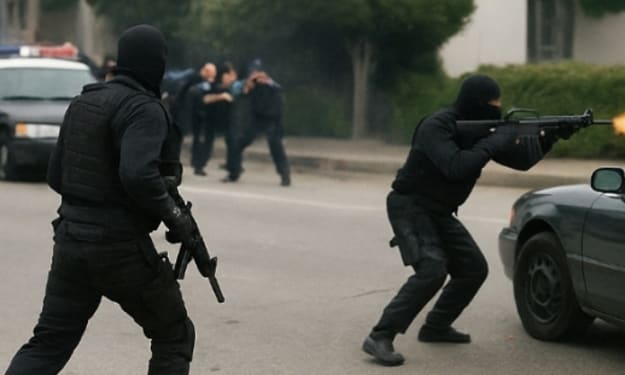
On the morning of February 28, 1997, a fleet of news helicopters flew toward a bank in a quiet neighborhood in North Los Angeles. When they arrived, they pointed their cameras at the bank’s parking lot and began broadcasting live. What appeared on the screens was a bank robbery—expected to be routine, like thousands before it—but this time, it was completely different. In a matter of moments, the robbery turned into one of the most violent shootouts in American police history. Two armed men engaged in a massive firefight with dozens of LAPD officers. The scene resembled a war zone: two men, fearless, firing nonstop, armed with automatic weapons, thousands of rounds of ammunition, and body armor impervious to standard police bullets. The police were outnumbered and under-equipped. Their handguns were useless against the robbers’ heavy armor and high-powered rifles. The streets of the city turned into a battlefield, broadcast live to millions around the world. One of the robbers was Larry Phillips Jr., a man who came from a long line of criminals—his grandfather robbed trains, and his father dug up graves. In 1984, he turned to bodybuilding and joined Gold's Gym in Pasadena. His goal was to build an impressive physique, but when he realized his body couldn't compete professionally, he chose a different path. He tried to appear as a businessman, even stealing a suit from a store—but was caught and jailed for a short time. After his release, he became a real estate agent, but the income didn’t meet his expectations. He turned to scams and fraud, and eventually to bank robbery. But he needed a partner—Enter Emil Mătăsăreanu, a Romanian immigrant who moved to the U.S. in 1976. Emil had health issues, was overweight, and suffered from bullying. But determined to change, he too joined the same gym as Larry. That’s where they met. What brought them together was their mutual love for guns. Larry was experienced, and Emil was a passionate hobbyist—soon that interest evolved into crime. Between 1990 and 1992, they carried out a series of minor robberies: hitting convenience stores and ambushing money transport vans. In 1993, they executed their first major heist—ambushing an armored truck and stealing tens of thousands of dollars. Later, they were stopped by police for speeding. A search of their car revealed an arsenal of weapons, ammo, smoke grenades, body armor, fake IDs, and even listening devices. However, since they weren’t caught in the act of robbery, they were only charged with illegal possession of weapons. Larry was sentenced to 99 days, Emil to 71. Upon release, they resumed preparations. In 1995, they ambushed another armored truck and killed the guard. In 1996, they hit two Bank of America branches, stealing hundreds of thousands of dollars each time—fast, efficient, and undetected. But the money ran out quickly. Their lifestyle didn’t allow for saving. So in 1997, they planned another robbery: the Bank of America branch on Laurel Canyon Boulevard, the largest in North Hollywood. It was strategically located—next to a mall, surrounded by open parking lots, with multiple escape routes. They stocked up on military-grade weapons: AK-47s, a Bushmaster XM15, an HK91 sniper rifle, and over 3,000 rounds of ammunition. Their armor was homemade—Kevlar vests reinforced with steel plates, and Larry even wrapped himself in industrial protective blankets. On the morning of Friday, February 28, at 9:16 a.m., they stepped out of a white Chevrolet, took Phenobarbital (a sedative to calm their nerves), and entered the bank. Their plan: take control, open the vault, fill their bags, and escape within 8 minutes. But something went wrong… The money they expected hadn’t arrived yet. The vault had individual safety deposit boxes, each needing a key. Meanwhile, a patrolling police car noticed them and reported a suspicious situation, requesting backup. Within minutes, the police surrounded the bank. Larry began shooting to intimidate civilians, then turned his gun toward the officers. Emil came out minutes later with a bag holding $33,000, not realizing it contained dye packs that exploded after being hit by a bullet, staining the cash red. The standoff escalated. The police were under-armed—some had to borrow high-powered rifles from nearby gun stores to match the robbers’ firepower. Larry and Emil moved in military formation, covering each other, taking turns firing, like trained soldiers. When they ran low on ammo, they tried to flee in their car. Police shot out the tires. Larry walked behind the vehicle, using it as a shield, still firing, while Emil drove slowly beside him. Eventually, they reached a residential neighborhood, where they split up. Larry hid behind an abandoned truck and was shot multiple times, dying on the spot. Emil tried to hijack another car, but the driver fled with the keys. Surrounded, Emil continued firing, even after taking over 20 bullets to the legs. In the end, he surrendered, was handcuffed, and left bleeding on the street for over 56 minutes, while paramedics were kept away in fear of hidden explosives. He died on the scene from blood loss. The shootout lasted 44 minutes, with over 2,000 rounds exchanged. Twelve police officers and eight civilians were injured. Over 300 officers and SWAT teams responded. Investigators later discovered more weapons, ammunition, body armor, and even a makeshift bomb factory. At the time, LAPD officers were equipped with 9mm pistols or .38 revolvers, ineffective against armored assailants. The incident revealed a major gap in police preparedness. In response, police departments across the U.S. upgraded their weapons and tactics. The AR-15 became standard issue, as did armor-piercing rounds, improved vests, and military-style helmets. Though this wasn’t the only reason for police militarization, it was a critical turning point. The North Hollywood shootout remains one of the most violent criminal encounters in American history—and it changed law enforcement forever.
By Ink pulse(different angle)about a year ago in Criminal
"I Want to Talk to You" – The Tragic Final Hours of Humaira Asghar
📰 Editor’s Note: This story is a follow-up to my earlier coverage of the sudden and tragic death of Pakistani actress and public figure Humaira Asghar. New revelations have emerged from the police investigation that deepen the mystery and raise even more troubling questions. Here is the full updated report based on the latest evidence.
By 🕵️♂️ True Crime Enthusiast | Storyteller of the Dark Side 🔍about a year ago in Criminal
I am tired of being politically correct and socially acceptable
On other planets they no longer have the karma of raging war against one another. They have learned there lessons and understand that violence solves nothing. It only exploits and kills people for material gain. To send your children to die or to drop bombs on innocent people would be a form of madness in these higher vibrations. They have counsels that equally represent every voice ethnicity or minority. It is against moral law to act in any kind of aggression that destroys one another. They only use peace and negotiation, as well as conflict revolution skills that are superior because they do not violate the law of love and represent an uncorrupted excellent moral fiber that exists in all of us. But more importantly built on a deeper respect and understanding of each other so ignorance does not exist. Things that ignorance creates like prejudice, discrimination and racism no longer exist. Earth wants you to believe that this is a utopian dream that is impossible.
By Julia Stellingsabout a year ago in Criminal