investigation
Whodunnit, and why? All about criminal investigations and the forensic methods used to search for clues and collect evidence to get to the bottom of the crime.
Whispers in White Noise
Audio forensics expert Tessa Reid made her reputation debunking "electronic voice phenomena" until the day she analyzed background noise from a ten-year-old murder scene and extracted a voice that shouldn't exist—the victim, speaking after time of death. When her findings are dismissed as technical glitches, Tessa launches her own investigation, discovering similar anomalies in five other unsolved homicides.
By Edmund Oduro2 years ago in Criminal
Trapped in Yemen: How a Kerala Woman's Dream Turned into a Death Sentence
Nimisha Priya once had a dream — not of luxury, not of fame, but of giving her family a better life. Born in a modest village in Kerala, India, Nimisha grew up like many young girls in rural India — with big dreams and limited options. But she was determined. Quiet yet ambitious, she poured her heart into becoming a nurse. Supported by her local church and fueled by the desire to lift her family out of poverty, she set out on a path that would eventually take her far from home — to war-torn Yemen. At just 19, Nimisha moved to Yemen in 2008, hopeful and wide-eyed. She believed that hard work and compassion would open doors. And for a time, they did. She quickly earned a good reputation in the hospitals she worked at. Patients trusted her. Colleagues respected her. Money started flowing in — enough to send back home to support her loved ones. Her dream was slowly coming true. In 2011, she married Tommy Thomas, a humble auto-rickshaw driver from Kerala. They shared love, values, and a dream of a better life. A year later, Tommy joined her in Yemen, and they were soon blessed with a daughter. Life was not easy, but it was theirs to build. But dreams often carry a cost. Tommy eventually returned to India with their daughter, hoping to give her a stable upbringing away from the growing unrest in Yemen. Nimisha stayed behind, determined to achieve something greater — to open her very own medical clinic. However, there was a catch: Yemeni law required foreign nationals to have a local partner in order to own a business. Enter Talal Mahdi, a Yemeni man she had known through her work. Nimisha trusted him. Why wouldn’t she? She had no idea that this decision would unravel her entire life. With help from friends and financial backing from her husband, Nimisha launched the Al Aman Medical Clinic — a 14-bed facility in the heart of Yemen. It flourished quickly. Patients poured in. Revenue grew. But as the money rolled in, so did Talal’s dark side. He began manipulating legal documents. He registered business assets in his own name. He claimed co-ownership. But most shockingly — and disturbingly — he started telling people that Nimisha was his wife. He forged a fake Yemeni marriage certificate using a photoshopped image from Nimisha’s real wedding in India. The manipulation was not just legal — it was personal, invasive, and deeply cruel. And then came the abuse. As Yemen plunged deeper into civil war, Nimisha found herself isolated. Tommy and her daughter couldn’t return. Indian evacuation efforts meant she was stuck. Alone. Vulnerable. And completely at the mercy of Talal. He reportedly began physically and emotionally abusing her. He cut her off from help. Controlled her every move. And all the while, she was drowning in loans, her clinic at stake, and her dignity stripped away. What do you do when the system that should protect you turns its back? When the law favors your abuser? When escape is no longer an option? In 2017, everything came crashing down. In a desperate, tragic turn of events, Nimisha and a friend took matters into their own hands. Talal was found brutally murdered — his dismembered body hidden in a water tank. The story exploded across global headlines. The nurse who came to save lives was now accused of taking one. She was arrested, tried, and convicted. In 2020, she was sentenced to death. Her pleas for mercy were rejected one by one. And on December 30, 2024, the President of Yemen officially denied her final request for clemency. Now, Nimisha Priya waits in a Yemeni prison — alone, with execution looming. Is she a criminal? Or a victim driven to the edge? This is not just a story about a murder. It’s a haunting tale of betrayal, desperation, and survival. A woman left behind by the system, manipulated by a predator, and punished by a law that refused to hear her voice. Activists across India and abroad have rallied for her release. Human rights groups have begged for a retrial. But time is running out. Nimisha’s story is a chilling reminder of how dangerous the world can be for migrant workers, especially women. It’s a wake-up call — a plea to listen, to care, and to never ignore the silent screams of those trapped in foreign nightmares. Because sometimes, the line between victim and criminal isn’t drawn in black and white — but in blood, fear, and broken dreams.
By Yasir Hamid 2 years ago in Criminal
The Palindrome Murders
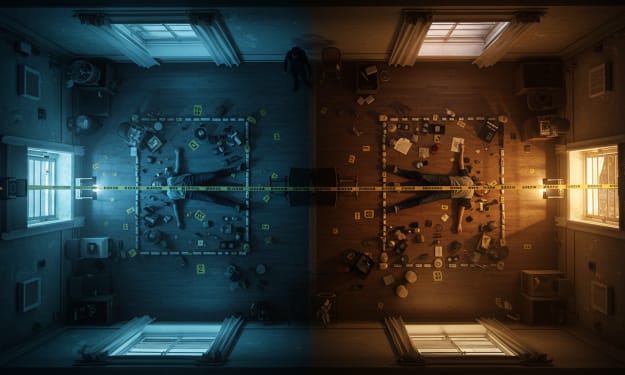
Detective Rhea Mercer had seen hundreds of crime scenes in her fifteen years with Homicide, but never one where the killer arranged the victim's possessions in perfect symmetry—until three bodies appeared across the city in one week, each staged like macabre mirror images.
By Edmund Oduro2 years ago in Criminal
How a Fiancé Visa Lawyer Can Speed Up Your K-1 Visa Process
Bringing your fiance to the United States on a K-1 visa is a big and exciting opportunity. But the process to do it can be slow, confusing, and stressful. There are a number of forms you need to fill out and documents to collect. However, if you make any small mistake, it can delay the case for more than a month. That is why many people choose to work with a fiance visa lawyer.
By Immigration INTL Law Group2 years ago in Criminal
Germany is still diligently looking for its fallen soldiers 80 years after World War II.
In a forest near Berlin, 107 wreckages were buried in Solle last week. Students placed white gerbera flowers on small black fins, and leaned them concerning the largely dug tombs of German soldiers. position. The gesture of memory was part of a long, complicated, and sometimes controversial effort 80 years after the war, and Nazi Germany began to record German deaths. That's not over yet - there is still a lot of work to identify the deaths and notify surviving families.
By Francis Dami2 years ago in Criminal
The Elevator
At 2:43 a.m., the silence in the office tower was broken only by the soft hum of the lights and the occasional groan of the ancient elevator. Erica Thorn, an overworked cybersecurity analyst, punched the elevator button with a sigh. She’d stayed too late again. Her fingers still itch from decoding the last anomaly, a strange string of encrypted data that did not belong to any project, and her eyes burned from hours of screen time. As the elevator doors creaked open on the 42nd floor, a tall man in a dark hoodie stood inside, staring at the ground. His face was shadowed because his hood was pulled low. She hesitated. “Going down?”
By Suborna Paul2 years ago in Criminal
True Criminals
The first time Marcus Blake saw the body, he felt nothing. It wasn’t guilt, or fear, or shock. It was emptiness—cold and quiet like the morning fog hanging over Brookside Alley. The blood had dried in strange patterns across the concrete, curling around the edges like the petals of a dying flower. Detective Holloway crouched beside the corpse, lit cigarette between his teeth, eyes narrowed as if trying to read the secrets in the blood.
By Hamdan Khan2 years ago in Criminal
The Mysterious Unsolved Disappearance of Sky Burnley. Content Warning.
Sky Burnley refused to let his 94-year-old grandmother be put in a nursing home. It was 2016, and Sky was 27 years old. A young man, with a lot going on in his own life, but he loved his grandmother and didn’t want to see her put in a home.
By Where are they? Podcast2 years ago in Criminal
India–Pakistan Tensions Rise
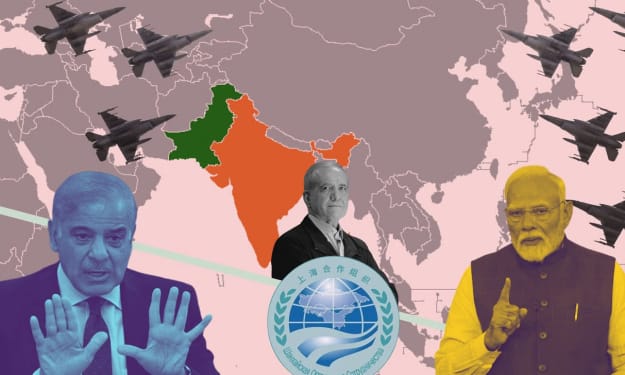
A deadly militant attack in Indian-administered Kashmir has reignited long-standing tensions between South Asia’s two nuclear-armed neighbors, India and Pakistan. The incident, which claimed the lives of 26 individuals—mostly Hindus—has triggered a new wave of diplomatic, military, and geopolitical unease in the region.
By Masood Zahid2 years ago in Criminal
Kashmir’s bloodstained meadows: Can the SCO show a road to reconciliation?
On April 22, 2025, the idyllic meadows of Pahalgam in Kashmir turned into a killing field. Twenty-six tourists—fathers, sons, dreamers—were gunned down by militants claiming allegiance to the Resistance Front, a shadowy group India links to Pakistan-based Lashkar-e-Taiba. India retaliated by suspending the Indus Waters Treaty, a lifeline for Pakistan's agriculture, while Pakistan closed its airspace to Indian flights and expelled diplomats. Nuclear arsenals loom; rhetoric hardens. Yet, amid this storm, a fragile olive branch emerges: Iran, reeling from its own tragedy—a port explosion in Hormozgan that killed at least 28 and injured 800—still urges dialogue, quoting 13th-century Persian poet Saadi, "Human beings are limbs of one body / Created from the same essence."
By Md kamrul Islam2 years ago in Criminal