interview
Interviews with defense attorneys, law enforcement officials, forensic psychologists and anyone with insight into bad behavior.
The Empire Crumbles: Diddy’s Dark Reign Exposed as Jury Deliberates His Fate
The air in the federal courthouse hung thick with a palpable tension, heavier than any bassline Diddy ever dropped. After seven weeks of harrowing testimony, graphic details, and a shocking glimpse into a world of alleged depravity, the fate of Sean "Diddy" Combs now rests in the hands of twelve jurors. As of this Monday morning, June 30, 2025, the jury has retreated behind closed doors, tasked with weighing evidence that could send one of hip-hop’s most iconic figures to prison for life. The very notion sends shivers down the spine of an industry once dominated by his seemingly unshakeable influence.
By Kelly Munala Brookesabout a year ago in Criminal
"Tensions and Trump: The Israel-Iran Conflict in a Changing Political Landscape"
As the world watches the Middle East with increasing concern, the recent escalations between Israel and Iran have once again thrust the region into a volatile spotlight. Airstrikes, proxy wars, cyberattacks, and sharp rhetoric have become frequent reminders of a decades-old animosity now reaching new heights. What makes the situation even more complex is the looming presence of former U.S. President Donald Trump, who is making headlines with a potential political comeback as the 2024 U.S. presidential election cycle gains momentum. In this tangled web of regional hostilities and international ambitions, the intersection of war and politics has never been more evident. The Recent Escalation The Israel-Iran conflict has deep roots, but the past year has seen a marked intensification. Iran, through its regional proxies like Hezbollah in Lebanon and various armed factions in Syria and Iraq, has increased its activities near Israel’s borders. In response, Israel has carried out a series of airstrikes deep into Syrian territory, allegedly targeting Iranian military infrastructure and weapons shipments. In April 2024, a deadly drone strike on an Iranian consulate building in Damascus, attributed to Israel, marked a dangerous turning point. Iran retaliated with a barrage of missiles launched directly from its territory into Israel—a rare and bold move not seen in years. Though most of the missiles were intercepted by Israel’s Iron Dome defense system, the symbolic impact was undeniable. For the first time, both nations engaged in open military confrontation, albeit still limited and carefully calculated. Regional observers feared the beginning of a full-scale war, while world powers scrambled to urge restraint. The Trump Factor While tensions boil in the Middle East, former President Donald Trump continues to be a divisive and influential figure in global affairs. As he mounts a vigorous campaign for re-election, Trump has used the Israel-Iran conflict as both a warning sign and a rallying cry for his supporters. During his presidency (2017–2021), Trump withdrew the United States from the Iran nuclear deal (JCPOA), imposed crippling sanctions on Tehran, and brokered the Abraham Accords, which normalized relations between Israel and several Arab countries. Trump’s foreign policy was marked by an unshakable alignment with Israel. His administration recognized Jerusalem as Israel’s capital and moved the U.S. embassy there, sparking outrage in much of the Muslim world. Now, with the current Biden administration attempting to pursue more cautious diplomacy with Iran, Trump has criticized what he calls a "weak and disastrous foreign policy." In several campaign rallies, he has stated that "this wouldn’t be happening if I were president," claiming that Iran was “tamed” during his term and that Israel felt “safe and strong.” His critics argue otherwise, pointing out that Trump's maximum pressure campaign on Iran may have contributed to the current crisis by hardening Iran’s resolve and diminishing diplomatic pathways. The Regional Dominoes The Israel-Iran conflict is not isolated. It pulls in other regional players, willingly or unwillingly. Hezbollah in Lebanon, Hamas in Gaza, and pro-Iranian militias in Iraq and Syria all serve as extensions of Tehran’s influence. At the same time, Arab states such as Saudi Arabia and the United Arab Emirates, which have increasingly aligned with Israel against Iran’s expansionism, are now caught in an uneasy position—supporting Israeli security while fearing regional fallout. The recent flare-ups have also affected the delicate balance of power in Iraq, where American and Iranian interests collide frequently. U.S. bases in Iraq and Syria have come under rocket attacks believed to be launched by Iran-backed militias. In Yemen, the Houthi rebels—another Iranian proxy—have intensified their actions in the Red Sea, disrupting global shipping lanes and drawing in Western naval forces. All of this creates a regional scenario where any miscalculation could spiral into a much broader war. Global Implications The United States, China, and Russia are all watching this conflict closely. While the Biden administration urges de-escalation and a return to nuclear negotiations, Trump’s potential return to power threatens to upend the diplomatic track once again. European nations, already exhausted by the prolonged war in Ukraine, are calling for calm but offer little in terms of leverage or military influence. Meanwhile, global markets have reacted nervously. Oil prices have spiked due to fears of instability in the Strait of Hormuz, through which one-fifth of the world’s oil supply passes. Investors are wary, and governments are beginning to plan for worst-case scenarios. The People Caught in Between As with all wars, it is the ordinary citizens who suffer the most. In Israel, cities from Tel Aviv to Haifa have experienced air raid sirens and brief but terrifying missile alerts. In Iran, funerals for Revolutionary Guard members killed in strikes have become almost routine, and public sentiment is increasingly nationalistic. Social media is ablaze with propaganda, misinformation, and political commentary from all sides. Iranians post pictures of damaged sites and martyred soldiers; Israelis share videos of intercepted missiles and bomb shelters. In both countries, fear and uncertainty dominate daily life. Looking Ahead The future of the Israel-Iran conflict remains uncertain. Will it escalate into a full-blown regional war, or will diplomacy manage to prevail? Much depends on the actions of not just Tehran and Tel Aviv, but also Washington. With Trump preparing for a political return, his stance on Middle East policy could once again become reality in just a matter of months. His rhetoric may embolden hawks in Israel and dissuade Iran from pursuing diplomacy. For now, the world waits—watching a dangerous confrontation unfold amid a dramatically shifting political backdrop
By Lal Sher Khan about a year ago in Criminal
Trump says he 'may or may not' strike Iran as US evacuates diplomats from Israel
**Trump Says He 'May or May Not' Strike Iran Despite the US Evacuation of Israeli Diplomats** With a cryptic statement that he "may or may not" authorize military action against Iran, former President Donald Trump has once more stoked global tensions. The ambiguous remark came amid heightened geopolitical instability in the Middle East and coincided with reports that the United States has begun evacuating diplomatic personnel from Israel due to escalating security threats.
By GLOBAL NEWSabout a year ago in Criminal
Chaos on Air: Israel Missile Strike Hits Iran Live News Broadcast, Studio Engulfed in Debris
Live on Air: When War Breached the Studio Walls On the evening of June 16, 2025, the global audience witnessed a surreal and terrifying moment as a missile strike by Israel hit the Islamic Republic of Iran News Network (IRINN) during a live broadcast in Tehran. As anchor Sahar Emami delivered the latest updates, the studio began to tremble. Within seconds, dust, debris, and shockwaves engulfed the room, forcing the anchor to flee the set mid-broadcast. The cameras continued rolling, capturing the chaos in real-time—a scene that rapidly went viral across social media platforms and news outlets.
By Mehtab Ahmadabout a year ago in Criminal
Five dead in latest Israeli shootings of Gazans seeking aid, say local officials
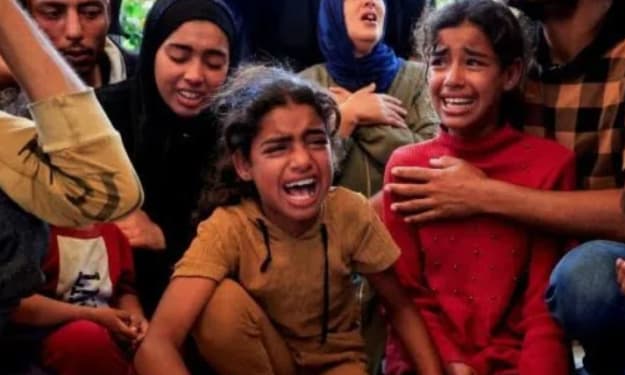
According to officials in the area, "Five Dead in the Latest Israeli Shootings of Gazans Seeking Aid" According to Gaza health authorities, Israeli forces opened fire near an aid distribution point in Rafah, killing five Palestinians and wounding several others. The incident happened early on Sunday as people gathered to get desperately needed humanitarian aid in southern Gaza, where hunger and chaos were getting worse. Local officials said that when Israeli troops fired live rounds, the victims were unarmed civilians trying to get food supplies. The shootings are the most recent in a string of violent incidents that have occurred at aid collection sites, where thousands of displaced Gazans have been congregating on a daily basis in increasingly difficult circumstances. Gunfire broke out without warning, according to witnesses, causing panic and bloodshed. One local claimed, "People were just standing in line." The shooting then began. People fled in every direction. According to the Israeli military, individuals approached in a "suspicious manner" during restricted hours, and that soldiers fired warning shots. In a declared combat zone, troops had acted in accordance with protocol, according to a spokesperson. However, the Gaza Ministry of Health denied the Israeli account, stating that the victims were clearly civilians and did not pose a threat. A ministry statement stated, "These repeated attacks on people seeking aid are unacceptable and must stop." The deaths occur amid growing global concern regarding the accessibility and safety of humanitarian aid in Gaza. The Gaza Humanitarian Foundation (GHF) recently implemented hubs to manage the distribution system, which has been widely criticized for putting civilians in danger. Over 60 people have reportedly been killed and hundreds have been injured in the vicinity of aid centers since the GHF system was introduced at the end of May. In two weeks, the International Committee of the Red Cross received nearly 1,000 patients, many of whom had been shot near distribution areas. The aid delivery model isn't protecting the people it's supposed to help, according to warnings from the UN and humanitarian groups. The UN High Commissioner for Human Rights, Volker Türk, stated that the targeting of civilians may constitute war crimes and called for a thorough investigation. Food collection has become a life-threatening ordeal, according to aid workers in Gaza due to overcrowding, disorganized distribution, and the presence of armed forces. A field coordinator for an international relief organization stated, "The situation is desperate." "For a bag of flour, people are putting their lives in danger." To lessen the likelihood of violence, officials with the GHF stated that they were looking into new approaches, such as direct distribution in neighborhoods, as well as reviewing security protocols. Despite this, difficulties with logistics and safety have necessitated numerous operations suspensions. In Gaza, the humanitarian situation is still dire. Many families are completely dependent on sporadic aid deliveries to survive with over 80% of the population displaced and critical infrastructure destroyed. Food insecurity is widespread, and hospitals are swamped. The shooting on Sunday occurred as Muslims were getting ready for the significant religious holiday known as Eid al-Adha. The celebrations were subdued by grief and hardship for many. “We have nothing,” said one mother of four. "We don't have any food, no place to sleep, and now they shoot us when we try to get help." There is a growing demand for accountability and aid system reform. Rights groups say that more civilians will die trying to survive unless drastic changes are made. A number of humanitarian organizations called on Israel and its partners to make sure that aid is distributed safely, openly, and in accordance with international law in a statement that they issued together. The statement read, "Every civilian death is a failure of humanity and a breach of responsibility." As the conflict grinds on and political efforts stall, the burden falls increasingly on local responders and ordinary people to manage the crisis. There is little hope left for those in Rafah and other besieged areas. One of the survivors of the shooting on Sunday stated, "We wake up every day not knowing if we’ll eat, or if we’ll live." This is not charity. It's a ruse."
By GLOBAL NEWSabout a year ago in Criminal
Room 313 Is Never Booked
The Bellmoor Hotel was old, but not abandoned. It stood in the heart of a foggy New England town, with creaking wooden floors, ornate wallpaper faded with time, and a lobby clock that had stopped ticking sometime in the 1950s. The place had a charm—quiet, polite, always dimly lit.
By Muhammad Saeedabout a year ago in Criminal
My Brother's Addiction Led Him to Prison
I still remember the night my mother stopped saying his name. It was subtle—like the way you stop looking at a closed door you know won’t open. She used to say, “Where’s Alex?” with a touch of worry, like any mother would. But that night, after our neighbor found him passed out behind the dumpster of the gas station, needle still in his arm, she just said, “We can’t keep doing this,” and walked back inside.
By Muhammad Sabeelabout a year ago in Criminal
I Was Catfished by Someone on the FBI's Most Wanted List
The FBI agents sitting in my living room looked exactly like you'd expect FBI agents to look—serious suits, serious expressions, and the kind of serious notebooks that make you wonder if your entire life is about to become evidence in a federal case.
By Muhammad Sabeelabout a year ago in Criminal