incarceration
Incarceration, rehabilitation, recidivism: The reality of prison life and what it's like to be an inmate locked up behind bars.
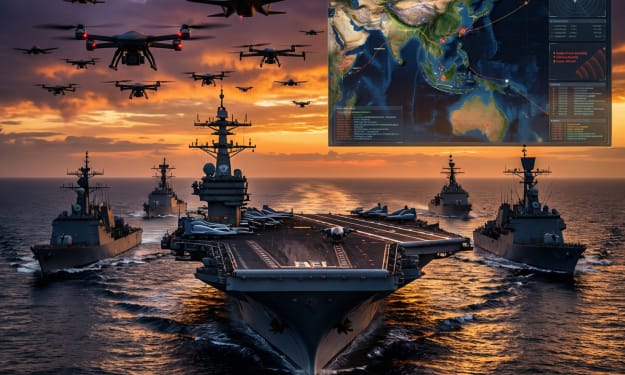
Floating Power and Fragile Diplomacy
Floating Power and Fragile Diplomacy In recent weeks, renewed attention on U.S. naval movements, particularly carrier strike groups operating across strategic waterways, has highlighted a deeper shift in how global power is projected. From the South China Sea to the Indian Ocean, the presence of American naval assets is no longer just a show of strength—it is a message shaped by technology, deterrence, and fragile diplomacy.
By Wings of Time 8 months ago in Criminal
The Fall of "El Jefe": From Olympic Athlete to FBI Most Wanted
The man in custody before you is the subject of today’s most viral story! Ryan Wedding, 44, was one of the FBI's Top Ten Most Wanted fugitives. After a 15-year manhunt and a $15 million reward on his head, he has finally been apprehended.
By Hossam Gamal9 months ago in Criminal
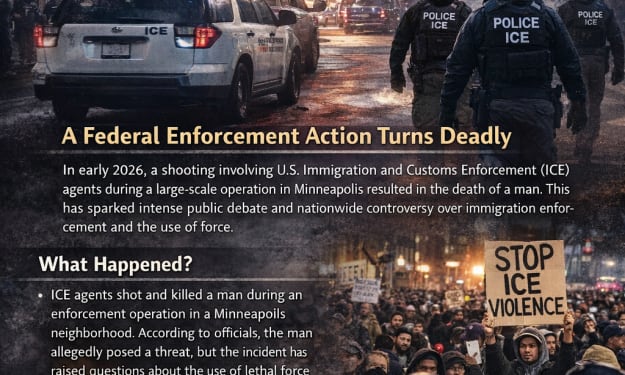
The ICE Shooting in Minneapolis A Closer Look at Federal Enforcement and Rising Tensions
The ICE Shooting in Minneapolis A Closer Look at Federal Enforcement and Rising Tensions In early 2026, Minneapolis found itself at the center of national attention following a shooting involving agents from U.S. Immigration and Customs Enforcement, widely known as ICE. The incident quickly moved beyond a single law enforcement encounter and became a symbol of broader debates surrounding immigration policy, federal authority, and the use of force in American cities. As details emerged, the shooting sparked intense public discussion, protests, and renewed scrutiny of federal operations carried out within local communities. The incident occurred during a large-scale immigration enforcement effort that brought a significant number of federal agents into Minneapolis. The stated goal of the operation was to locate and detain individuals suspected of immigration violations and other related offenses. While federal officials described the mission as necessary for public safety and law enforcement, many local residents experienced it as sudden, aggressive, and disruptive to everyday life. According to official accounts, the shooting happened during an encounter between ICE agents and a civilian in a residential area of the city. The situation escalated rapidly, ending with an agent firing a weapon and killing the individual. Federal authorities stated that the agent acted in response to a perceived threat, while community members questioned whether lethal force was necessary and whether alternative actions could have been taken. The lack of immediate clarity surrounding the event fueled public anger and distrust. What intensified the reaction was the fact that this shooting did not occur in isolation. It followed other recent incidents involving federal agents using firearms during enforcement actions in the same metropolitan area. The close timing of these events led many observers to describe the situation as part of a troubling pattern rather than a single tragic mistake. For residents of Minneapolis, especially those in immigrant and minority communities, the repeated use of force deepened fears and heightened anxiety. Local leaders responded swiftly. City officials and state representatives expressed concern about the scale and tactics of federal enforcement in Minneapolis. Some argued that the operations were carried out with little coordination with local authorities and insufficient understanding of neighborhood dynamics. Others warned that aggressive federal actions risked undermining years of efforts to build trust between law enforcement and the communities they serve. At the same time, federal agencies defended their presence and actions. Officials emphasized that ICE agents are trained to handle dangerous situations and that officers must make split-second decisions when they believe their lives or the lives of others are at risk. From this perspective, the shooting was portrayed as a defensive response during a volatile encounter rather than an act of excessive force. This divide in narratives became a defining feature of the public debate. Public reaction in Minneapolis was immediate and intense. Demonstrations erupted across the city, with protesters calling for accountability, transparency, and an end to what they described as militarized immigration enforcement. Marches and rallies drew attention not only to the shooting itself but also to larger questions about who controls public safety and how immigration laws are enforced in urban environments. For many protesters, the incident symbolized systemic problems rather than an isolated failure. Civil rights advocates also weighed in, arguing that federal enforcement actions should be subject to stronger oversight, especially when they involve lethal force. They called for independent investigations and clearer rules governing when agents may use weapons during arrests. These voices emphasized that accountability is essential for maintaining public trust and preventing future tragedies. Beyond Minneapolis, the shooting reignited a national conversation about immigration enforcement in the United States. Supporters of strict enforcement argued that federal agencies must be allowed to operate decisively to uphold the law. Critics countered that aggressive tactics often produce fear rather than safety and can damage relationships between communities and authorities. The Minneapolis case became a focal point for these competing views. As investigations continue, the city faces difficult questions about the future. How should federal agencies operate within local jurisdictions. What limits should exist on the use of force. And how can governments balance enforcement priorities with respect for human life and civil liberties. The answers to these questions will shape not only the outcome of this case but also the broader direction of immigration policy and law enforcement practices. The ICE shooting in Minneapolis stands as a powerful reminder of the human impact of policy decisions. It illustrates how quickly enforcement actions can escalate into tragedy and how deeply such events can affect communities. Whether this moment leads to meaningful reform or deeper division will depend on the willingness of leaders to confront hard truths, listen to affected communities, and pursue solutions rooted in accountability and justice.
By America today 9 months ago in Criminal
Kendrick Simpson's Downfall
On January 15th, 2006, an insult was answered by a bullet. Tempers were hot on that cold winter night in Oklahoma City. Fritzi’s Hip Hop night club was a happening place in the city back in 2006. It was a place that attracted all kinds of interesting and sometimes very dangerous individuals. In this case it had attracted some hurricane survivors. Ok, folks, let me back up and explain a little bit.
By Cassie Moore9 months ago in Criminal
AIR FORCE ONE INCIDENT WHY A TECHNICAL ISSUE TURNED A ROUTINE FLIGHT INTO A GLOBAL HEADLINE
AIR FORCE ONE INCIDENT WHY A TECHNICAL ISSUE TURNED A ROUTINE FLIGHT INTO A GLOBAL HEADLINE Air Force One is more than just a presidential aircraft. It is a flying symbol of American power, political stability, and national security. That is why any incident involving it instantly captures global attention. A recent technical issue that forced Air Force One to alter its flight plans quickly became a major news story, raising questions about safety, politics, and the future of presidential aviation. While the incident itself was described as minor, its impact on public discussion was significant. It combined breaking news value, political sensitivity, and long-term implications, making it a topic worthy of deeper analysis rather than a brief headline. **Why does any issue involving Air Force One become major news** Air Force One carries the President of the United States and serves as a mobile command center. Any unexpected development involving the aircraft immediately triggers concerns about security and readiness. Even minor technical problems are treated with extreme caution because of the potential consequences. For the public, the name Air Force One alone creates instant interest, turning routine safety decisions into widely discussed events. **What exactly happened during the Air Force One incident** Shortly after departure, the aircraft experienced a technical irregularity that led the flight crew to take precautionary action. The decision was made to change plans and ensure the safety of everyone on board. Officials emphasized that the issue did not pose an immediate threat, but protocols required a full assessment on the ground before continuing long-distance travel. **Was the President ever in danger** According to official statements, there was no direct danger to the President. Air Force One is designed with multiple backup systems, and crews are trained to respond immediately to even minor anomalies. The response demonstrated how seriously safety procedures are enforced, reinforcing confidence rather than undermining it. **Why this incident matters politically** Beyond aviation concerns, the incident carried political significance. Presidential travel is closely tied to diplomacy, international meetings, and strategic messaging. Any disruption can affect schedules, optics, and public perception. Political opponents and supporters alike pay close attention to such moments, often interpreting them through broader narratives about leadership, preparedness, and national strength. **How the event reflects on the aging Air Force One fleet** The incident reignited discussion about the age of the current Air Force One aircraft. The planes have served multiple administrations and require extensive maintenance. While they remain highly capable, events like this highlight the challenges of operating aging but mission-critical equipment. This has renewed public interest in delayed replacement programs and long-term investment decisions. **What this reveals about U.S. security protocols** Rather than signaling weakness, the response showcased the strength of U.S. security procedures. The willingness to alter plans immediately demonstrates a system built on prevention, not reaction. The event reassured many observers that even small technical issues are handled with maximum caution when national leadership is involved. **How public reaction turned a technical issue into a trending topic** Public curiosity played a major role in amplifying the story. Searches surged as people asked why the plane changed course, what went wrong, and whether it signaled a larger problem. Social media and news cycles transformed a controlled safety decision into a trending global discussion, proving how powerful the Air Force One brand remains. **What this incident means for the future of presidential air travel** Looking ahead, the event strengthens arguments for accelerating modernization efforts. As global travel demands increase and geopolitical tensions remain high, reliability becomes even more critical. Future Air Force One aircraft are expected to incorporate advanced systems that reduce the likelihood of similar disruptions while maintaining the highest security standards. In conclusion, the Air Force One incident was not just a technical story. It combined breaking news appeal, political weight, and long-term strategic questions. That combination is exactly what makes it worthy of a full article. The event served as a reminder that when Air Force One moves, the world watches, and even the smallest detail can carry global significance.
By America today 9 months ago in Criminal
Before the Suitcases: The Melanie McGuire Story
No one expects evil to arrive wearing scrubs and carrying a lunch bag. Melanie McGuire looked correct. That was the first deception, and it wasn’t even intentional. A fertility nurse. A mother. A woman living in New Jersey suburbia where lawns are trimmed and lives are assumed to be manageable. She fit so cleanly into the picture of normal life that no one thought to question the frame.
By Aarsh Malik9 months ago in Criminal
Take it to the Bank. Content Warning.
The most vulnerable of us can take a care ride to the mall. We might go for that shopping trip as though it were a normal, everyday trip. On August 31st,1999, Mary Bowles, was a retiree who just wanted to go to Promenade Mall in Tulsa. She was there to do a little shopping and do some walking because it was too hot to walk outside. Our gal, Mary, wanted to get some afternoon walking in, and the Promenade Mall in Tulsa was a good place to go. Benches spread out and good air conditioning along with lots of places to get something cold to drink, she would have a safe time walking in there. If she had only made it inside the mall. The mall often had walkers throughout the day, so this was her way of keeping up with her exercise as a number of seniors did.
By Cassie Moore9 months ago in Criminal
Crime Chronicles: Darya Nikolaevna Saltykova
A little while ago, we covered the story of Delphine LaLaurie (1787 - 1849), the New Orleans socialite who tortured and murdered her slaves. We also covered Erzsebet Bathory (1560 - 1614), who did the same thing in Hungary around 200 years before that; I didn't think I'd find another one, but I did - in Russia.
By Greg Seebregts9 months ago in Criminal
A Mother's Love Lost. Content Warning.
It was December 30th, 1988, just two days before the New Year. Jack Dale Walker had convinced a coworker to drive him out to the trailer where his girlfriend lived. Hansel Norton, the co-worker, had known Jack for barely three full weeks. Hansel was trying to be a good friend to this new friend. So, Jack, was young, only 22 years old and appeared to be love sick for the girl who was the mother of his baby.
By Cassie Moore9 months ago in Criminal
Donald Trump Withdrawing U.S. Forces From Qatar Amid Fears of Iranian Escalation
Donald Trump Considers Withdrawing U.S. Forces From Qatar Amid Fears of Iranian Escalation The recent killing of approximately 2400 protesters in Iran has once again drawn global attention to the deep political and security crisis inside the country. These deaths, linked to widespread demonstrations against economic hardship, political repression, and government authority, have intensified regional tensions and raised serious concerns about Iran’s internal stability. As unrest grows and the risk of external escalation increases, the security balance in the Middle East has come under renewed scrutiny. Against this backdrop, former U.S. President Donald Trump has reportedly considered the possibility of withdrawing American forces from the U.S. military base in Qatar. The move is described as a precautionary step driven by fears of potential Iranian retaliation or escalation that could place U.S. troops at risk. This development highlights how domestic unrest in Iran can quickly evolve into a broader regional and international security issue.
By America today 9 months ago in Criminal