fact or fiction
Is it fact or merely fiction? Fact or Fiction explores the myths and beliefs we hold about copycat killers, eyewitnesses testimony, what makes a murderer and more.
The Slave Louisa Who Sewed Poison into the Clothes of the Big House Family – Tennessee, 1853
What if vengeance didn’t strike with a blade or a bullet, but with something softer? What if death didn’t come on a battlefield, but in the folds of a gown or the seams of a coat? What if a needle carried more danger than a sword? In the blistering heat of a Tennessee summer in 1853, whispers began to spread through the halls of a wealthy plantation house. At first, the family thought it was only illness, the kind that clung to the South every summer. But soon the sickness grew stranger, darker, more terrifying. Blisters rose on skin, minds unraveled into madness, and healthy bodies withered to bones. The family turned to doctors, to prayer, to remedies — but the deaths continued. And behind every elegant dress and finely sewn shirt stood one quiet figure. A woman few noticed. A woman few spoke to. A woman whose hands never stopped working the needle. Her name was Louisa. To the family, she was nothing more than a seamstress — enslaved, silent, invisible. But to history, she may be remembered as something far more chilling: the woman who stitched death into every garment she made. Life on a Tennessee Plantation By 1853, Tennessee was at the heart of the antebellum South. Plantations stretched across rolling fields of cotton, tobacco, and corn. White-pillared houses stood proudly on hills, their wealth built on the labor of enslaved men and women. Life on the plantation followed a rhythm: fieldwork from sunrise to sunset, housework that never ended, overseers shouting commands, and masters measuring profit in bales of cotton. For the enslaved, there was no escape. Some worked the fields until their backs broke. Others cooked, cleaned, or cared for children they could never call their own. A few, because of special skills, were kept inside. Louisa was one of them. She worked in a small room tucked away in the back of the big house — the sewing quarters. From dawn until lantern-light, her needle pierced cloth, her fingers stitching dresses, coats, and bedding. Every thread she pulled passed silently through her hands. To the White family, her work was invisible. They wore the clothes she made without thinking. But among the enslaved, whispers began to grow: Louisa’s silence hid something. Her eyes carried secrets. Her needle carried power.
By Yasir Hamid about a year ago in Criminal
The Triple Betrayal: How the CIA’s Top Spy Turned Against Them
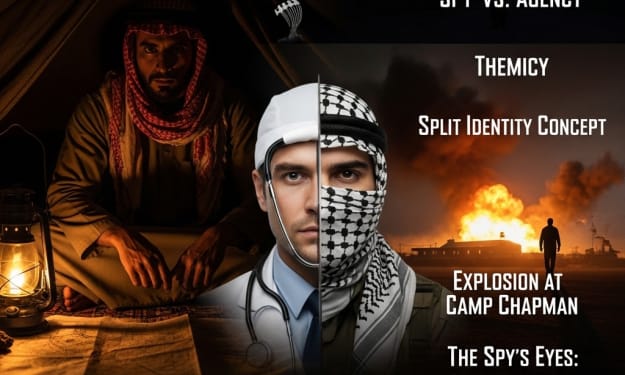
The night was cold in Amman when the prison door shut behind Dr. Humam Khalil al-Balawi. He sat in silence, the dim light casting long shadows on the concrete floor. He wasn’t just a doctor anymore — he was a suspect, a prisoner, and, perhaps, the CIA’s newest weapon.
By Leah Brookeabout a year ago in Criminal
My Father's Sins, My Mentor's Revenge
The whiskey glass felt heavy in my hand, the amber liquid doing little to burn away the cold that had settled in my bones six months ago. My name is Isaac Sullivan—Ike to my friends—and I used to be a detective. Now, I was just a man haunted by the ghosts of a case I could never close. I stared at the TV, the morning news a meaningless drone, until one image snapped me back to reality: a brick wall, smeared with a number crudely painted in blood. The number 10.
By Wesley Thorneabout a year ago in Criminal
She Was Murdered in the Morgue. The Only Witness Was the Doctor... and She Was Next.
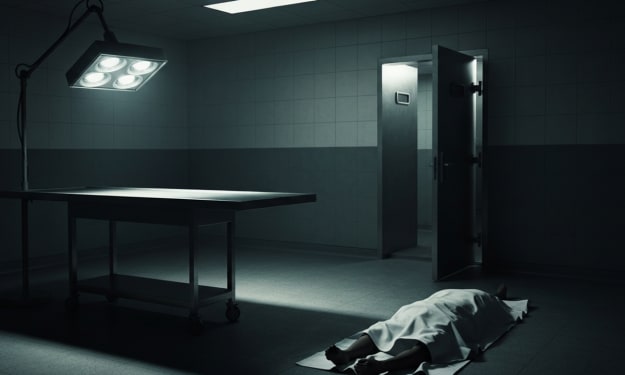
A murder in a morgue is like a fire at the fire station. It’s a special kind of brazen. But when I, a homicide detective with twenty years on the force, discovered our only witness had vanished from the locked crime scene, I knew this wasn't just a murder. It was something far more sinister.
By Wesley Thorneabout a year ago in Criminal
The DNA on the Coffee Cup. AI-Generated.
The manicured lawns of Scottsdale, Arizona, were supposed to be a refuge from the chaos of the world. But on February 22nd, 2017, the chaos came home. Jessica Pierce stood on the pristine porch of her sister's sprawling ranch-style house, a cold dread creeping up her spine. For two days, her calls to her sister, Linda Turner, had gone unanswered.
By Wesley Thorneabout a year ago in Criminal
The Ghost of Highway 10. AI-Generated.
The desert night on Interstate 10 is a lonely place. For truckers like Ricky Vargas, it was just another long haul, the hypnotic drone of the engine and the endless stretch of asphalt his only companions. He was moving a shipment of heroin for a powerful syndicate, a job he’d done a hundred times. But tonight was different. Tonight, he had an appointment with The Ghost.
By Wesley Thorneabout a year ago in Criminal
Whispers in the Dark
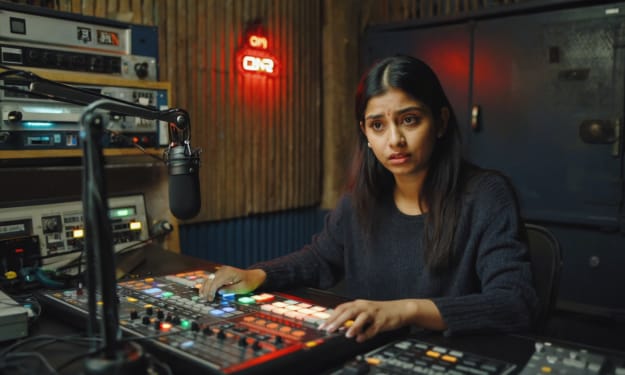
It was a late Thursday night when Kelly Stone, the host of Midnight Radio, tuned her microphone and settled into her chair. The station, an old building tucked on the outskirts of the city, was quiet except for the hum of the equipment and the soft buzz of the neon "ON AIR" sign. Kelly loved this time of the night. It felt like she was the only person awake, the only voice on the airwaves.
By Solene Hartabout a year ago in Criminal
U.S. Designates Majeed Brigade as a Foreign Terrorist Organization Amid Rising BLA Attacks
Pakistani authorities have termed the U.S. designation of the banned Majeed Brigade as a “foreign terrorist organization” a commendable step. On August 11, the U.S. State Department announced: “Today, the Department of State is designating the Balochistan Liberation Army (BLA) and the Majeed Brigade as Foreign Terrorist Organizations (FTOs). The Majeed Brigade is also being added to the BLA’s existing ‘Specially Designated Global Terrorists’ (SDGT) list.” According to the U.S. State Department, the Balochistan Liberation Army was first designated as a Specially Designated Global Terrorist group in 2019 after multiple terrorist attacks. However, since then, both the BLA and Majeed Brigade have claimed responsibility for further attacks. The statement mentioned that in 2024, the BLA claimed responsibility for suicide attacks near Karachi Airport and the Gwadar Port Authority Complex. In March 2025, the BLA claimed the hijacking of the Quetta-to-Peshawar-bound Jaffar Express train, in which over 100 security personnel were killed and more than 300 passengers were taken hostage. The State Department said: “Designating the organization as a terrorist group plays a significant role in our fight against terrorism and is an effective way to deter support for terrorist activities.” It should be noted that Pakistan had declared the Majeed Brigade, the BLA’s suicide squad, as a banned terrorist organization in 2024, while the separatist BLA itself was banned in 2006. Previously, Pakistan had urged the United States to declare the Majeed Brigade a terrorist organization. The BLA’s Majeed Brigade has been active in Balochistan for over a decade, and in recent years, the group’s attacks have intensified and expanded in scope. Due to this situation, Pakistan had also requested the United Nations Security Council to impose a ban on the Majeed Brigade. is the Majeed Brigade and what militant activities has it been involved in? The name of the Majeed Brigade and its so-called “fidayeen” (suicide attackers) first emerged on December 30, 2011, when a suicide bomber targeted a car outside a house on Arbab Karam Khan Road in Quetta, the capital of Balochistan, on a winter evening. The house belonged to Shafiq Mengal, son of former federal minister Naseer Mengal. Shafiq Mengal escaped unharmed, but 10 people, including his guards, were killed, and 23 others were injured. The banned Balochistan Liberation Army claimed responsibility for the attack, saying it was carried out by the Majeed Brigade, and the suicide bomber was a young man named Darvesh. After this incident, the Majeed Brigade disappeared from the scene for a while and did not claim responsibility for any major attack. Ustad Aslam, also known as Aslam Achu, was the first leader of the Majeed Brigade. He brought both innovation and intensity to the group’s operations and shifted the decades-long Baloch insurgency from the mountains to urban areas, particularly Karachi. In December 2018, Aslam Achu was killed in an attack in Kandahar. Leadership of the group then passed to a man named Bashir Zeb, a former chairman of the Baloch Students Organization (BSO). Aslam Achu faced multiple charges for bomb blasts, attacks on security forces, and targeted killings in Balochistan. A bounty of 5 million rupees had been placed on his head. Almost seven years after the attack on Shafiq Mengal, in August 2018, a truck collided with a bus carrying Chinese engineers in Dalbandin, the capital of Chagai district, which is rich in gold and copper deposits. The suicide attack injured three Chinese engineers and two others. The Majeed Brigade claimed responsibility, revealing the attacker was a young man named Rehan — the son of Majeed Brigade leader Aslam Achu. That same year, in November 2018, a major attack targeted the Chinese Consulate in Karachi, in which four attackers were killed in a police encounter. The Majeed Brigade also claimed responsibility. In 2019, the group attacked the Pearl Continental Hotel in Gwadar, a central hub of the China-Pakistan Economic Corridor (CPEC), killing five people, with three attackers killed. The group described this as a “fidayeen mission.” The following year, in June 2020, the Karachi Stock Exchange was attacked, with four attackers killed. The Majeed Brigade also claimed responsibility. More recently, in 2022, Shari Baloch, a woman, carried out a suicide bombing at the Chinese Confucius Institute in Karachi University. In 2023, another woman, Samia Qalandrani, attacked a Frontier Corps (FC) vehicle in Turbat; she was the fiancée of Rehan, son of Aslam Achu. In 2024, a woman named Mahil Baloch carried out a suicide attack on an FC camp in Bela. All these attacks were claimed by the Majeed Brigade, and it became clear the group had begun using women for suicide missions. Similarly, in March this year, the group claimed responsibility for the hijacking of the Jaffar Express and the killing of passengers. According to Abdul Basit, writing for the Jamestown Foundation, the banned Majeed Brigade possesses high-grade weaponry, including improvised explosive devices (IEDs), anti-personnel and anti-tank mines, grenades, rocket-propelled grenades (RPGs), and various automatic weapons like M4 rifles, BM-12s, MM-12s, and MM-012s. He adds that the group’s militants also have access to advanced explosives like C4 for making suicide vests. Where did the name “Majeed Brigade” come from? During the tenure of Pakistan’s first PPP Prime Minister, Zulfikar Ali Bhutto, when Balochistan’s first elected government — led by the National Awami Party — was dismissed, resistance had already begun in the province. In August 1975, when Prime Minister Bhutto arrived in Quetta to address a public gathering, a young man named Majeed Langove was killed in a grenade explosion. Reports later indicated that Majeed intended to attack Bhutto. Majeed Langove belonged to the Mangochar area and was associated with the Baloch Students Organization (BSO) since his student days. After his death, his younger brother was born and also named Majeed. He later joined the banned BLA and was killed in 2011 in an encounter with law enforcement near Quetta. The BLA states that on the day of the younger Majeed’s death in 2011, the formation of the “fidayeen group” was announced, and Ustad Aslam, aka Aslam Achu, named the group after both brothers — hence, “Majeed Brigade.” What does the U.S. designation of the Majeed Brigade as a “foreign terrorist organization” mean? When the U.S. designates a group as a “foreign terrorist organization,” all its assets are frozen, and no individual or entity is allowed to conduct any transactions with it. Providing any form of material support to such a group is considered a serious crime under U.S. law, punishable by 20 years or more in prison. Members and supporters of the group are also banned from entering the United States, with strict immigration restrictions applied. According to the U.S. State Department website: “It is unlawful for any person in the United States or subject to U.S. jurisdiction to knowingly provide material support or resources to a designated Foreign Terrorist Organization (FTO).” Under U.S. law, “material support” includes financial aid, lodging, expert advice, training, false documents and identification, communications equipment, explosives, personnel, and means of transportation. If a member of a designated FTO is not a U.S. citizen, they are barred from entry, and if they are already in the U.S., they may be deported. In addition, if a U.S. financial institution finds that it controls funds in which a designated FTO or its members have an interest, it must report this to the U.S. Department of the Treasury. The State Department says the purpose of such designation is to cut off terrorist financing, encourage other countries to do the same, isolate the organization internationally, prevent donations or economic dealings with it, and raise public awareness about such groups.
By Real contentabout a year ago in Criminal
Whispers Beneath the Streetlight. AI-Generated.
The rain had been falling for hours, washing the city’s dirt into slick gutters that gurgled like they were swallowing secrets. Detective Mara Kessler stood under a flickering streetlight, collar turned up against the cold. She was waiting for a man she’d only met in whispers — the kind of whispers you only hear from people who are scared to talk too loud.
By MUHAMMAD BILALabout a year ago in Criminal
Echoes of Betrayal. Content Warning.
Kolkata, a city thick with heat and the constant murmur of the Hooghly River carrying its secrets, was where Dr. Ananya Sharma felt most alive. Just 31, she was deep into her postgraduate training at RG Kar Medical College and Hospital. Her days – or rather, never-ending shifts – were a blur of mending gashes, comforting panicked patients, and offering a quiet word of hope to those nearing the end. Her stethoscope wasn’t just a tool; it was her shield. Her smile, a soothing touch.
By Debarghya Chatterjeeabout a year ago in Criminal