capital punishment
Weigh the pros, cons and controversies surrounding the grave issue of capital punishment; should the death penalty be allowed?
Tragedy in Cambridge: The Life and Death of Saudi Student Mohammed Al-Qasim
A Promising Journey Cut Short Cambridge, England — known for its prestigious universities, historic architecture, and vibrant student life — became the scene of a tragedy that has shocked communities both in the United Kingdom and Saudi Arabia. On what began as an ordinary night, a young Saudi student’s life was taken in an unprovoked act of violence, leaving a family in mourning and sparking an international investigation.
By 🕵️♂️ True Crime Enthusiast | Storyteller of the Dark Side 🔍about a year ago in Criminal
Jermaine Jenas Accuses BBC of Destroying His Career After Sexting Scandal
When Words Wound: Jermaine’s Reckoning The blue lights danced over the skyline of Marbella, where Jermaine Jenas was trying—halfheartedly—to escape the turmoil back in the UK. The sun dipped beyond the horizon, casting long shadows over his holiday refuge, but his mind was anything but serene.
By Ahmad Mustafaabout a year ago in Criminal
1000 Babies — The Nurse Who Swapped Newborns and Sparked a Trail of Death
1000 Babies — The Dark Secret That Shook a Town In the lush, quiet landscapes of Kerala, where coconut palms sway lazily over serene backwaters, life appears simple and peaceful. But behind closed doors in one modest home, a secret was festering — a secret that would ripple through the lives of more than a thousand families.
By 🕵️♂️ True Crime Enthusiast | Storyteller of the Dark Side 🔍about a year ago in Criminal
The Mastermind Games: season 02 Episode 01
The elevator doors slid open with a hiss, revealing a glass corridor suspended high above ground. Beneath them stretched an entire city — but it was no ordinary city. It was flawless. Artificial. Precise. A utopia built on algorithms.
By Engr. Mansoor Ahmadabout a year ago in Criminal
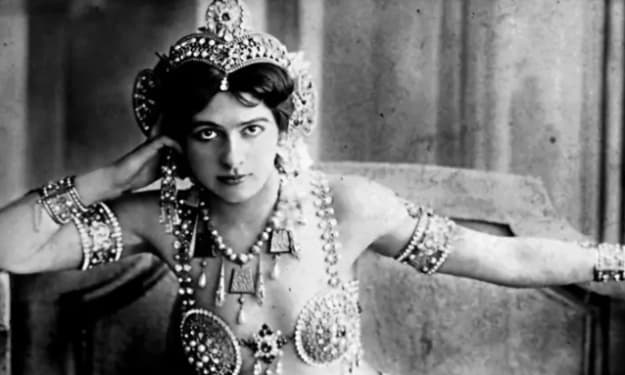
Mata Hari: The Famous Spy Who Refused to Be Blindfolded Before Her Execution
On the morning of October 15, 1917, a grey military vehicle left the main prison of Paris. Inside was a 41-year-old Dutch woman dressed in a long coat and wearing a wide-brimmed hat. A decade earlier, this woman had captivated the capitals of Europe. She was a blazing flame, unmatched in dance, and among her admirers were ministers, industrialists, and military generals. But then World War I broke out, changing the world forever. The woman still believed she could dazzle all of Europe with her charm. But now, the men in high places wanted something else from her — not her affection, but information. Her crime? She was accused of being a spy who seduced Allied officers, extracted secrets from them, and passed them on to the German army. Newspapers sensationalized the stories, claiming that thousands of Allied soldiers had died because of Mata Hari. But the evidence presented in court told a different story. In reality, she was a double agent, made a scapegoat.
By Ikram Ullahabout a year ago in Criminal
The Mastermind Games: Season 01 Episode 03
The corridor bathed in red light was silent—eerily silent—as Clara and Julien walked side by side, tension thick between them. Clara's eyes darted to the corners, scanning for surveillance. Julien, still reeling from the revelation that Clara might have been "recruited" into the game long before it began, couldn’t hide his suspicion.
By Engr. Mansoor Ahmadabout a year ago in Criminal
A Doctor’s Life Lost to ‘Honor’: When Family Becomes the Judge, Jury, and Executioner
Introduction In a heartbreaking incident from Jhang, Pakistan, a young woman—an accomplished doctor who had just returned from Uzbekistan after completing her education—was brutally murdered by her own brother. Her crime? She chose to marry someone she loved, a fellow doctor from Uzbekistan, in an online Nikah. This murder, committed under the shadow of "honor," once again forces society to confront a painful question: Why is a woman’s autonomy considered dishonorable in some families? This article delves into the social, cultural, and moral questions raised by such acts of violence, where women are killed not by strangers, but by their own blood. --- The Incident: A Life Cut Short The victim had recently returned to Pakistan after years of hard work, sacrifice, and perseverance to become a doctor. Her family had supported her financially and emotionally through this journey. However, when she expressed her wish to marry her classmate from Uzbekistan, her brother disagreed. Despite trying to pursue the relationship respectfully and privately—through an online Nikah—her choice enraged her brother, who took her life in the name of so-called honor. This tragedy is not the first of its kind, and unfortunately, it may not be the last. --- What is ‘Honor’? And Who Decides It? In many South Asian and Middle Eastern cultures, "honor" is often tied to the actions of women—particularly around marriage, relationships, and public behavior. A family’s dignity is seen to rest on the "purity" and obedience of its daughters and sisters. In this system, male members of the family are expected to guard this honor, and if it is perceived to be tarnished, they may go to deadly extremes to restore it. But what kind of honor is this, where a brother feels entitled to take the life of a sister for making an independent life choice? Does honor lie in murder or in compassion? Who gave men the right to play God over women’s lives? --- Education Without Empowerment: A Hollow Achievement This case highlights a dangerous contradiction: many families encourage girls to pursue higher education, but with invisible strings attached. Girls are told to become doctors, engineers, or professionals—but only within limits set by the family. The moment they begin to think independently, especially in matters of marriage, those same families feel betrayed. Was her education for her personal growth or just to raise the family’s social status? If a girl is taught to think critically, to make informed decisions, and to build a life of her own, why is she punished when she does exactly that? It seems that for some, a daughter is only valuable as long as she remains obedient. The idea of education is celebrated, but not the empowerment that comes with it. --- Online Nikah: Autonomy or Rebellion? Online marriages are becoming more common among young people, especially those studying or working abroad. They offer a legal and religious way to formalize relationships without the need for elaborate family involvement. In this case, the girl did not run away or enter into a secret relationship. She followed a legitimate route to marry the man she loved. Still, for her brother, this act was a betrayal. It was not the manner of marriage that offended him—it was the loss of control. He, like many others in patriarchal societies, believed that he had the right to decide when, whom, and how his sister should marry. --- Hypocrisy of "Honor": Where Was It Before? One of the most ironic aspects of such cases is the selective morality. The girl was sent to a foreign country to live and study alone for years. At that time, there were no concerns about "honor." She represented pride and progress. But when she made a personal choice in love and marriage, suddenly she became a source of shame? If she had returned and silently accepted a marriage arranged by her family, her brother would have felt proud. But the moment she asserted her right to choose, she became a threat. This is not honor. This is control. And control masked as morality is the most dangerous kind. --- A Murder is a Murder — Not a Justification Religious texts and moral philosophy are clear: “Whoever kills a person... it is as if he had slain all of mankind.” (Qur’an, 5:32) No excuse, no cultural tradition, no anger justifies the killing of another human being—especially not one's own sibling. The brother who committed this act could have chosen dialogue, understanding, or even disagreement. But by choosing murder, he didn't restore his family’s honor—he destroyed it. --- What Needs to Change? 1. Redefining Honor Society must evolve its understanding of honor. Real honor lies in supporting and respecting the choices of others, not in violence or dominance. 2. Family Counseling and Mediation Families should be educated and counseled on how to deal with disagreements without resorting to violence. 3. Legal Consequences Perpetrators of honor killings must be punished strictly under the law. Families should not be allowed to "forgive" the killer to escape justice. 4. Empowering Women Fully Education must come with emotional and legal empowerment. Girls should be taught their rights and how to protect them. 5. Media and Religious Leadership Both media and religious leaders must speak out clearly against honor-based violence. Silence enables further crimes. --- Conclusion The murder of the young doctor in Jhang is not just a personal tragedy—it is a mirror reflecting the flaws in our society. It raises uncomfortable but necessary questions about how we treat women, how we define honor, and whether we truly value education or just use it as a status symbol. Let this not be another forgotten case. Let her memory serve as a wake-up call that a society that kills its daughters in the name of honor has no honor left to protect.
By Ikram Ullahabout a year ago in Criminal
The Disappearance of Madeleine McCann
On the evening of May 3, 2007, three-year-old Madeleine McCann vanished from her family’s holiday apartment in the seaside resort of Praia da Luz, Portugal. Her parents, Kate and Gerry McCann, had been dining with friends at a nearby restaurant, taking turns to check on their children. When Kate returned around 10 p.m., Madeleine’s bed was empty.
By Hassan Janabout a year ago in Criminal