capital punishment
Weigh the pros, cons and controversies surrounding the grave issue of capital punishment; should the death penalty be allowed?
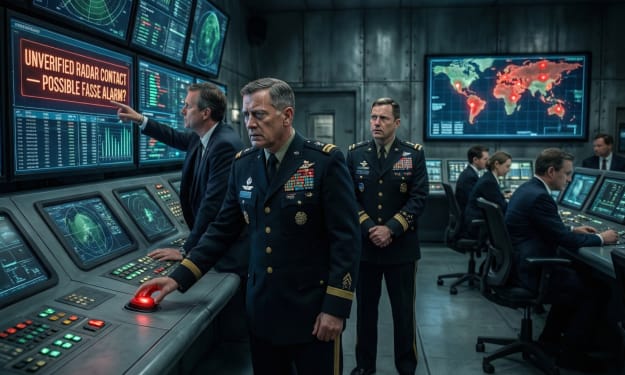
Nuclear Command Risks in a Time of Internal Tension
Nuclear Command Risks in a Time of Internal Tension When people think about nuclear power, they often focus on missiles, warheads, and military strength. But the most important part of any nuclear system is not the weapon itself—it is the command structure behind it. Clear leadership, trusted decision-making, and reliable communication are what prevent disasters. When these systems face internal tension, the risks grow quietly but dangerously.
By Wings of Time 9 months ago in Criminal
JUSTICE FOR ALEX PRETTI . Content Warning.
PUBLIC STATEMENT DEMANDING JUSTICE FOR ALEX PRETTI We come together today to demand truth, accountability, and justice for Alex Jeffrey Pretti, a 37‑year‑old VA nurse, U.S. citizen, and licensed concealed‑carry permit holder, who was shot and killed by federal agents on January 24, 2026, in Minneapolis. Verified witness videos and multiple investigative reports make one thing unmistakably clear: the official narrative surrounding his death does not match the evidence.
By Press Release 9 months ago in Criminal
THE SHOOTING OF DONALD TAYLOR AND THE PURSUIT OF JUSTICE. Content Warning.
Page 1 — Introduction: A Call for Accountability and Truth My name is Leavie scott, and I stand before you today on behalf of the family, loved ones, and community members who continue to mourn the loss of Donald Taylor, a 32‑year‑old Black man whose life was taken by a Hollywood, Florida police officer on August 3, 2025.
By Press Release 9 months ago in Criminal
He shouldn’t have touched it… but he did
Mark and Elena were celebrating Mark’s forty-fifth birthday. Elena insisted they dine at a small traditional restaurant in the quiet coastal town of Riverview Heights. They spent the evening laughing, dancing, and enjoying the warm atmosphere, a night that seemed perfect… almost too perfect.
By Ahmed Abdeen9 months ago in Criminal
A Sunday Morning That Changed Everything
Early one Sunday morning around 5:00 a.m., I was DoorDashing in New Port Richey, Florida, just trying to earn money and mind my own business. The streets were mostly quiet, and I was focused on getting orders delivered safely and quickly.
By Press Release 9 months ago in Criminal
Can Aircraft Carriers Survive the Drone Age?
Can Aircraft Carriers Survive the Drone Age? For more than seventy years, aircraft carriers have stood at the center of global military power. They are mobile airbases, capable of projecting force anywhere on the planet without relying on foreign soil. Their presence alone can alter diplomacy, deter rivals, and reassure allies. But a new challenge is rising—quietly, cheaply, and rapidly. The age of drones is forcing militaries to confront an uncomfortable question: are aircraft carriers becoming vulnerable giants in a world of unmanned warfare?
By Wings of Time 9 months ago in Criminal
Drones vs Aircraft Carriers
Drones vs Aircraft Carriers For decades, aircraft carriers have symbolized ultimate military power. They are floating cities, armed with fighter jets, guided missiles, radar systems, and layered defenses. A single carrier strike group represents not just military strength, but political will. Wherever it sails, it sends a message: power has arrived.
By Wings of Time 9 months ago in Criminal
Floating Power and Fragile Diplomacy
Floating Power and Fragile Diplomacy In recent weeks, renewed attention on U.S. naval movements, particularly carrier strike groups operating across strategic waterways, has highlighted a deeper shift in how global power is projected. From the South China Sea to the Indian Ocean, the presence of American naval assets is no longer just a show of strength—it is a message shaped by technology, deterrence, and fragile diplomacy.
By Wings of Time 9 months ago in Criminal
You Shall Be Hanged by the Neck
A Cruel Love I finished watching the film “A Cruel Love.” I was initially drawn to it because of the actor Toby Jones, who plays a solicitor in the film. He was the main actor in the ITV drama “Mr Bates vs the Post Office.” This was a look into the prosecution of about 700 post office workers in Great Britain. It’s called the nation’s worst miscarriage of justice. I wrote about this in an earlier story as part of my “Dirty Dozen” series.
By Calvin London9 months ago in Criminal
Trump’s Latest Statements Stir Global Debate With the UK NATO and Greenland
Trump’s Latest Statements Stir Global Debate With the UK NATO and Greenland In recent weeks, renewed attention has focused on former U.S. President Donald Trump following a series of statements and political positions that have reignited international controversy. Americans searching for the latest political news have shown strong interest in Trump’s comments involving the British royal sphere, his long running dispute connected to Greenland, and his continued criticism of NATO allies. Together, these issues reflect a broader pattern in Trump’s approach to foreign policy, one that emphasizes national interest, sharp rhetoric, and public pressure on allies. Trump’s remarks have once again placed him at the center of global diplomatic discussions, raising questions about how his views could shape international relations if he returns to power or continues to influence U.S. politics. **What Did Trump Say That Sparked Tension With the British Prince and the UK** Trump recently made comments questioning the role and effectiveness of non American forces in past NATO military operations, particularly in Afghanistan. His remarks were widely interpreted as minimizing the sacrifices made by British troops, including members of the royal family who served on the front lines. In the United Kingdom, these statements were seen as deeply disrespectful, not only to military personnel but also to national memory and shared wartime sacrifice. British political figures and public voices reacted strongly, emphasizing that UK forces fought and lost lives alongside American soldiers. The involvement of a British prince in the discussion elevated the controversy, turning it from a policy disagreement into a symbolic issue tied to honor, service, and national pride. For many observers, the situation highlighted how Trump’s blunt language can quickly escalate diplomatic tensions, even with long standing allies. **Why Trump’s NATO Comments Continue to Alarm Allies** Trump’s relationship with NATO has long been strained, and his recent statements reinforced familiar concerns among European partners. He once again argued that the United States carries a disproportionate burden within the alliance, suggesting that many member states rely too heavily on American military power while failing to contribute enough themselves. This narrative resonates with some American voters who believe U.S. resources are overstretched. However, for NATO allies, Trump’s comments raise fears about the reliability of U.S. commitments. NATO is built on mutual trust and collective defense, and public criticism from a former U.S. president challenges the sense of unity the alliance depends on. The renewed debate has led many Americans to ask whether Trump’s stance represents a negotiating tactic or a genuine willingness to weaken traditional alliances. **How the Greenland Issue Returned to the Spotlight** Trump’s name has also resurfaced in discussions about Greenland, a topic that originally shocked the international community during his presidency. Recent comments and political signals have revived interest in the idea that the United States should expand its influence in the Arctic region, where Greenland holds strategic importance. While Trump stopped short of proposing direct control, his remarks suggested that Greenland remains vital to U.S. security and economic interests. This immediately drew firm responses from Denmark and Greenlandic leaders, who stressed sovereignty and self determination. For Americans following the story, the Greenland issue reflects Trump’s transactional approach to foreign policy, viewing territory and alliances through the lens of strategic value rather than tradition. **Is Trump Redefining America’s Role on the Global Stage** One of the most common questions Americans are asking is whether Trump’s statements signal a deeper shift in how the United States views its role in the world. His rhetoric consistently emphasizes strength, independence, and leverage over cooperation and diplomacy. Supporters argue this approach forces allies to take greater responsibility, while critics warn it risks isolating the U.S. and weakening long term partnerships. This debate has become central to discussions about America’s future foreign policy direction, especially as global tensions rise and alliances face new pressures. **Could These Disputes Affect U.S. Relationships With Allies** Another major concern is whether Trump’s repeated clashes with allies could cause lasting damage. Diplomatic relationships rely not only on treaties but also on trust and respect. Public disputes with NATO members, criticism involving the UK, and provocative comments about Greenland all contribute to uncertainty about American intentions. Some analysts believe these tensions can be repaired through dialogue, while others fear they encourage allies to look elsewhere for security and cooperation. **Why Are Americans Searching for These Stories Now** Public interest in these issues reflects growing awareness that global politics directly affect domestic life. Defense spending, international trade, energy security, and military commitments all influence the U.S. economy and national priorities. Trump’s statements bring these topics back into focus, especially as voters consider leadership styles and foreign policy philosophies. The renewed attention also shows how Trump remains a dominant figure in political discourse, capable of shaping headlines and conversations far beyond U.S. borders. As debates continue, Trump’s latest controversies serve as a reminder that words spoken by influential leaders carry global consequences. Whether viewed as strategic pressure or diplomatic disruption, his comments on the UK, NATO, and Greenland have reopened critical conversations about alliances, sovereignty, and America’s place in a changing world.
By America today 9 months ago in Criminal
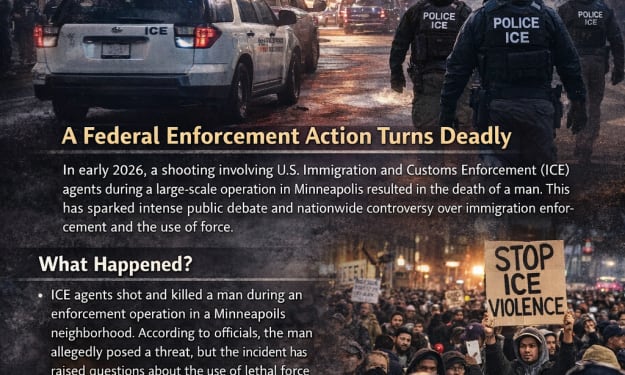
The ICE Shooting in Minneapolis A Closer Look at Federal Enforcement and Rising Tensions
The ICE Shooting in Minneapolis A Closer Look at Federal Enforcement and Rising Tensions In early 2026, Minneapolis found itself at the center of national attention following a shooting involving agents from U.S. Immigration and Customs Enforcement, widely known as ICE. The incident quickly moved beyond a single law enforcement encounter and became a symbol of broader debates surrounding immigration policy, federal authority, and the use of force in American cities. As details emerged, the shooting sparked intense public discussion, protests, and renewed scrutiny of federal operations carried out within local communities. The incident occurred during a large-scale immigration enforcement effort that brought a significant number of federal agents into Minneapolis. The stated goal of the operation was to locate and detain individuals suspected of immigration violations and other related offenses. While federal officials described the mission as necessary for public safety and law enforcement, many local residents experienced it as sudden, aggressive, and disruptive to everyday life. According to official accounts, the shooting happened during an encounter between ICE agents and a civilian in a residential area of the city. The situation escalated rapidly, ending with an agent firing a weapon and killing the individual. Federal authorities stated that the agent acted in response to a perceived threat, while community members questioned whether lethal force was necessary and whether alternative actions could have been taken. The lack of immediate clarity surrounding the event fueled public anger and distrust. What intensified the reaction was the fact that this shooting did not occur in isolation. It followed other recent incidents involving federal agents using firearms during enforcement actions in the same metropolitan area. The close timing of these events led many observers to describe the situation as part of a troubling pattern rather than a single tragic mistake. For residents of Minneapolis, especially those in immigrant and minority communities, the repeated use of force deepened fears and heightened anxiety. Local leaders responded swiftly. City officials and state representatives expressed concern about the scale and tactics of federal enforcement in Minneapolis. Some argued that the operations were carried out with little coordination with local authorities and insufficient understanding of neighborhood dynamics. Others warned that aggressive federal actions risked undermining years of efforts to build trust between law enforcement and the communities they serve. At the same time, federal agencies defended their presence and actions. Officials emphasized that ICE agents are trained to handle dangerous situations and that officers must make split-second decisions when they believe their lives or the lives of others are at risk. From this perspective, the shooting was portrayed as a defensive response during a volatile encounter rather than an act of excessive force. This divide in narratives became a defining feature of the public debate. Public reaction in Minneapolis was immediate and intense. Demonstrations erupted across the city, with protesters calling for accountability, transparency, and an end to what they described as militarized immigration enforcement. Marches and rallies drew attention not only to the shooting itself but also to larger questions about who controls public safety and how immigration laws are enforced in urban environments. For many protesters, the incident symbolized systemic problems rather than an isolated failure. Civil rights advocates also weighed in, arguing that federal enforcement actions should be subject to stronger oversight, especially when they involve lethal force. They called for independent investigations and clearer rules governing when agents may use weapons during arrests. These voices emphasized that accountability is essential for maintaining public trust and preventing future tragedies. Beyond Minneapolis, the shooting reignited a national conversation about immigration enforcement in the United States. Supporters of strict enforcement argued that federal agencies must be allowed to operate decisively to uphold the law. Critics countered that aggressive tactics often produce fear rather than safety and can damage relationships between communities and authorities. The Minneapolis case became a focal point for these competing views. As investigations continue, the city faces difficult questions about the future. How should federal agencies operate within local jurisdictions. What limits should exist on the use of force. And how can governments balance enforcement priorities with respect for human life and civil liberties. The answers to these questions will shape not only the outcome of this case but also the broader direction of immigration policy and law enforcement practices. The ICE shooting in Minneapolis stands as a powerful reminder of the human impact of policy decisions. It illustrates how quickly enforcement actions can escalate into tragedy and how deeply such events can affect communities. Whether this moment leads to meaningful reform or deeper division will depend on the willingness of leaders to confront hard truths, listen to affected communities, and pursue solutions rooted in accountability and justice.
By America today 9 months ago in Criminal