
Sixteen Children, Four Adults, One House of Horrors
Inside the Ohio family nightmare, the mother who became a child bride, and the childhoods that may never be recovered.

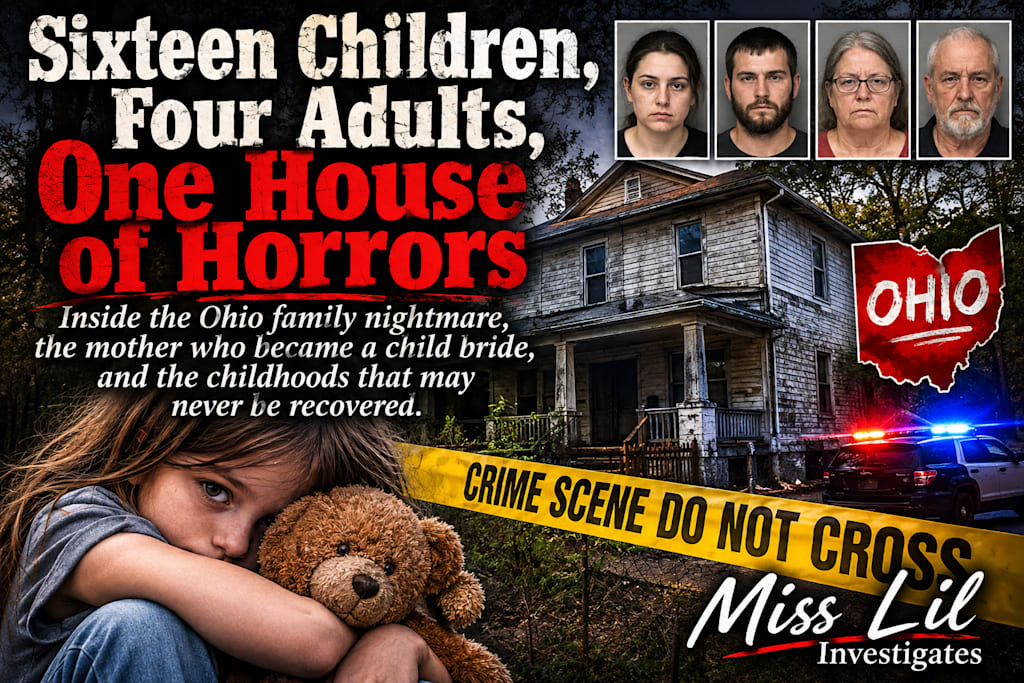
Sixteen Children, Four Adults, One House of Horrors
Inside the Ohio family nightmare, the mother who became a child bride, and the childhoods that may never be recovered.
By Miss Lil | Lily Writes
CONTENT WARNING: This article discusses child neglect, alleged abuse, extreme living conditions, family violence, and the removal of children from their home.
Pull Up a Chair. This Is Going to Be Difficult.
Well, folks, put the kettle on. Today, Miss Lil has something far more bitter than the tea I usually serve.
I have spent plenty of time digging through crime stories. I've investigated missing people, mysterious deaths, disturbing histories, and cases that leave you staring at your screen wondering how human beings are capable of doing the things they do.
But every once in a while, a case comes along that makes even a seasoned true crime writer stop, shake her head, and ask a question that doesn't seem to have an adequate answer.
Why?
Why would four adults allow sixteen children to live in conditions that authorities have described as deplorable? Why were so many children seemingly denied the most basic necessities of childhood? How does an entire family become so disconnected from the outside world that sixteen children can grow up without the ordinary experiences most of us take for granted?
And perhaps the most uncomfortable question of all: How many opportunities were there for someone to notice?
In June 2026, authorities in Hamden, Ohio, uncovered a situation that would quickly become known as the state's House of Horrors.
Sixteen children. Four adults. One home.
The adults included a mother, a father, and the paternal grandparents. All four were arrested following the discovery, and all became defendants in a criminal investigation involving child endangerment.
The children, ranging in age from approximately 18 months to 18 years, were removed from the residence.
Sixteen individual lives were suddenly pulled out of a world that, according to investigators, had failed to provide even the most fundamental protections children should receive.
This isn't just a story about a filthy house.
It's a story about isolation, alleged neglect, family dynamics, accountability, and the possibility that some of the adults involved may themselves have been shaped by circumstances that deserve examination.
But let's make one thing clear before we go any further.
Understanding the adults does not mean forgetting the children.
And that is where this investigation begins.
June 30, 2026: The Discovery in Hamden
The investigation came to a head on Tuesday, June 30, 2026, when law enforcement officers executed court-authorized search warrants at a residence on Ohmer Street in Hamden, a small community in Vinton County, Ohio.
What investigators encountered was serious enough to prompt an immediate response.
Sixteen children were located inside the residence.
According to the Ohio Attorney General's July 1 announcement, the children were removed and placed in the temporary custody of the Ohio Department of Job and Family Services. They were transported to local hospitals for medical evaluations.
Some were treated and released. Others required more extensive medical attention and remained hospitalized in serious condition.
Two children reportedly required air transportation to a higher-level trauma center.
Let that sink in for a moment.
Sixteen children had to be removed from their home, and some required emergency medical intervention.
The investigation described conditions inside the residence as deplorable. Subsequent reporting revealed that the children had reportedly been largely confined to a small room, approximately 12 feet by 12 feet, for an extended period.
Imagine sixteen growing children sharing a space that small.
Imagine trying to sleep, eat, learn, play, or simply breathe in an environment where there is little room to move.
Imagine being a toddler who has never experienced a normal playground, a teenager who has never attended a classroom, or a child who has no idea that the circumstances surrounding their everyday existence are not normal.
We need to be careful not to invent experiences for these children. We do not know what each child remembers, what each child understood, or what each child endured individually.
But we do know that authorities considered the circumstances serious enough to remove all sixteen.
And we know that the children needed medical attention.
The Ohio Attorney General also reported that investigators believed the family had lived in multiple Ohio counties since 2008 and had largely avoided establishing medical and other government records during that time.
That detail raises an enormous question.
How does a family with sixteen children move through communities without establishing the kinds of records that normally connect children to schools, doctors, and public services?
This is not a question with an easy answer, and we should not assume that every agency or institution had prior knowledge of what was happening.
But it is a question worth asking.
Because children do not become invisible by accident alone. There are systems designed to notice when children are missing from education, medical care, and other essential services.
When those systems fail to connect the dots, vulnerable children can fall through the cracks.
And sometimes, as this case demonstrates, those cracks become an entire canyon.
Four Adults, Sixteen Children, and a Family Home
The four adults arrested were:
Elizabeth Siders, the children's mother.
Gary Siders Jr., their father.
Christina Siders, their paternal grandmother.
Gary Siders Sr., their paternal grandfather.
According to the Ohio Attorney General's initial announcement, each adult was charged with sixteen counts of endangering children, a second-degree felony.
Later court reporting described additional charges and amended charging information, including misdemeanor child-endangering counts. Elizabeth and Gary Jr. also face separate allegations involving sexual misconduct with a minor who was not one of the sixteen children removed from the home.
All four defendants entered not-guilty pleas.
It is important to remember that criminal charges are allegations, not convictions. Each defendant is entitled to the legal process, and the prosecution must establish guilt under the applicable law.
Still, the circumstances that brought authorities to this residence deserve a thorough examination.
The grandparents were not simply distant relatives living somewhere else. Christina reportedly owned the home where the children were found. The four adults were members of the same family unit.
What did each person know?
Who made decisions about the children's daily lives?
Who controlled access to medical care, education, and the outside world?
Were there disagreements inside the household? Did anyone attempt to intervene? Did anyone recognize that the children were in danger?
Those are questions investigators and prosecutors must answer through evidence.
And they matter because sixteen children do not become isolated in a household without a complicated series of circumstances surrounding the adults responsible for them.
Elizabeth Siders: The Girl Who Became a Mother at Fifteen
Now, this is where the story becomes especially complicated for me.
I am not interested in turning a criminal investigation into a simple good-versus-evil story when the documented history suggests there may be much more to examine.
Elizabeth Siders was fifteen years old when she married Gary Siders Jr., who was eighteen, in West Virginia in 2008.
According to court records described by the Associated Press, the couple crossed into West Virginia to marry at the Mason County Courthouse with Elizabeth's parents' consent.
Their first child was born in May 2008, approximately two months after the marriage.
Elizabeth was still a teenager.
Think about that.
At an age when most girls are navigating high school, friendships, first jobs, and the ordinary awkwardness of growing up, Elizabeth was already entering motherhood.
Court records indicate she has been pregnant during most years since then.
By the time authorities removed the sixteen children in June 2026, Elizabeth was approximately thirty-three years old.
That means a significant portion of her adult life had been spent raising children.
But I want to pause here.
What kind of childhood did Elizabeth herself have?
What did she learn about marriage, motherhood, obedience, family responsibility, and the role of women?
Did she have meaningful choices when she entered this marriage? Did she understand the life she was stepping into? Was she supported by the adults around her, or were decisions being made for her?
These are not questions we can answer simply by looking at her marriage certificate.
We do not have sufficient verified information to declare that Elizabeth was forced into marriage, that she was trafficked, or that she was brainwashed. Those are serious conclusions requiring evidence.
However, her age at marriage and the circumstances surrounding her early motherhood make her personal history an important part of this investigation.
A fifteen-year-old is still a child.
A teenager can be legally married under certain circumstances and still be developmentally vulnerable, emotionally dependent, and susceptible to controlling relationships.
If a young person grows up believing that obedience is love, that isolation is normal, or that questioning a spouse is disloyalty, those beliefs can become deeply ingrained.
That is why coercive control deserves consideration.
Coercive control is a pattern of behavior used to dominate another person. It can involve isolation, intimidation, financial dependence, restrictions on movement, manipulation, and the gradual erosion of someone's ability to make independent decisions.
It does not always look like the dramatic scenes we see in television crime programs.
Sometimes it develops quietly.
Sometimes the person experiencing it doesn't recognize it as abuse because it is the only relationship dynamic they have ever known.
And sometimes outsiders looking in see a situation that the person inside it has been conditioned to accept.
Could some of those dynamics have been present in Elizabeth's life?
That is something a thorough investigation should explore.
But there is another side to this discussion.
Sixteen children were allegedly endangered.
Elizabeth was not fifteen when authorities found them. She was an adult, and the children's mother.
If the evidence establishes that she participated in neglect or knowingly allowed her children to suffer, those actions must be examined.
Being a possible victim of coercive control does not automatically erase responsibility for harm inflicted on someone else.
It does, however, raise important questions about culpability, mental health, agency, and the circumstances in which alleged conduct occurred.
I can hold two thoughts in my head at the same time.
I can wonder what happened to the fifteen-year-old girl who entered this marriage, and I can demand answers about the sixteen children who depended on her.
Those two positions are not contradictory.
They are necessary.
Gary Siders Jr.: The Father at the Center of the Family
Now let's talk about Gary Siders Jr.
He was eighteen when he married Elizabeth in 2008. Their first child arrived shortly afterward.
For years, the couple's family grew.
Sixteen children were ultimately found in the Hamden residence.
What was Gary Jr.'s role in the household?
What decisions did he make? What did he know about the children's living conditions? What was his relationship with his parents, who were also arrested in connection with the case?
These are central questions.
It would be tempting to focus almost exclusively on Elizabeth because she was the mother and because her early marriage makes her personal history particularly compelling.
But that would leave out a crucial part of the investigation.
Gary Jr. was an adult father. He was also a defendant in the child-endangerment case.
He must be examined independently, rather than treated as a background character in his wife's story.
The separate sexual misconduct allegations also require attention. According to WOUB, Elizabeth and Gary Jr. were indicted on charges involving a minor who was identified as Elizabeth's niece. The alleged victim in that separate case was not one of the sixteen children removed from the Hamden residence.
The couple has pleaded not guilty.
We must keep those allegations distinct from the child-endangerment case and avoid treating charges as established facts.
But they are part of the broader legal picture, and they deserve to be followed as the proceedings develop.
Christina and Gary Siders Sr.: The Grandparents
There is another layer to this family story that cannot be ignored.
The paternal grandparents, Christina and Gary Siders Sr., were also arrested.
The home where authorities found the children reportedly belonged to Christina.
That fact alone makes her role an important part of the investigation.
What did she know about the children's living conditions?
What responsibility did she have for their safety?
Did she participate in household decisions, or did she have a different understanding of what was happening?
And what about Gary Sr.?
The answers must come from evidence, not assumptions about what grandparents should or should not have known.
But the fact that four adults from the same family were charged in connection with the circumstances surrounding these children makes this more than a story about one parent struggling to cope.
It is a story about an entire family structure that authorities are now investigating.
And then came the competency proceedings.
The Dementia Question: When the Courtroom Becomes Another Battle
This is one of the developments that has attracted considerable attention.
Both grandparents have faced competency proceedings, and the outcomes have been different.
First, Gary Siders Sr.
In September 2026, a Vinton County judge accepted an evaluation finding Gary Sr. mentally incompetent to stand trial.
His attorney indicated that his declining mental health was not considered restorable.
The judge subsequently dismissed the criminal case against him.
That does not mean a court found him innocent of the allegations.
It means the court determined that he could not be tried under the circumstances established by the competency evaluation.
There is a substantial difference.
Now, Christina Siders.
Her case took another turn in November.
A psychological evaluation identified several risk factors for cerebrovascular dementia and recommended a comprehensive neuropsychological evaluation to determine whether her cognitive impairment was related to dementia.
On November 9, 2026, a judge ruled Christina incompetent to stand trial at that time.
However, unlike her husband, she was considered potentially restorable to competency.
The court ordered further treatment and evaluation at an inpatient facility.
Her case was not simply dismissed.
The distinction matters.
And here is something else worth understanding.
Competency to stand trial and legal insanity are not the same thing.
Competency generally concerns a defendant's present ability to understand the proceedings and assist in their own defense.
An insanity defense concerns the defendant's mental state at the time of the alleged offense.
A person may be competent to stand trial but still pursue an insanity defense. Likewise, someone may be found incompetent to stand trial because of a current mental condition without that automatically establishing legal insanity at the time of the alleged conduct.
These are separate legal questions.
We should not assume that a dementia diagnosis is fabricated simply because it arises during a criminal case.
Dementia is a genuine medical condition, and a person experiencing significant cognitive impairment may be unable to participate meaningfully in a trial.
But the consequences are understandably difficult for people looking at a case involving sixteen vulnerable children.
When criminal charges are dismissed because someone cannot be restored to competency, families and communities may feel that accountability has disappeared.
That frustration is understandable.
Still, the legal system cannot punish someone who is legally incapable of participating in a trial simply because the allegations are horrifying.
The courts must follow the law.
And we must continue to distinguish between a finding of incompetency and a finding of innocence.
Elizabeth's November 9 Court Appearance
November 9 brought another important development.
Elizabeth Siders was ruled competent to stand trial.
Her attorney, Thomas Stolly, questioned the adequacy of the evaluation, stating that it involved approximately ninety minutes of assessment conducted over Zoom.
He indicated that he intended to seek another evaluation, particularly concerning whether Elizabeth could pursue a not-guilty-by-reason-of-insanity defense.
He also raised concerns about potentially controlling behavior and the influence of the family environment on Elizabeth's mental health.
According to reporting by WOUB, her attorney said he wanted a more extensive examination that would include her background and the circumstances in which she grew up.
There is a distinction here that deserves emphasis.
A competency ruling does not establish that Elizabeth was mentally healthy throughout her life.
It does not settle whether she experienced coercive control.
It does not determine whether she was legally insane when the alleged offenses occurred.
It answers a specific legal question about her present ability to stand trial.
Her attorney has indicated that further evaluation is being pursued.
And on November 9, another detail emerged.
Elizabeth is pregnant again.
Her attorney confirmed the pregnancy but did not provide a due date or details about how far along she is.
That news adds another deeply troubling dimension to an already complicated situation.
Sixteen children have been removed from her care. The criminal proceedings are ongoing. And another child is reportedly on the way.
I don't say that to ridicule Elizabeth or to make assumptions about the pregnancy.
I say it because it raises practical questions about the safety, welfare, and future of another child entering a family already under extraordinary scrutiny.
That child deserves protection, too.
Sixteen Children: The People We Must Not Forget
Now, let's step away from the adults for a moment.
Because I fear that the legal drama, the competency hearings, the family history, and the headlines may eventually overshadow the most important people in this case.
The children.
Sixteen individual human beings.
Not sixteen counts on an indictment.
Not sixteen photographs in a news report.
Not sixteen talking points for a television panel.
Sixteen children.
They ranged from toddlers to teenagers. Some reportedly had significant medical needs. Some were described in reporting as having difficulty speaking. Authorities said the children were not enrolled in school.
The Associated Press reported that some of the children had reportedly been confined largely to a small room and had experienced little ordinary contact with the outside world.
We should be cautious about repeating descriptions such as "feral," which have appeared in coverage of the case.
Children who have experienced extreme isolation or deprivation are not animals.
They are children who may never have been given the opportunity to develop skills that most people take for granted.
A child who has not received adequate education may struggle academically.
A child who has not had consistent medical care may have untreated conditions.
A child who has been deprived of ordinary social experiences may have difficulty communicating, trusting others, or navigating unfamiliar environments.
None of those difficulties makes the child less deserving of compassion.
They make the responsibility to help that child even greater.
And recovery is not going to happen overnight.
The children may need medical treatment, developmental assessments, educational support, psychological care, stable placements, and years of patient attention.
Some may have memories they cannot easily explain.
Some may struggle with the sudden change from everything they knew.
Some may feel frightened even when they are finally safe.
And some may not yet understand what has happened.
We should not expect sixteen children to recover on the same schedule or in the same way.
They are individuals.
Their privacy must be protected, and their stories should never be reduced to graphic details for public consumption.
The real victory will not be the number of headlines this case generates.
It will be the number of children who eventually get the opportunity to live ordinary, healthy, independent lives.
To attend school.
To make friends.
To celebrate birthdays.
To choose their own clothes.
To learn how to ride a bicycle.
To complain about homework.
To argue over television.
To experience the wonderfully boring parts of childhood.
Those are things children should never have to earn.
They should simply be allowed to have them.
Where Were the Systems That Should Have Seen Them?
This is where the investigation needs to go beyond the four defendants.
According to the Ohio Attorney General's July 1 announcement, investigators believed the family had lived in multiple Ohio counties since 2008 and had largely avoided establishing medical and other government records.
That statement deserves careful attention.
Sixteen children represent sixteen opportunities for interaction with institutions designed, in part, to protect children.
Schools.
Doctors.
Hospitals.
Public health services.
Child welfare agencies.
Local authorities.
Of course, we do not yet know which agencies had contact with the family, whether reports were made, or whether anyone had previously raised concerns.
We should not accuse specific workers or agencies of ignoring warnings without evidence.
But we can ask how children can remain outside ordinary systems of oversight for so long.
Were the children homeschooled? If so, what records existed?
Were they receiving vaccinations and routine medical care?
Were there prior investigations?
Did the family move frequently enough to complicate the ability of local agencies to identify a pattern?
Were there adults outside the household who knew something was wrong?
Did anyone try to seek help?
These are not merely administrative questions.
They are questions about child protection.
A system that only notices a child when an emergency becomes impossible to ignore is a system that needs to examine how it identifies children at risk.
The purpose of child protection should be to intervene before a situation reaches the point where children require emergency removal and hospitalization.
Prevention matters.
Early intervention matters.
And the ability to connect information across jurisdictions can matter enormously when families move repeatedly.
This case should prompt a serious examination of how children who are isolated from schools and medical services can be identified and protected.
The Psychology of Isolation and Coercive Control
There is another reason I want to spend time discussing Elizabeth's background.
When we examine a household in which one or more adults may have experienced control, isolation, or manipulation, it is important to understand how those dynamics can operate.
Coercive control is not always a single dramatic event.
It can be a pattern.
A person may gradually lose access to friends, family, money, transportation, information, or independent decision-making.
They may become dependent on the person controlling the household.
They may be told that outsiders cannot be trusted.
They may come to believe that the conditions they live in are normal.
And when children are raised inside that same environment, they may inherit the household's understanding of what is normal.
That does not mean every isolated family is abusive, nor does it mean every person in a controlling relationship responds in the same way.
It also does not establish that Elizabeth experienced coercive control.
But given her age at marriage, the rapid onset of motherhood, and the family circumstances now under investigation, her history deserves more than a passing mention.
If there was manipulation, intimidation, or a pattern of control, investigators and qualified experts should examine it.
If there was a history of abuse, that history may help explain the circumstances surrounding the alleged conduct.
But explanation and excuse are not interchangeable.
And the children cannot be expected to pay for the failures of the adults around them.
A mother can be vulnerable and still have responsibilities.
A father can be under pressure and still have responsibilities.
Grandparents can have medical problems and still have a history that deserves examination.
This is not a contest to determine which adult deserves the most sympathy.
It is an investigation into what happened to sixteen children.
The Questions That Remain
As of November 11, 2026, the legal proceedings are still developing.
There are several important questions that remain unanswered.
What exactly happened inside the home?
The initial descriptions are disturbing, but the public does not yet have a complete account of each child's individual circumstances or the full investigative evidence.
How long were the children isolated?
Authorities have described prolonged confinement, but the precise circumstances and duration for each child need to be established through evidence.
What did each adult know?
The prosecution will need to establish the conduct and responsibility of each defendant individually.
What was Elizabeth's upbringing like?
Her marriage at fifteen is documented. The circumstances leading to it, her experiences within the marriage, and any history of controlling behavior require further investigation.
What happens to the grandparents' cases?
Gary Sr.'s case was dismissed after he was found incompetent and not restorable. Christina's case remains subject to further evaluation because she may be restored to competency.
What happens with Gary Jr.?
His competency evaluation remains an important unresolved part of the criminal proceedings.
What will happen to the children?
Their immediate safety has been addressed through removal, but their long-term medical, educational, developmental, and emotional recovery will require continuing support.
And finally:
Could anyone have intervened sooner?
That may be one of the most important questions to emerge from this entire case.
Miss Lil's Final Thoughts: Sixteen Childhoods Are Not a Family Dispute
I'm going to be honest with you.
This case leaves me angry.
Not simply because of the conditions described by authorities, but because of what those conditions represent.
Sixteen children depended on adults to make decisions for them.
They depended on adults to feed them, protect them, educate them, take them to doctors, and teach them how to navigate the world.
They had no meaningful power over where they lived or the circumstances into which they were born.
And according to investigators, their lives were shaped by conditions that ultimately required their removal and emergency medical attention.
I find myself thinking about Elizabeth.
A fifteen-year-old girl entering a marriage with an eighteen-year-old boy. A teenager becoming a mother almost immediately. A young woman whose adult life appears to have revolved around repeated pregnancies and a growing family.
I wonder what she was taught.
I wonder whether she was allowed to make choices.
I wonder whether she understood that the conditions surrounding her were not normal.
I wonder whether someone controlled her, whether she was isolated, and whether she ever believed she could leave.
Those questions matter.
But I also think about the sixteen children.
And I cannot let the mother's story become the only story.
If Elizabeth was controlled, I want to know how.
If she was abused, I want to know what happened.
If the family environment shaped her understanding of motherhood and responsibility, I want experts to examine that history.
But if evidence establishes that she participated in the neglect of her children, that must be addressed, too.
The same applies to Gary Jr. and the grandparents.
Medical conditions must be taken seriously. Competency must be determined fairly. And nobody should be declared guilty simply because the public is horrified.
But the children must not disappear behind the legal proceedings.
They have already lost time they can never get back.
They deserve a future that isn't defined by the house where they were found.
And perhaps that is the part that makes this story so difficult to put down.
We can debate the adults.
We can analyze the charges.
We can follow every hearing and every medical evaluation.
We can ask whether the systems meant to protect children failed.
But sixteen children should never have needed a rescue operation to begin experiencing the basic things that make a childhood.
A safe bed.
A warm meal.
A clean home.
A doctor when they are sick.
A classroom.
A friend.
A chance to grow up without fear.
Sixteen children.
Four adults.
And an enormous number of unanswered questions.
So, for once, Miss Lil is setting down her teacup.
Because there is nothing entertaining about this story.
There is nothing amusing about the circumstances.
And there is certainly nothing ordinary about sixteen children having to be rescued from the people who were supposed to protect them.
The question isn't just how this happened. The question is how we make sure it never happens to another sixteen children.
Until next time, keep asking questions, keep looking beyond the headlines, and never forget the human beings behind the stories.
— Miss Lil
Lily Writes | True Crime, Uncomfortable Truths, and the Stories That Demand to Be Heard.
Sources and Further Reading
Ohio Attorney General's Office: Update on Vinton County Abuse Case, July 1, 2026
Associated Press: Man whose 16 grandchildren found living in filthy conditions is found incompetent to stand trial
WOUB Public Media: Vinton County grandmother ruled incompetent while mother ruled competent in child endangerment case, November 9, 2026
WOSU Public Media: Mother ruled competent, grandmother ruled incompetent in Vinton County child neglect case, November 10, 2026
Dayton 24/7 Now: Former prosecutor reacts to latest competency decisions in Vinton County child abuse case, November 9-10, 2026
Reporting note: Criminal charges are allegations unless and until proven in court. Court proceedings and medical evaluations are ongoing. This article reflects publicly available reporting as of November 11, 2026. Some details concerning the children's individual experiences remain undisclosed to protect their privacy.
About the Creator
Lilithea Adasia
I dig where others look away. 🖤 True crime, paranormal mysteries, uncomfortable truths, and the beautifully broken human experience. I chase the stories others bury and ask the questions others avoid. Come curious. Leave questioning.
Enjoyed the story? Support the Creator.
Subscribe for free to receive all their stories in your feed. You could also become a paid subscriber, letting them know you appreciate their work.
Comments
There are no comments for this story
Be the first to respond and start the conversation.