
She Reported Her Own Son for Selling Her Gold Necklace. Then She Walked Into the Police Station With Him.
A 13.29-gram necklace, a WeChat post, and the legal question families avoid: Does taking from home count as theft?
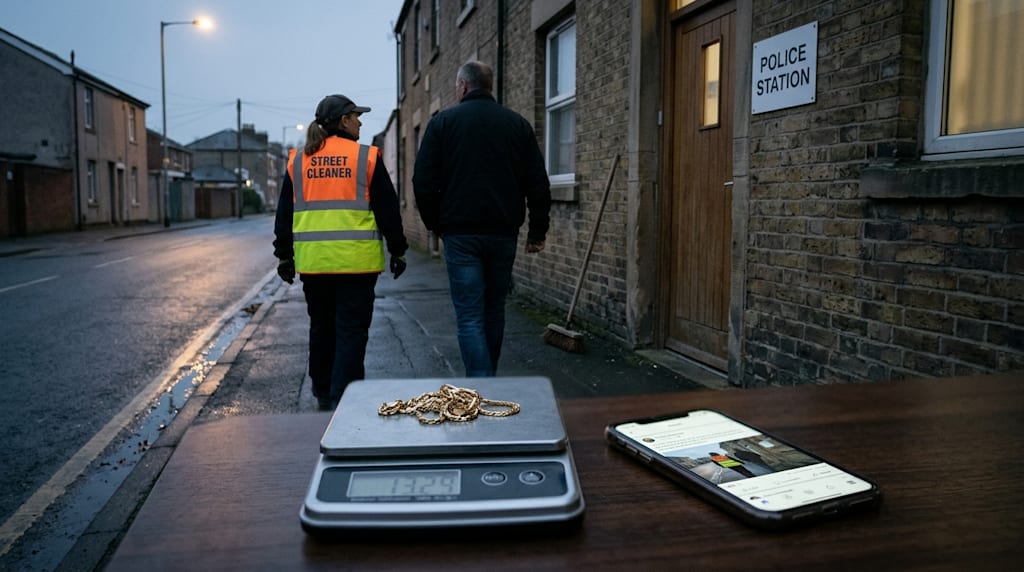
The photo on WeChat Moments showed a gold necklace lying on a small electronic scale. The caption had six words: “Down I go, brothers.”
The man who posted it was Zhao’s son. The necklace weighed 13.29 grams. He sold it at 870 yuan a gram and received 11,562 yuan. Then he left for a trip.
Zhao is a street cleaner. For a while she thought she had lost the necklace while sweeping. Her nephew recently scrolled past the post, recognized what he saw, and told her. She checked. The necklace had not been lost on the street. Her son had taken it.
He had taken money and belongings from the home before and sold them to spend the cash. This time Zhao did not soften. She called the police. Her son turned himself in with her beside him. The Yuecheng District branch of the Shaoxing Public Security Bureau in Zhejiang Province disclosed the case recently. The son is now under criminal coercive measures.
The case put a question on the table that many people thought had an easy answer: Does taking something from your own home count as theft? And after a mother reports her son, can she take the report back?
The legal answer to the first question is yes.
Theft protects possession. The necklace belonged to Zhao. She had it in her home. Her son took it without telling her, sold it, and used the money. In form, that fits the elements of theft: taking property belonging to another, with the intent to possess it unlawfully, by secret means.
The family relationship does not erase the act. It changes how the act is handled.
The Supreme People’s Court and Supreme People’s Procuratorate’s interpretation on theft cases has a special rule. Article 8 says that where a person steals property from a family member or close relative, if forgiveness is obtained, the conduct generally may not be treated as a crime; where criminal responsibility is pursued, leniency should be given as appropriate.
Read that rule closely. It does not say family theft is not theft. It says forgiveness can keep a family theft case out of criminal treatment. Forgiveness is the condition. The decision sits with the public authority.
Two facts in this case make that decision harder. First, the son had taken household property before. Under the same interpretation, three or more thefts within two years can constitute “repeated theft,” which can establish theft even where a single amount is not large. Second, he sold the necklace and went traveling, and the sale itself was posted on WeChat Moments. Those facts make it harder to describe the conduct as minor.
The police’s decision to impose criminal coercive measures has a legal basis. It is also not a conviction. Coercive measures are part of the process. A court has not yet decided the case.
The second question is whether Zhao can withdraw the case. She cannot do it by herself.
Theft is a public prosecution case in China. The power to pursue or drop the case belongs to the public authorities, not to the victim. Article 16 of the Criminal Procedure Law lists the situations in which a case must be dropped or not pursued. A victim’s change of mind is not one of them. A victim can report. A victim cannot un-report.
Forgiveness still matters. In a family theft case, a statement of forgiveness is one of the heaviest factors in the file. It can support a police decision to withdraw the case. It can support a prosecutor’s decision not to prosecute. But it does not bind them. The mother supplies a condition. The police or the prosecutor decides whether to use it.
That difference is easy to miss. A mother may think she controls the outcome. She controls one input. The decision sits with the police or the prosecutor.
The report did not come out of nowhere. The son had taken from the home before. The mother had forgiven before. The house had a boundary that was not a boundary.
A family can absorb small losses: cash missing from a wallet, an item gone from a shelf, a promise made and broken. Then the losses repeat, and the promise repeats, and the household learns to treat the exception as the rule. The person who takes learns that the house will close its eyes. The person who is taken from learns to hide things, then to check, then to wonder.
Zhao is a street cleaner. The necklace was 13.29 grams. The sale brought 11,562 yuan. That is not a rounding error in her life. Her son put the necklace on a scale, took a photo, wrote six words, sold it, and left for a trip. The photo did what a hidden theft could not do: it made the pattern visible.
Her nephew saw the post. He told her. She checked. The necklace she thought she had lost while sweeping had never been on the pavement.
The son turned himself in with his mother. That detail changes how the case reads.
She did not hand him to the police and walk away. She walked in with him. For the law, that fact can support a finding of surrender and a lighter handling. For the family, it is a small opening. The mother was not only saying no. She was also still standing there.
This is the part that the phrase “she reported her own son” can hide. A report is an act of boundary. A walk into the station together is an act of accompaniment. Both happened. A family can do both at once, even when the two acts pull in different directions.
The son may not see it that way. A young man who has been forgiven many times may have learned that the house had no boundary that held. A police report teaches the opposite lesson in one afternoon. He may read the report as betrayal. He may read the walk beside him as the only reason to listen. No one can choose that reading for him.
The worry that he will blame his mother is not imaginary. It is one of the ways this kind of case can go wrong. If he leaves the process with a story in which his mother sold him out, the law has interrupted a cycle without repairing the relationship. He may become more careful about getting caught. He may not become more honest.
If he leaves with a story in which his mother stopped him, the report may do what a hundred conversations could not. That outcome is not guaranteed by the law. It depends on what happens after the police station: whether he repays, whether he asks for help, whether the mother can hold the boundary without turning every meal into a trial, whether anyone else in the family stops covering for him.
The law can interrupt a cycle. It cannot make a person grow up. The report is a hard stop. The work after the stop is slower and less visible.
Prosecutors will weigh the amount, the earlier thefts, the surrender, any repayment, and any statement of forgiveness. The police may keep the case. The prosecutor may not prosecute. A court may decide. The mother’s forgiveness can open a door. It cannot walk through it for him.
On her next shift, Zhao went back to her route. Her broom scraped the curb. The pavement was the same. The necklace was not there. It had never been there.
About the Creator
Jin
Writer of reamstories
https://reamstories.com/jin
Enjoyed the story? Support the Creator.
Subscribe for free to receive all their stories in your feed. You could also become a paid subscriber, letting them know you appreciate their work.
Comments
There are no comments for this story
Be the first to respond and start the conversation.