
She Flew to Bangkok for a Trip. Nine Days Later, Her Family Saw the Black Plastic.
Wang Ran was 24, a livestreamer from Nanjing. The ransom was 600,000 yuan. The threat: pay, or she goes to a club.
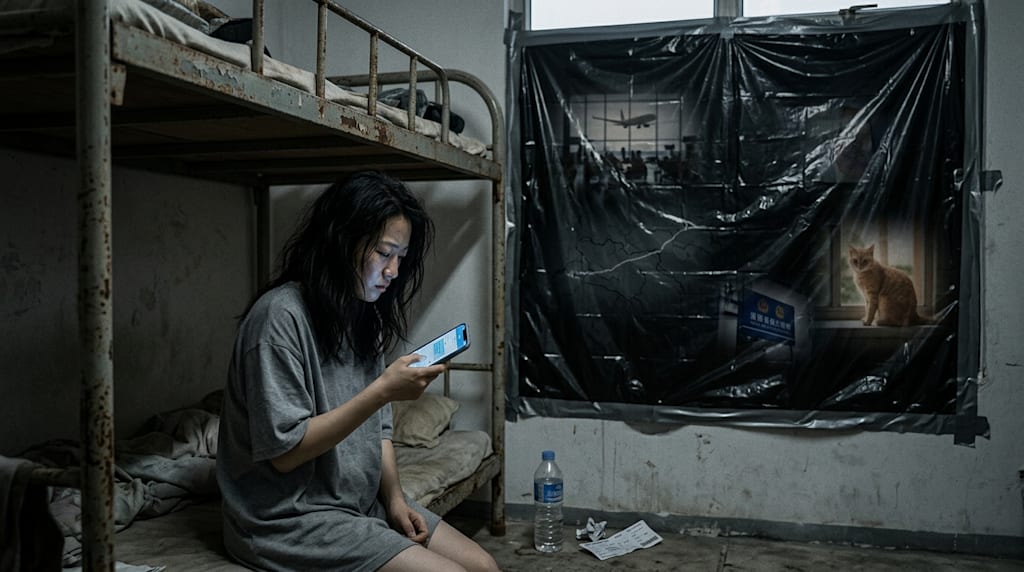
Black Plastic Sheeting
On September 12, Wang Ran bought a bottle of Nongfu Spring at Nanjing Lukou Airport, 550 ml, after security, two yuan more than outside. She took a photo of her boarding pass and sent it to the family group chat, no caption. Her cousin later scrolled through the chat and realized that was the last time Wang Ran sent anything on her own.
The boarding pass said Bangkok. A 24-year-old livestreaming sales host going to Thailand was not unusual. In the past two years, at least four or five peers around her had gone for supply chains, livestreaming bases, business meetings. No one thought the trip needed special reporting.
After September 12, the family group chat was quiet for three days. Her cousin sent two messages, one asking "Arrived?" and one funny video. Neither got a reply. On the fourth day, her cousin made the first call. No answer. On the fifth day, the second. On the sixth day, the third. By September 19, she had made forty-seven calls. At the end of every WeChat message, it showed "Sent," never "Read."
On September 20, the phone connected. Wang Ran was not the one who answered.
When her cousin described the video call, her speech slowed, as if every word had to be rehearsed before she could say it. She saw Wang Ran sitting on the lower bunk of a bunk bed. The bed was iron, its paint mostly gone, patches of rust dark and light. The room had no window, or the window had been sealed with black plastic sheeting, attached with wide tape, corners peeling up, letting through a bit of gray-white light. Wang Ran wore a gray short-sleeved shirt, hair loose, no makeup. Her cousin called her name. She looked up, eyes unfocused, as if looking at the camera and also at something behind it.
Someone beside her spoke. It was not Wang Ran. The person demanded 600,000 yuan and gave three days. The exact words were: "If you can't raise it, she goes to a club."
Her cousin said she did not cry then. She repeated one question: "Where are you?" The other side did not answer. The video call ended.
Wang Ran's father was in Harbin. Her mother was in poor health, so for now she had not been told the full picture. Her father decided to go to Nanjing to report to the police, because Wang Ran had lived there before she disappeared, and Nanjing police could take the case under territorial jurisdiction. On the afternoon of September 20, he arrived in Nanjing and went to the police station for the neighborhood where Wang Ran rented. The officer who received him said anti-fraud personnel would be arranged to coordinate. Her father brought a document folder: a copy of Wang Ran's ID, screenshots of chat records, a screen recording of the video call, and a handwritten family relationship chart. He was afraid he would not be able to explain it clearly.
The police station sign was blue with white Chinese characters. There were two steps at the entrance. Her father stood on the steps for a while before going in.
Wang Ran was not the first.
In April this year, Xiao Yang, a 19-year-old college student from Guangdong, was invited by a female "friend" to Thailand for Songkran. After landing in Bangkok, the "friend" did not show up. A man picked her up in a car. The car drove for a long time. She later learned it was heading to Three Pagodas Pass on the Thailand-Myanmar border. Her family paid 30,000 USDT, more than 200,000 yuan. After paying, the other side said procedures could not be processed during Songkran, then said the compound only lets people in, not out. Xiao Yang told her family on the phone that someone who secretly sent their location "was beaten by people in the compound with sticks until blood was all over the ground, and was handcuffed."
Wang Bo, a young man from Sichuan rescued and returned to China in May this year, was deceived in a more everyday way. He was studying language in Bangkok, living downtown, and thought he was safe. Because he needed to exchange currency for a Japanese visa, he found a travel agency online. The other side said the exchange rate in Chiang Mai was better and could send a car to pick him up. The car came. The driver handed him a bottle of water. He saw the driver drink it too, so he did not think much. When he woke up, his hands were cuffed, the car was crossing the border, and armed men stood by the river.
The bait in these three cases was different: a travel invitation, a friend's recommendation, a good exchange rate. The destination was the same. A July report by the UN International Organization for Migration said scam compounds in Myanmar, Cambodia, and Laos employ about 300,000 people from more than 80 countries. The ransom demand for Wang Ran is 600,000 yuan. Divide one by the other and she is two yuan in the arithmetic of the trade.
The case prosecuted by the Second Branch of the Shanghai People's Procuratorate in August this year described how the operation works: a group entrenched in Myawaddy, Myanmar, used overseas work as bait to lure people abroad, escorted them with armed personnel, raped and forced female victims into prostitution, then resold them to scam compounds. The indictment's wording was "for the purpose of selling people." Not "fraud," not "unlawful detention," but "selling people."
Wang Ran's cousin said the room in the video "looked a bit like a factory building in the countryside." She used the word "factory." A factory is for production. In that room sealed with black plastic sheeting, what was being produced, she did not say.
Now, Wang Ran's father is in Nanjing waiting for news. Her cousin is in Harbin waiting for news. The three days the kidnappers gave, counting from September 20, end on September 23. The family did not say whether they planned to pay. The police officer at the station said anti-fraud personnel would contact the family. Anti-fraud officers are trained to stop transfers to scammers. A ransom demand requires a different response.
Wang Ran's WeChat profile picture was a side-profile photo, backlit, expression unclear. Her Moments cover was an orange cat lying on a windowsill, with Nanjing's buildings outside. Her last Moments post was on September 11. The content was three words: "Setting off." The image was an airport floor-to-ceiling window, with a blurry figure reflected in the glass, holding a phone.
Under that Moments post, there were twenty-three likes. The newest comment was left on September 20, only two words:
"Waiting for you."
No period.
About the Creator
Jin
Writer of reamstories
https://reamstories.com/jin
Enjoyed the story? Support the Creator.
Subscribe for free to receive all their stories in your feed. You could also become a paid subscriber, letting them know you appreciate their work.
Comments
There are no comments for this story
Be the first to respond and start the conversation.