
She Drew for 13 Years. A Scam Took 40,000 Yuan. Then She Fell From the 32nd Floor.
A 25-year-old illustrator in Foshan was tricked into borrowing money, then spent her last days trying to draw her way out.
On November 12, 2025, her journal read:
5:30–7:00: Wake up, stay in bed, scroll on phone
7:00–7:30: Make breakfast
7:30–8:00: Eat
8:00–8:30: Walk after meal
8:30–11:00: Work
11:00–11:30: Make lunch
11:30–12:00: Eat
12:00–12:30: Walk after meal
12:30–14:30: Nap
14:30–17:00: Work
17:00–19:00: Walk
19:00–20:00: Soak feet, tidy up
20:00–21:30: Lie in bed, scroll on phone
21:30–5:30: Sleep
She had kept this schedule since at least last year. She was 25. Her online name was “Not Eating Grapefruit.” She rented in Foshan. She drew illustrations. Her coloring was clear and vivid. Her feed had scenery, stray cats, small birds. She cooked. She steamed buns. She kept a journal. She had practiced drawing for twelve, thirteen years. Her earliest Xiaohongshu post was in 2022. She earned money by taking commissions. A half-body illustration cost 250 yuan. It took more than six to seven hours. After platform and studio cuts, not much reached her hand.
On September 13, a commission came.
The other person said they were a Xianyu customer service agent. The account was frozen. She needed to create transaction flow to unfreeze it. Video meeting. Scan a QR code. Open a loan app. She transferred money. Principal: 10,000 yuan. Loans: 24,000 yuan. Total: more than 40,000 yuan. She called the police. The Nanhai Branch of the Foshan Public Security Bureau issued a police report receipt.
She took a photo of the receipt and saved it on her phone. Next to it was the dough left from steaming buns the day before.
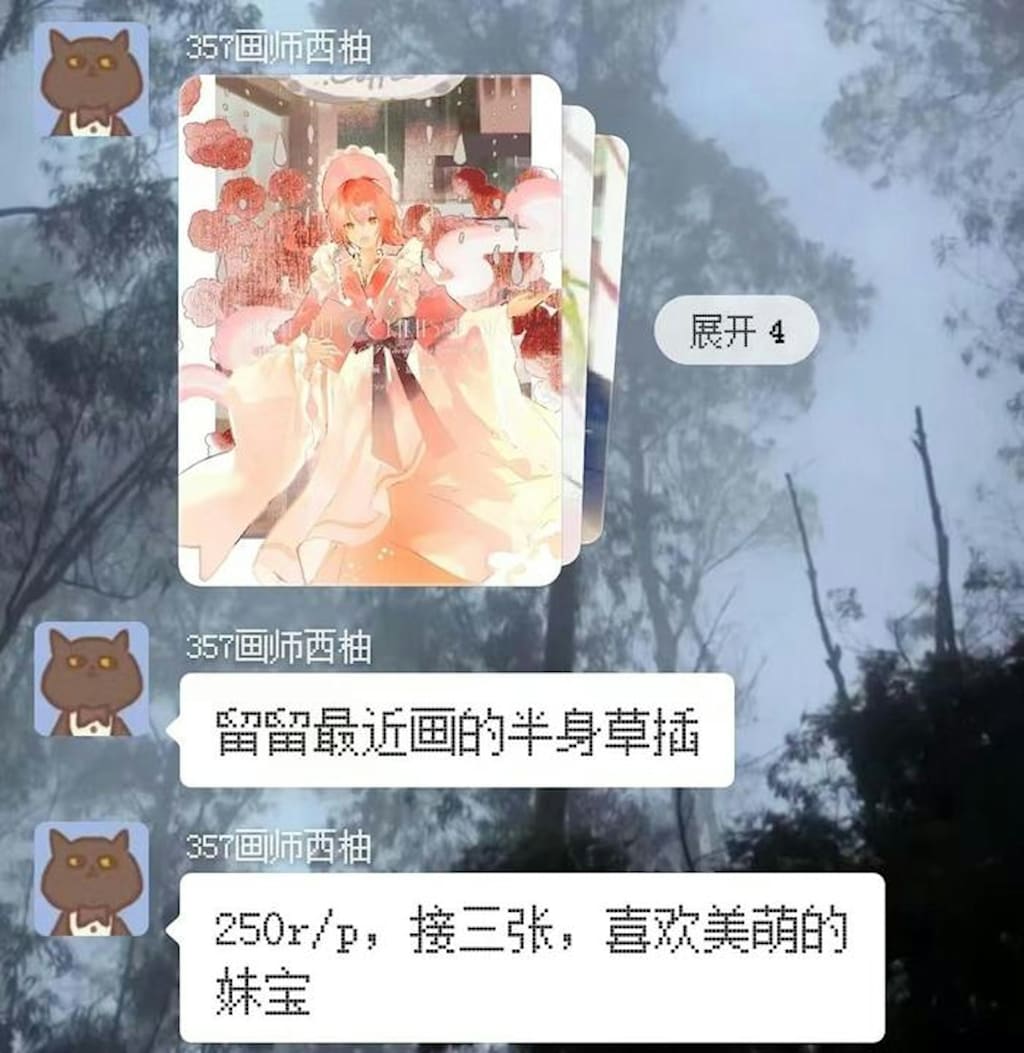
On September 17, she posted on Mihuashi. High-intensity drawing. Mental breakdown. She posted a commission notice. She hoped netizens would spread it. She asked clients to commission her. She said she would treat it seriously and deliver quality work. She wrote: Huabei debt was the biggest part. With rent and various miscellaneous expenses, she needed at least 8,000 yuan a month. That afternoon, she posted her last message in the drawing group. She opened three recent half-body illustrations, 250 yuan each.
A fellow artist in the group recalled that after being scammed, she updated comments three or four times a day. She drew every day to pay the money back.
Another artist said that last month he encountered the same scam. The same greeting. The same commission script. The person asked him to add a Xianyu account. Then the person used various reasons to get him to scan a WeChat QR code. He grew suspicious. He refused. He nearly got scammed.
In the early hours of September 18, she fell from the 32nd floor of her residence.
Her father posted a photo of her tombstone after the burial in her drawing group. He thanked everyone in the group for their care and help for his daughter. A netizen claiming to be her sister commented under her account. The comment confirmed her death. On September 30, a local source said the report center had registered the artist’s fraud case. The fall and death were true. Criminal charges had been ruled out. Family had come from out of town to handle the aftermath. The fraud case was still under investigation.
After she died, the comments appeared: “Rest well, teacher,” “What a pity,” “Good night, teacher.”
When she was alive, posting about being scammed and asking for commissions, she might have met another set of words: “This is a scam, right?” “Is 40,000 worth it?” “I’m not your parent. If you have no money, go to your parents.”
Living people carry risk. Netizens fear scams. They fear trouble. They fear being cheated. So they stay away. Dead people have no aggression. People send sympathy when there is no risk to them. The same crowd that might have mocked her could now say “good night.”
The scammers should be condemned. They pretended to be Xianyu customer service. They used account freeze as a reason to demand transaction flow. They induced QR code scans. They opened video meetings. They opened loan apps. This is a professional script. Being scammed is not stupidity. Any talk of “How could she be so dumb?” is secondary harm.
Scams have escalated. They drain savings. They induce online loans. Of the 40,000 yuan, 10,000 was principal. 24,000 was loans. She lost her savings. She took on monthly debt. Financial platforms, payment channels, and video meeting software should flag high-risk scenarios: immediate transfer after opening a new loan, opening banking or loan apps while screen sharing, frequent late-night QR scans. These should trigger mandatory interception, cooling-off periods, and manual review.
Platforms cannot just match information. Xianyu, Mihuashi, and other platforms should verify customer service identities. They should trigger pop-up warnings for keywords such as customer service, freeze, transaction flow, scan code, video meeting, and loan. Transactions should stay on the platform. Leaving the platform for private chat, QR scans, and transfers should itself be intercepted. The commission industry needs transaction guarantees, blacklist sharing, and artist protection mechanisms. Artist communities can share scam scripts, Xianyu accounts, QR codes, and video meeting software IDs. When a suspicious commission appears, warn each other.
Freelancers are economically vulnerable. A drawing costs 250 yuan. It takes six to seven hours. The platform takes a cut. Monthly expenses are 8,000 yuan. No social insurance. No medical insurance. No housing fund. No stable base salary. No paid sick leave. Freelancers need social insurance, medical insurance, mutual aid communities, financial buffers, and debt counseling. They cannot rely only on working harder on commissions. Artists are not machines. They cannot fill the hole left by a scam with endless overtime.
After being scammed, the most dangerous things are shame and isolation. She did not want her family to know she was stupid, incompetent, a burden. She did not want to shift the burden to others. She was unwilling to repay debt in a way that violated her self-identity. Asking for help is not shameful. Being scammed is being a crime victim, not a personal failure. Telling family, telling friends, seeking legal aid, seeking debt negotiation. None of it is shameful.
Psychological crisis intervention must move earlier. She used to sleep at 21:30 and wake at 5:30. On the last night, she did not sleep. From lying down at 9:30 to jumping in the early hours, she struggled alone for hours. If people around notice something wrong, do not just comment “Stay strong.” Send a private message. Call. Contact family. If necessary, call the police or send her to a hospital. The 12356 psychological assistance hotline is available. In an emergency, call 110 or 120.
Anti-fraud advice must be specific. Do not scan strangers’ QR codes. Do not share your screen. Do not download unfamiliar video meeting software. Do not open online loans under someone else’s instructions. Do not leave the platform to trade. Real customer service will not ask you to create transaction flow to unfreeze. Anything that requires transfer first or loan first to take a commission, withdraw, or unfreeze is a scam. After being scammed, immediately call 96110 or 110. Save chats, transfers, QR codes, and meeting records. Contact the bank and payment platform to stop payment and freeze. Contact the loan platform to explain the scam and apply for negotiation. Do not take out loans to repay loans. Cross-border scam recovery is difficult. It requires international law enforcement cooperation, rapid interception of fund chains, governance of phone cards and bank cards, and platform data retention. The police report receipt is the starting point of the investigation.
Her account is still there. Three half-body illustrations, 250 yuan each. Under her latest post, someone wrote:
“Good night, teacher.”
About the Creator
Jin
Writer of reamstories
https://reamstories.com/jin
Enjoyed the story? Support the Creator.
Subscribe for free to receive all their stories in your feed. You could also become a paid subscriber, letting them know you appreciate their work.
Comments
There are no comments for this story
Be the first to respond and start the conversation.