
Saddam Hussein’s $1 Billion Bank Heist Explained: The Shocking True Crime Story of the Central Bank of Iraq Robbery
How a handwritten order reportedly helped remove nearly $1 billion from Iraq’s central bank just before the 2003 war began.

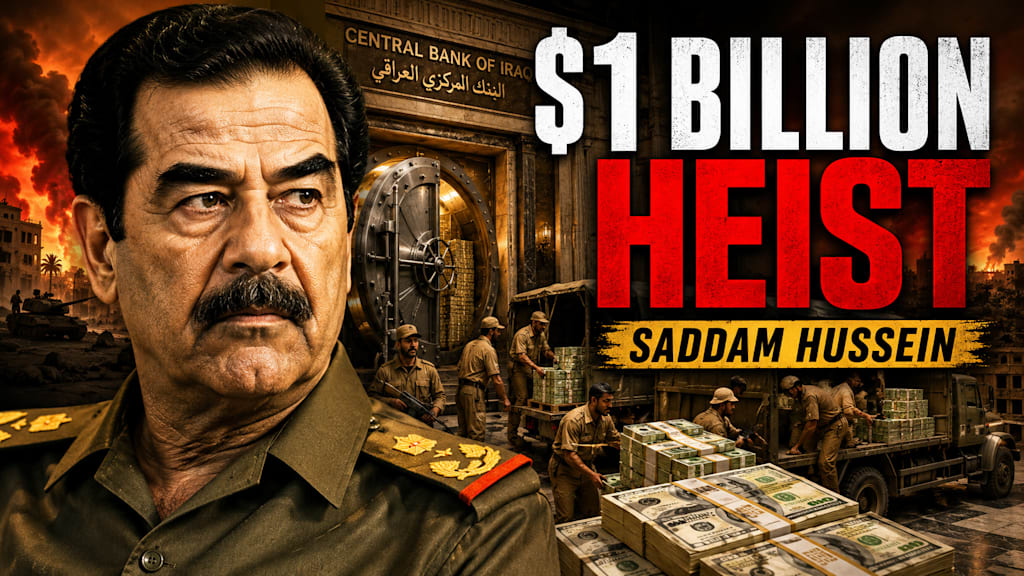
Some of the biggest robberies in history involved guns, masks, tunnels and months of careful planning. But one of the most extraordinary bank heists ever reported was carried out in a completely different way.
There was no dramatic shootout. No secret tunnel. No gang breaking through a vault in the middle of the night.
Instead, the story began with a handwritten order carrying the authority of Iraqi President Saddam Hussein.
In March 2003, just as the United States-led invasion of Iraq was about to begin, an enormous amount of cash was removed from the Central Bank of Iraq in Baghdad. Contemporary reports put the amount at roughly $1 billion, making the incident one of the largest cash removals from a bank ever recorded.
The Central Bank of Iraq Robbery Begins
Iraq was facing an approaching war in March 2003. Saddam Hussein’s government knew that American military action was imminent.
According to accounts from Iraqi bank officials and later investigations, Saddam issued written authorization allowing his younger son, Qusay Hussein, and other officials to collect an enormous amount of foreign currency from Iraq’s central bank.
ABC News later reported that the handwritten document authorized the removal of approximately $920 million in US dollars and €90 million.
What happened next sounded more like a scene from a crime thriller.
Qusay Hussein and others reportedly arrived at the Central Bank of Iraq, and huge quantities of cash were prepared for removal.
Nearly $1 Billion Loaded Onto Trucks
Moving close to a billion dollars in physical cash is not a simple operation.
CNN reported that witnesses saw large trucks outside the Central Bank of Iraq during the early hours before the war. Bank officials said more than $900 million was removed, with the operation requiring trucks to transport the money.
ABC News reported that the cash was transported using three flatbed trucks, with US currency packed into containers holding huge amounts of money.
The extraordinary part was that this was not a conventional armed robbery.
The people removing the money allegedly had authorization from the country's own president.
That is what makes the Saddam Hussein bank heist such an unusual true crime story. The people responsible did not need to secretly defeat the bank’s security system. The order came from the highest level of government.
Why Did Saddam Hussein Remove the Money?
One explanation was that Saddam wanted to protect government funds before Iraq came under military attack.
The Iraq Survey Group later reported that Saddam had ordered around $1 billion to be removed from the Central Bank of Iraq because he feared the money could be destroyed during an allied attack.
But outside Iraq, the incident was widely portrayed as an extraordinary bank robbery because enormous public funds had effectively been taken under Saddam’s personal authority.
The timing made the story even more dramatic.
The money disappeared from the bank just as Iraq was entering one of the most chaotic periods in its modern history.
What Happened to Saddam Hussein’s Missing $1 Billion?
The entire billion dollars did not disappear forever.
After US forces entered Iraq, large amounts of cash were discovered at locations connected to Saddam Hussein’s regime.
The Iraq Survey Group eventually concluded that most of the money had been recovered, but around $130 million remained unaccounted for.
ABC News similarly reported that approximately $132 million remained missing later in 2003.
That missing portion added another mystery to an already extraordinary crime story.
Where exactly did the remaining millions go?
And who ultimately controlled that money?
Even years later, those questions helped keep the Central Bank of Iraq robbery among the most fascinating bank-heist stories in modern history.
Qusay Hussein and the Aftermath
Qusay Hussein was one of Saddam Hussein’s most powerful sons and was viewed as an important figure within the Iraqi regime.
His role in removing the central bank money placed him at the centre of the story.
Only months after the invasion began, Qusay was killed during a battle with US forces in July 2003.
Saddam Hussein himself was captured later that year.
Yet the story of the money had already become part of modern crime history.
A Bank Heist Unlike Any Other
Most famous bank robbers try to hide their identities.
This case was almost the opposite.
A ruler allegedly signed an order, his son went to the country’s central bank, and trucks carried away nearly a billion dollars while a war was about to begin.
That combination of political power, enormous amounts of cash and an incredibly simple handwritten authorization is why the 2003 Central Bank of Iraq robbery remains so unusual.
It proves that the most unbelievable true crime stories do not always require complicated plans.
Sometimes, all it takes is a piece of paper — when the signature on that paper belongs to one of the most powerful men in the country.
About the Creator
parwinder singh
🎬 Movie & Entertainment Writer sharing reviews, ending explanations, story breakdowns, plot twists and hidden details from Bollywood, Hollywood, South Indian cinema, Korean dramas and OTT releases.
Enjoyed the story? Support the Creator.
Subscribe for free to receive all their stories in your feed.
Comments
There are no comments for this story
Be the first to respond and start the conversation.