
Rape Academy, NameHim.io, and the Disturbing Double Standard of Online Accountability
Online Accountability

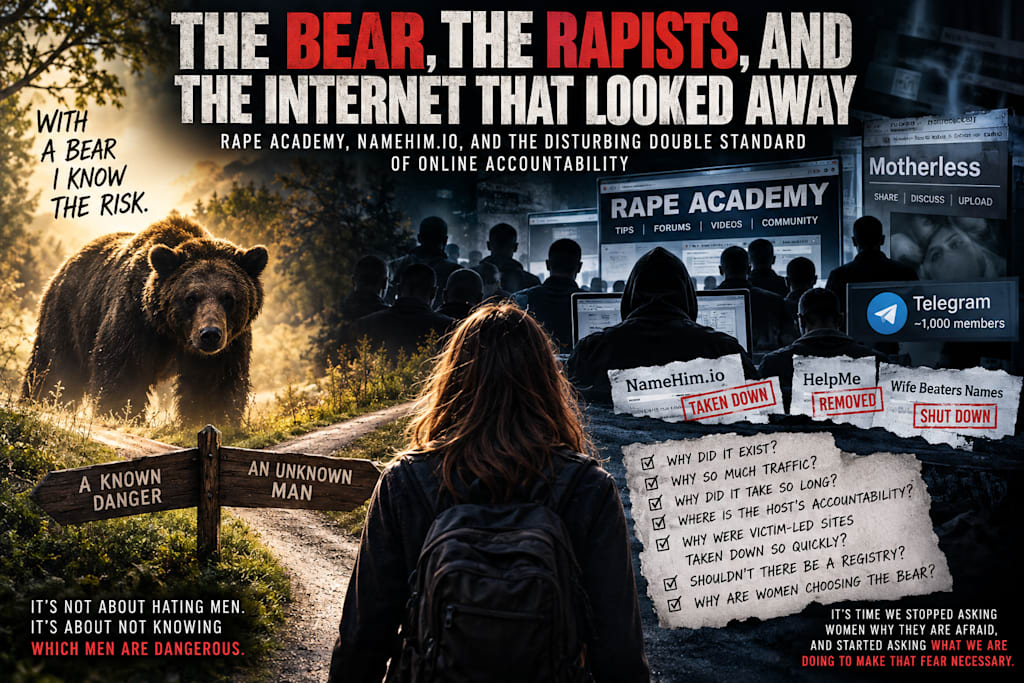
THE BEAR, THE RAPISTS, AND THE INTERNET THAT LOOKED AWAY
Rape Academy, NameHim.io, and the Disturbing Double Standard of Online Accountability
Let's talk about something ugly. Not uncomfortable in the way that an awkward conversation at Thanksgiving is uncomfortable. I'm talking about the kind of ugly that makes you question what the hell is happening to society.
Websites and online communities associated with sexual violence have raised serious questions about how far misogyny can travel when it finds an audience, how platforms respond to abusive material, and why survivors so often struggle to make themselves heard.
And then there are the people who ask why women are choosing the bear.
Seriously?
WHY THE HELL DID A "RAPE ACADEMY" EXIST?
The internet has always had its dark corners, but some corners aren't simply dark. They're places where the suffering of other human beings can become entertainment, a source of validation, or a subject of instruction.
A CNN investigation published in March 2026 examined online networks where men shared disturbing material involving women who appeared unconscious during sexual acts, discussed drug-facilitated sexual assault, and circulated content associated with abusing intimate partners without their knowledge or consent. CNN also reported on a Telegram group with nearly 1,000 members.
Stop and think about that.
This isn't merely a conversation about one person committing a crime behind closed doors. It's about online environments where people can gather, share material, reinforce one another's attitudes, and potentially normalize behavior that violates another person's bodily autonomy.
Why would anyone participate?
There isn't one explanation for every individual. However, several factors can help explain why these communities emerge.
Normalization. When people repeatedly encounter others treating sexual violence as acceptable or amusing, the community can reinforce those attitudes.
Anonymity. A screen can make it easier to avoid social consequences and distance oneself from the person being harmed.
Group validation. People looking for approval can find communities that reward cruelty rather than challenge it.
Access. Searchable tags, private groups, recommendations, and file-sharing systems can make disturbing material easier to locate and distribute.
Profit and engagement. When platforms benefit financially from traffic, subscriptions, or advertising, harmful material can become commercially attractive unless effective safeguards intervene.
None of these factors excuses sexual violence. They help explain why prevention requires more than punishing individual offenders after the damage has been done.
Now, let's clear up one important point.
Viral claims about millions of men visiting a website to learn how to rape have sometimes relied on traffic statistics for an entire adult website rather than verified visits to specific abusive material. Website visits do not establish how many unique people visited, what they viewed, or why they were there.
We should not exaggerate numbers to make this story horrifying.
The documented concerns are horrifying enough without inventing statistics.
WHY DID IT TAKE SO LONG TO SHUT THESE PLATFORMS DOWN?
This is where the discussion moves beyond individual perpetrators and into the responsibility of the companies that make online distribution possible.
CNN's investigation examined Motherless, a pornographic website that hosted large quantities of so-called "sleep" content, including material involving women who appeared unconscious. The investigation brought scrutiny to the website and the infrastructure supporting it. Dutch authorities subsequently took the site offline in May 2026 as prosecutors opened a preliminary investigation. The site later returned.
That sequence raises serious questions.
If a platform can attract substantial traffic while hosting material associated with sexual exploitation, why does effective intervention sometimes come only after journalists expose the problem?
Several structural problems contribute to these delays.
First, many platforms depend on users to report harmful material after it has already been uploaded. That is a reactive system. Survivors may not know the material exists, may be unable to find it, or may fear the consequences of reporting it.
Second, illegal content and deeply disturbing content are not always treated identically under the law. Legal obligations depend on the material, the jurisdiction, and the circumstances.
Third, websites, infrastructure providers, operators, and users may be located in different countries. That can complicate investigations and enforcement.
Fourth, companies may have systems that respond to individual complaints without adequately identifying larger patterns of abuse.
These complications explain why enforcement can be difficult. They do not excuse a failure to respond to credible evidence of harm.
WHERE IS THE HOSTING COMPANY'S ACCOUNTABILITY?
A website operator and its infrastructure provider do not necessarily have identical responsibilities. A hosting company should not automatically be held legally responsible for every piece of material uploaded by a customer.
But neither should the word "infrastructure" become a magic shield against scrutiny.
Companies should be expected to answer some very basic questions:
What complaints or warnings did they receive, and when?
Did they investigate those complaints promptly?
Did they have procedures for identifying repeated patterns of abuse?
Were they responding only to individual URLs, or did they examine the broader problem?
What happened when their safeguards failed?
Accountability should depend on evidence, knowledge, control, and applicable law.
A temporary shutdown is not necessarily a permanent solution. Content can migrate. Accounts can reappear. Similar communities can form elsewhere.
The real measure of accountability is whether the systems that enabled the harm are meaningfully changed.
WHY WERE VICTIM-LED WEBSITES REMOVED SO QUICKLY?
Now we reach one of the most frustrating parts of this conversation.
After the investigation brought renewed attention to online sexual abuse, people created websites intended to let women anonymously identify men they said had abused them. One of those projects was NameHim.io.
According to reporting from Callisto, a nonprofit focused on technology and sexual violence prevention, NameHim.io was taken down after three days when malicious users added the creator, his wife, and his children to the public list.
That is a serious problem. The creator and his family did not deserve to be targeted. Neither do innocent people who happen to share a name with someone accused of a crime.
But that does not mean the need that inspired such a project should be dismissed.
When survivors feel compelled to build their own warning systems, we should be asking why they believe the systems already available to them are not enough.
A crowdsourced list of names can be dangerous without verification, moderation, and procedures for correcting errors. It can expose survivors, invite retaliation, and spread false allegations.
But simply shutting down an unsafe reporting tool does not solve the underlying problem.
Where can someone report a pattern of abuse? How can a survivor preserve evidence? How can someone warn others without putting themselves at risk? What happens when a person fears that reporting an assault will lead to disbelief, retaliation, or public humiliation?
These questions deserve serious answers.
We should distinguish between verified convictions, pending charges, confidential survivor reports, and unverified community allegations. They are not interchangeable, and they should never be presented as though they are.
A properly designed system could preserve reports, protect survivors' identities, identify possible patterns through lawful procedures, and provide appropriate warnings without treating every submission as an established fact.
The answer cannot simply be to silence everyone.
WHAT ABOUT HELPME AND WIFE BEATERS NAMES?
HelpMe, Wife Beaters Names, and NameHim.io belong in the wider discussion about victim-led reporting, online safety, and the risks survivors face when trying to warn one another.
However, we should not assume that all these services were removed under identical circumstances or for the same reasons. Reliable, complete timelines for every named service are not readily established by the reporting discussed here.
NameHim.io's documented history illustrates a genuine challenge: a system designed to help people share safety concerns can also be exploited by people acting maliciously.
The broader issue remains.
Why are survivor-support systems so often improvised, fragile, and vulnerable to abuse, while online environments associated with sexual exploitation can attract significant audiences before effective intervention occurs?
That is a question for technology companies, regulators, lawmakers, and institutions responsible for protecting victims.
It is also a question about priorities.
SHOULD THERE BE A REGISTRY FOR SEXUAL OFFENDERS?
I understand why people want one. When someone commits sexual violence, the public has a legitimate interest in protecting others from further harm.
And the United States already has a sex offender registration system.
The national framework established through the Sex Offender Registration and Notification Act, commonly known as SORNA, sets standards for registration and public notification. State laws determine how those requirements operate in practice.
But there is an important distinction between a registry of people convicted of qualifying offenses and a public database of everyone accused of sexual misconduct.
A conviction-based registry has a legal finding behind it. A database of allegations requires different safeguards because an allegation is not automatically proof of a crime.
That distinction should not be used to dismiss survivors. It should guide the design of better systems.
What should we demand?
A stronger, more accessible conviction-based registry. Records should be accurate, searchable, and clear about convictions, appeals, and other legal outcomes.
A secure system for reporting abuse. Survivors should have ways to document incidents, preserve evidence, and report potential patterns without being forced to publish their identities.
Real accountability for platforms. Companies should have meaningful procedures for responding to credible reports of sexual exploitation and should face consequences when they violate their legal obligations.
Better protection for survivors. Legal assistance, confidential reporting, trauma-informed support, and effective processes for removing nonconsensual intimate images should be accessible.
No single registry can prevent every assault. But survivors should not have to build their own fragile systems from scratch every time existing institutions fail them.
We can protect the public while requiring evidence, fair procedures, accurate records, and ways to correct mistakes.
Those safeguards are not the enemy of survivors. They are part of building a system people can trust.
WHY WOMEN ARE CHOOSING THE BEAR
The bear debate was never really about whether bears are harmless.
It was about uncertainty, vulnerability, and trust.
If a woman encounters a bear in the woods, she can recognize a physical threat and take precautions based on its behavior.
But a person who poses a threat can be someone she knows. Someone she loves. Someone who shares her home. Someone with a respected reputation. Someone who has convinced everyone around him that he is a good man.
The CNN investigation brought that particular fear into focus by reporting on accounts of women allegedly being drugged and sexually assaulted by intimate partners, sometimes without realizing what had happened to them.
Consider the implications.
Someone can be violated by a person they trust, and material associated with that abuse can potentially be circulated among strangers.
That strikes at the foundation of personal safety.
When people respond to women's concerns by demanding that every survivor produce perfect evidence immediately, ridiculing their fears, or treating the entire discussion as an attack on men, they miss the point.
Women are not saying every man is a rapist.
They are saying they cannot always know who is dangerous, and the consequences of guessing wrong can be catastrophic.
The bear is a symbol of a much bigger question.
Why should someone have to accept an unreasonable level of risk simply because the threat might come from a person they are expected to trust?
That deserves an honest answer, not ridicule.
THE DOUBLE STANDARD: WHOSE SAFETY BECOMES URGENT?
Here is where the strongest version of this argument lies.
We cannot conclude that every victim-led website was shut down because its users were women, or that every harmful-content platform was deliberately protected. The evidence does not establish that blanket claim.
But we can examine the systems that create these outcomes.
When harmful material circulates online, who has the resources to hire lawyers, contact regulators, preserve evidence, and pressure a company into action?
When survivors want to warn one another, who bears the risk of defamation claims, doxing, retaliation, and public disbelief?
When a platform says it depends on users to report illegal content, what happens to the people who never discover that intimate images of them are online?
When a company removes a page or shuts down a service, is that the end of its responsibility, or should it have to demonstrate that its systems have changed?
These are questions of institutional accountability. They should be answered with evidence, transparent procedures, and enforceable standards.
The United Kingdom's communications regulator, Ofcom, has investigated platforms over their duties to assess and mitigate risks involving illegal intimate imagery and child sexual abuse material. It has also taken enforcement action against providers for breaches of online safety requirements.
Stronger accountability mechanisms are possible. The debate is about what obligations should apply, how they should be enforced, and how to ensure that survivors are not left carrying the burden.
A society cannot meaningfully claim to take sexual violence seriously if its response begins only after the harm has become impossible to ignore.
And a company cannot establish that it has done enough merely by pointing to a report button if its safeguards repeatedly fail to prevent foreseeable abuse.
THE BOTTOM LINE
Survivors deserve to be heard, protected, and supported. They should not have to wage a separate battle against every platform, institution, and person who dismisses them.
At the same time, public systems must distinguish allegations from proven crimes, protect innocent people from malicious accusations, and provide fair ways to correct errors.
The goal should not be to replace one unchecked system with another.
It should be to create a system in which reporting abuse is accessible, credible evidence is preserved, repeat offenders can be identified through lawful processes, and platforms face meaningful consequences when they fail their obligations.
And perhaps the most unsettling question of all is this:
How many women have to discover that their own violation has become somebody else's entertainment before preventing that harm becomes a priority, rather than a response to the next scandal?
That is the question worth keeping on the table.
Not because every allegation is automatically proven. Not because every man is dangerous. But because nobody should have to wonder whether the person who hurt them is being celebrated somewhere online while they struggle to be heard.
And nobody should have to choose between remaining silent and risking everything just to warn someone else.
It's time we stopped asking women why they are afraid.
It's time we started asking what we are doing to make that fear necessary.
About the Creator
Lilithea Adasia
I dig where others look away. 🖤 True crime, paranormal mysteries, uncomfortable truths, and the beautifully broken human experience. I chase the stories others bury and ask the questions others avoid. Come curious. Leave questioning.
Enjoyed the story? Support the Creator.
Subscribe for free to receive all their stories in your feed.
Comments