
Northern Myanmar’s Scam Industry Won’t Die in a Courtroom
The Four Families are gone. The conditions that built them are already installing new routers.
CCTV aired A Record of the Fall of Telecom Fraud in Northern Myanmar. Many viewers felt relief. On screen, bosses who once ruled compounds with absolute authority have shaved heads, wear prison uniforms, and stand in court. Put their faces beside the wanted notices and little changes. Scroll back further and most came from ordinary backgrounds. Some ran small shops. Some drifted through casinos. Some ran errands along the border. Their common trait was location, guns, and connections. They dared to kidnap and defraud. In another place, without armed groups collecting protection money, without cross-border money laundering, without truckloads of young people tricked over, many might be street debt collectors, labor contractors, or small bosses.
It is easy to focus on a few bosses. But telecom fraud in northern Myanmar is a criminal economy. Bosses die. Families fall. Compounds close. The economy remains, so someone fills the gap.
Executions Are Gunshots, Not the End of the Rainy Season
Do executions work? Yes. Compound owners watch the news. Smuggling brokers raise prices. Local armed groups pull back for a while. The Four Families are destroyed. Kokang’s old protection network breaks. Main bosses are arrested, transferred, tried. These moves tell the border: debts are not forever unpaid.
After the gunshots, buildings across the border install new routers. Myawaddy, Cambodia, Dubai. Compounds change signs. Telecom fraud moves like water. Block one opening and it finds the next crack. Where governance is weak, profits high, and protection strong, it flows there.
Deterrence fades. The first execution shocks most. By the tenth, people think they will not be caught. After the hundredth, high profits still make people gamble. The money is too good. Risk becomes cost. If punishment is unlikely, if money chains, tech chains, and personnel chains remain, if armed groups still feed soldiers with compounds, people keep lining up.
Executions end individual criminals. They do not end a criminal ecosystem. The death penalty can remove bosses. It cannot remove demand: victim markets, laundering channels, technical tools, personal data trading. It cannot remove supply: poverty, governance vacuum, armed separatism, cross-border movement.
The Soil: Guns, Compounds, Script Books
In Laukkai, Kokang, a building carries a “Technology Park” sign. Barbed wire sits on the walls. Broken glass sits under the barbed wire. Guards hold walkie-talkies. Electric batons hang at their waists. Inside, the first page of a script book reads: “Hello, I am XX Securities customer service.” On the second floor, iron bunk beds, plastic basins, no passports. Someone wants to leave. Someone blocks the door.
Outside, armed groups set checkpoints. Every vehicle pays. Armed groups use money to feed soldiers. Compounds use soldiers for protection. A loop forms: soldiers feed compounds, compounds feed soldiers.
Start with governance. Myanmar’s central government has weak control over the border. Ethnic armed groups stand everywhere. Law and property rights have no stable expectation. Whoever has guns has territory. Whoever has territory collects taxes, rent, and opens compounds. Compounds are not hidden black workshops. They are a kind of investment promotion.
Next, armed protection. Scam compounds need security, walls, enforcers, routes, electricity, internet. Ordinary criminal gangs cannot handle that. Local armed groups provide violence. Compounds provide cash. Armed groups buy weapons and expand territory.
Then the cross-border chain. Smuggling, kidnapping, human trafficking, SIM card brokers, traffic generation, call scripts, tech maintenance, money laundering. The division of labor is clear. Some defraud. Some transport people. Some launder money. Some write scripts. Some maintain networks. It works like a multinational company. The business is crime.
Then poverty and the high-salary illusion. Legal jobs are few. Young people have no way out. Compounds lure them with high pay, trick them over, confiscate passports, restrict freedom, force labor. Victims become perpetrators. Perpetrators become victims again.
Then geography and history. Border trade, drugs, casinos, smuggling. These have been intertwined for decades. Northern Myanmar is not a blank sheet. It is a place where forces, interests, and routes overlap. Telecom fraud is the latest crop.
This soil is fertile. It feeds parasitic economies.
The Four Families Fall, the Water Flows Elsewhere
The destruction of the Four Families in Kokang is a major victory. Power will not leave a vacuum. One family falls, another force takes over. One compound closes, another opens. One place cracks down, the industry moves.
Crack down in northern Myanmar and it moves to Myawaddy. Crack down in Myanmar and it moves to Cambodia, Laos, Dubai, even Africa. Wherever governance is weak, profits high, and protection strong, it goes.
Taking down the Four Families is necessary. It is not the finish line. The finish line is making protection unprofitable, making the chain visible, and making legal industry more worthwhile than crime.
Stationing Troops: They Can Clear Out, But They Cannot Issue Property Deeds
Many people think: send troops, eliminate it completely, and that solves it.
Legally, Myanmar is a sovereign state. Unilateral troops in northern Myanmar infringe on another country’s sovereignty. They violate international law and non-interference. Diplomacy, regional security, and public opinion would all react.
Realistically, northern Myanmar is not flat ground. It is armed factions, complex terrain, tangled interests. Troops can clear out. They also become occupiers, targets, and get stuck in guerrilla war, diplomatic war, public opinion war. Afghanistan and Iraq are lessons enough.
Functionally, the military can destroy compounds. It cannot issue property deeds, open courts, build schools, or attract investment. Without rule of law, property rights, markets, and education, troops push crime underground or elsewhere. The military can cut. It cannot amend soil.
The viable path is, under respect for Myanmar’s sovereignty, to push China-Myanmar joint law enforcement, border control, cutting cards, networks, and funds, pursuing fugitives and assets, repatriation and trials, and joint regional governance. It is hard. It is slow. It is more realistic than unilateral troops.
A Genius Builds a Legitimate Industry: First Ask Who Gets the Protection Money
Some think: if a genius went to northern Myanmar and built a brand-new legitimate industry, giving locals livelihoods, would that not eradicate telecom fraud?
Legitimate industry needs peace, rule of law, property rights, infrastructure, markets. Without these, agriculture, tourism, logistics, processing, and energy struggle to compete with telecom fraud, casinos, drugs. Telecom fraud is hugely profitable. It does not need long-term trust, brand, or rule of law. It needs information asymmetry, violence, and money channels.
If a genius wants a legal farm, processing plant, or tourist area in northern Myanmar, he needs security, land contracts, loans, market channels. Local armed groups can tax, kidnap, or swallow it at any time. Without institutional protection, the genius gets co-opted or driven out.
What northern Myanmar lacks is a system that lets geniuses survive. Alternative planting, border trade, agricultural processing, vocational education are all directions. They must be tied to ceasefire, governance, anti-corruption, cross-border cooperation. Otherwise, legal industry becomes a new money-laundering shell for the criminal economy.
Eradicating Telecom Fraud Requires Five Layers of Action
First, strike. Joint law enforcement, pursuing fugitives and assets, cutting cards, networks, and funds, repatriation and trials. This stops the bleeding.
Second, break chains. Smuggling, human trafficking, money laundering, technical support, traffic platforms. This cuts blood vessels.
Third, pressure. Targeted sanctions on local armed groups and protectors. Cut their economic sources. This pulls out the umbrella.
Fourth, alternatives. Legal industry, infrastructure, education, employment. This amends the soil.
Fifth, governance. Push Myanmar’s internal reconciliation and border governance. Regional countries participate. This is long-term ecological restoration.
You need all five. Missing one leaves a leak. Strike without alternatives and crime moves. Alternatives without governance and industry gets swallowed. Governance without cooperation and cross-border chains stay open.
A Corner of the Seal Peels Up
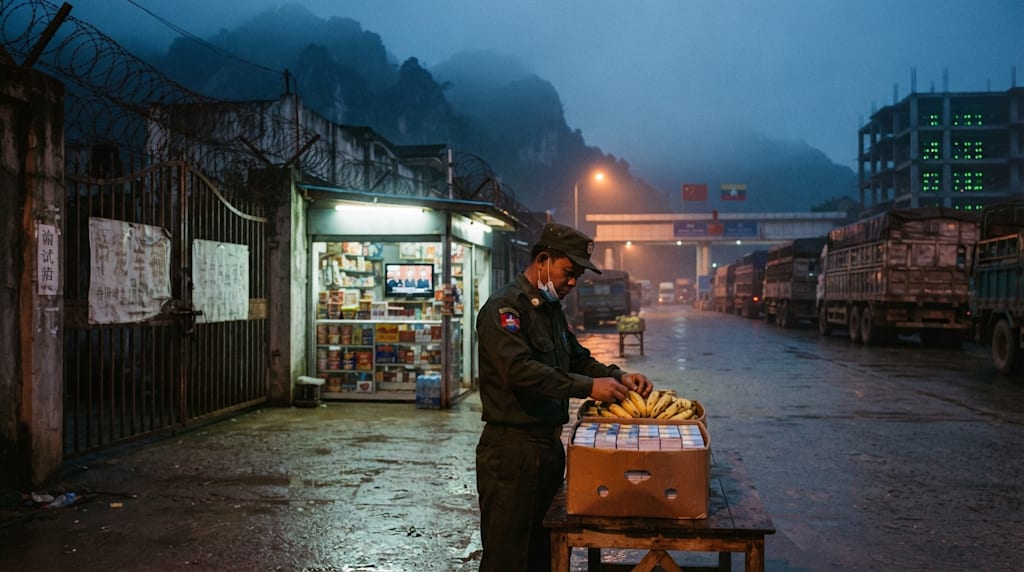
A closed compound in Laukkai. The iron gate is sealed. Rain has wet the seal. A corner peels up. Next door, a small shop is open. It sells instant noodles, Red Bull, cigarettes. A young man in flip-flops buys a pack of cigarettes. He asks the owner: “When does the new compound open?” The owner gives change. He does not look up. “Don’t know.”
The young man leaves. The seal peels up a little more.
Behind him, more trucks come from the border checkpoint. Cargo beds full of bananas. A checkpoint officer opens a box. Underneath are SIM cards. He closes the box. He waves. The truck drives on.
Behind it, more trucks.
About the Creator
Jin
Writer of reamstories
https://reamstories.com/jin
Enjoyed the story? Support the Creator.
Subscribe for free to receive all their stories in your feed. You could also become a paid subscriber, letting them know you appreciate their work.
Comments
There are no comments for this story
Be the first to respond and start the conversation.