
Miss Lil's Tea Time:
She Was Having a Bad Day. A Mother Is Dead.

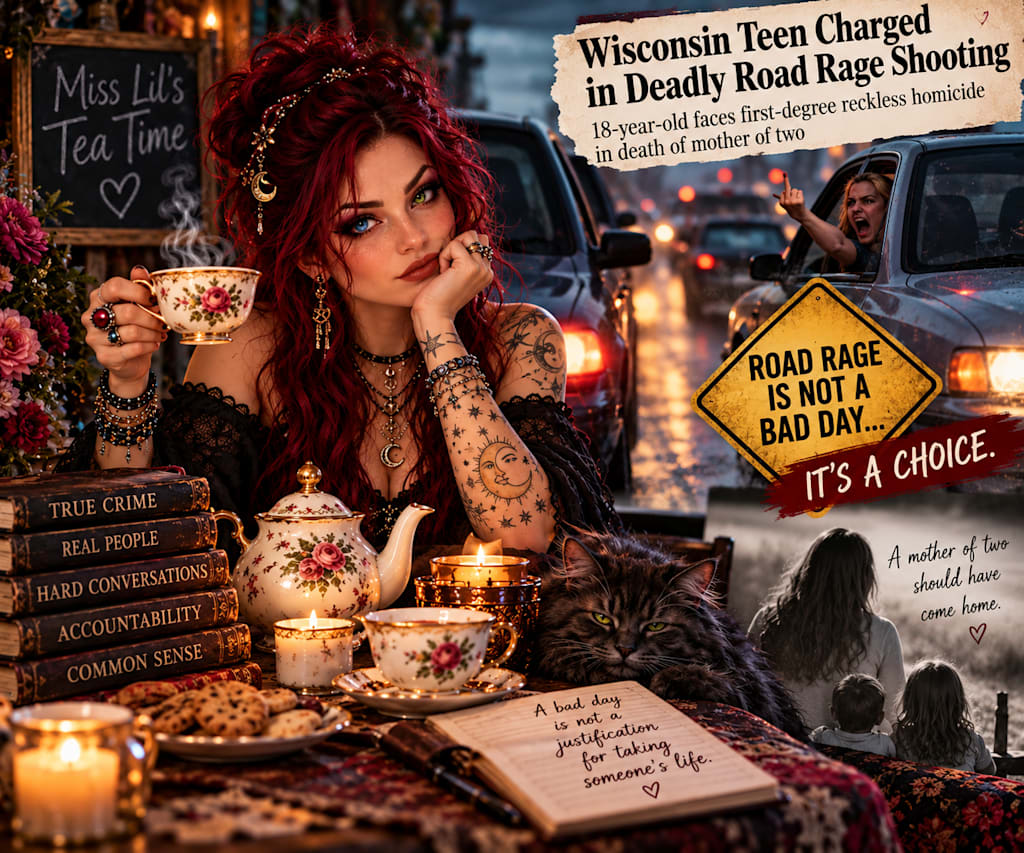
Miss Lil's Tea Time: She Was Having a Bad Day. A Mother Is Dead.
By Miss Lil
Well, my lovely tea drinkers, put the kettle on because I have a story today that has me sitting here staring at my teacup, wondering what on earth is wrong with people.
I could have sworn we just talked about this very thing. You know, the whole idea that being angry, upset, or having a rotten day does not give you permission to hurt somebody else.
Apparently, we need to have that conversation again.
And this time, the story hits a little closer to home because we're talking about Milwaukee, Wisconsin.
According to reports, an 18-year-old woman, Mariah Ruiz, has been charged with first-degree reckless homicide following the fatal shooting of 44-year-old Minerva Hernandez-Lopez, a mother of two. The shooting reportedly happened on August 17, 2026, during a road rage confrontation.
Now, before we go any further, let me make one thing clear. A criminal charge is not a conviction, and the case deserves to be handled through the proper legal process. I'm not here to pretend I sat in the courtroom or witnessed what happened.
I'm here to talk about the story, the reported circumstances, and one particular explanation that really got under my skin.
She was having a bad day.
Puts teacup down.
Are you kidding me?
We've all had a bad day, sweetheart.
I don't know about you, but I've had days when I wanted to crawl back into bed, pull the covers over my head, and inform the entire world that I would not be accepting visitors.
Bills come due. People disappoint us. Family arguments happen. Somebody says something they shouldn't, and suddenly we're carrying around a whole lot of frustration that has absolutely nowhere to go.
And traffic? Don't even get me started on traffic.
There are days when I wonder whether some people received their driver's licenses in a cereal box. Somebody cuts you off, somebody rides your bumper, and somebody else acts like the road belongs exclusively to them.
It's aggravating. It can be frightening, too, especially when another driver starts behaving aggressively.
But do you know what most of us do?
We complain about it. We mutter a few choice words to ourselves. Maybe we tell somebody about the idiot we encountered on the way home.
Then we get on with our lives.
We don't pull out a gun.
We don't decide that another person's life is worth less than our wounded pride.
And we certainly shouldn't be turning a disagreement in traffic into a situation where somebody ends up dead.
Having a bad day is part of being human. What you choose to do because you're having that bad day is another matter entirely.
How did a road rage incident end with somebody dead?
The reported circumstances of this case are disturbing because road rage is something people encounter every day. Most incidents end with angry words, a few rude gestures, and drivers going their separate ways.
According to reports about the criminal complaint, the confrontation involving Ruiz and Hernandez-Lopez escalated after an incident between their vehicles. The two reportedly exchanged words, and the encounter continued rather than ending there.
Investigators allege that Ruiz fired the shots that killed Hernandez-Lopez.
The details of the confrontation matter, and the evidence will need to be considered through the legal process. But whatever the argument was about, it ended in a tragedy that cannot be undone.
And that's what I keep coming back to.
There were so many opportunities for this situation to end differently. One person could have driven away. The other could have let the argument go. Either driver could have decided that whatever had happened on the road simply wasn't worth pursuing.
Instead, a woman lost her life.
I keep wondering how many people have found themselves in a similar situation, gotten angry, and made the decision to walk away. Probably millions. We don't hear about those people because nothing terrible happened. They went home, ate dinner, complained about traffic, and went to bed.
That's how these situations should end.
Not with police tape. Not with a family receiving devastating news. And certainly not with children suddenly facing life without their mother.
Let's talk about the person who isn't coming home.
This is the part of these stories that always gets to me.
The headlines tell us who was charged, what the charges are, and what investigators believe happened. Those details are important. But sometimes I think we get so caught up in the person accused of committing a crime that we forget about the person who died.
Minerva Hernandez-Lopez was 44 years old and a mother of two.
She wasn't just a name in a news report. She had people who loved her. She had a place in her family's everyday life, and there were undoubtedly ordinary things she did that nobody thought twice about until the possibility of doing them again was taken away.
I don't know her family personally, and I'm not going to pretend I know exactly what they're going through. Grief is personal, and no two people experience it in precisely the same way.
But I do know that losing someone suddenly is devastating. And when that loss happens in circumstances like these, the questions can be especially difficult.
Why did it happen? Could it have been prevented? What was going through the other person's mind?
Her children are left with a loss that no court case can reverse.
Even if the legal system reaches a conclusion, even if there is an apology, even if the person responsible eventually expresses genuine remorse, none of that brings their mother back.
That's the reality sitting underneath all the headlines.
A family has to learn to live with an absence they never asked for.
And somewhere in the middle of all this, we're supposed to accept that the confrontation began on a day when somebody was already upset.
I am sorry, but that explanation doesn't make this easier to understand. If anything, it makes me want to ask an even bigger question: when did our bad moods become everybody else's problem to survive?
Being young doesn't make this less serious.
Ruiz was 18 at the time of the alleged shooting. That's young, and I think it's fair to acknowledge that people at that age are still growing, learning, and figuring out how to handle difficult situations.
But being young doesn't make the death of another person any less real.
We can recognize that an 18-year-old has a great deal of life ahead of her while also recognizing that the consequences of an alleged act of violence are enormous.
Those two things can be true at the same time.
I don't believe every person who makes a terrible decision is beyond redemption. I don't believe people should be denied due process because a case makes the public angry. And I certainly don't believe we should decide someone's guilt based on a headline.
But compassion isn't the same thing as making excuses.
If somebody is struggling emotionally, they deserve help. If somebody is overwhelmed by anger, they need to learn how to manage it before that anger causes harm. And if somebody is accused of a serious crime, the allegations must be examined fairly and thoroughly.
What we shouldn't do is turn the phrase "bad day" into some kind of explanation that makes the consequences easier to dismiss.
Plenty of people experience heartbreak, family trouble, financial stress, and personal crises without harming anyone.
They struggle. They cry. They ask for help. Sometimes they make mistakes, apologize, and try again tomorrow.
That is what dealing with difficult emotions is supposed to look like.
When did walking away become so difficult?
Here's something I've never quite understood about road rage.
Why do people feel the need to continue an argument with a complete stranger when they could simply leave?
You don't know that person. You don't know what kind of day they're having, what they're capable of doing, or whether they're carrying a weapon. You don't know whether a few angry words will turn into something much more dangerous.
And frankly, you don't need to know.
If another driver is acting aggressively, create distance. Don't follow them. Don't try to teach them a lesson. Don't get out of your vehicle to prove a point.
Let them think they've won.
Let them believe they're the biggest fool on the road.
You can be right about what happened and still make the wrong decision by pursuing the argument.
Sometimes the smartest thing you can do is let somebody else have the last word.
I know, I know. That can be difficult when somebody has insulted you or treated you unfairly. Nobody likes feeling disrespected.
But your pride will recover from an insult.
You can get over a rude gesture.
You can tell the story later about the absolute lunatic you encountered on the highway.
You cannot undo a fatal decision.
And no argument about traffic is worth finding out the hard way that you should have driven off.
So what are we supposed to take away from this?
I don't have some grand theory about why people behave the way they do, and I'm not going to pretend one article explains every act of violence.
What I do know is that we need to stop confusing an emotion with permission to act on it.
Anger happens. Frustration happens. Life can be unfair, and sometimes people really do treat us terribly.
But there is still a choice in how we respond.
If you feel yourself getting so angry that you might hurt somebody, step away. Put distance between yourself and the situation. Call someone you trust. Get help before an awful moment becomes something you can never take back.
And if you're the person on the receiving end of somebody else's road rage, don't feel obligated to engage. Your safety matters more than winning an argument with a stranger.
These are simple things, but they matter.
Because the person in the next car isn't just an obstacle between you and your destination. They're a human being with people waiting for them, responsibilities to meet, and a life that matters.
Minerva Hernandez-Lopez was a mother who should have been able to go about her day without becoming the victim of a fatal confrontation.
Her children should not have to grow up without her because an encounter on the road turned deadly.
And an 18-year-old now faces a criminal case that could shape the rest of her life.
All of this is a terrible reminder that a few moments of anger can have consequences that last far beyond the argument itself.
Miss Lil's final pour
My lovely tea drinkers, I know I've been a little blunt today. But honestly, how else are we supposed to talk about something like this?
I'm tired of hearing about people dying over arguments that should never have gone this far. I'm tired of seeing families left to pick up the pieces after somebody makes a decision that cannot be undone.
And I'm tired of the idea that being angry somehow explains away the responsibility we all have for our actions.
You can have a bad day. You can be furious with the world. You can even think the person who cut you off is the most obnoxious human being ever to grace the pavement.
But you still have a responsibility to keep your hands to yourself and your weapons out of an argument.
A bad day is temporary.
A death is permanent.
That's the part I wish everybody would remember.
So the next time somebody cuts you off, gives you the finger, or does something that makes your blood boil, take a breath. Let them go. Go home to the people who love you.
Don't let a stranger's actions decide the rest of your life.
And don't become the reason somebody else's family never gets to see their loved one again.
Miss Lil takes another sip of tea and shakes her head.
I wish I could say that's the end of today's unpleasant conversation. Unfortunately, stories like this keep reminding us that it's one we need to have.
Until next time, my lovelies, please take care of yourselves, look out for one another, and remember that being angry doesn't give any of us the right to destroy somebody else's life.
Now, if you'll excuse me, I need to put the kettle back on.
This cup has gone cold.
And somehow, that seems fitting.
What do you think, my lovely tea drinkers? Have we forgotten how to walk away from an argument, or have we simply stopped teaching people that not every insult requires a response? I'd genuinely like to hear your thoughts.
Until next time,
Miss Lil ☕
About the Creator
Lilithea Adasia
I dig where others look away. 🖤 True crime, paranormal mysteries, uncomfortable truths, and the beautifully broken human experience. I chase the stories others bury and ask the questions others avoid. Come curious. Leave questioning.
Enjoyed the story? Support the Creator.
Subscribe for free to receive all their stories in your feed.
Comments