
Juliana Umba Nzita:
A Sixteen-Year-Old Girl, a Closed Case, and the Questions That Refuse to Disappear

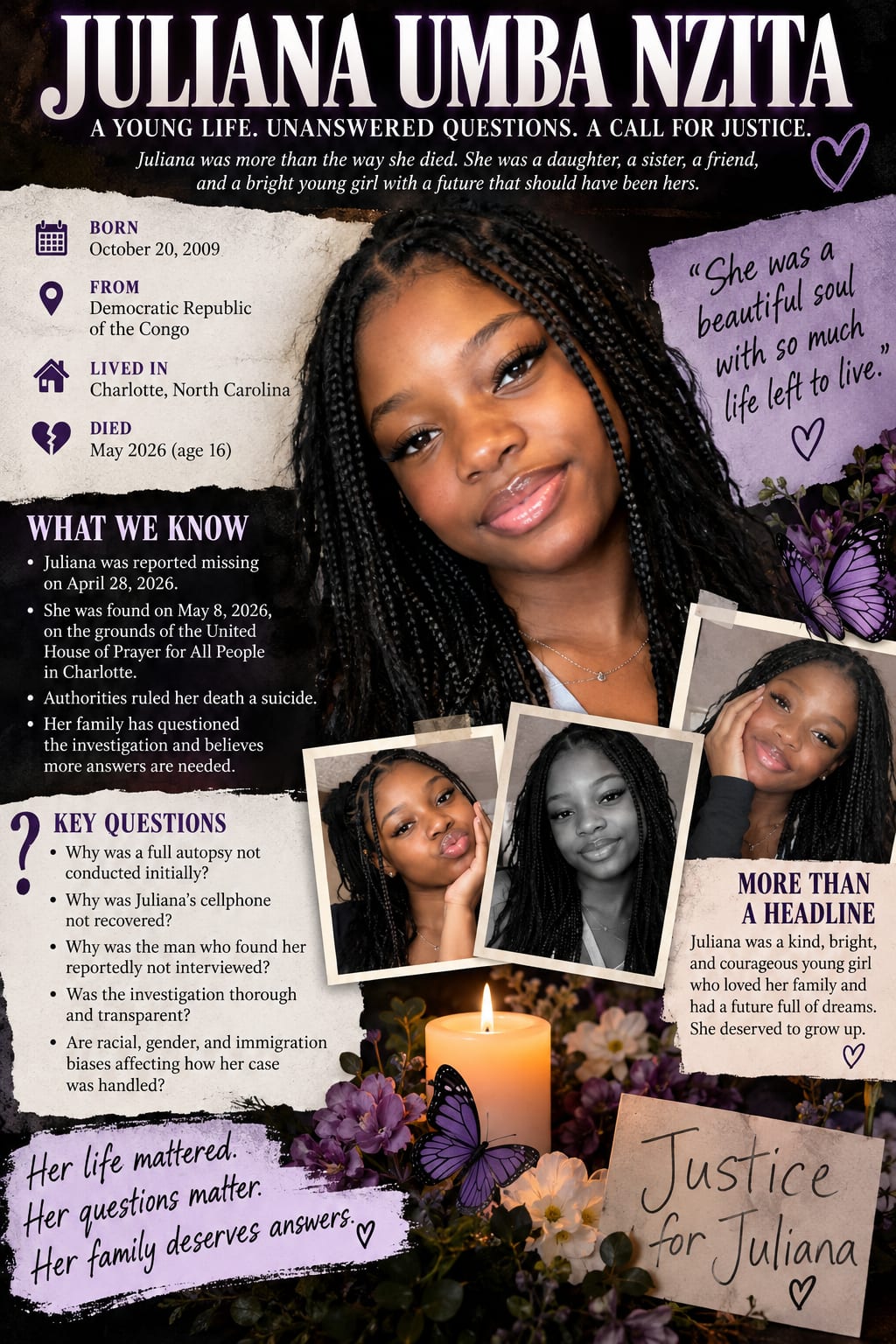
Juliana Umba Nzita: A Sixteen-Year-Old Girl, a Closed Case, and the Questions That Refuse to Disappear
When a child dies under troubling circumstances, the public deserves answers. When a family questions the investigation into that death, they deserve to be heard.
Content warning: This article discusses the death of a minor, suicide, bullying, racial violence, and concerns about law enforcement investigations.
There are stories that break your heart. There are stories that make you angry. And then there are stories that leave you wondering how a family is supposed to find peace when the official answers do not address the questions that matter most.
The death of Juliana Umba Nzita is one of those stories.
Juliana was sixteen years old. Originally from the Democratic Republic of the Congo, she lived in Charlotte, North Carolina. She was someone's child, someone's family member, and a young person whose life should have stretched far beyond the age of sixteen.
Instead, her death became the center of a troubling public debate about investigative standards, institutional accountability, racial history, and the treatment of families who question official conclusions.
Authorities ruled her death a suicide. Her family has questioned that determination, and investigative reporting by The Charlotte Observer brought attention to aspects of the case that deserve public scrutiny.
Let us be clear from the beginning: there is no publicly established proof that Juliana was murdered. It would be irresponsible to declare that she was lynched or that a specific person committed a crime without evidence establishing those claims.
But it is equally irresponsible to treat every question about an official conclusion as an attack on law enforcement.
We can demand evidence without inventing it. We can question an investigation without pretending we already know the answer.
And we can insist that a sixteen-year-old girl's death deserves serious scrutiny without turning her into a symbol at the expense of the person she was.
Because before we discuss the controversy, we need to remember Juliana.
A Young Life That Deserved So Much More
Juliana Umba Nzita was born on October 20, 2009. Her obituary identifies her as a sixteen-year-old from Charlotte who was originally from the Democratic Republic of the Congo. She died in May 2026.
The details publicly shared by her family describe a young girl who experienced serious bullying beginning around the age of twelve. According to her family's memorial fundraiser, those experiences left lasting emotional wounds.
Think about that for a moment.
Twelve years old.
An age when a child should be learning who she is, developing friendships, discovering her interests, and figuring out the world with the reassurance that the adults around her will help keep her safe.
Instead, her family says she endured bullying that affected her deeply.
Bullying is often minimized. It gets dismissed as a normal part of growing up, a rite of passage, or something children simply need to learn to ignore.
Sometimes adults tell children to toughen up, stop being sensitive, or learn to stand up for themselves.
But persistent bullying is not harmless childhood drama.
Humiliation can follow a child home. Exclusion can make school feel unbearable. Cruel messages can continue long after the school day ends.
A child can be surrounded by people and still feel profoundly alone.
We cannot know everything Juliana experienced privately, and we should not pretend to understand her inner life from a distance. Her family's account, however, is a reminder that the emotional suffering of young people must never be brushed aside.
We also must not reduce Juliana's life to that suffering.
She was more than the bullying she reportedly experienced. She was more than the circumstances of her death.
She was a person with a future that should have remained hers to live.
Her family deserved to watch her grow older. They deserved the ordinary milestones that make up a life: birthdays, achievements, changing dreams, and the opportunity to see the child they loved become an adult.
Instead, they were left grieving a daughter who never got that chance.
And then came the questions surrounding her death.
Ten Days Missing. A Death Ruled a Suicide.
Juliana was reported missing on April 28, 2026.
According to reporting by The Charlotte Observer, she was found on May 8 on the grounds of the United House of Prayer for All People in north Charlotte. A man walking his dog discovered her body near a tree.
The circumstances were disturbing.
She was found with a cargo-securing strap around her neck, and a small blue child's chair was nearby. Her feet were reportedly touching the ground.
These details have drawn public attention, but none should be treated as conclusive proof of how she died.
A person's body position alone cannot establish whether a hanging was a suicide or a homicide. That determination requires a careful evaluation of the complete evidence.
What happened next, however, became a central source of concern.
The Mecklenburg County medical examiner ruled Juliana's death a suicide within days. Charlotte-Mecklenburg Police Department subsequently closed its investigation, reportedly four days after the medical examiner's determination.
The newspaper's investigation highlighted several questions about the process.
According to that reporting:
A full autopsy was not conducted during the initial examination.
Juliana's cellphone was not recovered.
The man who discovered her body was reportedly not interviewed by police.
Her family questioned the conclusion and the speed with which the case was closed.
Those are not insignificant concerns.
When a sixteen-year-old is found dead in circumstances that raise questions, the public has a legitimate interest in understanding how investigators reached their conclusions.
What evidence did they examine?
What alternative explanations did they consider?
What steps were taken to rule out foul play?
Were any investigative opportunities missed?
These are ordinary questions of accountability.
They are not proof of murder. They are not proof of a cover-up.
They are questions that deserve clear, evidence-based answers.
The Autopsy Question: Why It Matters
One of the most troubling aspects of the public controversy is the absence of a full autopsy during the initial examination, as described in the reporting.
A medical examiner's external examination and a comprehensive autopsy are not the same thing. The appropriate forensic work depends on the circumstances of a death, the available evidence, and professional judgment.
Authorities have maintained that their examination supported the suicide ruling. Police said they found no evidence of foul play.
Those statements must be included when examining the case fairly.
At the same time, Juliana's family has questioned whether the examination and investigation went far enough.
Why is that question important?
Because determining how someone died is not a popularity contest.
It should not depend on whether the public finds an official explanation emotionally satisfying. It should depend on the quality of the evidence and the reliability of the process used to interpret it.
When a family has serious doubts, explaining the investigative process can help establish whether those doubts are supported by evidence or whether the original conclusion remains justified.
An independent forensic examination can sometimes provide additional information, although it may face limitations depending on the evidence available and the passage of time.
It is not a guarantee that every question will be answered.
According to later reporting, Juliana's family pursued an independent autopsy and DNA testing with assistance from civil rights advocates.
As of the latest publicly available reporting I located for this article, I could not verify a final, publicly released result from that independent review.
That uncertainty should be stated plainly.
We should not manufacture findings that have not been released. We should not claim that forensic evidence proves a crime when no such conclusion has been established publicly.
But neither should the absence of a definitive public answer be used to silence reasonable requests for transparency.
If additional forensic work confirms the original determination, the public should be able to understand the evidence supporting it to the extent the law permits.
If it raises new questions, those questions should be examined.
The purpose of an investigation is not to defend an early conclusion at all costs. It is to establish the truth.
The Missing Phone and the Unanswered Questions
Juliana's cellphone reportedly was never recovered. The man who discovered her body reportedly was not interviewed by police, according to the newspaper's investigation.
Her family also questioned aspects of the handling of her belongings.
Each detail deserves careful examination.
A missing cellphone does not prove foul play. A witness not being interviewed does not automatically establish misconduct.
There may be investigative information that has not been released publicly, and outsiders cannot responsibly assume they know every step investigators took.
But these details raise legitimate questions about investigative completeness.
Was the cellphone searched for?
Were there records or other digital evidence that could help establish Juliana's movements before her death?
Was the person who discovered her body later contacted, and if not, why not?
Were other witnesses identified and interviewed?
How were the physical evidence and scene documented?
These are the kinds of questions that can be answered through records, explanations from investigators, and independent review.
They are also the kinds of questions that become harder to resolve when public communication is limited.
Families who lose loved ones under ordinary circumstances may struggle with grief. Families who lose loved ones in unexplained or disputed circumstances face an additional burden.
They may feel compelled to become investigators themselves.
They must learn unfamiliar terminology, seek legal assistance, request records, challenge decisions, and repeatedly explain why they believe more work is needed.
All of this happens while they are grieving.
Imagine trying to process the death of your child while simultaneously trying to understand whether every reasonable investigative step was taken.
Imagine being told that a case is closed while still struggling to reconcile the official conclusion with what you understand about the circumstances.
Even when authorities believe they have reached the correct conclusion, they should recognize that a family's need for answers does not necessarily end when a case file closes.
A compassionate, transparent explanation is not an admission of wrongdoing. It is part of public accountability.
Why the History of Lynching Matters, Without Replacing the Evidence
Juliana's death has also attracted attention because of the circumstances in which she was found and the painful history those circumstances evoke in the United States.
For generations, Black Americans were subjected to racial terror, including lynchings carried out publicly and sometimes with the participation or approval of local communities.
These acts were not merely individual crimes. They were instruments of racial intimidation, often accompanied by failures of law enforcement and the denial of justice to victims and their families.
That history has not disappeared from the collective memory of Black communities.
Consequently, when a Black person is found hanging from a tree under circumstances that prompt questions, people may experience fear, anger, and suspicion shaped by historical experience.
Those reactions cannot simply be dismissed as irrational.
But historical context must be handled responsibly.
The fact that a death evokes the history of lynching does not establish that the death itself was a lynching.
That conclusion requires evidence specific to the case.
Juliana's death has been officially classified as a suicide, and authorities have said they found no evidence of foul play. Her family disputes the conclusion and has sought further scrutiny.
Public reporting has identified questions about the investigation, but those questions do not independently prove a homicide.
We can acknowledge the history without declaring an unproven motive.
We can recognize why people are alarmed without presenting speculation as fact.
Indeed, taking the history seriously should make us more determined to demand rigorous investigations, careful documentation, and credible evidence.
History teaches us what can happen when authorities fail to protect people or when institutions refuse to confront legitimate concerns.
It does not give us permission to abandon the standards of evidence that distinguish justice from accusation.
Juliana deserves that standard of care.
Do Black Girls Receive the Attention They Deserve?
Juliana's story also raises a larger question: How do race, age, gender, and immigration background affect the way missing people are perceived and their deaths investigated?
Black women and girls have long been the subject of advocacy campaigns highlighting disparities in public attention surrounding missing-person cases.
Advocates argue that some cases receive less sustained media coverage and fewer public resources than others, leaving families to work harder to keep their loved ones' names in the public eye.
The concern is not simply about whether a story makes the evening news.
Public attention can influence whether information reaches potential witnesses, whether a community recognizes a missing person, and whether officials face pressure to communicate clearly about an investigation.
When a missing child belongs to a community that already feels overlooked, limited communication can deepen distrust.
That does not establish that race determined the decisions in Juliana's case. Proving discrimination in a specific investigation requires evidence about the decisions made, the standards applied, and whether comparable cases were handled differently.
But asking whether systems treat families consistently is a legitimate part of public accountability.
Would the same investigative steps have been taken if Juliana had been a different race?
Would the same decisions have been made if the family had greater access to influential people, legal resources, or media attention?
Did investigators apply the same standards that would be expected in any death involving a minor under unusual circumstances?
These are questions worth examining through evidence, not assumptions.
Fairness should not depend on a family's ability to attract national attention.
A grieving family should not need a viral campaign to obtain a meaningful explanation of how authorities reached a conclusion about their child's death.
And a child's worth should never be measured by how many people recognize her name.
When Trust Is Lost, Transparency Matters
The public response to Juliana's death grew after The Charlotte Observer published its investigation in July 2026.
The reporting prompted further discussion among Charlotte officials and community members.
Charlotte Mayor Rob Harrington expressed confidence in the police department's handling of the case. Other local officials sought additional answers.
The Charlotte-Mecklenburg Community Relations Committee also questioned police about the investigation during a meeting in July.
This matters because the controversy did not remain confined to social media.
It became a public question about investigative procedures and institutional trust.
Police departments have difficult responsibilities. Investigators must evaluate evidence, avoid contaminating witness accounts, protect confidential information, and resist public pressure to reach a predetermined conclusion.
They cannot responsibly change an official finding simply because thousands of people disagree with it.
But the public also cannot be expected to accept every official statement without scrutiny.
Trust is not created by demanding unquestioning obedience.
It is earned through competence, consistency, honesty, and a willingness to explain decisions.
When an investigation becomes controversial, a clear account of the evidence and procedures can help distinguish legitimate concerns from rumors.
Where information cannot be released, officials should explain those limitations as clearly as possible.
And when errors occur, acknowledging and correcting them strengthens accountability rather than undermining it.
There is an important difference between criticizing individual investigators and demanding that institutions demonstrate their work.
The latter is a necessary part of a functioning democracy.
The question should never be whether authorities are entitled to scrutiny. They are.
The question is whether that scrutiny is fair, evidence-based, and directed toward finding out what happened.
The Danger of Turning a Child Into a Viral Mystery
As Juliana's name spread online, so did competing claims about her death.
Some people questioned the suicide ruling. Others went further, describing her death as a murder or lynching.
Those stronger allegations must be distinguished from the facts that have been publicly established.
Social media can bring attention to cases that might otherwise be overlooked. It can help families find advocates, journalists, legal assistance, and people willing to demand answers.
But social media can also turn uncertainty into certainty in a matter of hours.
A photograph becomes evidence of a theory. A detail becomes proof of a conclusion. Someone's speculation is repeated so frequently that people forget it was speculation in the first place.
The result can be devastating.
It can spread misinformation, encourage harassment of people who have not been shown to have committed wrongdoing, and make it harder to separate credible information from rumor.
It can also obscure the person at the center of the story.
Juliana was not a puzzle created for strangers to solve. She was a sixteen-year-old girl whose family is grieving.
Her death deserves public attention, but that attention should not require people to sensationalize her final moments or make unsupported accusations.
We should be able to demand a thorough investigation without declaring that we know who is responsible.
We should be able to recognize troubling circumstances without treating every unanswered question as proof of a conspiracy.
And we should be able to discuss the possibility of institutional failure without claiming that every official involved acted with malicious intent.
Truth is not strengthened by exaggeration.
If there is evidence of a crime, that evidence should be examined. If there is evidence of investigative failure, that failure should be addressed. If the official conclusion is correct, the evidence should support it.
The goal is not to win an argument on the internet.
The goal is to establish what happened to Juliana.
What Should Happen Now?
The questions surrounding Juliana's death deserve a response grounded in evidence and accountability.
Several steps would help address the concerns raised publicly.
1. Complete and explain the independent forensic review
The independent forensic review should be allowed to reach a conclusion. Its findings should be communicated accurately, with appropriate recognition of any limitations.
No one should claim that the results establish something they do not.
2. Explain the basis for the official determination
Authorities should explain the basis for their determination as fully as the law permits.
The public deserves a clear understanding of the evidence and procedures that informed the ruling, even if certain investigative details must remain confidential.
3. Evaluate credible new evidence
If additional forensic findings, witness information, or other material evidence emerges, investigators should assess it objectively rather than dismiss it simply because the case was previously closed.
4. Allow appropriate independent scrutiny
An independent review can help determine whether investigative standards were followed and whether any omissions require correction.
5. Treat Juliana's family with dignity
Their questions should receive serious consideration, and their grief should not become an obstacle to obtaining information about their daughter.
None of these steps requires assuming that Juliana was murdered.
They require only the recognition that a death involving a child deserves a reliable investigation and that legitimate concerns should be addressed on their merits.
If the evidence supports the original ruling, a transparent process can help establish that.
If it does not, the investigation must respond accordingly.
Either way, the pursuit of truth should be the priority.
The Question We Should All Be Asking
There is a temptation, when a case becomes controversial, to focus entirely on whether we personally believe the official conclusion.
But belief is not the same as evidence.
I do not need to declare Juliana's death a murder to believe that the questions surrounding the investigation deserve attention.
I do not need to accuse a particular person of wrongdoing to demand that investigators explain how they reached their conclusions.
And I do not need to know the final answer to recognize that a grieving family deserves to be heard.
What I want is something more fundamental than a particular verdict.
I want a process that can withstand scrutiny.
I want investigators to examine evidence thoroughly, consider reasonable alternatives, document their decisions, and explain their conclusions.
I want families to be treated as people who have suffered an unimaginable loss, not as nuisances because they refuse to stop asking questions.
Most importantly, I want the same standards to apply regardless of a victim's race, gender, age, nationality, or social standing.
If we believe that every life has equal value, that belief must mean something when a case is difficult, uncomfortable, or controversial.
It must mean that a sixteen-year-old girl receives the same seriousness and care that we would demand for any child.
It must mean that uncertainty is acknowledged rather than concealed behind false confidence.
And it must mean that the search for truth continues wherever credible questions remain.
Juliana Was More Than the Way She Died
It is easy to let the circumstances of a death swallow the life that came before it.
In Juliana's case, the public discussion has focused heavily on the location where she was found, the medical examiner's ruling, the police investigation, and the possibility of racial violence.
Those issues matter. They deserve serious examination.
But Juliana was not born to become a headline. She was not born to become the subject of a national debate about policing. She was not born to have strangers argue over the final moments of her life.
She was a young girl who should have had the opportunity to grow up.
Her family's account of the bullying she experienced reminds us that the suffering of children can be invisible to people who are not paying attention.
Her death reminds us that families can be left with profound uncertainty when they do not believe they have received adequate answers.
We cannot undo what happened to Juliana.
We cannot give her family back the years they should have had with her.
But we can insist that her life not be reduced to an unresolved controversy.
We can treat her family with compassion. We can reject the spread of unverified claims while refusing to dismiss legitimate questions.
And we can demand that the institutions entrusted with investigating deaths do their work thoroughly, impartially, and transparently.
I do not claim to know what happened to Juliana Umba Nzita. The publicly available evidence does not justify declaring her death a murder.
But I believe that a family's unanswered questions deserve to be taken seriously, especially when the circumstances of a child's death have raised substantial concerns about the investigative process.
That is not a declaration of guilt.
It is a demand for accountability.
Juliana was sixteen.
Her life mattered before her name became a headline. Her family's grief matters now. And the truth about her death matters, whatever that truth ultimately proves to be.
We do not honor Juliana by pretending we know what happened.
We honor her by insisting that the search for the truth be worthy of the life that was lost.
Sources and Further Reading
Juliana's obituary: House of Rosadale
Information about her life and family.Investigative reporting: The Charlotte Observer investigation, republished by ArcaMax
Details concerning the circumstances of Juliana's death and questions about the investigation.Family and community concerns: TheGrio
Reporting on the family's concerns and calls for additional scrutiny.Community oversight: WBTV
Coverage of questions raised about the police investigation.
Editorial note: This article reflects publicly available reporting located as of October 12, 2026. The official ruling, the family's objections, and unproven theories are deliberately distinguished. Verify any subsequent forensic findings or investigative developments before publication.
About the Creator
Lilithea Adasia
I dig where others look away. 🖤 True crime, paranormal mysteries, uncomfortable truths, and the beautifully broken human experience. I chase the stories others bury and ask the questions others avoid. Come curious. Leave questioning.
Enjoyed the story? Support the Creator.
Subscribe for free to receive all their stories in your feed.
Comments