
I Was a Dodo in Europe
Two robberies in four days taught me that the safety I took for granted in China does not exist everywhere.
The sunset in Venice dyed the whole canal rust-red. Chen Mo stood on the steps of the Rialto Bridge and watched his wife crouch down to tie her shoe. Her backpack zipper was open, a clam with its mouth gaping. He had reminded her many times. She always said, “Just a moment.” In that moment, a woman in a striped shirt bumped into her, said “Sorry,” and walked away. By the time they reached the top of the bridge, the wallet was gone. Credit cards, residence permit, two hundred euros in cash, and a birthday card their daughter had drawn, folded in four, tucked into an inner pocket.
“Forget it,” his wife said. Her voice was flat, cloth rinsed too many times. They kept walking as if nothing had happened. It was their fourth day in Europe, and they had already been robbed twice. The first time was at Gare du Nord in Paris. A man shoved past them, ran down the stairs, and disappeared into the crowd. Chen Mo chased him two steps, then stopped. His wife was still standing where she was, holding the cut strap of her backpack, her face blank. He had seen that expression before, in news reports, on the faces of Chinese tourists interviewed after being robbed. A mixture of shock, shame, and “I knew this would happen.”
Dodo. When he saw that metaphor on his phone, he was sitting in a Chinese restaurant in Florence. The owner’s wife brought a plate of fried rice and said in a low voice, “Be careful out there. Another Chinese tour group was robbed yesterday.” He nodded and kept scrolling. A Chinese person who had lived in Milan for ten years wrote: Chinese tourists are like dodos. They don’t know predators exist. They wear their backpacks behind them, stick their phones in their pockets, leave cameras on café tables. He read this and pictured his wife’s open backpack as she tied her shoe, his own hand instinctively patting his pocket in the Paris metro. In China, he never had to do that.
Chengdu last year. Two in the morning, he walked out of his neighborhood to buy cigarettes. The girl at the convenience store was asleep on the counter, her phone lying face-up on the register, WeChat open. He bought cigarettes, walked to the door, and looked back. The phone was still there. The girl was still asleep. He stood at the door smoking half a cigarette and felt the moment turn strange. Why had he looked back? What was he checking? He was checking that the phone was still there. He was checking that the world was normal. In Chengdu at that hour, normal meant a phone on the counter would not be stolen, a backpack behind you would not be stolen, a wallet in your pocket would not be stolen.
But now he was in Florence. The owner’s wife brought a dish of vinegar and said, “Where are you going tomorrow? Rome? Rome is worse. Around the Spanish Steps, they specifically target Chinese tourists.” She said this calmly, as if reading a menu. She was used to it. She had lived in Italy for fifteen years, been pickpocketed seven times, robbed twice. Her strategy was to stuff cash into her bra, keep a photocopy of her passport under her insole, and carry only an old phone when she went out. She said all this while wiping tables, the rag squeaking across the surface.
Chen Mo returned to the second half of the metaphor. Dodos went extinct because they didn’t know what fear was. Did Chinese people really not know? Or did we know too well, just in the wrong way? In Paris, he saw a Chinese girl on the metro clutching her bag, knuckles white, eyes like a cat backed into a corner. Her fear was real, but she was still robbed. Fear is useless here. Fear cannot stop a hand from entering your pocket, cannot stop a blade from slicing your backpack, cannot stop a man from bumping into you and running down the stairs.
He began to observe. On a bus in Rome, a Roma woman held a magazine, and under the magazine was a hand reaching into a tourist’s pocket. Her hand was steady, like taking a pair of socks from her own drawer. An Italian grandmother next to her saw it and turned her face away. The driver saw it in the rearview mirror and kept driving. No one shouted, no one moved. The woman got off at the next stop and disappeared into the crowd. The whole thing took less than ten seconds, a dance rehearsed a thousand times.
He saw why Europeans compared Chinese people to dodos. They had known predators since childhood. They knew which neighborhoods not to take out a phone in, knew to hold their bags in front of them on the metro, knew to step back when a stranger came close. This knowledge was written in their bones, passed down through generations. Chinese people did not have this knowledge. We had another kind: you can go out at two in the morning, packages can be left at the door, phones can be left on tables. This knowledge was also written in our bones, also passed down. It had been passed down for too short a time, so short that we thought it was eternal.
His wife bought an ice cream at the Spanish Steps in Rome. She stood on the steps, sunlight on her face, and smiled. It was the first time she had smiled since being robbed twice. Chen Mo looked at her. The smile was precious. It was also dangerous. It meant she had relaxed, meant she had forgotten there was no wallet in her pocket, meant she had become a dodo again. He wanted to remind her, but the words caught in his throat. He did not want to make even an ice cream uneasy.
That night, they organized their luggage in the hotel. His wife turned her backpack inside out, checking every pocket. She found the birthday card their daughter had drawn, folded in four, tucked into the innermost hidden pocket. The thief had not taken it. She unfolded it. Three people, hand in hand, sun in the upper left corner like a yellow button. She looked at it for a long time, then folded it again and put it in the new wallet, the one with a zipper, the one that could be worn across the chest.
“Airport tomorrow,” Chen Mo said.
“Mm,” she said.
“It’ll be better once we’re there.”
She did not answer. She fastened the wallet, put it into the innermost pocket of the backpack, and pulled the zipper all the way down. She did these things slowly, as if tying a knot that would never come loose.
A comment under that post came back to him: “If dodos could fly, they wouldn’t have gone extinct.” That was wrong. Dodos could not fly because their wings were too short. Chinese people were not incapable of vigilance. Our vigilance did not work on this soil. Our wings were grown for another sky. Under that sky, backpacks could be worn behind you, phones could be left on tables, you could go out at two in the morning to buy cigarettes. That sky was something we had held up ourselves, held up for decades, held up so tightly that we thought the whole world was like that.
But the world was not.
The next morning, they waited for their train at Roma Termini. A man in a black jacket walked over with a newspaper and asked if they wanted one. Chen Mo shook his head. The man left. A while later, Chen Mo noticed his wife’s backpack zipper was half open again. He reached for it. The wallet was still there. She had put it in the innermost pocket the night before, zipper pulled all the way down. He looked at her. She looked at him. Neither said anything, but her hand came over and held his. Her hand was cold, gripping tight, a wing finally learning to fold.
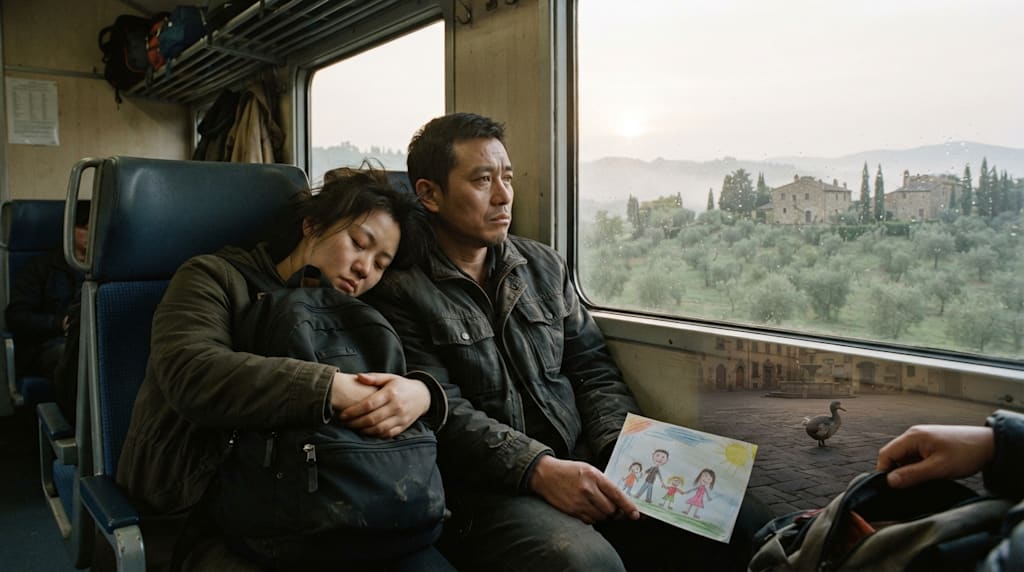
The train came. They got on, found their seats, put the backpack on their laps, zipper against their bodies. Outside the window, Rome receded slowly in the morning light, a postcard being pulled away. The title of that post came back to him: “So many Chinese people have been robbed in Europe lately. Foreigners say Chinese people are like a flock of dodos that don’t know predators exist.” He turned off his phone, leaned back, and closed his eyes. He did not want to think about dodos anymore. He wanted to go home, back under that sky where you did not have to look over your shoulder. There, he could wear his backpack behind him again, leave his phone on the table, go out at two in the morning for cigarettes without looking back.
But he could not go back. He could not return to China and become innocent again. He had seen the predator. Fear had a shape now. It would follow him, a tiny thorn stuck somewhere that would never heal. Next time he bought cigarettes late at night in Chengdu, he would look back. He would check that the phone was still there. He would check that the world was still normal. But he would no longer take that normal for granted. He would know that normal had to be guarded, that it had a cost, that it was a sky many people had paid for.
The train passed through the Tuscan fields. Morning mist flowed between the olive trees. His wife slept against his shoulder, backpack hugged to her chest, zipper against her chin. He glanced at the backpack, then out the window. A cloud covered the sun. The fields darkened. Soon the cloud passed, sunlight poured down again, and the fields brightened.
The card his daughter had drawn came back to him. Sun in the upper left corner, like a yellow button. Three people holding hands, standing on grass. Green grass, blue sky, yellow sun. That was his daughter’s sky. When she drew it, she did not know there was another sky in this world, where the sun was gray, the grass was gray, and people stood in a square, ready to look back at any moment.
He was going to bring that sky home, bring it back whole. That was the only thing he wanted to do now.
About the Creator
Jin
Writer of reamstories
https://reamstories.com/jin
Enjoyed the story? Support the Creator.
Subscribe for free to receive all their stories in your feed. You could also become a paid subscriber, letting them know you appreciate their work.
Comments
There are no comments for this story
Be the first to respond and start the conversation.