
I Spent 31 Years Thinking I Understood the O.J. Simpson Trial. Then I Read the Divorce Settlement.
The story China never told wasn’t about a bloody glove. It was about a Ferrari, a waitress, and a fortune that made procedural justice the only language left.
I first noticed a detail in an interview with Henry Lee.
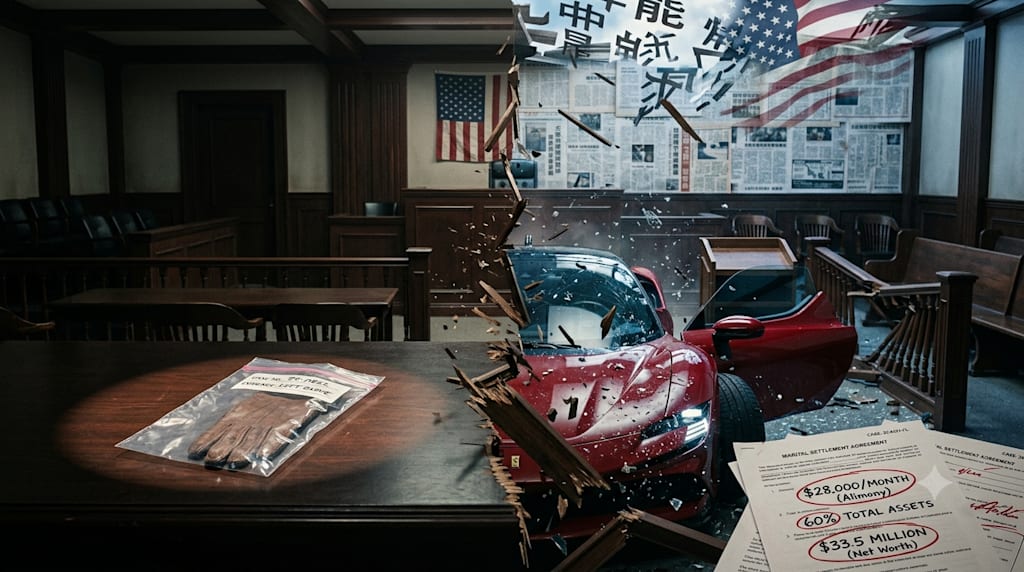
When he talked about the blood evidence at the Simpson crime scene, he didn’t use the phrase “procedural justice.” He said, “That glove. Simpson couldn’t put it on in court.”
That was 1995. The same year, my father stood at the counter of a supply-and-marketing co-op in a county town and argued with the shop assistant over a price difference of three mao. The two events had nothing to do with each other. But the image stayed with me, and later I realized why: for a very long time, my father, my generation, and I never really understood what the O.J. Simpson trial was actually about.
The version we kept hearing always opened the same way: Simpson was the murderer of his wife, but because the police had mishandled evidence collection, he was found not guilty. It was a story about procedural justice.
Once those words—“procedural justice”—appeared, every discussion slid straight into the law school textbook. We argued furiously about whether it was acceptable to let a guilty man walk free, and we skipped the twenty episodes of backstory. The question nobody asked was: Why, from the media to the jury, did Americans never mount the kind of moral siege we expected around the simple fact of “Did Simpson kill her or not?”
That question nagged me for years. Then I read a divorce settlement agreement.
Nicole Brown, Simpson’s ex-wife, was driving a Ferrari at the time of the murder. Her new boyfriend was in his early twenties. And on her employment history, it said: restaurant waitress.
Not “socialite,” not “entrepreneur.” Waitress.
Here, you need a piece of financial knowledge that only an American professional athlete would have. In the locker room, a veteran like John Stockton would tell a rookie who’d just signed a big contract: “Half the money you’re looking at right now isn’t yours.” He wasn’t talking about taxes.
NBA player Trevor Ariza earned $110 million over his career. Two years into retirement, he sat down on a podcast and did the math: when he divorced, 60% of his assets went to his ex-wife, plus $28,000 per month in spousal and child support. The support payments were calculated based on his peak-year salary, not his post-retirement income. His first year out of the league, his income was zero.
The Sports Illustrated statistic was this: 60% of NBA players go bankrupt within five years of retirement. In the NFL, it’s 78%. The two reasons, far ahead of everything else: divorce and bad investments.
Simpson played in the NFL. When he retired, the league didn’t have the kind of big guaranteed contracts it does now.
So rewind to before June 12, 1994. Nicole Brown and O.J. Simpson were already divorced. The property division was still being fought. We’re talking about sums in the tens of millions of dollars. Simpson’s management team was trying to get the support base lowered. Nicole’s lawyers were insisting it stay fixed to his peak earning years. Nicole was driving a Ferrari and seeing a younger man. And Simpson, according to his former agent, “every time someone mentioned that money, within three seconds his knuckles would go white.”
None of this was included in the early case summaries printed in China. It wasn’t deliberate suppression. The editors who translated those articles simply didn’t understand why their American counterparts were spending so many column inches explaining the origin story of a Ferrari. They thought it was tabloid gossip and skipped it.
Then the murders happened. Nicole and her friend Ronald Goldman were killed at Nicole’s home.
The LAPD almost immediately named Simpson the sole suspect. Headlines in major American papers ran with a striking uniformity: not “Suspected Simpson,” but “Simpson Kills Wife.” The tone was that of someone reporting an established fact.
At the time, I stared at those headlines, baffled. Where was the evidence? Where was the trial? Why was even the word “allegedly” missing?
The answer was right there in that property settlement. In the mind of the American media, a professional athlete facing a divorce with a ten-million-dollar bite, and then the ex-wife turns up dead—they felt no need to explain who the killer was. It was like explaining why coal is black. In their society, “athlete-divorce-bankruptcy-murder” was a chain of lived experience that required no argument.
So from day one, this trial had nothing resembling the moral high ground. The prosecution stood on the empirical probability of “athlete kills wife.” The defense stood on the technicality of “the evidence does not hold up.” Neither side raised a moral banner. No one in that courtroom talked about women’s safety. No one talked about the unfairness of divorce law. All the moral debates that would have erupted instantly in a different context were, in this case, quietly bypassed by the American justice system through mutual consent.
They went straight to an evidence war.
That is where Henry Lee came in. He appeared as a forensic expert for the defense, and in court he did one thing: he presented the LAPD’s collection logs and demonstrated that the sampling, storage, and labeling of blood evidence from the scene contained multiple violations. He didn’t say Simpson wasn’t the killer. He said, “This evidence cannot be admitted.”
The prosecution couldn’t refute that.
The jury returned a verdict of not guilty. This was not a “triumph of justice,” nor an “escape of a wicked man.” This was what happened inside a vacuum where neither side held a moral priority, and technical evidence became the only remaining standard of judgment. The prosecution couldn’t produce a clean chain of custody, so they lost.
The core of this case was never “procedural justice defeats factual truth.” The core was this: when the socio-economic reality behind a murder is complicated enough to dissolve a simple “good guy/bad guy” story, the only language left to both sides is technique.
It took me until 2026 to put that whole chain together. Thirty-one years after the murders. Across those three decades, countless Chinese-language legal explainers kept repeating “procedural justice” and missed the one premise that made procedural justice the only option: there were no good people here. Only an ex-husband facing a financial strangulation and a dead woman who had taken him to civil court demanding enormous sums.
One last detail. After Simpson was acquitted in criminal court, a civil court ordered him to pay $33.5 million to the victims’ families. He spent the rest of his life dodging that debt, paroled in 2017, dead in 2024. When he died, he was living in a house in Las Vegas that had no title in his name, registered under a friend’s.
In his obituaries, nobody mentioned “procedural justice” anymore.
About the Creator
Jin
Writer of reamstories
https://reamstories.com/jin
Enjoyed the story? Support the Creator.
Subscribe for free to receive all their stories in your feed. You could also become a paid subscriber, letting them know you appreciate their work.
Comments
There are no comments for this story
Be the first to respond and start the conversation.