
How Many Rappers Have to Die Before the Beef Ends?
The Deadly Price of Rap Rivalries

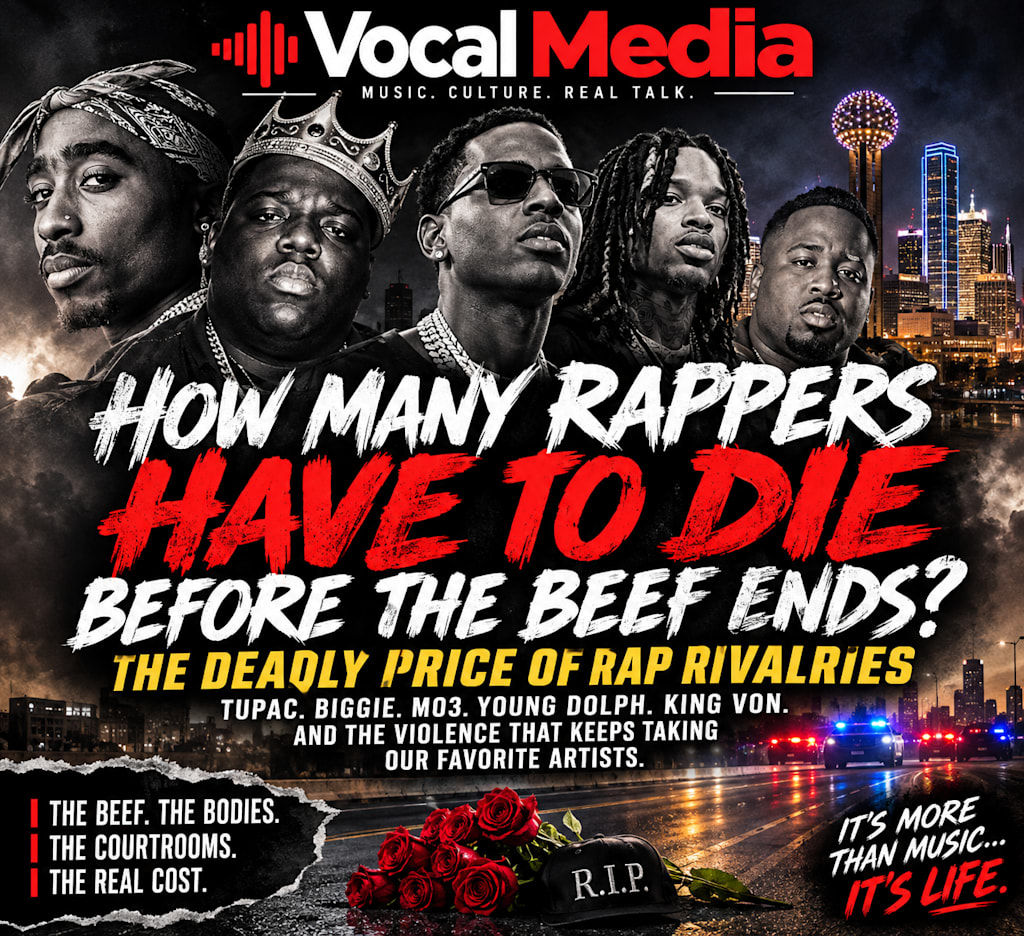
How Many Rappers Have to Die Before the Beef Ends? The Deadly Price of Rap Rivalries
From Tupac and Biggie to FBG Duck, King Von, Young Dolph and MO3, the music industry has watched too many talented artists lose their lives amid rivalries, retaliation and conflicts that should never have ended in murder.
There is something deeply disturbing about watching a young man work his way into the music industry, build a following, make money, establish a name for himself and finally reach a place where his talent is paying off, only to have his life cut short because of a conflict he couldn't seem to walk away from.
And I'm not talking about somebody dying from an illness or losing their life in an unfortunate accident. I'm talking about the growing history of rappers whose deaths have been connected to personal disputes, neighborhood rivalries, gang conflicts and, in some cases, other people allegedly arranging their murders.
At what point does the beef become more important than being alive?
How many careers have to end before somebody realizes that a diss track isn't worth a funeral? How many mothers have to identify their sons? How many children have to grow up watching old music videos because the fathers they hear singing and rapping in those videos will never walk through their front doors again?
We've watched this happen in Chicago, Dallas, Memphis, Los Angeles and other cities. Some of these cases resulted in convictions. Others remain unresolved. Some involved actual disagreements between artists, while others involved much larger conflicts that extended beyond the recording studio.
And that's an important distinction. Not every rapper who gets murdered is a victim of rap beef. Robbery, personal disputes and other criminal activity have also taken lives in the hip-hop community.
But when we look at the cases where rivalries, retaliation and music-related conflicts have played a documented role, one question keeps coming back:
How many more rappers have to die before walking away becomes more important than winning an argument?
Tupac Shakur: When a rivalry became part of hip-hop history
Date of death: September 13, 1996
Tupac Shakur was only 25 years old when he died after being shot in Las Vegas.
His murder became one of the most infamous cases in hip-hop history, partly because of the growing East Coast-West Coast rivalry involving Death Row Records and Bad Boy Records.
Tupac was associated with Death Row Records, while Christopher Wallace, better known as The Notorious B.I.G. or Biggie Smalls, was one of the biggest artists associated with Bad Boy Records.
The relationship between the two artists had deteriorated. Public accusations, songs, interviews and the increasingly hostile atmosphere surrounding their respective camps helped turn their disagreement into something much larger.
However, the circumstances surrounding Tupac's murder were more specific than simply two rappers exchanging insults.
On September 7, 1996, Tupac was riding in a vehicle with Death Row co-founder Suge Knight in Las Vegas when a confrontation earlier that evening involving members of the South Side Compton Crips escalated into a deadly retaliation.
Tupac died six days later, on September 13.
For nearly three decades, the case remained unresolved.
Then came a major development.
In August 2026, a Nevada jury convicted Duane "Keffe D" Davis of orchestrating Tupac's murder. Prosecutors argued that the killing was retaliation for an earlier physical altercation involving Tupac, Suge Knight and Davis's nephew.
That conviction brought a significant development to a case that had become almost synonymous with the darker side of hip-hop history.
Tupac's death wasn't simply the loss of a rapper. It was the loss of an artist whose influence continued to grow long after he was gone.
And the fact that it took nearly 30 years for a jury to reach a verdict demonstrates just how long the consequences of violence can follow the people left behind.
The Notorious B.I.G.: Another life lost during the East Coast-West Coast era
Date of death: March 9, 1997
Christopher Wallace was 24 years old when he was murdered in Los Angeles.
Biggie's death came approximately six months after Tupac's.
He was leaving a music industry party when another vehicle pulled alongside the SUV in which he was traveling. A gunman opened fire, killing the Brooklyn-born rapper.
Biggie's murder became permanently associated with the East Coast-West Coast rivalry.
But there is an important fact that often gets lost when people discuss this case: Biggie's murder remains unsolved.
There have been decades of speculation, documentaries, books and allegations concerning who was responsible and why. Investigators examined possible connections to the rivalry surrounding Death Row and Bad Boy Records, but no criminal conviction has established that a particular person ordered his murder.
We cannot turn speculation into fact simply because a theory has been repeated for years.
What we can say is that two of hip-hop's most influential artists died within months of each other during an era when disagreements between artists and their entourages had become increasingly dangerous.
The music survived. Their families had to live with the losses.
And the industry was left with two enormous absences.
Lil JoJo: A Chicago rivalry that became part of drill music's history
Date of death: September 4, 2012
Joseph Coleman, known as Lil JoJo, was just 18 years old when he was killed in Chicago.
His name belongs in this conversation because his death occurred against the backdrop of an increasingly public conflict involving Chicago drill artists and neighborhood affiliations.
Lil JoJo had released music criticizing rival groups and artists, including people associated with Chief Keef.
His song "3HunnaK" was part of an online exchange that involved insults directed at rival factions.
The disagreement was not confined to music. Social media posts and videos made the conflict increasingly public.
On September 4, 2012, Coleman was riding on the back of a friend's bicycle in Chicago's Englewood neighborhood when he was shot.
The circumstances surrounding his death prompted investigators to examine possible connections to the ongoing rivalry.
However, the murder has not been conclusively solved in court, and no one should be identified as his killer based on social media accusations or internet speculation.
What makes this case particularly troubling is Coleman's age.
He was 18.
He was still at the beginning of his life, trying to establish himself through music in a city where neighborhood conflicts had become intertwined with the emerging drill scene.
His death illustrates how quickly online hostility and real-world tensions can become connected.
And it raises an uncomfortable question: When did publicly insulting somebody become something that could put an entire group of young people in danger?
Chinx: A dispute that followed him beyond the neighborhood
Date of death: May 17, 2015
Lionel Pickens Jr., professionally known as Chinx, was a Queens rapper associated with the Coke Boys collective and French Montana.
He was 31 years old when he was killed in Queens, New York.
Chinx had been building his career and gaining recognition in the New York hip-hop scene. His music was reaching a wider audience, and he had become a recognizable name among fans of East Coast rap.
His murder was investigated as a targeted shooting.
The case eventually produced arrests and a conviction.
Investigators connected the killing to a dispute involving Quincy Homere and Jamar Hill. Reporting on the case described an argument involving a telephone while the men were incarcerated at Rikers Island.
Homere, who also pursued a rap career under the name Qwality, eventually pleaded guilty to manslaughter.
In August 2024, he was sentenced to 23 years in prison.
Hill was also charged in the case, but the two defendants' legal proceedings should not be treated as identical.
Chinx's murder is not an example of a proven disagreement between two established rap stars over a diss track. It is an example of a personal conflict involving people connected to the music scene that ended with an artist losing his life.
That distinction matters.
The larger point remains: Chinx had a career, a wife and children. His murder left a family to deal with a loss that no prison sentence could reverse.
FBG Duck: When the streets and the music became difficult to separate
Date of death: August 4, 2020
Carlton Weekly, known professionally as FBG Duck, was 26 years old when he was murdered in Chicago.
He was associated with Fly Boy Gang, commonly known as FBG, and became a recognizable artist within the city's drill music scene.
Duck's conflict with rival Chicago factions was widely publicized. His music included references to rival groups and individuals, and prosecutors later presented evidence about the connection between drill music, social media and an ongoing neighborhood conflict.
One of the most important developments in this case came in January 2024.
A federal jury convicted six members or associates of the O-Block faction in connection with Duck's murder.
The Department of Justice explained that prosecutors had established that the defendants participated in a criminal organization involved in violence and that the murder was intended to protect or increase their positions within that organization.
The prosecution connected the killing to the longstanding conflict between rival Chicago factions.
The rivalry also intersected with the music of Duck and other Chicago rappers, including King Von.
Duck was murdered while shopping in Chicago's Gold Coast neighborhood.
Think about that for a moment.
A man could be out shopping, handling an ordinary part of his day, and suddenly become the target of a violent conflict that had been developing around him.
Six people were ultimately convicted in the federal case.
That is six people whose involvement was established through a jury verdict, not simply internet commentary.
But no conviction can return Carlton Weekly to his family.
And his death demonstrates how a conflict that becomes part of an artist's public identity can extend far beyond the music.
King Von: A Chicago rapper killed in Atlanta
Date of death: November 6, 2020
Dayvon Bennett, known professionally as King Von, was 26 years old when he died in Atlanta, Georgia.
Von was associated with Only The Family, commonly known as OTF, and was closely connected to Chicago's O-Block music scene.
His music frequently reflected the violence and conflicts associated with his experiences and environment.
He also had publicly discussed rivalries with other artists.
On November 6, 2020, an altercation between two groups outside the Monaco Hookah Lounge in Atlanta escalated into gunfire.
King Von was among those shot.
The Georgia Bureau of Investigation confirmed his death as part of its investigation into the incident.
Timothy Leeks, who was associated with Quando Rondo, was initially charged in connection with Von's killing. However, prosecutors later dismissed the charge under Georgia's self-defense law.
That outcome is important because we cannot describe Leeks as someone convicted of murdering King Von.
The circumstances also illustrate why we must be careful about labeling every confrontation a straightforward rap-beef murder.
The public rivalry involving Von and Quando Rondo formed part of the surrounding context, but the immediate incident involved a confrontation between groups of people.
King Von's death was another devastating loss for Chicago's hip-hop community, even though it happened hundreds of miles away from the city where he built his reputation.
MO3: A Dallas highway, a murder-for-hire allegation and a six-year wait for justice
Date of death: November 11, 2020
Melvin Noble, better known as MO3, was 28 years old when he was murdered on Interstate 35E in Dallas, Texas.
This is the case that brings the entire conversation back to where it started.
MO3 and fellow Dallas rapper Yella Beezy had a longstanding public conflict.
On November 11, 2020, MO3 was traveling on the interstate when another vehicle approached him. The gunman got out, and MO3 attempted to escape. He was fatally shot.
For years, investigators pursued the case.
Kewon White was eventually convicted of capital murder in September 2026 for carrying out the killing.
But the investigation went beyond identifying the person who pulled the trigger.
Prosecutors alleged that Yella Beezy, whose legal name is Markies Conway, arranged the murder and offered $40,000 to have MO3 killed.
Conway denied the allegations and pleaded not guilty.
During the trial, prosecutors presented financial evidence, witness testimony, cellphone information and other evidence. A witness who had previously implicated Conway also recanted portions of his earlier testimony, creating a significant challenge for the prosecution.
Nevertheless, on November 11, 2026, a Dallas County jury found Yella Beezy guilty of capital murder.
He was sentenced to life in prison without the possibility of parole.
The timing is almost impossible to overlook.
MO3 died on November 11, 2020.
Yella Beezy was convicted on November 11, 2026.
Exactly six years separated those two dates.
MO3's family spent six years waiting for this particular conviction.
And while the case has reached a major legal milestone, another defendant, Devin Brown, remains charged and awaits his own trial.
This is not just a story about two rappers who didn't get along.
It is a story about a life lost, a family left grieving, and a murder-for-hire prosecution that ended with a life sentence.
Young Dolph: Memphis, money, rivalries and a complicated murder case
Date of death: November 17, 2021
Adolph Thornton Jr., professionally known as Young Dolph, was 36 years old when he was murdered in Memphis, Tennessee.
He was the founder of Paper Route Empire and had developed a successful independent music career.
Young Dolph was particularly known for building his own business rather than relying entirely on the traditional record-label system.
His public rivalry with Yo Gotti and the surrounding Memphis music scene frequently attracted attention.
On November 17, 2021, Dolph was murdered outside Makeda's Homemade Butter Cookies in Memphis.
The investigation eventually led to multiple arrests and prosecutions.
In September 2024, Justin Johnson was convicted of first-degree murder and conspiracy to commit first-degree murder. He received a life sentence.
During the trial, co-defendant Cornelius Smith testified about an alleged arrangement involving Hernandez Govan and Anthony Mims, also known as Big Jook, who was Yo Gotti's brother.
Smith's testimony described an alleged payment arrangement connected to the killing.
However, the legal proceedings did not end with that testimony.
In August 2025, a jury found Hernandez Govan not guilty of first-degree murder and conspiracy to commit first-degree murder.
That verdict matters.
Although prosecutors had argued that Govan organized the killing, the jury did not find him guilty.
And while Big Jook was named in testimony, that does not establish that Yo Gotti ordered or participated in Young Dolph's murder.
We have to distinguish allegations, testimony and convictions.
Young Dolph's death was another devastating loss for Memphis.
He was an artist, a father and a businessman who had built something of his own.
His murder left his children without their father and his community without an artist who had become an important figure in its music scene.
Not Every Rapper's Murder Was About Rap Beef
There are other murdered rappers whose names frequently appear in conversations about hip-hop violence.
But being murdered does not automatically mean someone died because of a rap rivalry.
Nipsey Hussle, for example, was murdered on March 31, 2019. His killer, Eric Holder Jr., was convicted in 2022. Evidence at trial described a personal confrontation between the two men, but the case should not be casually classified as a feud between rival recording artists.
XXXTentacion was murdered on June 18, 2018. Three men were convicted in 2023 in connection with a robbery that resulted in his death. That was a robbery case, not an established rap-beef murder.
Takeoff, a member of Migos, was killed on November 1, 2022, in Houston. Police described an argument connected to a dice game. Authorities said Takeoff was not involved in the argument and was an innocent bystander.
These cases deserve to be remembered, but they should not be used to inflate a list of artists supposedly killed over rap beef.
Accuracy matters because these are real people, real families and real criminal cases.
The money, the music and the inability to walk away
Here is the part I struggle with.
Hip-hop has created opportunities for people who might never have imagined making a living through music.
Artists have built record labels, clothing businesses, publishing companies, touring careers and independent brands. Some have become millionaires. Others have created opportunities for people in their neighborhoods.
But success does not automatically remove someone from the environment that shaped them.
An artist can become famous and still find himself surrounded by the same arguments, rivalries and personal conflicts that existed before the money arrived.
And sometimes, the people around that artist have just as much influence over the direction of his life as the music itself.
Social media has also changed the way disagreements play out.
An argument that once might have happened privately can become a public spectacle. A comment becomes a response. A response becomes a song. The song becomes a challenge. Fans take sides, and people who have absolutely nothing to do with the original disagreement begin participating.
There is pressure to respond.
Pressure to defend a reputation.
Pressure not to look weak.
But who benefits when somebody refuses to walk away?
Certainly not the artist who ends up dead.
Certainly not the person who spends decades in prison.
And certainly not the children who have to grow up without a parent.
The music industry makes money from entertainment, not from watching its artists become another entry in a homicide investigation.
And fans should be able to enjoy music without feeling like they have to choose sides in a real-world conflict.
What about the families?
We spend so much time discussing the music, the rivalries, the court proceedings and the people accused of committing these crimes that we sometimes forget about the people who have to live with the consequences.
A mother does not get to replace her son.
A child does not get another opportunity to grow up with their father.
A sibling does not get another phone call.
A family does not get to return to the way things were before the violence.
And even when a conviction happens, the sentence does not undo the loss.
For some families, justice takes years. For others, the case remains unresolved. Some have to sit through trials and hear details about the deaths of people they loved.
There is no record deal that makes that experience easier.
There is no platinum plaque that replaces a person.
And there is no amount of online support that can bring somebody back.
At some point, the beef has to end
I'm not suggesting that artists have to be friends with everybody.
I'm not suggesting that people should pretend they like one another or ignore legitimate disagreements.
People are going to have differences. People are going to fall out. Business partnerships end. Friendships dissolve. Artists compete for audiences, opportunities and recognition.
That's life.
But there is a difference between disliking somebody and deciding that person should no longer be alive.
There is a difference between responding to a song and allowing a personal conflict to consume your entire future.
And there is a difference between protecting your reputation and destroying your life over an argument.
If you've made it out of a difficult environment, why not enjoy the opportunities that come with getting out?
Why not invest the money, build the business, take care of your children, help your family and keep making music?
Why does somebody have to win an argument that neither person will remember ten years from now?
The people who died in these cases will never get the opportunity to answer that question.
Tupac never got to see how much his music would influence future generations. Biggie never got to experience the full extent of his legacy. FBG Duck never got to see where his career might have gone. King Von never got to finish the story he was writing through his music. MO3 never got to see what the next six years might have brought him. Young Dolph never got to continue building the business he worked so hard to establish.
And there are families who would give anything to have those years back.
Maybe that's what needs to become part of the conversation.
Not just who dissed whom. Not just who responded. Not just which neighborhood or city claims an artist.
We need to talk about the lives that are being lost and the futures that are being taken away.
Because at the end of the day, a diss track is still just a song.
A disagreement is still just a disagreement.
And a reputation is not worth spending the rest of your life in prison.
How many rappers have to die before the beef ends?
I don't think that's an unreasonable question.
I think it's one the music industry, the artists, their entourages and their audiences need to start taking seriously.
Because the next young man whose picture appears in a memorial post could have been making music, raising his children, building a business or simply enjoying the life he worked so hard to create.
Instead, we'll be listening to his old songs, watching old interviews and reading another headline about a life cut short.
And I'm tired of seeing that become part of the story of hip-hop.
The music should outlive the beef. The artists should get to live long enough to enjoy the careers they worked so hard to build.
About the Creator
Dakota Denise
Every story I publish is real lived, witnessed, survived, by myself or from others who trusted me to tell the story. Enjoy 😊
Enjoyed the story? Support the Creator.
Subscribe for free to receive all their stories in your feed. You could also become a paid subscriber, letting them know you appreciate their work.
Comments
There are no comments for this story
Be the first to respond and start the conversation.