
His Parents Said He Was Too Young to Understand. A Court Still Made Them Pay.
A 9-year-old cut across traffic and left a motorcyclist with a Level 10 disability. The mediation check was 42,000 yuan. The law says the bill should have been higher.
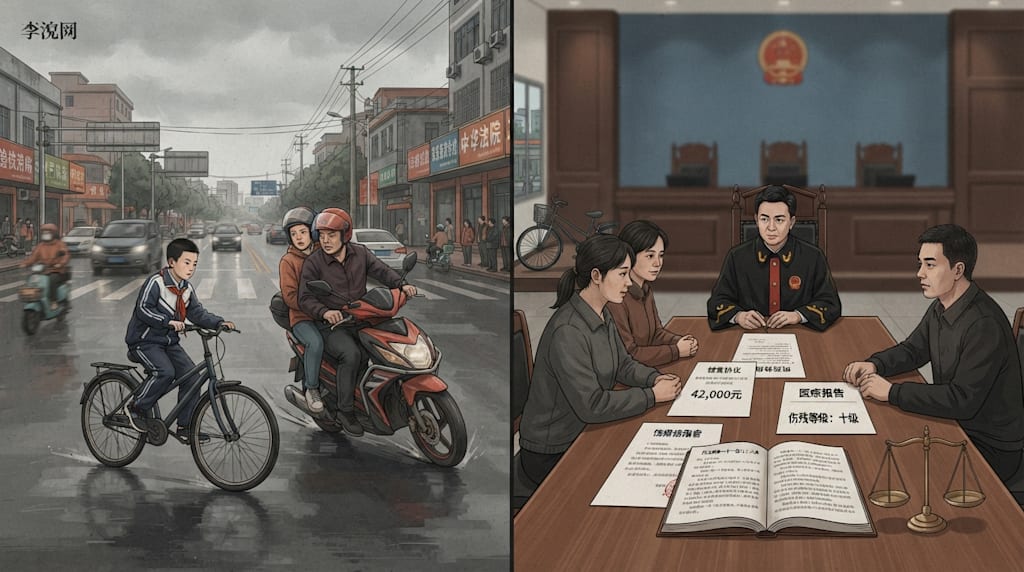
On August 27, 2025, in Liuyang, Hunan, a 9-year-old boy named Liu rode a bicycle along the south auxiliary road of Huapao Avenue. He turned right without warning and crossed the motor vehicle lane. Nie was riding a motorcycle in the same direction with Dai on the back. Nie could not stop in time. Both vehicles crashed. Three people were hurt. Two vehicles were damaged.
Nie went to the hospital. Doctors found multiple injuries. An appraisal later rated him as having a Level 10 disability. His medical bills, follow-up treatment, disability compensation, and other losses topped 100,000 yuan.
Traffic police investigated. Liu had ridden on the wrong side of the roadway. He turned without slowing down or signaling. He was also under 12, the legal age to ride a bicycle on the road. Police said those facts made him mainly responsible. Nie had no driver’s license. His motorcycle had not passed regular safety inspections. He carried a passenger illegally and failed to drive safely. Police gave him secondary responsibility. Dai did nothing wrong.
The liability was clear. The payment fight was not.
Nie tried to negotiate with Liu’s parents. They refused. They gave two reasons. First, their son was young and did not understand. Second, both sides were injured, so they did not need to pay. They rejected the police finding and the compensation claim. Talks stalled.
The case went to Liuyang People’s Court. A judge mediated. The parents eventually changed their position. They agreed to a settlement. The plaintiff also considered the family’s finances and made a concession. Liu’s parents paid 42,000 yuan on the same day. The payment covered medical costs, lost wages, disability compensation, mental distress, and other losses. Both sides agreed that the matter was closed.
The numbers do not match the outcome. A Level 10 disability. Statutory losses of more than 100,000 yuan. A mediated payment of 42,000 yuan. Police found the child mainly responsible. The final check looks like secondary responsibility.
Why?
A young child is not a legal excuse
The parents said their son was too young to understand. That line works in conversation. It does not work in court.
Article 1188 of the Civil Code says: when a person with no or limited civil capacity harms someone, the guardian bears tort liability. If the guardian has fulfilled their duties, the court may reduce that liability.
Liu was 9. He had limited civil capacity. He rode a bicycle on a public road and caused a Level 10 disability. His guardian bears liability. The only question is whether the guardian fulfilled his duties. He did not.
Article 72 of the Road Traffic Safety Law Implementation Regulations says a person must be 12 to ride a bicycle on the road. Liu was 9. His guardian let him ride anyway. That alone is a failure of guardianship. The guardian did not stop him. He allowed a child under 12 to enter a motor vehicle lane. There is no basis to reduce liability.
The parents’ own words prove the opposite point. A child is young. A child cannot judge speed, distance, blind spots, or sudden danger. That is why a child needs supervision. A child does not understand. That is why he should not face traffic alone. Using “he does not understand” as a reason to avoid payment shifts the cost of poor supervision onto the victim.
The victim does not owe the family anything.
The parents also argued that both sides were hurt, so no one should pay. That argument fails. Tort liability follows fault and causation. Nie’s injury does not cancel his right to compensation. Each side’s losses are calculated separately. They are not offset just because both sides were injured. If that were the rule, the person who got hurt would always be right. The person hurt worse would never have to pay. That is not how the law works.
The police split responsibility 70/30
Police found Liu mainly responsible and Nie secondarily responsible. The facts support that split.
Liu did three things wrong. He rode under age 12. He failed to keep to the right side of the roadway. He turned without slowing down or signaling and cut across the motor vehicle lane. Those acts caused the crash.
Nie did three things wrong. He drove without a license. His motorcycle had not been regularly inspected. He carried a passenger illegally and did not drive safely. Those acts contributed to the crash, but they were not the main cause.
In cases between motor vehicles and non-motor vehicles, courts often divide primary and secondary responsibility at 70 percent and 30 percent. Liu’s guardian bears primary responsibility, about 70 percent of the compensation. Nie bears about 30 percent.
The 70 percent figure is not random. It reflects fault and causation. Liu cut across the lane. That was the direct cause of the crash. Nie’s violations increased the risk. They did not cause the crash by themselves.
Once the split is set, the compensation follows statutory items.
The statutory bill was far higher than 42,000 yuan
Nie had a Level 10 disability. He could claim disability compensation, medical expenses, follow-up treatment, lost wages, nursing costs, and mental distress compensation.
Disability compensation is usually the largest item. Hunan’s 2024 per capita disposable income for urban residents was 51,243 yuan. The formula is:
51,243 yuan × 20 years × 10 percent = 102,486 yuan.
Disability compensation alone tops 100,000 yuan.
Medical expenses and follow-up treatment are paid based on official receipts. Nie had multiple injuries. Those costs depend on how severe the injuries were and how long treatment lasted.
Lost wages depend on how long Nie could not work. That includes hospital time and the full rest period after discharge. A medical certificate or appraisal report sets the time. If Nie had fixed income, the court uses the actual lost income. If not, it uses Hunan’s average annual wage for urban private units, 60,537 yuan, or a similar industry standard.
Nursing costs depend on Nie’s need for care. The court uses lost-wage rules or Hunan’s average wage for resident services, repair, and similar industries.
Mental distress compensation in Hunan is usually around 5,000 yuan for a Level 10 disability.
Add those items. Nie’s lawful compensation likely exceeds 150,000 yuan. At 70 percent responsibility, Liu’s guardian should owe more than 100,000 yuan.
The mediated payment was 42,000 yuan. Less than half.
The 42,000 yuan was a concession, not the full liability
Some readers will ask why the court settled for 42,000 yuan if the law points to more than 100,000 yuan. Did the court blur the responsibility?
Mediation is not a judgment. It is a voluntary agreement. Nie accepted 42,000 yuan for two practical reasons. The family had limited money. He wanted payment now.
If Nie had pushed for a judgment, he might have won more. Then he would face enforcement. The family might not be able to pay. He might get less in the end. He chose a smaller amount that could actually be collected.
The parents also had reasons to settle. They paid less than a judgment might have ordered. They avoided more legal costs, interest, and a larger court award. They closed the case in one day.
The 42,000 yuan is a compromise based on litigation risk, enforcement risk, and the family’s finances. It is legally valid. It does not mean the guardian’s lawful liability was only 42,000 yuan. If the court had ruled, the guardian would likely have owed far more.
The low payment reflects the plaintiff’s mercy and the family’s limited means. It does not mean the parents won the legal argument or that the court accepted “he is too young to understand.”
The real failure started before the crash
The more important question is why a 9-year-old was riding on the road alone.
The law sets the age at 12. That age is not a formality. Children under 12 cannot reliably judge road risks, control a bicycle, or react to sudden danger in motor vehicle lanes. The age line exists to prevent crashes.
Liu was 9. His guardian let him ride. He cut across the lane. The crash happened. Nie became disabled.
The parents said the child was young and did not understand. That is exactly why the guardian should have held his hand, watched his bicycle, and kept him off the road. The guardian did none of that. Then he used the child’s age to refuse payment. That logic moves the guardian’s responsibility onto the victim.
The victim had no choice. Nie was driving normally. A child crossed in front of him. He was hurt. His medical bills, lost wages, and disability compensation do not disappear because the person who caused the crash was 9. His disability rating does not become void because the other side says the child is young.
Guardianship is not a private matter. The road is not a playground. A bicycle is not a toy. The age-12 rule is not a suggestion. It is law.
If a child does not learn the rules now, society will teach him later. The lesson will hurt more. If a family does not teach responsibility now, the law will make the family carry it later. That sequence is exactly what happened here.
The check cleared. The rule did not change
The mediation agreement was performed the same day. 42,000 yuan arrived. Both sides agreed the case was closed.
Nie’s Level 10 disability report still exists. Liu’s bicycle may still be leaning against a wall. Traffic on Huapao Avenue keeps moving.
Responsibility was assigned. The account was settled. But the age-12 rule still stands. The rule that guardians bear tort liability still stands.
The 42,000 yuan is the victim’s concession, the mediator’s compromise, and the result of the family’s finances and enforcement risk. It does not change one fact: a 9-year-old rode across a motor vehicle lane and caused a Level 10 disability. Under the law, his guardian should pay. A child being young does not obligate others to suffer the cost, and it does not let a guardian escape liability.
About the Creator
Jin
Writer of reamstories
https://reamstories.com/jin
Enjoyed the story? Support the Creator.
Subscribe for free to receive all their stories in your feed. You could also become a paid subscriber, letting them know you appreciate their work.
Comments
There are no comments for this story
Be the first to respond and start the conversation.