
His Mother’s Will Left Him the House. His Ex-Wife Still Got a Share.
A RMB 4 million inheritance case shows why “to my son” is not the same as “only to my son.”
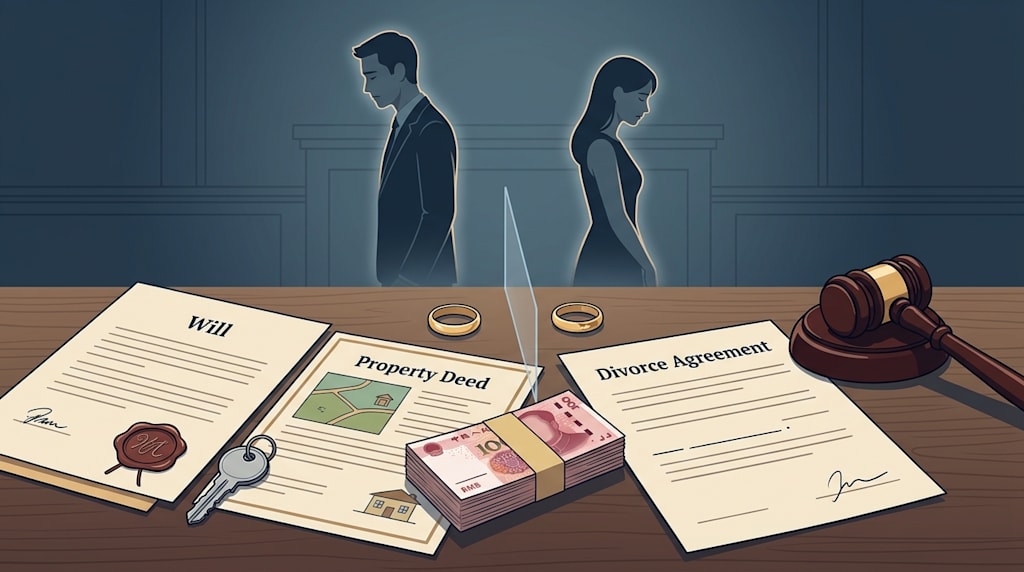
According to public reports, Beijing No. 3 Intermediate People’s Court heard a post-divorce property dispute. Ms. Li and Mr. Zhang divorced. Ms. Li later sued because Mr. Zhang did not pay the agreed RMB 1 million compensation. During that trial, Ms. Li learned that Mr. Zhang’s mother had died while the couple was still married. Mr. Zhang had inherited 62.5% of his mother’s share in a property under her will. The four heirs sold the property together. Mr. Zhang received more than RMB 4 million from the sale. Ms. Li argued that the inheritance happened during the marriage, so the sale proceeds were joint marital property. She sued again for division. The court found that the mother’s holographic will said the property share went to Mr. Zhang, but it did not say the share belonged only to Mr. Zhang personally and was not joint marital property. The court treated the inherited share as joint marital property and supported Ms. Li’s claim.
The legal logic is simple. The case still exposes a common drafting mistake: a will can name the person who receives property without saying that the person receives it free of marital claims. The court did not apply a rule that all inheritance during marriage is shared. It applied Article 1063(3) of the Civil Code and found that the will did not meet that exception. The divorce agreement also could not dispose of property that Ms. Li did not know about and that the agreement did not list.
I. What the case actually decided
Ms. Li did not ask the court to reopen a property division that had already covered everything. She claimed a piece of joint marital property that was not dealt with at divorce and that she did not know about.
The timeline matters. Mr. Zhang’s mother died before the divorce. The inheritance happened during the marriage. Mr. Zhang received the property share under the will. The share later became more than RMB 4 million in sale proceeds. The divorce agreement divided the home the couple bought after marriage and their deposits. It also said Mr. Zhang would pay Ms. Li RMB 1 million. The agreement did not mention the share Mr. Zhang inherited from his mother. Ms. Li learned about the inheritance during another trial. She then sued for division of the sale proceeds.
The dispute has two parts. The first is substantive: does property inherited during marriage belong to the inheriting spouse alone or to both spouses? The second is procedural: after signing a divorce agreement, can a spouse sue for division when the property is discovered later? The court answered both. The will did not exclude the spouse’s share, so the inherited share was joint marital property. Joint marital property not dealt with at divorce can still be divided after divorce.
II. The default rule and the exception
Article 1062 of the Civil Code says property acquired during marriage includes “property inherited or received as a gift.” That property is presumptively joint marital property, unless Article 1063(3) applies. Article 1063(3) says “property determined in a will or gift contract to belong to one party only” is that spouse’s personal property.
The rule is:
Property inherited during marriage is presumptively joint marital property. It becomes personal property only when a will or gift contract determines that it belongs to one party alone.
The operative phrase is “determined to belong to one party only.” The law asks for a clear intent to exclude the other spouse’s shared ownership. Naming an heir does not do that by itself.
The mother’s will said the property share went to Mr. Zhang. It did not say “belongs to Mr. Zhang personally,” “does not constitute joint marital property,” “shall not be treated as joint property between him and his spouse,” or “his spouse has no right to claim a share.” The court read the will’s silence as no exclusion. A court cannot add an intention the deceased did not express. A will can be formally valid and still fail to achieve directed succession.
III. Why “to Mr. Zhang” does not mean “only to Mr. Zhang”
In everyday speech, a mother’s will saying the property goes to her son seems clear. Under marital property rules, it answers only one question: who is the heir? It does not answer the second question: does the heir’s spouse share in the property?
Article 1062(4) puts inherited property into joint marital property by default. A parent who wants to exclude a daughter-in-law or son-in-law must use wording the law recognizes. “To be inherited by so-and-so,” “others shall not compete,” and “others shall not interfere” usually do not exclude shared ownership in court.
Beijing courts have seen many holographic wills that failed this test. The number does not prove that judges are harsh. It shows a gap between how people write wills and what the law requires. Many people focus on who receives the property. They overlook the rights form in which the property is received.
The gap costs more in high-value estates. A will may run a few hundred words, while the property behind it may include real estate, equity, and financial assets worth millions. Imprecise wording can push inherited property into a child’s marriage, and later divorce, debt, or inheritance disputes can follow.
IV. A divorce agreement’s catch-all clause cannot dispose of unknown property
Mr. Zhang could argue that the divorce agreement settled everything: the property, the deposits, and the RMB 1 million compensation. Why did that argument fail?
A divorce agreement can dispose only of property both parties knew about and brought into the negotiation. If one spouse did not disclose property, the other spouse did not know about it, and the agreement did not list it, a catch-all clause such as “the parties have no other disputes” or “property under each party’s name belongs to that party” usually does not waive the unknown property claim. Article 83 of the Supreme People’s Court’s Interpretation (I) on the Marriage and Family Book says that after divorce, a party may sue to divide joint marital property that was not dealt with at divorce. If the property is indeed joint marital property not involved at divorce, the court shall divide it. Article 1092 allows a party to request re-division after divorce if the other party concealed, transferred, sold off, destroyed, or squandered joint marital property, or fabricated joint debts to take the other party’s property.
Mr. Zhang did not disclose the inheritance at divorce. Ms. Li learned about it during another trial. The sale proceeds were joint marital property not involved at divorce. The divorce agreement did not bar her claim. A catch-all clause cannot shield concealed property.
The result would differ if the agreement had listed the inheritance and fixed its ownership, or if Ms. Li had known about it and clearly waived her right. The law gives relief for unknown property. It does not invite people to reopen known deals.
V. The limitation period runs from discovery
Post-divorce property claims have a limitation issue. Under Article 84 of the same interpretation, a claim to re-divide joint marital property under Article 1092 has a three-year limitation period. The period starts the day after the party discovers the matter. For property not dealt with at divorce, courts often treat the date of discovery as the key starting point.
Ms. Li’s discovery during the other trial mattered. The divorce registration date did not start the clock. The inheritance date did not start it either. The discovery date did. The rule helps the spouse who discovers the property, but it also requires action. A long delay after discovery can still support a limitation defense.
VI. Proof and defenses
The parties prove different things.
The spouse claiming joint marital property usually must show that the inheritance happened during the marriage, that the property came from that inheritance, and that the property was not dealt with at divorce. Ms. Li could use the inheritance notarization, sale records, bank statements, the divorce agreement, and the transcript from the other trial.
The spouse claiming personal property must show that the will or gift contract “determined” that the property belonged to one party only. Submitting the will is not enough. The spouse must persuade the court that the will contains a clear intent to exclude the other spouse’s shared ownership. A will that says only “so-and-so shall inherit” is hard to defend on this point.
Other defenses include: the inheritance happened before marriage or after divorce; the will’s wording excluded shared ownership; the money was spent reasonably and not concealed; the divorce agreement listed and disposed of the property; or the claim is time-barred. Each defense needs evidence, not just assertion.
VII. Practical steps for three groups
People making wills. If you want property to go only to your child and stay out of your child’s marriage, do not write only “to my son” or “to my daughter.” Write that the property goes “only to [name] alone, as personal property, not as joint marital property between [name] and his or her spouse, and his or her spouse has no right to claim a share.” Directed succession needs two statements: who receives the property, and who alone receives it. Coordinate the will with marital property agreements, insurance, and trusts so that one document is not undone by marital property rules.
People signing divorce agreements. Do not rely on “no other disputes.” List inherited property, equity returns, options, intellectual property income, insurance cash value, trust beneficiary rights, and other assets that are easy to miss. Fix ownership or reserve rights. If one spouse has received an inheritance during the marriage or expects one, address it in the agreement.
People who discover property after divorce. Preserve evidence: the will, inheritance notarization, property registration, sale contract, bank statements, divorce agreement, and trial transcript. File a post-divorce property dispute promptly. Ask for property preservation when needed. If the other spouse concealed or transferred property, invoke Article 1092 and ask the court to give the concealing spouse a smaller share or no share.
Conclusion
The dramatic part of this case is easy to summarize: the ex-wife received a share of RMB 4 million. The useful part is the rule. A court does not guess at intentions hidden in silence. It reads the text and assigns the risk.
Mr. Zhang’s mother may have wanted the house to go to her son. She did not write that it went only to him. The default rule made the inherited share joint marital property. Mr. Zhang may have thought the divorce agreement ended everything. He did not disclose the inheritance, so the agreement could not dispose of rights Ms. Li did not know she had. The court divided the property because it was not part of the divorce division.
For families with valuable assets, precise wills and divorce agreements matter more than explanations after a lawsuit starts. “To whom” is the first sentence. “Only to whom” is the sentence that controls the outcome. Listing known property is routine. Handling unknown and overlooked property is the real risk control. The law does not protect property more carefully because it is valuable. It protects rights that the documents express with precision.
About the Creator
Jin
Writer of reamstories
https://reamstories.com/jin
Enjoyed the story? Support the Creator.
Subscribe for free to receive all their stories in your feed. You could also become a paid subscriber, letting them know you appreciate their work.
Comments
There are no comments for this story
Be the first to respond and start the conversation.