
He Was Fired a Month After His Stage 4 Cancer Diagnosis. Then the Arbitration Award Arrived.
Li Yu won 110,000 yuan from his former employer. The company appealed. He has about 10 months to live.
September 11, 2026
Li Yu read the arbitration award twice. He did not smile.
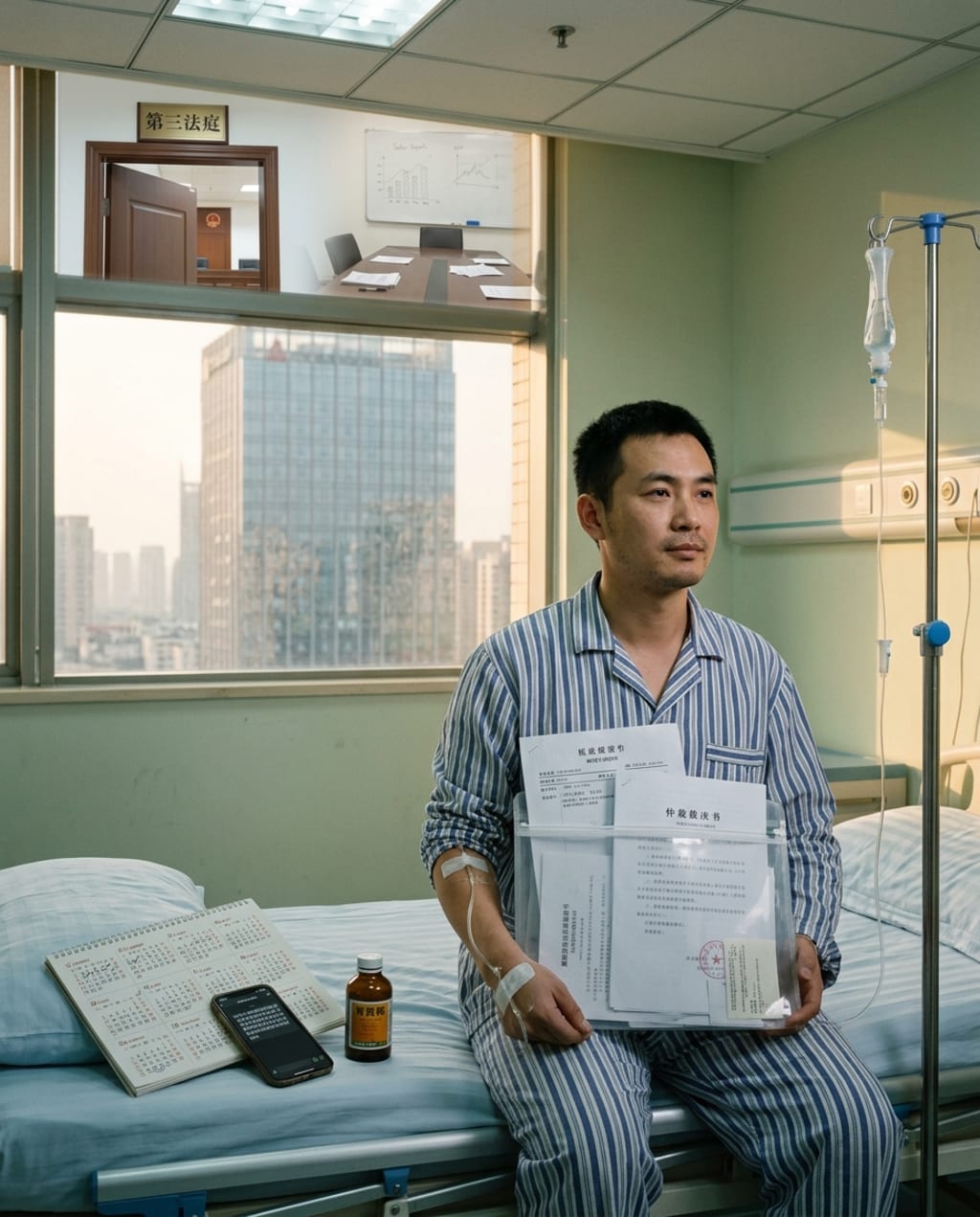
He folded the paper in half and placed it in a clear plastic document bag. The bag already held his gastroscopy report, a chemotherapy appointment slip, and an estimate for second-line treatment. The estimate said 50,000 to 60,000 yuan per treatment. Someone had written "possibly 70,000" in pen next to the number.
The award said Guanyuan Data Co., Ltd. Guangzhou Branch had unlawfully ended his labor contract. The company owed 15,748.81 yuan in compensation and 94,492.86 yuan in medical subsidy. Total: about 110,000 yuan.
He opened WeChat and messaged the company's HR. He asked for a quick resolution.
HR replied that the company had filed a lawsuit. He should contact its lawyer.
Li Yu put the phone face down on the table. He is 33. His doctor told him that with a poor prognosis, he had about 10 months left.
"I don't know when the lawsuit will end," he said. His voice stayed level. "Whether I am still here by then is unknown."
January 2026
Li Yu passed three interviews and left his old job for Guanyuan Data's Guangzhou branch. He became a key account salesperson. His salary rose 20 percent to about 16,000 yuan a month. Probation lasted six months.
He had spent nearly a decade in sales in Guangzhou and Shenzhen. He built a client list from cold calls and factory visits. He had long been the top salesperson at his previous company. At the new job, he finished the onboarding assessment early and signed the 2026 Sales Target Responsibility Statement. The annual contract target was 1.6 million yuan.
The company's score sheet marked him qualified in several core areas. Only "closing deals" remained at zero.
"Deals take time, especially in key account sales," Li Yu said. He opened a screenshot of the company system on his phone. It showed three client opportunities. "The clients expressed interest. We discussed at meetings when deals might close."
May 20, 2026
Persistent bloating sent him for a gastroscopy. He had yearly physicals. His pre-employment exam showed no problems.
The gastroscopy report said: stage 4 stomach cancer.
"My symptoms were mild. Some bloating. No pain," he said. "I did not expect that when they found it, it was already late."
He told his direct supervisor. He asked for leave. The company approved 15 days of sick leave.
June 16, 2026
When the sick leave ended, Li Yu returned to work. He wanted to discuss what came next. He asked to use the medical period guaranteed to enterprise employees under Chinese law. HR and his supervisor said his performance did not meet the standard.
On June 16, the company sent him a Notice of Termination of Labor Contract through WeChat. Less than a month had passed since his diagnosis.
"From January to May, I passed every assessment. They never raised performance with me. They paid my salary and performance pay normally," Li Yu said. "Later they said that paying my salary did not mean I passed. They said I had not met the annual sales target."
The Arbitration
At arbitration, the company's main evidence was an internal performance review. It said Li Yu had closed no deals and scored 5.59, below the 6 required to become a regular employee. The review period ran from January 14, 2026, to July 13, 2026.
The company started the review early. The period had not ended. Nearly a month remained in probation. The company still gave him a failing score and terminated him.
The arbitration award said the company "did not give the applicant a reasonable period for performance correction and ability improvement" and "failed to prove that it had agreed with the applicant on clear hiring conditions, nor could it prove that this assessment went through lawful and complete procedures."
Li Yu's lawyer said labor law requires an employer to prove it clearly told a probationary employee the hiring conditions. It must also show objective, fair assessment procedures and standards. The company had only a performance rating form. It did not have a special assessment standard for probation confirmation.
"Every failing score, negative comment, and assessment conclusion came after my cancer diagnosis and sick leave," Li Yu said. "This is retroactive reasoning and retroactive evidence."
The Company Responds
A reporter called Guanyuan Data Co., Ltd. Guangzhou Branch. The staff member who answered confirmed the company knew Li Yu was seriously ill. The company rejected the arbitration result and had filed a lawsuit.
"We had negotiations before. His output did not meet company standards. That is also the core basis for our arbitration and first-instance proceedings," the staff member said.
The reporter asked if the company knew about the statutory medical period. The staff member said: "Before we knew he was sick, we had already felt he was unsuitable. There may have been a lag in company procedures. In essence, his unsuitability came first."
The reporter asked for earlier records or notices that Li Yu was unsuitable. The staff member said, "It is not convenient to disclose. The relevant materials were already submitted as litigation materials during arbitration."
The arbitration commission found those materials insufficient. It said the company had not proved Li Yu failed the hiring conditions. It found the company at fault for unlawfully ending the labor relationship during the medical period.
On the roughly 110,000 yuan award, the staff member said the company could not afford it. "We are not a big company that focuses on social responsibility. We are a private enterprise. Business is under pressure. He had not become a regular employee. We cannot take care of everyone."
She said the company would pay two or three times his salary as "moral assistance." The arbitration amount was "too high."
The reporter asked whether the company had considered how long litigation would wear down a seriously ill worker. The staff member said, "That is not something the company needs to consider."
Corporate records show Guanyuan Data Co., Ltd. Guangzhou Branch has no registered capital. Its parent, Guanyuan Data Co., Ltd., has more than 28 million yuan in registered capital and has completed 280 million yuan in Series C funding.
The Legal Center
The dispute asks whether the company unlawfully ended the contract when it dismissed Li Yu during probation for not meeting hiring conditions after his stage 4 cancer diagnosis.
Article 42 of China's Labor Contract Law says an employer may not terminate a contract under Articles 40 and 41 if a worker "is sick or injured non-work-related and is within the prescribed medical period."
The medical period is not the treatment cycle. It is a legal protection period against dismissal. Under the former Ministry of Labor's rules, an employee with less than 10 years of service and less than 5 years at the current employer has at least a 3-month medical protection period. For special diseases such as cancer, if the employee does not recover within 24 months, the period can be extended after a labor capacity assessment. A Supreme People's Court Gazette case says workers with special diseases such as cancer and mental illness should receive a 24-month medical period.
Li Yu was diagnosed on May 20 and dismissed on June 16. The gap was less than a month. Even under the shortest 3-month medical period, the dismissal fell inside the protected window.
The legal picture has one more layer. Article 42 bars termination under Articles 40 and 41. The company used Article 39, which allows dismissal during probation if the employee is proven not to meet hiring conditions. The medical period alone does not directly bar an Article 39 dismissal. The case turns on whether the company can prove Li Yu failed the hiring conditions.
Article 21 of the Labor Contract Law says that during probation, an employer may not terminate unless the worker falls under Article 39 or Article 40, paragraphs 1 and 2. If the employer terminates during probation, it must explain the reason.
To dismiss a probationary employee for not meeting hiring conditions, the employer must prove three things. It clearly told the employee the hiring conditions at entry. It has specific data on probation performance. The performance truly fails those conditions.
The company's main evidence was a performance rating form issued later. It was not a special assessment standard for probation confirmation. The company started the assessment before the review period ended, gave a failing score, and terminated him. The arbitration commission found the company "failed to prove that it had agreed with the applicant on clear hiring conditions, nor could it prove that this assessment went through lawful and complete procedures."
Li Yu passed assessments from January to May. He received normal salary and performance pay. The company never interviewed him about performance problems. Every failing score and negative comment came after his cancer diagnosis and sick leave.
How the 110,000 Yuan Breaks Down
The award has two parts.
Unlawful termination compensation: 15,748.81 yuan. Under Article 87 of the Labor Contract Law, unlawful termination requires twice the economic compensation standard. Li Yu worked at the company for about five months, less than six. Economic compensation is half a month's salary. Double that is one month's salary.
Medical subsidy: 94,492.86 yuan. Under Article 6 of the former Ministry of Labor's Measures for Economic Compensation for Violation and Termination of Labor Contracts, an employer must pay a medical subsidy of at least six months' wages when a worker is sick or injured non-work-related and the contract is terminated. For serious illness, the increase must be at least 50 percent of the subsidy. For terminal illness, the increase must be at least 100 percent. The arbitration commission awarded the amount based on six months' wages.
The two amounts serve different legal purposes. One punishes unlawful dismissal. The other compensates treatment losses caused by termination during illness.
One Arbitration, Two Trials
The arbitration award is not final. The company can sue. Under Article 50 of the Law on Labor Dispute Mediation and Arbitration, a party dissatisfied with an award for a labor dispute outside Article 47 may file in a people's court within 15 days of receiving the award. If no lawsuit is filed, the award becomes legally effective.
The "one arbitration, two trials" system was meant to protect litigation rights. In cases involving seriously ill workers, it can become a delay tool.
Li Yu has filed first-instance materials with the Tianhe District People's Court in Guangzhou. "The court has not told us to pay the fee yet. A judgment could come this year if things move fast. It could be next year if they do not," his lawyer said. "The chance that the first instance overturns the award is low."
Li Yu cannot wait that long. "The doctor said I may have about 10 months. Next I need surgery, and I need to see what is happening inside my body," he said. "I also do not know how long the first and second instances will take."
A labor dispute first instance uses a simplified procedure with a 3-month limit, or 6 months under ordinary procedure. The second instance has a 3-month limit. If the company appeals after losing at first instance, the run from first-instance filing to second-instance judgment could take 6 to 9 months in the best case. Extended procedures could push it past a year.
Li Yu has applied for unemployment insurance. The fund pays his medical insurance for a period. He is on first-line chemotherapy. Medical insurance covers about 90 percent. Second-line treatment will bring heavy out-of-pocket costs.
"Second-line treatment can cost 50,000 to 60,000 yuan, or even 70,000, each time. The 110,000 yuan from arbitration is my lifeline," he said. "The company will not provide the medical period. It will not honor the award."
Can Advance Execution Outrun Time?
Civil litigation has an advance execution system. Urgent cases seeking medical expenses can ask for early enforcement before judgment. Under Article 44 of the Law on Labor Dispute Mediation and Arbitration, an arbitration tribunal may, on request, order advance execution for cases seeking labor pay, work injury medical expenses, economic compensation, or damages, and transfer the order to a people's court. A worker who applies for advance execution may not need to provide security.
Li Yu's lawyer could ask the court for advance execution of part or all of the award. That would ease the out-of-pocket pressure of second-line treatment. Advance execution requires clear rights and obligations between the parties and a failure to execute that would seriously affect the applicant's life. The arbitration award already found unlawful dismissal. Li Yu's condition meets the serious-affect standard.
The Document Bag
Li Yu folded the arbitration award. He put it in the clear plastic bag with his medical records. The bag also held a second-line treatment cost estimate: 50,000 to 60,000 yuan per treatment.
His phone lit up with an insurance deduction message. He put the phone face down on the table and looked at the chemotherapy appointment slip.
The court hearing notice had not arrived.
About the Creator
Jin
Writer of reamstories
https://reamstories.com/jin
Enjoyed the story? Support the Creator.
Subscribe for free to receive all their stories in your feed. You could also become a paid subscriber, letting them know you appreciate their work.
Comments
There are no comments for this story
Be the first to respond and start the conversation.