
He Refused a 50-Yuan Wait Fee. Then He Drove Drunk.
A late-night argument became a 2,200-yuan bill because the customer kept choosing the worst next move.
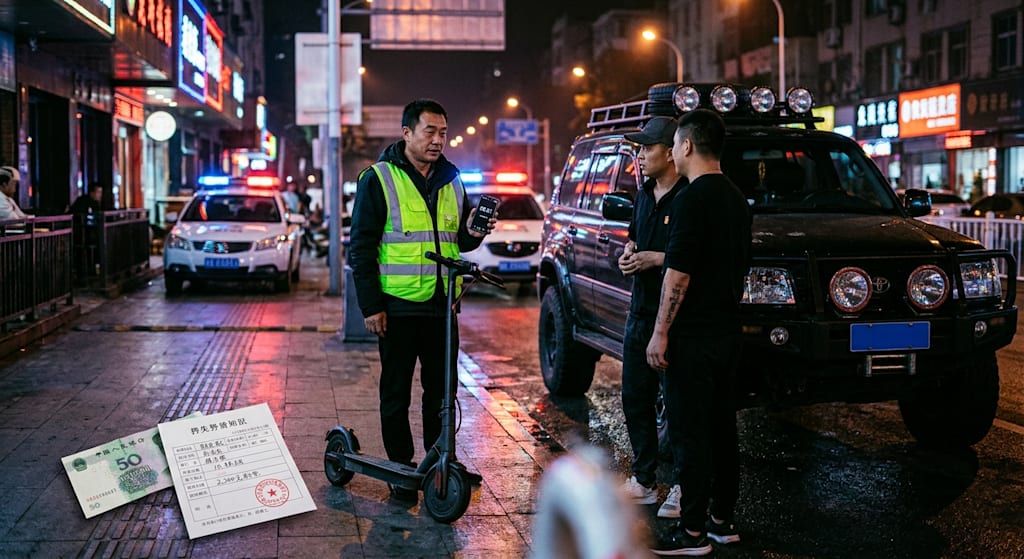
A designated driver arrives. The customer is still drinking and talking with friends. Fifty minutes pass. The car has not moved. The driver asks for a waiting fee. The customer refuses. The customer calls the police first.
That is where the night starts. It is also where it could have ended. A dispute over 50 yuan is a civil-service dispute. Police can mediate. They cannot order one side to pay. The customer could have negotiated, complained to the platform, asked for an itemized bill, or paid under protest and disputed it later. Instead, the argument moved into a series of separate illegal acts, and each one carried its own penalty.
The waiting fee was not invented out of thin air
Major Chinese designated-driver platforms commonly give the driver ten minutes of free waiting time after arrival. After that, waiting is charged by the minute, usually around one yuan per minute, with a cap. Local standards vary, but the logic is public. The driver’s time has a price. A driver who waits fifty minutes is not parked for free. He is losing another order, another hour of sleep, and another stretch of the night on a curb.
So “one yuan a minute” is not automatically a “black driver” rate. The weakness in this case is that the dispute appears to have happened outside a platform order, or at least without a clear digital record of the waiting time and the quoted fee. When the price is agreed orally at the roadside, the customer has more room to refuse, and the driver has more trouble proving the claim. That is an industry problem. Platforms could make waiting time, fee confirmation, and order records more rigid. A transparent timer would prevent many arguments before they start.
An unclear fee does not make the customer’s later conduct lawful. A disagreement over 50 yuan belongs in negotiation, platform complaint, or small-claims court. It does not belong in insults, and it does not belong behind the wheel after drinking.
What the 2,200 yuan was for
The driver reported the car for illegal modification and illegal parking. Police came and issued a 400 yuan penalty. After that, the customer insulted the driver in front of the police. The driver made a second report. After the statement was finished, the customer drove away drunk. The driver noted the residential compound, waited overnight, and called police again. The drinking-and-driving violation was confirmed.
Reports put the total at 2,200 yuan: 400 yuan for the modification and parking violations, and 1,800 yuan for drinking and driving. The license was suspended for six months, and 12 points were recorded. Reports also say the insult complaint was administratively filed.
The legal ranges fit those numbers. Illegal modification can bring a warning or a fine up to 500 yuan and an order to restore the car. Illegal parking can bring a warning or a fine of 20 to 200 yuan. Drinking and driving brings a six-month license suspension and a fine of 1,000 to 2,000 yuan. The exact classification depends on the blood-alcohol reading. A low reading leads to administrative penalties. A high reading can become a criminal case. The reported 1,800 yuan fine and six-month suspension fit the administrative range.
“Revenge reporting” does not erase the violation
The driver’s reports were clearly retaliatory. He was angry. He had waited fifty minutes, been refused payment, and been insulted. He reported the modification and parking violations after the customer refused to pay. He followed the customer’s car after the police statement. The motive was not civic virtue.
That motive matters for judging the driver’s methods. It does not matter for judging whether the car was illegally modified, illegally parked, or driven after drinking. Administrative penalties attach to the act, not to the informant’s mood. If a car has illegal spotlights, the car has illegal spotlights. If a person drives after drinking, the person drives after drinking. A police officer who declined to act because the informant was “too angry” would be applying the law selectively.
Online arguments blur this point. People say the driver was “malicious,” so the penalties were “staged.” But the customer staged the penalties himself. The car had illegal spotlights. It was parked illegally. He insulted the driver in front of police. Then he drove after drinking. The reports were a trigger, not the cause. Remove the violations, and the reports go nowhere.
The overnight stakeout is understandable and still not a model
The driver’s decision to follow the customer to his residential compound and wait overnight is the most uncomfortable part of the story. It produced a result: a drunk driver was caught before he could hurt someone. It also carried risks. A private citizen tracking another person at night can escalate into confrontation. A stakeout can cross into harassment. Evidence collected by an angry individual can be contaminated, disputed, or obtained in ways that create new problems.
The safer route is to call police immediately with the plate number, location, and direction of travel. Let traffic police intercept the car. The driver’s information can be useful. The driver’s physical pursuit is not necessary. Cheering for the result should not turn a risky method into a template.
That distinction matters because similar cases keep producing the same split reaction. In a 2025 Wenzhou case, a designated driver’s dispute over 2.6 yuan led to a report against a KTV, and the KTV was shut down for three months. The driver later said the comments were split between support and blame. People liked that “sticking to the small thing” produced consequences. They also worried that any small argument could be escalated into a life-changing report. Both reactions are understandable. Neither changes what the law says about the underlying violations.
Why some people sympathize with the car owner
The sympathy for the car owner usually comes from fear of the person who will not let go. Most people have parked badly or lost their temper with a service worker. The idea that a stranger might follow them, document them, and report every possible violation feels disproportionate. It makes everyday conflict feel unpredictable.
That fear has a basis, but it is being attached to the wrong person. The car owner was not a passive victim of a fifty-yuan trap. He refused to pay. He insulted the driver. He insulted him again in front of police. He drove after drinking. At every point, he had an exit: pay, negotiate, apologize, call another driver, take a taxi, leave the car. He took none of them.
The dangerous fact is that a man who had been drinking got behind the wheel. That danger was not aimed at the designated driver. It was aimed at pedestrians, other cars, and anyone unlucky enough to be on the road at that hour. Sympathy for the car owner can exist. It cannot erase the steering wheel.
What the night cost
The customer was fined 2,200 yuan. His license was suspended for six months. He lost 12 points. He may face a separate administrative case for the insult. The designated driver lost a night’s sleep and gained a story.
The 50 yuan was never paid. The 2,200 yuan was. The difference came from the customer’s decisions after the argument began. A civil dispute stays civil only if both sides keep it there. One side did not.
Fee disputes belong in negotiation, platform support, or court. Modification, parking, insults, and drinking and driving belong with the traffic police and public security authorities. Mixing the two is expensive. The customer mixed them himself.
About the Creator
Jin
Writer of reamstories
https://reamstories.com/jin
Enjoyed the story? Support the Creator.
Subscribe for free to receive all their stories in your feed. You could also become a paid subscriber, letting them know you appreciate their work.
Comments
There are no comments for this story
Be the first to respond and start the conversation.