
He Knew He Had HIV. He Still Went to That Rented Room Five Times.
A court sentenced him to one year and a 2,000 yuan fine. The law was not punishing the disease. It was punishing the choice.
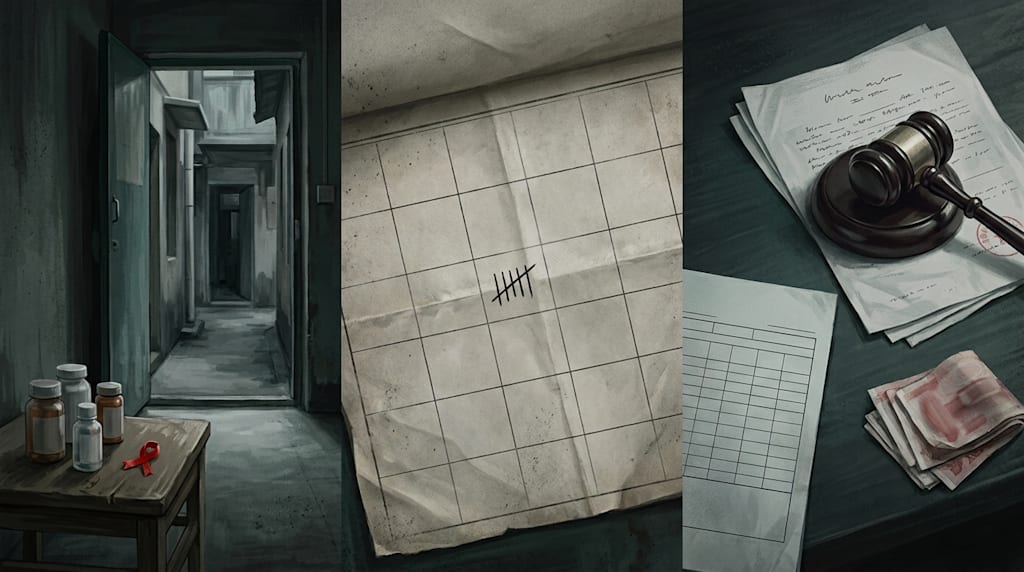
After Diagnosis, He Still Went to That Rented Room
On October 31, 2019, the disease control department diagnosed Lü with HIV/AIDS. After that, he took medication regularly and attended follow-up appointments. His viral load was controlled. His immune indicators were recorded. In the CDC file, he looked like a patient who cooperated with treatment.
From May to August 2025, Lü went to a rented room in a self-built house in Xuzhou District, Yibin City. Hu was there. He paid for sex. Once, twice, three times. Total: 330 yuan. He also went to a rented room in an alley. Sun was there. Twice. Total: 200 yuan.
The report says May to August 2025: four months. In four months, he went to two rented rooms, sought out two women, five times total. He paid 530 yuan.
The police called him to the station. He came and confessed. He did not object to the facts or charges in the indictment. He signed an affidavit pleading guilty and accepting punishment. On August 25, 2025, the Xuzhou District People's Court of Yibin City, Sichuan Province, found Lü guilty of spreading venereal disease at first instance. The court sentenced him to one year in prison and a fine of 2,000 yuan.
The Law Punishes "Knowing" Plus "Soliciting Prostitution"
Article 360 of the Criminal Law is short: "Whoever, knowing that he or she suffers from serious venereal diseases such as syphilis and gonorrhea, engages in prostitution or solicits prostitution shall be sentenced to fixed-term imprisonment of not more than five years, criminal detention, or control, and shall also be fined."
HIV/AIDS is a serious venereal disease. The article does not say another person must be infected. It says two things: knowing, and then engaging in prostitution or soliciting prostitution. When both happen, the crime is complete.
This is a conduct crime. The law moves the trigger for punishment to the dangerous act itself. HIV transmission is irreversible. Waiting until someone is infected would cost too much. So if a person knows he has the disease and still solicits prostitution, the act is already criminal.
Lü was diagnosed in 2019. In 2025, he solicited prostitution. He knew he was infected. He went to the rented rooms. He paid for sex. He engaged in sexual acts. Four times? No. Five times. The elements of spreading venereal disease are all present.
The One-Year Sentence
The statutory penalty for spreading venereal disease is fixed-term imprisonment of not more than five years, criminal detention, or control, and a fine. One year is within that range. The sentence is not five years because of mitigating circumstances.
First, voluntary surrender. The police called Lü to the station. He came and confessed. Under the Criminal Law, voluntary surrender can lead to a lighter or mitigated punishment. Second, he pleaded guilty and accepted punishment. He signed the affidavit, and the law allows leniency. The court considered the whole case, adopted the prosecution's sentencing recommendation, and sentenced him to one year and a fine of 2,000 yuan.
Two other cases show the range.
In Changshun County, Guizhou, a woman knowingly infected with HIV engaged in prostitution about 50 times. The court sentenced her to one year and nine months in prison and a fine of 3,000 yuan. She did not voluntarily surrender. The court found she posed a greater risk to the public.
In Pudong New Area, Shanghai, a man knowingly infected with HIV solicited prostitution. The report did not say how many times. The court sentenced him to seven months in prison, suspended for one year, and a fine of 3,000 yuan.
Lü's case falls between them. It is heavier than the Shanghai case because he solicited prostitution multiple times and did not receive a suspended sentence. It is lighter than the Guizhou case because he voluntarily surrendered and pleaded guilty. The statutory maximum is five years. He received one. That number comes from legal calculation, not from a moral verdict.
If Infection Occurs, the Charge Changes
The judicial interpretation is clear: if a person knows he is infected with HIV, engages in prostitution or solicits prostitution, and thereby infects another person with HIV, he is convicted of intentional injury. If the injury is serious, the sentence is three to ten years in prison.
Between spreading venereal disease and intentional injury is actual infection. Without infection, the charge is spreading venereal disease. With infection, it is intentional injury. The sentence jumps from not more than five years to three to ten years. If the person spreads HIV to an unspecified number of people, the charge may be endangering public safety by dangerous means, which carries a heavier penalty.
The report does not say whether Hu or Sun was infected. So Lü was convicted of spreading venereal disease. That follows the judicial interpretation. It also leaves a public health question. It is not clear whether Hu and Sun were tested or received post-exposure prophylaxis. They were handled in separate cases. That does not mean health intervention was completed.
Rented Rooms, Alleys, Follow-up Records
Lü went to two places: a rented room in a self-built house and a rented room in an alley. Neither appears in the CDC's follow-up records. The CDC records the date of diagnosis, the medication regimen, and the viral load. It cannot record where Lü went, whom he saw, or what he did from May to August 2025.
If a person infected with HIV stays on standard treatment and the viral load remains undetectable, the virus will not spread through sex. This is a scientific fact, abbreviated U=U. But U=U is not a legal exemption. The law still requires infected persons not to knowingly engage in prostitution or solicit prostitution. Science has lowered the risk of transmission. It has not removed the illegality of deliberate conduct.
The underground sex trade makes the risk harder to control. There are no routine health checks, no condom-use monitoring, and no post-exposure intervention. Lü paid 530 yuan in the rented rooms. Hu and Sun were handled in separate cases. These facts became a legal case. Beyond the legal case, there is testing, treatment, prophylaxis, and education. Those do not finish simply because a judgment is issued.
The Numbers on the Judgment
Lü was sentenced to one year in prison and a fine of 2,000 yuan. The prison term is calculated from the date the judgment is executed. The fine must be paid within a specified period. Hu and Sun were handled in separate cases. In the CDC's follow-up records, October 31, 2019, is marked as the date of diagnosis. For May to August 2025, those columns are blank.
He still takes the medication. Follow-up will continue. At the next follow-up, the doctor will ask about viral load, CD4 cell count, and whether he missed any doses. Lü will have to answer. The "one year" and "2,000 yuan" on the judgment will not appear in the follow-up form.
About the Creator
Jin
Writer of reamstories
https://reamstories.com/jin
Enjoyed the story? Support the Creator.
Subscribe for free to receive all their stories in your feed. You could also become a paid subscriber, letting them know you appreciate their work.
Comments
There are no comments for this story
Be the first to respond and start the conversation.