
He Found a Body in the Woods. Then He Found His Old Partner’s Lighter.
A murdered maintenance man, a missing reset key, and a text message held back for a year: the mechanism behind Cold at Riverbend.
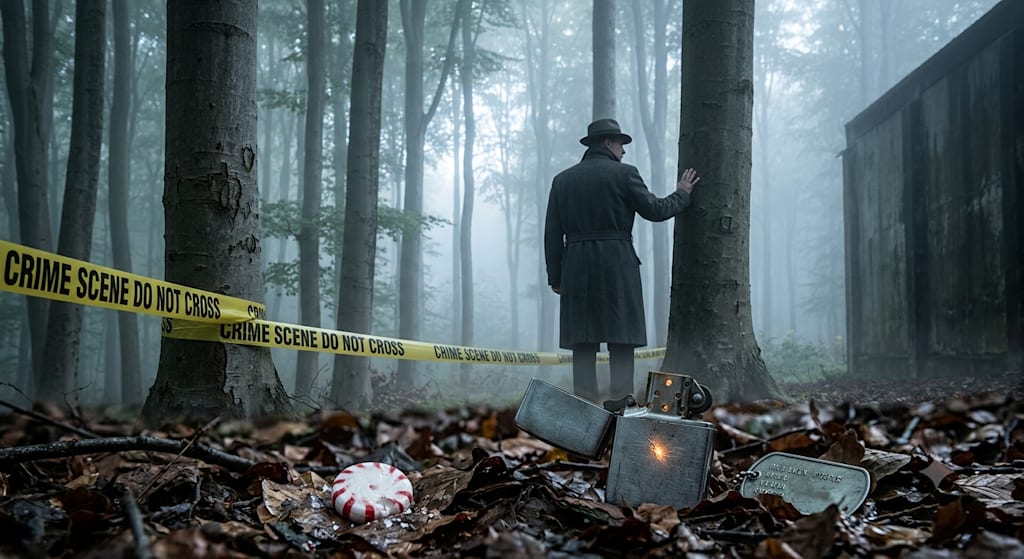
A body was found at East Hill.
Detective Victor Aaron wasn’t in my unit, but he got to the scene before I did.
When I pulled up, he was backing out of the dirt path through the trees. There were pine needles on the cuffs of his jacket. He didn’t brush them off. His phone was clutched in his left hand against the steering wheel, screen dark. He looked at me through the windshield for one beat longer than normal, then his eyes cut away.
01
Leo Walker, Homicide Division, Brookside Precinct, Spring Valley. I’d cleared a few quiet cases in three years, and the squad had started putting the tough ones on my desk.
At 6:11 in the morning, Chief Lauer’s call came through. Two words: “East Hill. Male.”
By the time I got there, Victor Aaron was ducking under the crime scene tape. We bumped shoulders. His car keys dropped into wet mud. He bent to pick them up, and when he looked up his eyes slid right past my face and landed on the light bar of my cruiser behind me.
Then he pulled his door open. The engine turned over, tires crunched over loose gravel, the sound sharp and high.
I stood where I was, thumb pressing the button on my ballpoint pen. Click. Click.
The case had been assigned to me late the night before. The co-investigator field in the system was blank. Victor Aaron’s name wasn’t on it anywhere.
I slid the pen back into my chest pocket, ducked under the tape.
02
The rubber gloves went on with a snap. Shoe covers rustled over dead leaves.
The victim was male, around forty. His face had been gnawed by animals; most of his right ear was gone. His fly was open. His genitals had been cut off, the wound edges uneven. There were deep ligature marks on his wrists and ankles, purple-black, fine fibers embedded in the skin.
The medical examiner lifted a flat foreign object out of his mouth with tweezers. I leaned in. A button battery, tooth marks along the rim.
The crime scene photographer’s flash went off. I blinked. When I opened my eyes again I saw that the victim was missing the first joint of his left pinky, an old wound. There was gray-white powder under his fingernails. It didn’t look like the leaf mold on the ground here.
I stepped back and my heel came down on something. I looked. Half a crushed hard candy, peppermint.
Victor Aaron used to chew that brand. Three years ago, in the hallway outside the interrogation room, he’d poured one into his palm and offered it to me. I hadn’t taken it.
Harper from the tech unit was crouched on the other side of the body. She looked up at me. “You know him?”
I said, “Get the battery to the lab first.”
I didn’t answer her question.
I walked past the tape line and pulled out my phone. An unread message sat in the notification bar, from a sealed internal number. Time sent: 3:42 a.m.
The woods at East Hill are wet in the morning. Wear old shoes.
I read the message twice. Didn’t reply. As I shoved the phone back into my pocket, my fingers brushed against a sticky half-piece of peppermint wrapper. It clung to my fingertip.
I crouched back down beside the body. Through the glove I touched the gray-white powder under the victim’s nails. I leaned close and smelled it. No scent. Solder residue. The kind used in electronics plants.
There was a ring of skin around the base of the victim’s right ring finger, slightly paler than the rest. A wedding band had been removed. But it hadn’t been yanked off by force — the edges were too neat, as if someone had twisted it off carefully.
Someone had done something ritualistic. Not to hide an identity. Just to take something away.
I stood up, and the world tilted for a half-second. I put a hand on the nearest tree trunk and pressed until the bark bit into my palm. Then I pulled off my right glove and signed the crime scene log. The tip of the pen punched through the paper.
03
The old Riverbend records room was in a red-brick low-rise on the east side of the industrial park. At nine that night I parked by the fire lane and went in through the rear entrance. The night clerk was a woman named Maureen, gray-haired, stirring a mug printed with WORLD’S BEST GRANDMA. She saw me, the teaspoon stopping mid-stir.
“Detective Carter,” she said. “Didn’t the Cold Storage Lane case just open this morning? You’re already digging through archives?”
I didn’t pick that up. I set my badge on the counter and slid it toward her. She didn’t look at the badge. She looked at me. After two seconds she pulled a ring of keys from a drawer and stood. The keys rattled, a thin sound.
“What do you need?”
“All night-shift rosters for Riverbend Cold Storage from the last seven years. Paper originals.”
She led me past two rows of steel cabinets and stopped under a fluorescent light that hummed. Section B, Row 4. Labels ran from RV-01 to RV-12.
“The smuggling case six years ago, the shipping labels all had the RV prefix,” she said. “The rosters are kept in the admin building. They’re not archived here.”
I said, “I know where they are.”
She turned to look at me. The hallway was quiet except for the echo of our footsteps. She hefted the key ring, slipped a temporary access card off it, and handed it to me.
“Third floor of the admin building. Third door. The card reader’s old — you have to hold the card flat and wait for the green light to stop flashing before you push the door. Push too early and the alarm goes off.”
I thanked her. She walked back the way we’d come. The teaspoon touched the rim of her mug again, a small, light clink.
The hallway lights on the third floor of the admin building were motion-activated. By the time I reached the third door the tube overhead flickered twice before it stayed on. The lock was an old magnetic card reader, not a digital keypad. I pressed the temporary card flat against it. The light blinked from red to green, flashed three times. I waited for the green to go dark, then pushed the door open.
The night-shift rosters were bound by year, stacked on the second shelf of a steel cabinet. The dust was thick. I pulled seven volumes, one for each of the last seven years, and spread them on a dust-covered metal table. The year labels had faded; I read them by the handwriting.
None of the rosters from the last four years had Victor Aaron’s name in them. Nobody from Narcotics, either. Six years ago, the year the Riverbend RV smuggling case was cracked, an entire page had been torn out of the night-shift roster. Page six. The tear ran right alongside the binding holes, the angle perfectly straight. Someone had used a ruler and a utility knife. Not their hands.
I pulled that volume out and set it on top. I took a photo of the torn stub with my phone. Along the ragged edge a tiny fragment of handwritten letters was still visible. The last line of page six, the 4:00 a.m. to 6:00 a.m. shift. The shift supervisor’s signature space had only the top half of one letter left.
L.
I put my phone back in my pocket. My fingers hit something hard. A dog tag on a chain. Victor’s. Eight years ago, the night we graduated from the academy, he’d gotten drunk and shoved it into my hand. “Keep it for me,” he’d said. I’d never given it back. He’d never asked for it. But I’d noticed, six months ago, that the back of the tag had new engraving—small, fresh lines that hadn’t been there when he handed it over. I’d never mentioned it.
I pressed my thumb against the tag for a beat. Didn’t pull it out.
The hallway lights shut off. I left through the side door of the admin building. Outside, a light rain had started. The drops hit the corrugated metal awning over the parking lot, the sound rising and falling. My car was still parked by the fire lane. Beside the driver’s side front tire a small puddle had collected. A thin film of oil floated on top. Another car had stopped here, engine idling for a while, then driven off.
I opened my door. Something was hanging from the rearview mirror. I hadn’t put it there.
A dog tag. Identical to the one in my pocket.
Wedged against the windshield was a folded convenience store receipt, half soaked through by the rain. I opened it. On the back, in ballpoint pen:
The roster doesn’t have what you’re looking for. Stop digging.
I knew the handwriting. Victor always put an extra hook on the number seven.
I flipped the receipt over. On the front: a black coffee, purchased at 7:14 p.m. at the Riverbend gas station minimart. And a pack of peppermint candy. The same brand he’d tried to hand me in the academy hallway eight years ago.
I folded the receipt in half and put it in the inside pocket of my coat. I started the engine, headlights off. The wipers dragged across the windshield, the rubber squeaking against dry glass.
My phone lit up. A text from an unknown number, no signature:
Unit Three at Riverbend Cold Storage had its power switched back on tonight. Go see for yourself.
I cranked the wheel hard. The tires cut through standing water. I didn’t drive toward the cold storage. I didn’t drive home.
I drove toward Victor Aaron’s apartment.
04
Victor lived at 112 Oak Street in Spring Valley, a duplex with gray-blue siding. I parked across the street next to a fire hydrant and killed the engine. The wiper blades stopped mid-sweep on the windshield, like two motionless arms.
A light was on in the second-floor window facing the street. Eleven at night, and the light was on.
I didn’t go in the front. I circled to the side of the building. The fire escape railing was black with rain, slick under my shoes. When I reached the second-floor landing I saw that his kitchen window was open a crack. The exhaust fan was spinning, pulling out the smell of coffee.
Victor was standing with his back to the window, at the counter. He was pouring coffee into a travel mug, moving slowly, as if counting drops. Three things lay on the counter: an open file folder, a car key, and a phone lying face down. Next to the file folder was a clear evidence bag holding a scratched silver lighter — I could see the engraving even from the window.
I rapped twice on the window frame with my knuckle.
He didn’t turn around. His pouring hand stopped. “The third step on the fire escape is loose. I heard it when you stepped on it.”
I said, “You left that receipt for me on purpose.”
He turned. He’d taken off his uniform shirt. Underneath he wore a dark gray long-sleeved T-shirt. There was a fresh abrasion on his left forearm, not yet scabbed. He saw me looking at it and pulled his arm half an inch closer to his side.
“You went through the rosters.”
“I did. Page six was cut out with a utility knife. The cut is fresh.”
He didn’t answer that. He lifted the travel mug, took a sip, his Adam’s apple bobbing once.
I climbed in through the window, my soles hitting the kitchen tile. I didn’t take my shoes off. He didn’t ask me to.
He didn’t unpack the whole case at once. He pulled one thing out at a time.
First, from the file folder, the original night-shift attendance sheet — page six, intact. At the bottom, in the slot for 2:00 a.m. to 4:00 a.m., a name was signed: Frank Aaron.
“My brother.” Victor set the travel mug down and rubbed his thumb along the rim, half a circle. “He worked the night shift at the cold storage six years ago. He was on duty the night the RV case broke. The investigation concluded he didn’t know about the smuggling. No charges. But the department flagged him internally as a connected person. He was transferred out. A year ago he shot himself.”
When he said shot himself, his right thumb pressed repeatedly into the webbing of his left hand — right where the callus from an industrial button would sit. I’d noticed that callus on him years ago, and on the dead man this morning.
He saw me looking at his thumb and stopped pressing. He picked up the evidence bag with the lighter. Silver. A deep scratch across the surface. Engraved on the bottom: V.A.
“This showed up at the East Hill scene this morning,” he said. “I was already there — I’d gotten a message at 3:42 a.m. telling me to go look. I didn’t know the body was my brother’s case until I saw this. My brother gave me a lighter just like it before he died. He’d engraved his initials. He put that scratch in it.”
He pulled a second lighter from his pocket — identical, same scratch, same engraving — and set it next to the bag. “Now there are two.”
I didn’t ask him to explain the callus. I’d seen it. He knew I’d seen it.
“What job did your brother have at the cold storage.”
“Unit Three operator,” Victor said. “He pressed one button. The compressor emergency stop.”
I pointed at the second lighter. “This one — you’ve had it since before he died.”
“He gave it to me six months before. Said it was a spare. I didn’t think about it.” He turned the lighter over. “Now I think he knew someone might come for him. He wanted me to have something with his mark.”
The only sound in the kitchen was the exhaust fan. The rain had stopped. Outside, the streetlight pushed through the wet window and threw a small, wavering square of light onto the ceiling.
I set the evidence bag down. From the inside pocket of my coat I took out the convenience store receipt, unfolded it, and placed it between the two lighters.
“You left that receipt for me so I’d come find you.”
He didn’t deny it.
“Why didn’t you just file a report.”
He was quiet for a long time. The exhaust fan made a clicking sound. He reached over and turned it off. The kitchen went very still.
“Because the anonymous text I got didn’t just tell me Unit Three was back online.”
He picked up the phone from the counter — the one that had been lying face down — unlocked it, and opened his messages. 7:09 p.m. Unknown number. One line:
Your brother didn’t kill himself. Go look at East Hill.
He set the phone back down, screen down again. On the back of the phone case was a faded sticker, a cartoon hound. The academy mascot from our year. The edges were worn white.
I pulled the dog tag out of my pocket and set it next to the two lighters. The chain had been tangled in the lining of my pocket for so long it had pressed fine lines into the metal.
Victor glanced at it. Didn’t touch it. His Adam’s apple moved again.
“You told me to keep it for you,” I said. “Eight years. You never asked for it back.”
He reached over and picked the tag up. He flipped it over. On the back, along with his blood type, was a small line he had engraved himself. It hadn’t been there eight years ago. It had been done a year ago.
Press it again.
He closed his fist around the tag. His knuckles went white.
I waited for him to speak.
He said, “The compressor emergency stop button on Unit Three — after you press it, it takes two keys turned at the same time to reset. One key in the operator’s hand, one in the shift supervisor’s. When my brother died, his key wasn’t on his body. The victim they found today had solder residue under his nails. A button-presser’s callus on his index finger. He wasn’t an operator, but he touched that button.”
He poured the coffee from his travel mug into the sink, rinsed the mug, and set it on the drying rack.
“Somebody restarted Unit Three,” he said. “Two people were there. One of them is dead. The other one took the key.”
He turned and looked at me. There was no heat in his eyes. Just something that had been pressed down for a very long time, finally floating up.
“You didn’t come here to find me. You came out of the admin building, found what I left on your car, and decided to ask me why. Now you know why.”
I said, “I know.”
I shifted my holster half an inch at my back. Not drawing. Just feeling that it was there.
“How many people are at Unit Three right now.”
“Right now,” Victor said, “none.”
“What does that mean.”
“That message telling you Unit Three had power again — I sent it. After I sent it, I went to look. The compressor had been restarted. The control panel had my brother’s old fingerprints on it. And one other person’s. Fresh. No dust mixed in.”
He paused.
“I got the fingerprint match back at nine o’clock. The dead man is Martin Cole, forty-one. A freelance maintenance contractor for Riverbend Refrigeration. Fired six months ago for ‘insubordination.’ But the person who fired him wasn’t his direct supervisor. It was an executive vice president at corporate — someone who’d never set foot on the plant floor.”
He flipped his phone over and opened a photo. An employee ID badge. The name on it: Martin Cole. Position: Emergency Brake System Maintenance. Under the photo, stamped in blue ink: RV-07.
Same prefix I’d seen that morning on the victim’s collarbone — the faint blue-black smudge that hadn’t quite faded.
I pulled the roster volume with the torn page from my inner coat pocket and laid it on the counter, open to the torn stub. That half-letter at the torn edge was still just the top half. L.
Victor pushed another document toward me. The original shift supervisor list from the RV case, page six. In the 4:00 a.m. to 6:00 a.m. slot, a full signature: Frank Aaron.
He pressed his thumb over his brother’s name.
“The original roster shows my brother’s signature. The photocopy in the official file has that column cut out. Someone is covering up the fact that my brother wasn’t in the supervisor’s booth that night. He was in Unit Three. And whoever was with him — his signature was torn out. First or last name starts with L.”
I said the letter: “L.”
Victor slid the dog tag into his pocket. A small length of chain hung out.
“I ran every executive who worked at Riverbend Refrigeration six years ago. Four people with a first or last name starting with L. One was transferred out two weeks before the RV case. One died of illness three years ago. Two left. One still lives in the city. The other moved back from out of state last month.”
He turned his phone screen toward me. A group photo from a company annual dinner, zoomed in on the lower right corner. A white man around fifty, gray-white hair, dark blue suit. The name on his badge was easy to read.
Lawrence Cohen. Executive Vice President.
I stared at the photo for five seconds. Then I stepped back from the counter and zipped up my coat.
“What’s your plan,” I asked.
Victor picked up his car key from the counter, weighing it in his palm.
“Go to the cold storage,” he said. “Pull the operation log from Unit Three. Then go find Lawrence Cohen.”
“By yourself?”
He looked at me. Then he took my dog tag out of his pocket and put it back in my hand.
“You keep it this time,” he said.
I closed my fist around the tag. The metal was warm.
I said, “I’m going with you.”
He walked to the kitchen doorway and pulled a rain jacket off a hook. He tossed it to me. Not his department jacket. An old civilian coat, the left shoulder mended with a line of stitches that weren’t quite straight.
I caught it. Put it on. Zipped it to the collar.
We went down the fire escape, one after the other. The third step really was loose. Rust flakes sifted down as we stepped on it.
05
Riverbend Cold Storage Unit Three sat at the deepest end of the industrial park — a gray concrete building with no exterior signage. At two in the morning we parked five hundred meters away behind an abandoned loading platform and walked in. Victor took point. His footfalls on the gravel made almost no sound. A way of walking that had been trained in.
The front entrance was a sliding steel door. A faint yellow light leaked through the gap between the panels. Victor pulled a key from inside his coat, inserted it into the lock, and turned it with a steady wrist. The lock cylinder snapping open echoed through the empty loading bay like a short gunshot.
We slipped inside sideways. The temperature in the cold storage was a good fifteen degrees lower than outside. Our breath clouded white. Somewhere deep in the building the compressor ran with a low, steady vibration underfoot.
The control room was on the second floor, up a steel ladder. Victor went first. I followed. The ladder rail was coated with condensation, slick under my palm.
The control room door was ajar. Victor pushed it open with his fingertips. The hinges didn’t make a sound. Inside, a single emergency light was on, throwing a rectangle of illumination across the control panel.
The protective cover over the compressor emergency stop button had been flipped open. The button itself was depressed, sunk into the panel. In the key-reset slot beside it, a key was inserted — and broken. Only half of it remained. Someone had twisted it off inside the lock.
Victor stepped up to the panel. He touched the sheared face of the broken key. The metal was bright along the break, no rust.
“He was here,” Victor said. “Lawrence Cohen. He broke the key off so no one could reset the system. So the machine would just sit here, dead.”
He opened the maintenance hatch beneath the console and pulled out a black box the size of his palm. The operation log recorder. He slid it into his coat pocket and zipped the pocket shut.
At that exact second, every light in the cold storage blazed on.
White light poured down from the ceiling. Victor and I both threw our arms up to shield our eyes. Footsteps sounded from the direction of the steel ladder. More than one person. Three, maybe four. Leather-soled shoes on metal rungs, moving at an unhurried, un-hidden pace.
Victor’s hand went to his holster. Mine did too.
The first person into the control room wore a dark blue suit, his gray-white hair combed smooth. Lawrence Cohen. Behind him were two men in security uniforms, Tasers on their belts. At the rear was a man I didn’t recognize — tall and thin, gold-rimmed glasses, carrying a briefcase.
Cohen looked at Victor. His expression was calm, like he’d run into a not-quite-familiar colleague at a board meeting.
“Detective Aaron,” he said. “Coming into my cold storage this late at night — procedure calls for notifying the property owner in advance.”
Victor didn’t move. His hand was still on his holster.
“Your cold storage,” Victor said, “was a crime scene six years ago. And it is again now.”
Cohen smiled. Not a sneer. The kind of smile people use across a negotiating table, no warmth in it.
“The case from six years ago is closed. No one was charged. Your brother Frank was a good man, and I was deeply saddened by what happened to him. But it has nothing to do with my company.”
“Then what about Unit Three being restarted tonight,” Victor said. “Why are Martin Cole’s fingerprints on this control panel.”
Cohen didn’t answer that. He tilted his head slightly. The man in the gold-rimmed glasses stepped forward, took a document from his briefcase, and set it on the edge of the control panel. An asset-transfer agreement, signed and dated. Six years ago. Three days before the RV case broke.
“Three days before the case opened,” Gold-Rims said, “Frank Aaron rented the nighttime operating rights for Unit Three in his own name. His signature is on the contract. If he engaged in any illegal activity inside the unit, the responsibility is his alone. The company bears no liability.”
Victor picked up the contract. He looked at the signature for a long time.
Then he turned the contract over, blank side up, and set it back down on the panel.
“The signature is forged,” he said. “My brother wrote the letter A with a downward slant on the crossbar. The A on this contract is flat.”
Cohen’s smile didn’t disappear. But the muscle at the corner of his mouth tightened.
“Handwriting analysis can be done again,” he said. “But I should remind you, Detective Aaron — you’ve entered private property illegally tonight. I can call the police. Even though you are the police.”
Before Cohen finished the sentence, I pulled out my phone and hit the call button. The screen lit up with a name: Chief Lauer. I’d pre-dialed the number in the car on the drive over, thumb hovering, waiting for the right second. Now I held the phone up, screen facing out, speaker on.
Cohen’s eyes flicked to the phone. His two security men shifted their weight. The briefcase man’s mouth opened slightly.
The call connected on the second ring. Lauer’s voice came through, low and alert: “Carter. Go ahead.”
I said, “You’re on speaker, Chief. We’re inside Riverbend Cold Storage Unit Three. Lawrence Cohen is here with two security personnel and a man carrying a briefcase full of forged contracts. He’s just threatened to call the police on two homicide detectives investigating a murder on his property. I thought you’d want to hear the rest of this conversation yourself.”
The line went quiet for two seconds. Then Lauer said, “Record it.”
Cohen stared at my phone. The smile was completely gone.
06
The next forty-eight hours moved fast.
The handwriting analysis was redone. Frank Aaron’s signature on the contract was confirmed as forged. The tech team pulled the recent start-up history from the operation log recorder — on the night of the murder, Unit Three had been powered on at 1:17 a.m. The emergency stop button was pressed at 1:43 a.m. At the exact moment the button was depressed, the safety valve inside the compressor was manually locked shut. Pressure couldn’t release. It wasn’t an operational error. Someone had rigged it into a trap.
Martin Cole’s bank records showed a deposit of fifty thousand dollars three days before the murder. The wire came from a shell company. Trace it up three layers and it led to a subsidiary of Riverbend Refrigeration. The signature on the subsidiary’s authorization documents was Lawrence Cohen’s. Genuine.
Frank Aaron’s body was re-examined. The M.E. found the same solder residue under his left fingernails that had been under Martin Cole’s. That meant Frank had also handled the compressor’s safety valve before he died. He hadn’t killed himself. He’d been trying to fix the valve when someone struck him from behind on the back of the head. The killer staged the scene as a suicide and took his reset key.
And Lawrence Cohen’s fingerprints turned up on the back of the “suicide note” found in Frank Aaron’s home. The note was written on Riverbend Refrigeration internal letterhead. The front had the company logo. The back was smooth, a surface that held prints well. Cohen’s fingerprint sample from the internal investigation six years ago was still in the system. The match came back in twelve hours. Positive.
The DNA from the button battery came back the same day: saliva residue that didn’t belong to the victim. It matched Lawrence Cohen. He hadn’t worn gloves when he shoved the battery into Martin Cole’s mouth.
The motive took until the third day to fully assemble. The Riverbend Cold Storage RV smuggling case from six years ago — the real contraband had never been frozen animal products. It was military-grade electronic components, hidden in the false walls of refrigerated shipping containers. Frank Aaron found one of the hidden compartments and reported it to his shift supervisor. The supervisor’s name started with L. Lawrence Cohen. Cohen was the actual operator of the smuggling ring. He’d used that night to destroy the bulk of the evidence, leaving only enough loose threads to avoid an indictment. Frank was transferred away. Martin Cole was the technician Cohen had hired to modify the compressor safety valve. Six years later, Cohen decided to eliminate everyone who knew.
Martin Cole was first. He’d been tortured before he died. The ligature marks on his wrists and ankles. The severed genitals. The button battery in his mouth — a hearing-aid battery. Martin Cole wore a hearing aid in his left ear. Someone had pried the battery out of his device and shoved it into his mouth.
The killer had been asking him questions. Questions he wouldn’t answer. The remaining person who knew, the one not yet dead, was Frank Aaron. He should have been killed a year ago. Cohen had someone forge the suicide note and stage the fake suicide. But he didn’t know who Frank had given the real evidence to before he died.
The anonymous text Victor received was sent from a backup number belonging to a deceased Narcotics informant. That informant had contact with Frank Aaron a year ago. The text had been scheduled for delayed sending, set the day before Frank’s death. If Frank hadn’t manually cancelled it after one year, it would go out.
Frank set it for one year. He gave Cohen one year. And he gave his own brother one year.
07
The day Lawrence Cohen was arrested, I didn’t go to the scene. Neither did Victor. We were in the precinct’s observation room, watching the monitor feed from the interrogation room. Cohen sat in a steel chair. His gray-white hair was disheveled. The dark blue suit was gone, replaced with a gray detention jumpsuit. He didn’t look the interrogator in the eye. He looked at his own hands on the table.
Victor stood beside me, the dog tag clenched in his fist. The chain was wrapped three times around his knuckles.
“My brother used to say,” he began, his voice very low, “that when you hit the emergency stop, the machine doesn’t really stop. It just goes into standby. As long as the key still exists, it can be restarted anytime.”
He flipped the tag over. The engraved words Press it again looked like a very thin scar in the cold light of the monitor screen.
I said, “You pressed it.”
He opened his hand. The tag fell back against his chest. The chain swayed twice, struck a shirt button, made a small sound.
“I pressed it,” he said. “This time, two people pressed it at the same time.”
He turned and walked out of the observation room. The hallway lights were bright. His shadow stretched out behind him, growing shorter.
I stood in front of the screen, watching Lawrence Cohen in the interrogation room. The interrogator slid the forged contract across the table. Cohen didn’t look at the contract. He looked at the camera. He was looking in my direction.
I picked up the internal phone on the desk and dialed the tech unit.
“Harper,” I said. “The lab report on the button battery from the cold storage scene. Is it back yet.”
“It’s back,” Harper said. “DNA matched Cohen. He didn’t wear gloves.”
I hung up and made a note in the case log. The pen tip paused on the paper. This time it didn’t punch through.
08
A week later. Riverbend Cold Storage was officially sealed. Lawrence Cohen was charged with two counts of first-degree murder, one count of attempted murder, smuggling military materiel, and evidence tampering. The case was transferred to the U.S. Attorney’s Office. As the first officer on the original scene, I was notified to prepare to testify.
The personnel clerk who handed me the subpoena added, “Detective Victor Aaron has been reassigned back to Homicide. He’ll be co-investigator on your open case.”
I took the subpoena, folded it, and put it in the inside pocket of my coat. The same pocket still held the convenience store receipt. The peppermint wrapper had long since lost its stickiness, but a small grease stain remained on the paper, yellowing.
I walked out to the parking lot. Victor’s dark blue Dodge was parked next to my black Chevy. He was leaning against the hood, holding an unwrapped peppermint candy between his fingers.
“You going to take it this time,” he said.
I reached over, took the candy, unwrapped it, and tossed it into my mouth. The peppermint hit the back of my nose.
“Too sweet,” I said. “Same as before.”
He crumpled the wrapper into a ball, flicked it with his thumb into a nearby trash can. The can liner was fresh, no other trash in it. The wrapper landed inside. The first piece.
We pulled our doors open. Engines started, one then the other. Two beams of light cut out of the lot, side by side, heading toward East Hill.
The place where Frank Aaron’s body had been found. The place where this case had started. The area wasn’t cordoned off anymore. The crime scene tape was gone. The leaf mold on the forest floor had been dried by sunlight, crisp underfoot. It felt nothing like that first morning.
Victor pulled a black urn from the back seat. No label, no inscription. He crouched under a beech tree, opened the lid, and tipped the ashes out around the roots. No prayer. No moment of silence. He just emptied the urn, then turned it upside down on the ground, and stood.
“My brother said the woods at East Hill are wet in the morning,” he said. “Wear old shoes.”
He looked down at his shoes. Dried mud clung to the uppers. Old shoes. He’d worn them for three years.
I said, “That text — he sent it to this number.”
“Yeah. He set it to delayed sending. The delivery date was supposed to be a year ago. But he pushed it out another year. I think he wanted to give me enough time.”
He pulled out his phone and opened the message. The timestamp showed a date from a year ago — the original scheduled send. But the delivery timestamp, the one that mattered, was this morning. 3:42 a.m.
“I only saw it this morning,” he said. “That’s why I was at the scene before you. I got the message, drove out there, found the lighter, and was about to leave when you pulled up. I didn’t know what I was standing in.”
I remembered the way he’d looked at me through the windshield — one beat too long, phone clutched in his hand, pine needles on his cuffs. A man who’d just had the ground pulled out from under him and was trying to decide whether to tell anyone.
“You could have told me then,” I said.
“I wasn’t sure it was real. I wasn’t sure my brother really hadn’t killed himself. I didn’t want to drag you in if it was nothing but a delayed fake message.”
He tucked the empty urn under his arm and started walking out of the woods. I followed.
“Now I’m sure,” he said.
He pulled his car door open, set the urn on the back seat, and strapped it in with the seat belt. Then he started the engine. The headlights lit the dirt road ahead. The dark blue Dodge didn’t pull away right away. He rolled down the window and stuck his left hand out. Between his thumb and forefinger he held a dog tag. Mine.
“You don’t need to keep it this time,” he said. “I’m giving it back.”
I took it. The tag was cold. He’d been sitting in the car that whole time and he hadn’t warmed it.
“What about the one in my car,” I asked.
He glanced at his own rearview mirror. A tag hung from it, identical to the one in my hand.
“I’m keeping this one,” he said. “I’ll keep it for me.”
He rolled the window up. The Dodge pulled away slowly, tires rolling over loose gravel. The sound wasn’t sharp. Not like that first morning. This time it was steady.
I stood where I was and hung the dog tag back around my neck. The metal pressed against the skin of my chest, slowly warming.
I put my hand in my pocket. My fingers hit a hard candy. Peppermint. The wrapper from the one Victor had given me was still in the trash can. This one was new. I didn’t know when he’d put it in my pocket.
I unwrapped it, dropped it into my mouth. The peppermint hit the back of my nose. Still too sweet.
I walked toward my car. My soles pressed into the dried leaf mold, a fine, brittle sound.
Behind me was the East Hill woods. Morning sunlight fell through the beech canopy onto the round depression in the earth where the overturned urn had been. The grass was pressed flat. It would grow back in a few days.
I opened the car door and started the engine. Before I shifted into gear, I bit down on the candy. It shattered. A shard of peppermint lodged between my teeth. My tongue couldn’t work it loose. I dug at it with my finger. Didn’t get it out. I let it be.
I shifted into gear. Drove toward the precinct.
In the rearview mirror the East Hill woods shrank smaller and smaller. The dog tag hanging from the windshield swung gently. I didn’t reach up to steady it.
About the Creator
Jin
Writer of reamstories
https://reamstories.com/jin
Enjoyed the story? Support the Creator.
Subscribe for free to receive all their stories in your feed. You could also become a paid subscriber, letting them know you appreciate their work.
Comments
There are no comments for this story
Be the first to respond and start the conversation.