
He Did Pull-Ups on a 1,500-Year-Old Temple Beam. Then Police Opened a Case.
A viral fitness stunt, a fragile wooden wonder, and the legal fight over what counts as damage.
What He Grabbed
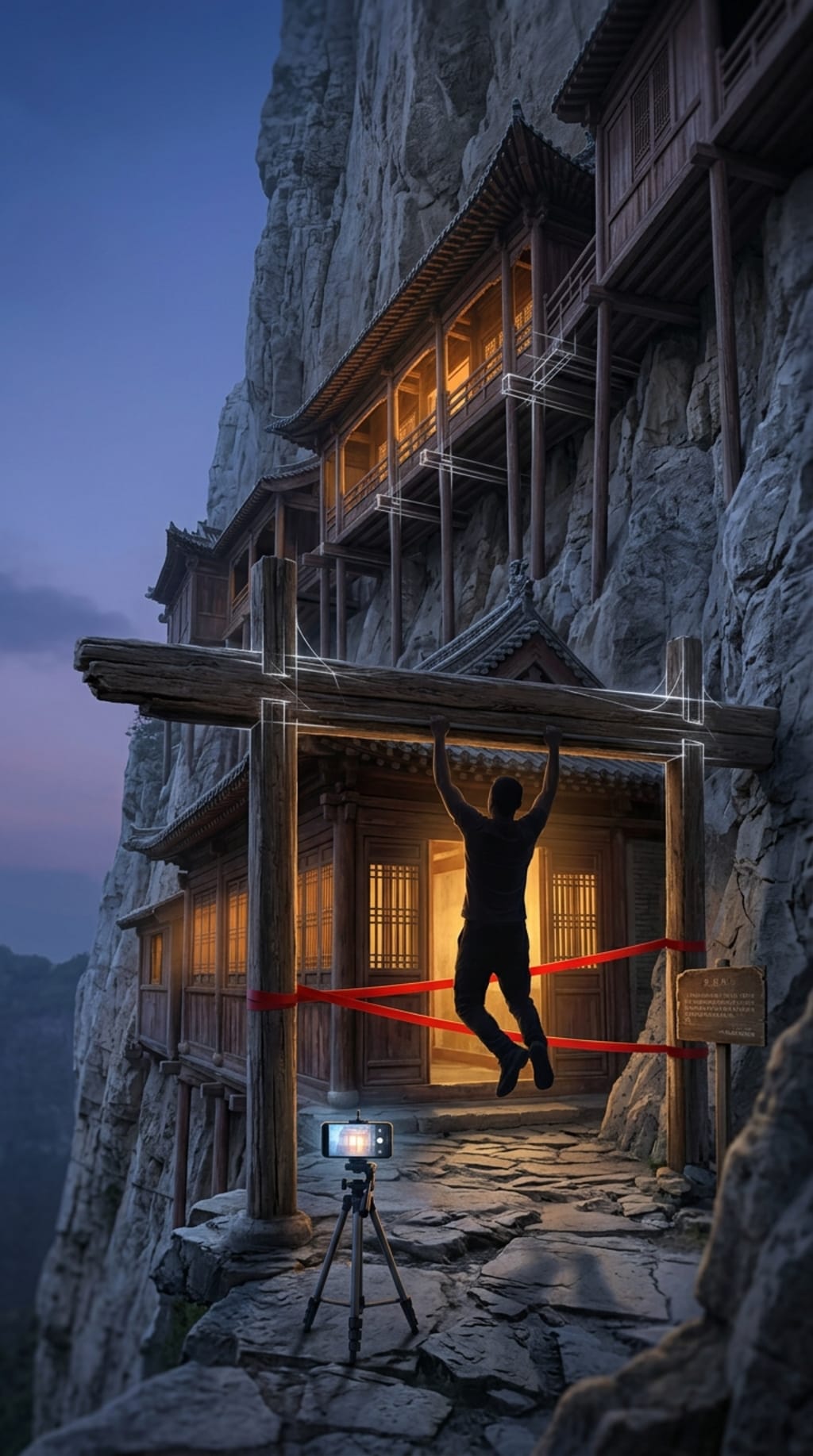
On September 27, 2026, at the Hanging Temple in Hunyuan County, Shanxi Province, a man jumped, grabbed a wooden beam above his head, and hung in the air. He completed five pull-ups. The video caption read “Xuankong Temple hanging,” a pun on the temple’s name. He uploaded the video on October 11. By October 12, it had gone viral. On October 13, the Hengshan Scenic Area Management Center issued a statement. Police opened a case.
The location was specific: the second intersecting beam on the north side of the front corridor of the Mahavira Hall. In traditional Chinese timber-frame architecture, an intersecting beam (穿插枋) connects columns. It is one node in a structural web.
The Hanging Temple is not held up by the thin wooden columns visible from below. Those columns mostly disperse lateral stress. The load-bearing system consists of 27 tapered hemlock beams, soaked in tung oil and wedged two-thirds of the way into the limestone cliff, locked by wooden pegs. The entire structure, 40 halls and pavilions, is assembled without a single nail or rivet, using traditional mortise-and-tenon joinery.
This fact matters because the “no visible damage” framing misses the point. The Hanging Temple works as one interconnected mechanical system. Hang 150 pounds from one intersecting beam, and you redistribute stress across every mortise and tenon connected to it.
The scenic area’s statement acknowledged this. The behavior, it said, created a “potential disturbance risk to the force balance of the timber structure system” and a “serious safety hazard.” The expert assessment confirmed no visible direct physical damage. The risk was structural, not theoretical.
The First Account: Administrative Penalty
Police filed the case under Article 75 of the Public Security Administration Punishments Law. The text is clear:
“Whoever commits any of the following acts shall be given a warning or be fined not more than 500 yuan; if the circumstances are relatively serious, shall be detained for not less than 5 days but not more than 10 days, and shall also be fined not less than 500 yuan but not more than 1,000 yuan: (1) carving, smearing, or deliberately damaging by other means cultural relics, scenic spots, or historic sites protected by the State.”
The key phrase is “deliberately damaging by other means.” The law requires a deliberate act against a protected cultural relic. Visible damage is not part of the test.
The man knew, or should have known, that he was grabbing a beam of a nationally protected cultural heritage site. He jumped, grabbed, and pulled five times. That is deliberate.
The second question is whether the circumstances qualify as “relatively serious.” The scenic area’s statement supplied the answer. It called the behavior “vicious in nature,” the hidden dangers “prominent,” and the video a source of “negative social demonstration effect” after it spread. That language maps onto the “relatively serious” threshold.
The likely outcome is 5 to 10 days of administrative detention, plus a fine of 500 to 1,000 yuan. A warning or a symbolic fine would not match the scenic area’s own characterization.
The Second Account: Civil Liability
The administrative penalty is only the first layer. Under the Cultural Relics Protection Law, anyone who causes damage to cultural relics bears civil liability. In judicial practice, “damage” is not limited to visible physical destruction. The costs of assessing and mitigating risk to a cultural relic can be recovered.
There is precedent. In the Fanjingshan carving case, a man used a hiking pole to carve four characters into a cliff face at a provincial-level protected site. The court ordered him to pay 60,952.08 yuan in restoration costs, 38,000 yuan in restoration design fees, and 25,000 yuan in punitive damages for environmental harm. The total came to 123,952.08 yuan, plus a public apology in a national newspaper. Four characters. Nearly 124,000 yuan.
In the Great Wall case, a man who excavated a trench through a section of the Jinshanling Great Wall was fined 50,000 yuan in criminal court. The criminal judgment did not address restoration. The procuratorate later filed a public interest lawsuit, demanding that he bear the cost of repairing the wall and the expenses of investigation and assessment.
The Hanging Temple case has already generated costs. The scenic area organized cultural relics protection and ancient architecture experts to conduct an on-site inspection. If later monitoring shows that the force balance of the timber structure has been affected, requiring reinforcement or repair, those costs will fall on the man who did the pull-ups.
The Third Account: Criminal Liability
This is where the case becomes harder to dismiss. Article 324 of the Criminal Law states:
“Whoever intentionally destroys precious cultural relics protected by the State, or cultural relics designated as major historical and cultural sites protected at the national or provincial level, shall be sentenced to fixed-term imprisonment of not more than three years or criminal detention, and shall also or only be fined; if the circumstances are serious, shall be sentenced to fixed-term imprisonment of not less than three years but not more than ten years, and shall also be fined.”
The Hanging Temple is a major historical and cultural site protected at the national level. Its beams, columns, and other components are part of the protected cultural relic.
Many people assume criminal liability requires visible, measurable destruction. That assumption is wrong.
Supreme People’s Procuratorate guiding cases have established that scribbling on stone inscriptions or other components of nationally or provincially protected cultural relics constitutes intentional destruction of cultural relics under the Criminal Law, even if the individual component is not severely damaged. The reasoning: such conduct “significantly alters the appearance of the cultural relic, affects the overall historical style of the protected site, and damages its historical, artistic, and scientific value.”
The question centers on whether the conduct damaged, or created a substantial risk of damaging, the historical, artistic, or scientific value of the site. Whether the beam broke matters less.
The scenic area’s assessment provides the answer. The behavior “created a potential disturbance risk to the force balance of the timber structure system.” That is a structural judgment. The historical and scientific value of the Hanging Temple lies in its structural integrity, a 1,500-year-old equilibrium that has survived earthquakes and weathering. Introducing an abnormal external force into that system is not a trivial act.
One caveat remains. Some courts interpret Article 324 as a “result crime,” requiring actual damage. The current assessment states that no visible direct physical damage has been confirmed. If the case proceeds to prosecution, the central dispute will be whether “potential disturbance risk,” confirmed by expert assessment, is enough to establish the “damage” element, or whether the absence of visible destruction forecloses criminal liability.
The answer depends on the depth of the ongoing investigation. If structural monitoring can demonstrate that the mortise-and-tenon joints have undergone measurable displacement or stress changes, even if invisible to the naked eye, then the “risk” becomes “damage,” and the criminal case becomes substantially stronger.
What the Video Reveals
The man’s social media profile, according to widely circulated screenshots, described him as having “lived in North America for ten years, returned to China.” Commentators seized on this detail. It is a distraction. The relevant question is why he did not pause. His former residence matters little.
He visited the Hanging Temple, a site that has drawn pilgrims for 1,500 years. The temple enshrines Sakyamuni, Lü Dongbin, and Confucius, three traditions sharing a single cliffside structure. People have come here to pray. He came, grabbed a load-bearing beam, did five pull-ups, filmed it, and uploaded it.
The video was not an accident. He edited it. He captioned it. He posted it. He waited. When it went viral, he deleted it. That sequence looks like someone who understood that “pull-ups on a 1,500-year-old temple” was content.
That is the social harm the scenic area identified: the “negative social demonstration effect.” If this behavior goes unpunished, the signal is clear. The Hanging Temple becomes a backdrop for fitness content. The beams become pull-up bars. The next influencer does seven pull-ups. The one after that does ten.
A single person hanging from a beam for five seconds may not break it. A thousand people doing it, over a thousand days, might. The legal system cannot wait for the thousandth person to act before responding.
The Beam Is Still There
The Hanging Temple’s structural logic is a balance. Twenty-seven beams, wedged into limestone, locked by wooden pegs. Mortise and tenon. No nails. No glue. A system that has held for fifteen centuries because every component carries its share of the load, and no component carries more than it can bear.
The man introduced a load the system was not designed to carry. The experts say the beam held. The risk, they say, is potential. The balance, they say, may have been disturbed.
The scenic area’s statement ends with a promise to improve patrols, add warning signs, and strengthen on-site guidance. Soon, there will likely be a sign at the Hanging Temple that says: “No pull-ups on the beams.”
Every absurd warning sign exists because someone did the absurd thing first.
The beam is still there, and the temple is still hanging. The man is waiting for the police to finish their investigation.
About the Creator
Jin
Writer of reamstories
https://reamstories.com/jin
Enjoyed the story? Support the Creator.
Subscribe for free to receive all their stories in your feed. You could also become a paid subscriber, letting them know you appreciate their work.
Comments
There are no comments for this story
Be the first to respond and start the conversation.