
Ex-Prince Andrew Investigation Widens Following Epstein File Release: What We Know So Far
As British police broaden their inquiry following the release of new Epstein-related files, renewed public attention is turning toward questions of accountability, influence, and unresolved allegations.

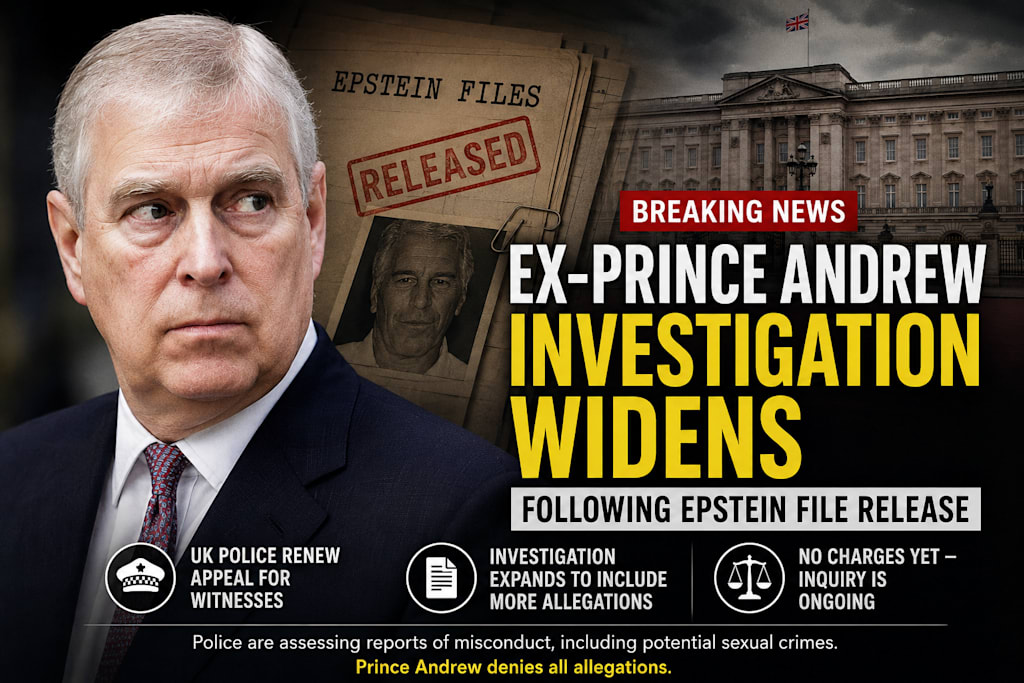
For years, Jeffrey Epstein has been one of the most disturbing scandals in modern history — a case that involved wealth, power, influence and allegations that spread around the world. Despite Epstein’s death in 2019, the controversies surrounding his network have continued to raise difficult questions. Now, a new development involving the former Prince Andrew has brought the story back into global focus.
British police have confirmed that the scope of their ongoing investigation into Andrew Mountbatten-Windsor — formerly known as Prince Andrew — is being broadened. The development comes after documents related to the Epstein case were released in the United States. According to authorities, a number of claims are being examined, including reports of possible sexual crimes.
The reactivation of the investigation has sparked renewed debate around the world, including in the UK. For many observers, this is not just a royal scandal, but a broader question about whether influential people are held to the same standard as ordinary citizens.
But what is really going on, and why has the issue become so important again?
A case in the spotlight again
On May 22, British investigators again appealed to the public to come forward with information as the investigation is being expanded.
According to Thames Valley Police, authorities are examining allegations relating to Andrew’s time as UK Trade Envoy from 2001 to 2011. Authorities have described the investigation as “complex” and said that corruption in public office could involve a range of potential crimes.
The new focus is on documents allegedly released under US transparency laws in connection with the Jeffrey Epstein case. Police say they are reviewing the information from the files and are also working with US authorities to see if any evidence is relevant to their investigation.
Importantly, police have made it clear that the investigation is still ongoing and no final conclusions have been drawn.
And that distinction is crucial.
In major celebrity cases, headlines often shape public opinion before the truth is revealed. That is why accuracy and impartiality are essential.
Why is Epstein still relevant?
Years after his death, Jeffrey Epstein continues to loom large over public life.
Jeffrey Epstein was arrested in 2019 on federal sex trafficking charges, but died in prison before facing trial. The case sparked global outrage because of his connections to politicians, celebrities, royalty and the business elite.
Several victims later claimed that Epstein used his wealth and influence to build a network of exploitation that remained hidden for years.
As court documents and government files continue to emerge, public attention has increasingly turned to individuals whose names have been linked to Epstein.
Most notably, former Prince Andrew.
Andrew has long faced criticism for his friendship with Epstein, particularly after a controversial 2019 TV interview that further damaged his reputation.
The interview was intended to defend him, but critics say it has instead raised more questions.
Andrew has since stepped back from royal duties and lost several royal privileges under mounting pressure.
Virginia Geoffrey’s allegations
The most controversial aspect of the Epstein controversy has been the allegations made by Virginia Geoffrey.
Geoffrey claimed that Epstein trafficked her and forced her to have sex with influential men, including Andrew, at a young age.
Andrew has always denied the allegations.
The case ended in an out-of-court settlement in 2022, but Andrew has not admitted to any wrongdoing.
For accountability advocates, the case has become a symbol of the larger question of whether powerful institutions respond appropriately to serious allegations.
While Andrew’s supporters have argued that media pressure and public judgment are inappropriate before a legal decision.
That disagreement remains a debate today.
Appeal for new witnesses
The most significant development in the current investigation is the appeal for new testimony.
According to police, they are reviewing reports of a woman who was allegedly taken to a location in Windsor in 2010 for sexual purposes. Authorities have assured that any potential witnesses or complainants will be treated with confidentiality, sensitivity and respect.
This public appeal shows that investigators are trying to reach out to people who may have more information.
In major investigations, especially in cases involving old allegations, the cooperation of witnesses can play a decisive role.
Many times people remain silent for years due to fear, depression or fear of public backlash.
That is why the new appeal is being seen as important.
However, police have not yet said that any criminal charges are being laid soon.
And this distinction is also important.
The breadth of the investigation does not automatically mean a conviction. It only means that authorities consider further investigation necessary.
Why are these investigations so sensitive?
Few stories have so many sensitive elements at once.
The royal family.
Political influence.
Allegations linked to one of the most notorious criminal scandals of the century.
And a crisis of public trust in institutions.
For these reasons, each new piece of news about the case attracts enormous media attention.
However, legal experts warn that public pressure can complicate investigations.
When cases become emotional or political, it becomes difficult for investigators to strike a balance between transparency and fairness.
Too little information breeds rumors.
Too much information can undermine the legal process.
Perhaps that is why British police have so far used cautious language.
The big question of accountability
At the heart of this whole story is a big question:
Are powerful people really accountable to the law?
For decades, critics have argued that wealth, fame and power sometimes create protections that ordinary citizens do not have.
The Epstein scandal has deepened these concerns.
People have questioned how Epstein managed to stay so close to influential figures for so many years, despite the allegations already being made.
Others have asked why warning signs were ignored.
Such cases often become a test of trust in institutions.
Public reaction and media attention
The reaction on social media after news of the widening investigation was divided.
Some say authorities should investigate every possible lead thoroughly and impartially.
While others warn against jumping to conclusions before the evidence is available.
The disagreement reflects a major reality of today’s digital age.
Major investigations now take place in real time on social media.
Every piece of news, leaked document or rumor instantly goes viral.
But going viral doesn’t always mean being true.
That’s why careful reporting is essential.
What could happen next?
The next phase of the investigation will likely depend on gathering evidence.
Police are reportedly working with US authorities to review material from the newly released files.
Testimony from potential witnesses could also change the course of the investigation.
If authorities find enough evidence, legal action is possible.
If not, the investigation could end without charges.
The situation is uncertain at this time.
Andrew continues to deny the allegations, while the investigation continues.
The bottom line
The widening investigation into the former Prince Andrew is another chapter in a story that many thought was over.
But the Epstein scandal continues to raise difficult questions about power, influence, justice and institutions.
For some, the case is a symbol of accountability for the powerful.
For others, it demonstrates the importance of due process and evidence.
For now, one thing is clear:
The Epstein debate is not over.
And as new files emerge, these questions will likely remain for many years.
About the Creator
Mohib Ullah
I write about crime, justice, and political affairs, focusing on real cases and current events. My goal is to deliver clear, research-based content that informs readers about law, society, and government systems.
Enjoyed the story? Support the Creator.
Subscribe for free to receive all their stories in your feed.
Comments
There are no comments for this story
Be the first to respond and start the conversation.