
EVERYONE IS JANE DOE, UNTIL IT'S TIME TO CARE:
PUT THE POLITICAL BULLSHIT DOWN AND PICK UP SOME HUMAN DECENCY

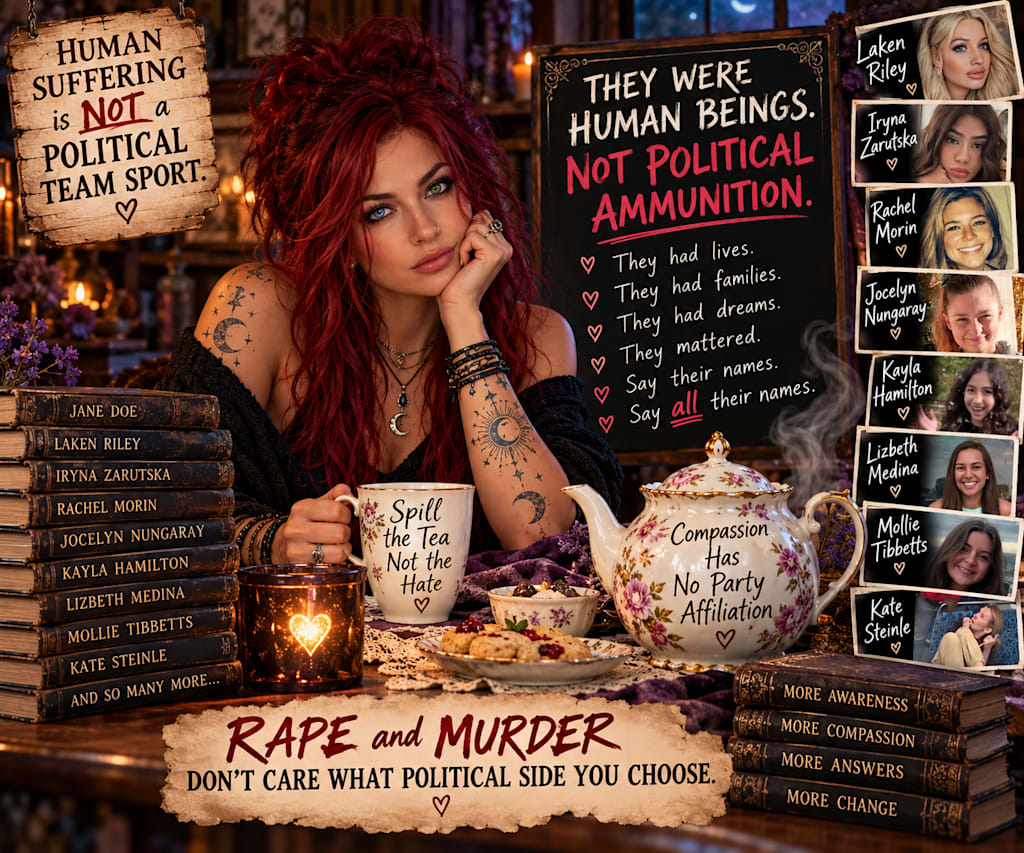
EVERYONE IS JANE DOE, UNTIL IT'S TIME TO CARE: PUT THE POLITICAL BULLSHIT DOWN AND PICK UP SOME HUMAN DECENCY
An open letter from Miss Lil, who is fresh out of patience, running low on tea, and absolutely not entertaining your political nonsense today.
Stops scrolling. Stares at the screen. Slowly puts the phone down.
Gets up, walks to the kitchen, fills the kettle, and returns to the tea table.
Well, ladies and gentlemen, gather your asses around the table. Miss Lil has some things to say, and judging by the absolute circus currently parading across my social media feed, we're going to need a bigger teapot.
Today's topic? A meme.
Yes, a meme.
A little black rectangle with a list of women's names and a caption suggesting that liberals don't care about the women listed because, apparently, their deaths haven't been discussed in whatever manner the person sharing the meme considers acceptable.
And just like that, we've managed to take the deaths of human beings, the grief of their families, and the horrific circumstances surrounding their cases and turn them into another round of my political team is better than your political team.
Sets kettle down rather firmly.
ARE WE FUCKING SERIOUS RIGHT NOW?
Because I need somebody to explain to me when basic human decency became a party-exclusive membership benefit. Did I miss the memo? Is there a secret handshake? Do we get a complimentary pamphlet explaining which murdered women we're allowed to care about depending on how we vote?
No?
Then what in the ever-loving fluffernutters are we doing here?
EVERYONE IS JANE DOE UNTIL SOMEONE REMEMBERS HER NAME.
The meme names women including Laken Riley, Iryna Zarutska, Rachel Morin, Jocelyn Nungaray, Kayla Hamilton, Lizbeth Medina, Mollie Tibbetts, and Kate Steinle.
These are not interchangeable talking points. They are not convenient props for a political argument. They are not names somebody gets to wave around like a flag to prove that an entire group of people is morally bankrupt.
They were human beings.
They had lives, families, histories, relationships, plans, and futures. They were somebody's daughter, sister, friend, or loved one. They were people who deserved to live, and their loved ones deserved a world in which their names didn't have to become rallying cries before the public paid attention.
And here's the part that seems to get lost somewhere between the outrage posts and the comment-section cage matches.
You can care about one victim without caring less about another.
Imagine that.
You can mourn Laken Riley and still care about other women who have been murdered.
You can want justice for Iryna Zarutska and still demand justice for victims whose names never trend.
You can be horrified by Rachel Morin's death and still acknowledge the suffering of women whose cases receive barely a whisper of public attention.
You can care about every single one of them without first submitting your political registration card for approval.
Wild concept, I know.
Apparently, some people have decided that compassion is a finite resource. Like we only have so many sympathy tokens in our pockets, and if we spend them on one victim, we won't have enough left for somebody else.
Well, somebody needs to tell those people that empathy isn't a limited-edition collectible.
There is no quota on human decency.
There is no rule saying that acknowledging one woman's suffering somehow diminishes another woman's life.
And there is absolutely no justification for turning a victim's name into a weapon against people who happen to disagree with you politically.
THE PROBLEM ISN'T THAT WE REMEMBER THESE WOMEN.
THE PROBLEM IS HOW WE USE THEIR NAMES.
Let's get one thing straight before somebody decides to throw a chair across the metaphorical tea table.
There is nothing wrong with demanding that victims receive attention. There is nothing wrong with criticizing media coverage, asking why certain cases receive more publicity than others, or questioning whether public officials are responding appropriately to violence.
Those are legitimate conversations.
Media attention can be uneven. Public outrage can be selective. Some cases receive national coverage while others struggle to get noticed beyond their own communities.
We can discuss those disparities. We should discuss them.
But there is a difference between asking, "Why aren't we paying more attention to these victims?" and declaring, "My political opponents don't care about these victims."
One invites a conversation.
The other starts a fight and calls it advocacy.
And if your entire argument depends on assuming that millions of people are indifferent to murder because they don't belong to your preferred political tribe, perhaps it's time to put the keyboard down and examine the argument you're making.
You do not know what every person thinks, feels, mourns, or supports based on a political label.
You do not know who donated to a victim's family, who followed a case quietly, who advocated for safer communities, who supported survivors, or who sat alone in their kitchen feeling sick over something they read in the news.
Silence on social media is not proof of indifference.
A lack of a particular post is not proof that somebody doesn't care.
And somebody disagreeing with you about immigration, criminal justice, public policy, or any other political issue does not automatically mean they approve of violence or have no compassion for its victims.
We can argue about policy. We can scrutinize decisions. We can demand accountability.
But we should have enough intellectual honesty to distinguish a disagreement over policy from a judgment about somebody's entire humanity.
Otherwise, we're not having a meaningful conversation about violence.
We're just using dead women to score points.
And frankly, that is a miserable way to honor anybody.
A VICTIM IS NOT A POLITICAL PROP. LET ME SAY THAT AGAIN FOR THE PEOPLE IN THE BACK.
A victim is not a political prop.
A grieving family is not a convenient backdrop for your next viral post.
A murder case is not an opportunity to prove that your side is righteous and the other side is rotten.
And a woman's life does not become more valuable because her death supports your preferred narrative.
Read that again.
A woman's life does not become more valuable because her death supports your preferred narrative.
Laken Riley deserved to live.
Iryna Zarutska deserved to live.
Rachel Morin deserved to live.
Jocelyn Nungaray deserved to live.
Kayla Hamilton deserved to live.
Lizbeth Medina deserved to live.
Mollie Tibbetts deserved to live.
Kate Steinle deserved to live.
Their worth did not depend on whether you agreed with their families, their politics, their backgrounds, or the political arguments people later attached to their cases.
They were human beings before anybody turned their names into headlines.
They were human beings before somebody built a political argument around their deaths.
And they remain human beings in our memories, long after the internet has moved on to its next outrage of the week.
We owe them more than a fleeting moment of attention followed by a comment-section war.
We owe their families the dignity of remembering that these cases involve real people living with real loss.
We owe the public honest discussions about violence, accountability, prevention, and justice.
And we owe one another enough decency to stop pretending that compassion belongs exclusively to one side of a political argument.
Because when you reduce a person's life to ammunition, you are no longer talking about that person.
You're talking about yourself, your argument, and your need to win.
And those are three very different things.
NOW, LET'S TALK ABOUT THE WOMEN WHO NEVER MAKE THE MEME.
Because here's another uncomfortable little truth for everybody sipping their politically flavored tea.
There are victims whose names you will never see on a viral graphic.
There are families whose grief never becomes a national talking point.
There are women whose cases receive limited coverage, whose stories fade from public attention, and whose loved ones continue searching for answers long after the internet has moved on.
There are survivors who carry trauma nobody sees.
There are people living with violence behind closed doors who never make the news at all.
There are missing persons whose names deserve to be remembered, unsolved cases that deserve renewed attention, and families who have spent years begging somebody to care enough to keep asking questions.
Where are the viral graphics for them?
Where are the thousands of shares?
Where is the outrage when a case doesn't fit neatly into a political narrative?
And before somebody answers, let me make something clear: I am not suggesting that we should stop talking about the women on this meme.
Absolutely not.
Keep saying their names.
Keep demanding justice.
Keep asking questions.
Keep their stories alive.
But don't you dare pretend that remembering these women requires us to forget everyone else.
The solution to selective attention is not a different kind of selective attention.
It's MORE attention.
More compassion.
More willingness to listen.
More determination to seek the truth, even when the truth doesn't fit comfortably into our preconceived ideas.
If your response to one group of victims being overlooked is to demand that another group receive less attention, congratulations. You've managed to recreate the very problem you're complaining about.
The goal should never be to decide which victims deserve the spotlight.
The goal should be to make sure fewer victims are left standing in the dark.
AND NO, THIS DOESN'T MEAN WE CAN'T TALK ABOUT POLITICS.
Before the comment section warms up its collective fingers, let me save us all a little time.
Yes, public policy matters.
Yes, immigration policy can be discussed in relation to particular cases when the facts support that discussion.
Yes, criminal justice systems should be scrutinized.
Yes, law enforcement practices, prosecutorial decisions, public safety measures, and government accountability deserve serious examination.
Nobody is asking you to abandon critical thinking or pretend that every policy produces identical outcomes.
But if you're going to use a specific case to support a policy argument, bring the actual facts. Establish what happened. Distinguish verified information from speculation. Explain the connection between the case and the policy you're discussing.
Do the work.
Don't simply post a victim's photograph, slap a political accusation beneath it, and expect that to count as an argument.
A tragedy can raise legitimate policy questions. It does not automatically prove every claim somebody wants to attach to it.
And one person's actions, however horrific, do not give us permission to invent facts about an entire population or assign collective guilt to millions of people.
Accountability belongs where the evidence leads.
Not wherever a political talking point would find it most convenient.
We can demand justice for victims and have complicated conversations about public policy at the same time.
Those two things are not enemies.
In fact, meaningful discussions about preventing violence require us to be willing to examine uncomfortable facts, competing explanations, and evidence that may challenge what we already believe.
That is called taking the issue seriously.
Turning a woman's death into a shortcut around evidence is not.
RAPE AND MURDER DO NOT CHECK YOUR POLITICAL AFFILIATION FIRST.
Let's bring this conversation back to the point, shall we?
Violence does not become acceptable because the victim belongs to a group you dislike.
Sexual assault does not become less horrifying because acknowledging it might complicate your political narrative.
Murder does not become less tragic because the victim's story is inconvenient to somebody's argument.
And a survivor does not have to hold the correct political opinions before we believe that their suffering matters.
Human cruelty is not neatly organized into party platforms.
Neither is grief.
Neither is trauma.
Neither is the lifelong damage that violence can leave behind.
People from different political backgrounds can experience the same horror, mourn the same loss, and agree that somebody deserves justice.
They can disagree about what policies would best prevent future violence while still recognizing that the victim was a human being whose life mattered.
That should not be a revolutionary position.
It should be the bare minimum.
And if your first instinct when you hear about a murdered woman is to ask which political side can be blamed for her death, I would gently suggest that you take a breath and remember that a person has died.
There will be time to examine the facts.
There will be time to discuss accountability.
There will be time to debate policy.
But the victim should never become an afterthought in a conversation supposedly being held in her name.
If we cannot remember that much, what exactly are we trying to accomplish?
Winning an argument?
Collecting likes?
Making the other side look bad?
Because I promise you, the people who loved those women did not lose someone they cherished so the rest of us could have better ammunition for Facebook.
Their loss is not your campaign material.
Their grief is not your engagement strategy.
And their loved ones do not owe you a convenient narrative.
MISS LIL HAS A FEW WORDS FOR THE COMMENT SECTION.
Picks up teacup. Takes a long, deliberate sip.
Now, for those of you who are still itching to turn this into a political cage match, I have a few suggestions.
First, stop assuming that everyone who disagrees with you is incapable of compassion.
Second, stop using the deaths of women as a measuring stick for whether somebody belongs to the morally superior political team.
Third, if you genuinely believe certain victims are being overlooked, do something constructive about it.
Share their stories accurately.
Support legitimate victim advocacy organizations.
Help amplify missing-person alerts from credible sources.
Support survivors.
Encourage evidence-based discussions about violence prevention.
Ask difficult questions of public officials when there is a factual basis for doing so.
Demand accountability where the evidence warrants it.
And for the love of everything in my teapot, learn the difference between remembering a victim and exploiting a victim's story.
One honors a human life.
The other uses that life to serve an agenda.
Those are not the same thing, no matter how many times somebody insists they are.
And if somebody shares a story about a victim you haven't heard of, your first response does not need to be, "Well, what about this other victim?"
You can simply say, "I didn't know about her. Thank you for bringing her story to my attention."
Imagine how much more we could learn if every conversation didn't immediately become a contest over whose suffering deserves the most recognition.
Imagine how many stories could reach new audiences if we spent less time accusing one another of indifference and more time sharing information.
Imagine what might happen if we stopped treating compassion as a political weakness and started treating it as a responsibility.
Now THAT would be something worth making viral.
THE FINAL WORD: PUT THE POLITICAL BULLSHIT DOWN.
Here is where Miss Lil is going to put the kettle away and speak plainly.
I do not care what political team you support.
I do not care which candidate you voted for.
I do not care whether your views line up neatly with mine or whether we would disagree about half the policies in the country.
Your political beliefs do not determine whether you are capable of compassion, and mine do not give me exclusive ownership of it.
What I care about is whether we can look at another human being's suffering and recognize it for what it is.
A tragedy.
A loss.
A life that mattered.
A family that deserves dignity.
A case that deserves to be handled with care, facts, and accountability.
Every victim deserves to have their story told honestly. Every case deserves to be taken seriously. Every survivor deserves to be treated with dignity. Every family searching for answers deserves to know that their loved one's name has not simply disappeared beneath the next wave of internet outrage.
And every one of us has a responsibility to remember that the people behind these stories are not fictional characters written to support our preferred political plot.
They are real.
Their pain is real.
Their absence is real.
And no amount of online arguing can change that.
So, yes, keep saying their names.
Say Laken Riley.
Say Iryna Zarutska.
Say Rachel Morin.
Say Jocelyn Nungaray.
Say Kayla Hamilton.
Say Lizbeth Medina.
Say Mollie Tibbetts.
Say Kate Steinle.
And then keep going.
Remember the women whose names you haven't learned yet. Remember the victims whose stories haven't gone viral. Remember the survivors who are still trying to put their lives back together. Remember the families who wake up every morning with an empty chair, an unanswered question, or a hole in their hearts that no court verdict and no social media post can ever completely repair.
Don't let their names become weapons.
Let their names remind us why this conversation matters in the first place.
Because human suffering is not a team sport. Victims are not political ammunition. And compassion is not supposed to come with party membership requirements.
If we can agree on nothing else, we should at least be able to agree that a human life deserves more respect than a cheap political point.
Sets the teacup down. Looks directly at the imaginary audience.
Now, if you'll excuse me, I need to make another pot of tea, because apparently the bare minimum of human decency is a surprisingly exhausting concept for some folks.
Drink your tea.
Check your facts.
Treat people like human beings.
And for fuck's sake, stop making dead women compete for your compassion.
They deserved better in life. The very least we can do is treat their memories better than this.
Miss Lil has left the tea table. The kettle is still hot. And the conversation, quite frankly, should never have been this difficult.
About the Creator
Lilithea Adasia
I dig where others look away. 🖤 True crime, paranormal mysteries, uncomfortable truths, and the beautifully broken human experience. I chase the stories others bury and ask the questions others avoid. Come curious. Leave questioning.
Enjoyed the story? Support the Creator.
Subscribe for free to receive all their stories in your feed.
Comments