
Brendan Dassey:
The Confession, the Conviction, and the Questions That Never Went Away

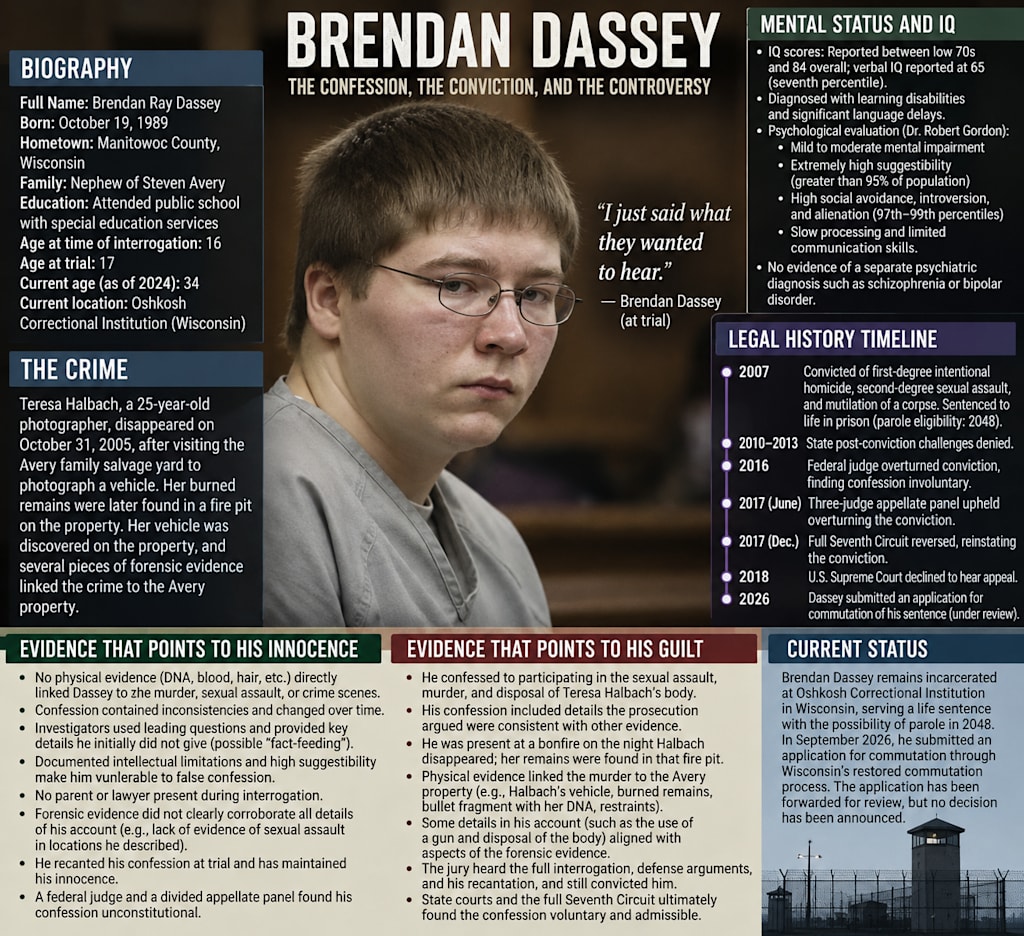
Brendan Dassey: The Confession, the Conviction, and the Questions That Never Went Away
He was sixteen years old when investigators questioned him about a murder. He had significant learning and communication difficulties. He eventually confessed to participating in a brutal crime, then insisted that his confession was false. A federal judge overturned his conviction, an appeals court reversed that decision, and the United States Supreme Court declined to intervene.
Nearly two decades later, Brendan Dassey remains in prison.
The case of Brendan Dassey has become one of the most controversial examples of disputed confessions in modern American criminal justice. It raises uncomfortable questions about police interrogation, intellectual limitations, the reliability of confessions, and what happens when a vulnerable teenager becomes a defendant in a murder case.
But this case cannot be understood by looking only at the interrogation room. There is evidence that supports the prosecution's position, evidence that raises serious questions about Dassey's guilt, and a complicated legal history that is frequently oversimplified in public discussions.
The most important distinction is this: Dassey's conviction was temporarily overturned by a federal court, but it was ultimately reinstated through the appeals process. He remains legally convicted, and no court has exonerated him. That legal outcome, however, does not erase the questions raised by his interrogation and the evidence presented at trial.
This is a closer examination of who Brendan Dassey was, what investigators said he did, why his confession became the center of the case, and what the available evidence can and cannot tell us.
1. Who Is Brendan Dassey?
Brendan Ray Dassey was born on October 19, 1989, in Wisconsin. He grew up in Manitowoc County, where he lived with members of his family, including his uncle, Steven Avery, whose property became the center of the investigation into the disappearance and murder of Teresa Halbach.
Dassey was sixteen years old in October 2005, when Halbach disappeared. He was a teenager attending high school, with documented learning and communication difficulties that would later become central to the arguments surrounding his confession.
His relationship to Avery placed him within the circle of people investigators scrutinized after Halbach's disappearance.
On October 31, 2005, Halbach, a 25-year-old photographer working for Auto Trader magazine, traveled to the Avery property to photograph a vehicle. She was never seen alive again. Her vehicle was subsequently discovered on the property, and her burned remains were recovered from a fire pit associated with Avery.
Avery became a suspect, and investigators eventually turned their attention to his nephew.
Dassey's case was tried separately from Avery's. The prosecution alleged that Dassey had participated with Avery in Halbach's sexual assault and murder and had helped dispose of her body.
Dassey denied the allegations at trial and maintained that the confession he had given investigators was untrue. Nevertheless, in 2007, a jury convicted him on three charges connected to Halbach's death.
The circumstances of his age, education, intellectual ability, and questioning would become essential to understanding why his case generated such intense controversy.
2. Teresa Halbach: The Crime at the Center of the Case
Before examining the accusations against Dassey, it is important to remember the person whose death started this case.
Teresa Halbach was a young photographer whose work took her to people's homes and businesses to photograph vehicles for sale. On Halloween 2005, she visited the Avery salvage yard near Mishicot, Wisconsin.
Investigators later found evidence connecting Halbach to the property. Her vehicle was discovered concealed among other vehicles, her blood was found inside it, and burned human remains identified as hers were recovered from Avery's fire pit.
The investigation also uncovered evidence associated with Avery's bedroom and garage, including a key connected to Halbach's vehicle, firearm evidence, and a bullet fragment that forensic examiners associated with Halbach.
These discoveries established the foundation of the prosecution's case against Avery. They did not, by themselves, establish that Dassey had participated in the murder.
That distinction matters enormously.
Evidence that a murder occurred on or near a particular property is not automatically evidence that every person associated with that property committed the crime. Investigators still have to establish the role of each accused person, and a jury must determine whether the evidence proves that person's guilt beyond a reasonable doubt.
For Dassey, the prosecution's principal link was his own confession.
That brings us to the most consequential part of the case.
3. The Interrogation: How a Sixteen-Year-Old Confessed
Dassey was questioned by investigators during the months following Halbach's disappearance. His March 1, 2006, interview became the central piece of evidence against him.
During that interrogation, Dassey eventually described participating with Avery in the sexual assault and murder of Halbach and helping dispose of her body.
The confession was videotaped. That recording later became important to both the prosecution and the defense because the public, jurors, and judges could examine not only the words Dassey said, but also the questions investigators asked before he gave particular answers.
The prosecution viewed the confession as an admission containing details that supported its theory of the crime. The defense argued that it was unreliable and had been produced through suggestive questioning of an intellectually vulnerable teenager.
The role of investigators
Investigators repeatedly encouraged Dassey to tell the truth and suggested that honesty would help him. They told him they were on his side and used statements indicating that he could be all right if he cooperated.
They also used deception, including asserting or implying that they already knew what had happened.
None of these tactics, considered individually, automatically makes a confession unconstitutional. Courts have long recognized that police may use certain deceptive interview techniques. The legal question is whether the total circumstances made a particular person's confession involuntary.
In Dassey's case, that question was especially complicated because of his age and intellectual limitations.
The defense argued that he interpreted the investigators' reassurance as a promise that he would not get into trouble if he told them what they wanted to hear. The prosecution disputed that interpretation and maintained that no specific promise of leniency was made.
Dassey was not physically threatened during the March 1 interrogation, according to the state courts' findings. The interviewers spoke in ordinary tones, and the court found that he was given food, drinks, and restroom breaks. He had been advised of his Miranda rights and agreed to speak with investigators.
Those facts became important to the courts that ultimately upheld the confession's admissibility.
Yet the absence of physical threats does not, by itself, establish that a confession is reliable. A person can provide a false confession without being physically abused, particularly when psychological pressure, suggestibility, and a desire to please authority figures are involved.
The central issue is not simply whether Dassey was comfortable in the room. It is whether he understood the situation, whether the answers reflected his own knowledge, and whether the interrogation influenced the account he ultimately gave.
The changing story
One of the most troubling features of the interrogation is how Dassey's account developed.
In portions of the interview, investigators asked what else had happened to Halbach and provided increasingly specific prompts when Dassey did not supply the expected information.
One widely discussed example concerns the manner of Halbach's death. Investigators had information indicating that she had been shot in the head, but Dassey initially did not identify that detail. He guessed at other possibilities before an investigator became more explicit and asked about something involving the head.
Critics argue that this sequence illustrates fact-feeding: a process in which an interviewer supplies information or clues that a suspect subsequently incorporates into a statement. If the suspect then repeats that information, it can appear to be independent knowledge even when it originated with the investigator.
The prosecution and the judges who upheld the confession offered a different interpretation. They noted that Dassey supplied some incriminating details in response to open-ended questions and resisted certain suggestions rather than agreeing with everything investigators proposed.
Both observations matter. The interrogation cannot be fairly evaluated by isolating only the most incriminating answers or only the most questionable exchanges. The entire sequence, including what investigators knew beforehand, what they suggested, what Dassey volunteered, and how he responded to corrections, must be considered.
The recording allows viewers to examine that process, but watching a person speak is not the same as knowing whether that person is telling the truth. Neither hesitation nor apparent confidence provides a dependable shortcut to determining guilt.
The competing interpretations of this interview would eventually divide the courts themselves.
4. Brendan Dassey's IQ and Mental Status
This is one of the most important parts of the case, and it requires careful language.
Dassey's documented intellectual and communication difficulties were not merely talking points introduced by a television documentary. They were examined during legal proceedings and discussed in judicial opinions.
What did his IQ tests show?
Dassey's test results varied according to the assessment and the measure being reported.
Assessment findingReported resultOverall intellectual abilityScores across assessments ranged from the low 70s to approximately 84Verbal IQA reported score of 65General intellectual ability in school-related assessmentReported at approximately the seventh percentile for students his ageCommunicationDocumented speech and language impairment and significantly delayed language skillsInterrogation suggestibilityOne forensic psychologist reported results indicating greater suggestibility than approximately 95% of the comparison population
These figures appear in the records and legal arguments discussed in the federal appellate litigation. They should not be treated as interchangeable scores from one single test.
An IQ score is a standardized estimate of performance on particular cognitive tasks. It is not a complete measure of someone's intelligence, memory, understanding, ability to tell the truth, or capacity to make decisions.
Dassey's reported verbal IQ of 65 is particularly relevant because language comprehension and verbal reasoning can affect how someone understands complicated questions, interprets indirect statements, and explains events.
His broader scores varied, and the record does not support reducing his entire cognitive profile to one number.
Was Brendan Dassey intellectually disabled?
The record describes Dassey as having low-average to borderline intellectual functioning in some assessments, with other test results falling lower. His documented language difficulties and learning needs were also significant.
However, it would be inaccurate to declare that he definitively met every clinical or legal criterion for intellectual disability simply because one reported IQ score was 65.
Clinical intellectual disability involves more than an IQ score. It also requires consideration of adaptive functioning, including practical, social, and conceptual abilities, and the developmental history of the individual.
The available court records establish meaningful intellectual and communication limitations. They do not justify casually assigning a definitive diagnosis beyond what the relevant assessments actually established.
What did the psychological examination reveal?
Forensic psychologist Dr. Robert Gordon reviewed Dassey's school records, conducted a mental-status examination, and administered psychological tests.
According to the 2017 federal appellate opinion, Gordon described Dassey's thinking as slow and identified a mild-to-moderate mental impairment. His assessments also indicated unusually high social avoidance, introversion, and alienation.
Gordon reported scores at approximately the 99th percentile for social avoidance, the 97th percentile for social introversion, and the 98.5th percentile for social alienation on the measures he discussed.
He also administered the Gudjonsson Suggestibility Scales, which examine a person's tendency to yield to questioning pressure and change answers in response to feedback. Gordon concluded that Dassey's results indicated greater suggestibility than approximately 95% of the population.
These are findings attributed to a particular expert and his assessments. They are not a universal verdict on Dassey's credibility, nor do they establish that every statement he made was false.
What does suggestibility actually mean?
Suggestibility is the tendency to be influenced by information, expectations, or pressure during questioning. In an interrogation, it can affect how a person responds when an interviewer challenges an answer, implies that a different answer is expected, or suggests that cooperation will improve the person's situation.
A highly suggestible individual may:
Change an answer after being told that it is incorrect.
Accept an interviewer's interpretation rather than persist with an uncertain answer.
Confuse information supplied during questioning with information remembered independently.
Agree with an authority figure to reduce conflict or gain approval.
Become increasingly committed to an account that has developed through repeated questioning.
These are potential vulnerabilities, not proof that they occurred in every instance of Dassey's interview.
In Dassey's case, the defense argued that these vulnerabilities interacted with his age, language limitations, and desire to please investigators. Gordon's findings supported the argument that Dassey was particularly susceptible to the techniques used during the interrogation.
The state courts, however, considered the psychological evidence and the circumstances of the interview and concluded that the confession was voluntary.
The distinction is important: a confession can be legally admissible without being scientifically or factually reliable in every detail. Admissibility and accuracy are related questions, but they are not the same question.
Did Dassey have a mental illness?
The publicly discussed record establishes cognitive, language, and social-functioning difficulties. It does not, by itself, establish a separate psychiatric diagnosis such as schizophrenia or bipolar disorder.
It is also inappropriate to diagnose Dassey retrospectively from televised footage. Quietness, awkwardness, flat affect, confusion, or difficulty articulating an answer can have many explanations.
The most defensible conclusion is that Dassey had documented intellectual and communication limitations that were relevant to assessing his ability to understand and respond to interrogation. Whether those limitations rendered his confession involuntary was ultimately a legal determination, not a psychiatric diagnosis.
5. The Evidence That Supports Questions About Dassey's Guilt
Arguments supporting Dassey's innocence generally focus on the reliability of his confession, the lack of physical evidence directly connecting him to the crime, and inconsistencies between his account and the forensic record.
These are serious issues. They deserve close examination without assuming that any single one automatically proves he was innocent.
A. No physical evidence directly linked Dassey to the murder
The federal appellate opinions discussing the case noted that investigators found no DNA, blood, hair, or other physical evidence directly connecting Dassey to Halbach's murder.
The prosecution had evidence connecting Halbach to Avery's property, including her blood in her vehicle, her remains in the fire pit, and a bullet fragment associated with her DNA. But those findings did not independently establish Dassey's participation.
This is a substantial distinction between the evidence against Avery and the evidence against Dassey.
The defense argued that, despite an extensive investigation, there was no forensic evidence placing Dassey in the locations where his confession said the assault and murder occurred.
There was no physical evidence identified as Dassey's that tied him to the alleged sexual assault, the reported stabbing, or the shooting.
The prosecution's case against him consequently depended heavily on the confession and on circumstances associated with the events of October 31, 2005.
What does that mean?
The absence of forensic evidence is not proof that a person did not participate in a crime. Not every offender leaves identifiable DNA, blood, or fingerprints, and the absence of evidence is not always evidence of absence.
But when a confession describes a violent crime involving multiple alleged acts, the lack of physical corroboration can become important, particularly if the confession itself is disputed.
It is reasonable to ask why the investigation did not produce physical evidence directly connecting Dassey to the alleged acts. It is not reasonable to pretend that this absence alone settles the question.
B. The confession contained inconsistencies
Dassey's account changed as investigators questioned him. At points, he appeared uncertain about basic details, made guesses, and revised his answers after investigators indicated that they were not satisfied.
The defense argued that this was evidence of an unreliable confession rather than a genuine recollection of events.
The issue becomes particularly significant when an investigator already knows the answer to a question and guides the suspect toward it.
If a suspect independently provides a previously unknown detail that is later verified, that can strengthen a confession. If the investigator supplies the crucial information first, the evidentiary value is different.
This is why the order of questions and answers matters so much in Dassey's case.
The federal district court and the initial appellate panel viewed the interrogation as raising serious concerns about whether Dassey's confession was the product of his own recollection or of the interview process. The full Seventh Circuit later disagreed that those concerns justified federal habeas relief under the governing legal standard.
C. The alleged crime scene did not corroborate every detail
Dassey's confession described a sexual assault and a violent killing involving events in Avery's trailer and garage.
Investigators did not find the forensic evidence that might ordinarily be expected to corroborate some of those specific allegations, such as Halbach's blood or DNA in the locations where the alleged assault was said to have occurred.
The defense also questioned the relationship between Dassey's description of the shooting and the forensic evidence recovered from the garage.
This matters because a confession should ideally be tested against independent evidence, not treated as self-validating merely because it is detailed.
A person can describe a crime inaccurately, and a person can also describe real events without leaving physical traces that investigators can recover. The evidentiary question is whether the details are independently supported and how much weight they deserve.
D. Dassey recanted his confession
At trial, Dassey testified that the acts he had confessed to had not happened and that his confession was made up. He maintained that he had been present for ordinary activities, including the bonfire, but denied participating in Halbach's assault and murder.
His recantation was consistent with the defense position that investigators had led him into an untrue account.
However, a recantation is not automatically proof of innocence. People sometimes retract truthful confessions, just as people sometimes make false ones. The reasons for the original statement and the later retraction must be examined alongside the other evidence.
The jury heard the defense challenge and convicted him anyway. Later, courts reviewed his claims about the confession and reached different conclusions at different stages of the proceedings.
E. The interrogation was conducted without a parent or lawyer present
Dassey's mother consented to his March 1 interview, but she was not present during it. He was sixteen and did not have an attorney with him during the interrogation.
The defense argued that this left a vulnerable juvenile without the support of someone who could help him understand the stakes, recognize the risks of answering questions, or challenge misleading assurances.
The absence of a parent or attorney does not automatically make a confession unlawful. Dassey was advised of his Miranda rights, and the courts that upheld the confession found that the circumstances did not render it involuntary.
Nevertheless, his age and cognitive profile make this a relevant concern when assessing how he understood the questioning and the consequences of his answers.
F. The original federal ruling found constitutional problems
In 2016, a federal magistrate judge granted Dassey relief after finding that his confession was involuntary under the applicable constitutional standard. The decision was upheld by a divided three-judge panel of the Seventh Circuit in June 2017.
Those rulings did not establish that Dassey was factually innocent. They concluded that his conviction could not stand because of the constitutional problems identified in the confession proceedings.
That was a significant legal development, but it was not the end of the case.
The full Seventh Circuit reheard the matter and reversed the grant of relief in December 2017.
The significance of these decisions is that the concerns about Dassey's confession were not merely a public-relations controversy. Federal judges seriously considered them under constitutional law. The ultimate legal outcome, however, favored the state.
6. The Evidence That Supports the Prosecution's Case
A thorough examination must also confront the evidence that supports the prosecution's position. Dassey's conviction was not based on a confession in isolation from every other circumstance, even though the confession was the centerpiece of the case against him.
The prosecution argued that Dassey had provided a detailed account of his participation in Halbach's assault, murder, and the disposal of her body, and that certain details corresponded with evidence discovered during the investigation.
A. His confession described participation in the crime
The most significant evidence against Dassey was his March 1, 2006, confession.
He admitted participating in the alleged sexual assault and murder and helping dispose of Halbach's body. These were not minor admissions. If accurate and voluntary, they directly implicated him in the crimes for which he was convicted.
The prosecution maintained that the confession was credible and that Dassey supplied meaningful details rather than simply repeating everything investigators suggested.
The state courts accepted the confession as voluntary and admissible. The jury heard the recorded interview and convicted him.
The weakness in this argument is not that a confession has no evidentiary value. It is that a confession's value depends on its reliability, the circumstances in which it was obtained, and the degree to which independent evidence supports it.
B. The bonfire and the disposal of Halbach's remains
Evidence established that Dassey and Avery were associated with a bonfire on the Avery property on Halloween night, when Halbach disappeared.
A family friend testified to seeing Avery and Dassey by a bonfire that evening. Halbach's burned remains were subsequently recovered from Avery's fire pit.
The prosecution argued that these circumstances supported aspects of Dassey's confession about helping dispose of Halbach's body.
But the existence of a bonfire does not establish what was burned, who knew what was happening, or whether Dassey understood that a crime had occurred. Those are separate questions requiring evidence.
The defense maintained that Dassey had participated in an ordinary bonfire and denied knowingly helping dispose of a murder victim.
The fire and the remains are established elements of the case. The precise role Dassey played is the disputed issue.
C. Physical evidence supported parts of the broader investigation
Investigators recovered items from Avery's property that the prosecution associated with the alleged crime, including handcuffs and leg irons found in Avery's bedroom, a charred shovel and rake, and a car seat associated with the burned remains.
The prosecution argued that some of these items were consistent with details in Dassey's account.
The important limitation is that evidence supporting the broader allegation against Avery is not automatically evidence of Dassey's personal participation. The presence of restraints does not independently prove that Halbach was restrained with them, and the recovery of burned objects does not identify who used them or for what purpose.
The prosecution's theory gained strength from the combined circumstances, but the defense questioned whether the physical findings independently corroborated the most serious allegations against Dassey.
D. The bullet fragment and the gun evidence
A bullet fragment recovered from Avery's garage was reported to contain DNA identified as Halbach's. The prosecution associated the fragment with a .22-caliber rifle recovered from Avery's bedroom.
This evidence was important to the broader investigation because it supported the allegation that Halbach had been shot.
However, the fragment did not contain Dassey's DNA, and its existence did not independently establish that he had fired a weapon or participated in the shooting.
The defense also challenged aspects of the forensic analysis and questioned whether the fragment's DNA results could reliably establish the circumstances in which the DNA came to be present.
Those challenges should not be mistaken for a judicial finding that the DNA was deliberately planted. They were disputes about the interpretation and reliability of forensic evidence.
The bullet evidence supports the prosecution's account of a shooting more directly than it supports a conclusion about Dassey's individual actions.
E. Dassey's statements about his whereabouts and activities
The prosecution relied on Dassey's accounts of his activities on October 31, along with the circumstances surrounding his participation in the bonfire.
These statements were relevant because they placed him within the setting of the alleged crime and helped investigators develop their theory of events.
But being present at a location is not the same as committing a crime. The question was whether the evidence demonstrated that Dassey had knowingly participated in the sexual assault, murder, or concealment of Halbach's death.
The prosecution argued that his confession supplied that missing connection. The defense argued that the confession was unreliable and that the surrounding evidence did not independently establish his guilt.
That is the central evidentiary dispute.
7. A Closer Look at the Competing Evidence
The following comparison separates established findings from the conclusions each side asks the public to draw.
IssueEvidence supporting concerns about guiltEvidence supporting the prosecutionConfessionChanging answers, leading prompts, and disputed reliabilityDassey made explicit admissions of participationForensic evidenceNo identified physical evidence directly linking Dassey to the assault or murderPhysical evidence established Halbach's death and connected the crime to Avery's propertyBonfireAttendance does not establish knowledge of a murderThe bonfire occurred on the night Halbach disappeared, and her remains were found in Avery's fire pitInterrogationDassey's age, cognitive limitations, and reported high suggestibilityState courts found the confession voluntary under the totality of the circumstancesCorroborationSome crucial details emerged after investigators supplied increasingly specific promptsThe prosecution argued that parts of the account were consistent with other evidenceCourt decisionsA federal judge and a divided appellate panel found grounds for reliefThe full Seventh Circuit reversed that relief, leaving the conviction in place
There is no need to pretend that every piece of evidence points in one direction. It does not.
The prosecution had a confession, evidence of a bonfire, and physical evidence establishing the murder and connecting it to Avery's property. The defense had substantial grounds to challenge the confession's reliability, including the interrogation recording, expert testimony about suggestibility, and the absence of physical evidence directly linking Dassey to the alleged assault and murder.
The unresolved question is how those pieces should be weighed together.
8. The Conviction Was Overturned, Then Reinstated
The legal history is often summarized inaccurately, so the sequence matters.
2007: Convicted and sentenced
A Wisconsin jury convicted Dassey of first-degree intentional homicide, second-degree sexual assault, and mutilation of a corpse, all as a party to a crime. He received a mandatory life sentence with the possibility of parole in 2048.
2010–2013: State post-conviction challenges fail
Dassey challenged the reliability and voluntariness of his confession and the effectiveness of his legal representation. The Wisconsin Court of Appeals affirmed the conviction in January 2013.
2016: A federal judge overturns the conviction
Federal Magistrate Judge William Duffin granted Dassey's petition for a writ of habeas corpus, finding that his confession was involuntary under the constitutional standard. The ruling directed that the state either release him or retry him within the prescribed period.
June 2017: A three-judge federal appellate panel agrees
A divided panel of the Seventh Circuit Court of Appeals upheld the grant of habeas relief, concluding that the state court had unreasonably applied the constitutional principles governing juvenile confessions.
December 2017: The full appeals court reverses
Sitting en banc, the Seventh Circuit reversed the earlier decision by a 4–3 vote. The majority concluded that the state court's decision upholding the confession was not unreasonable under the demanding federal habeas standard.
2018: The Supreme Court declines review
In June 2018, the U.S. Supreme Court declined to hear Dassey's appeal. This left the Seventh Circuit's decision in place. The refusal to hear the case was not a separate ruling that independently determined whether his confession was true.
2026: Still incarcerated and seeking commutation
Reporting published September 30, 2026, states that Dassey submitted an application for commutation of his juvenile life sentence. Commutation is a request to reduce a sentence, not to overturn a conviction. The report said his application had been forwarded for review.
Why did the judges disagree?
The disagreement was not simply about whether Dassey's interrogation looked troubling.
The federal district court and the original appellate panel concluded that the state court had failed to apply the constitutional requirements adequately to a juvenile with Dassey's intellectual limitations and vulnerability to suggestion.
The full Seventh Circuit majority approached the question differently. Under federal habeas law, a federal court cannot overturn a state conviction merely because it would have reached a different conclusion. The state court's decision must cross a demanding threshold of unreasonableness under federal law.
The majority concluded that the state courts' finding of voluntariness was within the bounds permitted by that standard.
Three judges dissented. They argued that the interrogation techniques, the psychological vulnerabilities of the sixteen-year-old defendant, and the role of investigator-supplied information made the confession constitutionally unacceptable.
The dissenters did not control the outcome. Their disagreement nevertheless demonstrates that experienced federal judges examined the same case and reached sharply different conclusions about the adequacy of the constitutional analysis.
What does the final ruling mean?
It means that the conviction remains legally valid.
It does not mean that the Supreme Court examined every disputed fact and declared Dassey's confession truthful. The Supreme Court declined to take the case, leaving the lower court's ruling undisturbed.
Likewise, the earlier federal ruling did not establish that Dassey was innocent. It granted relief because of the court's conclusion about the constitutional validity of his confession.
These distinctions are essential. A ruling about whether a confession was obtained constitutionally is not the same as a factual finding about whether the defendant committed the crime.
9. Where Is Brendan Dassey Now?
As of the latest reporting available for this write-up, dated September 30, 2026, Dassey remains incarcerated at Oshkosh Correctional Institution in Wisconsin. He is serving his life sentence, with parole eligibility reported for 2048.
In September 2026, Dassey submitted an application for commutation through Wisconsin's restored commutation review process. The application was forwarded for review, according to the Wisconsin Law Journal's report based on reporting by the Appleton Post-Crescent.
Commutation and exoneration are different things:
Commutation reduces or changes a sentence but does not itself reverse the conviction.
A new trial would allow the case to be tried again under the applicable legal rules.
Exoneration generally refers to a person being cleared of the conviction, often through a legal determination that establishes innocence or invalidates the conviction.
The commutation application is a development in his efforts to obtain relief from his sentence. It is not evidence that his conviction has been overturned, and it does not establish that a commutation will be granted.
10. What Making a Murderer Got Right, and What It Cannot Prove
The Netflix documentary series Making a Murderer brought Dassey's interrogation and conviction to a worldwide audience.
It helped viewers see the actual interview rather than relying exclusively on a written description of what happened. It also brought attention to the psychological research surrounding false confessions, juvenile interrogation, and the influence of leading questions.
Those are legitimate subjects of public concern.
But a documentary is an edited narrative, not a substitute for the entire evidentiary record. It can help viewers understand a case while also directing their attention toward particular interpretations.
The same caution applies to arguments made in defense of the conviction. A judicial ruling that a confession was admissible does not transform every statement in it into independently verified fact.
The most useful approach is to return to the underlying record, distinguish direct evidence from inference, and ask what each piece of evidence actually establishes.
Dassey's intellectual limitations are documented. His confession is recorded. The absence of physical evidence directly linking him to the alleged assault and murder was discussed in the federal litigation. The jury convicted him, and the full Seventh Circuit ultimately rejected the basis on which a federal judge had ordered relief.
All of those facts belong in the same account.
11. The Difference Between a Conviction and Certainty
Brendan Dassey's case exposes a difficult tension within the criminal justice system.
The law must allow investigators to question suspects, and confessions can be powerful evidence. At the same time, a confession is not infallible. People sometimes admit to crimes they did not commit, and the circumstances in which a statement is obtained can affect its reliability.
Dassey's age, language difficulties, intellectual functioning, and expert-assessed suggestibility make the circumstances of his interrogation particularly important. His confession contained serious allegations, but the defense raised substantial questions about how some of those allegations emerged and whether the independent evidence corroborated them.
The prosecution had legitimate arguments to make. Dassey admitted to participation in a grave crime, his account included details the state considered corroborative, and the jury heard the defense's challenges before reaching its verdict. The state courts subsequently upheld the confession, and the full federal appeals court concluded that the conviction could not be overturned under the applicable habeas standard.
It would be irresponsible to present those rulings as though they never happened.
It would be equally irresponsible to suggest that a conviction makes every concern about the evidence irrelevant.
The absence of physical evidence directly linking Dassey to the assault and murder does not prove innocence. His intellectual limitations do not prove that he lied or that investigators necessarily coerced him. And the federal judges who questioned the confession did not establish his factual innocence.
But those limitations and the interrogation record are reasons to examine the case carefully rather than treating the confession as the end of the discussion.
The most defensible conclusion is that Dassey's guilt remains a matter of intense public controversy, while his legal status is clear: he stands convicted, his conviction has not been vacated, and he remains imprisoned.
Whether the evidence was sufficient to establish what actually happened is a separate question from whether the courts ultimately allowed the conviction to stand.
That distinction is the heart of this case.
Sources and Further Reading
For readers who want to examine the legal record rather than rely on summaries, these are the most useful starting points.
Wisconsin Court of Appeals, State v. Dassey (2013)
https://www.wicourts.gov/ca/opinion/DisplayDocument.html?content=html&seqNo=92079
The state appellate decision affirming Dassey's conviction and rejecting his arguments about the confession and his legal representation.Seventh Circuit Court of Appeals, June 22, 2017
https://law.justia.com/cases/federal/appellate-courts/ca7/16-3397/16-3397-2017-06-22.html
The original appellate decision upholding the federal judge's grant of habeas relief, including discussion of the interrogation, expert testimony, and lack of physical evidence directly linking Dassey to the crime.Seventh Circuit Court of Appeals, December 8, 2017
https://law.justia.com/cases/federal/appellate-courts/ca7/16-3397/16-3397-2017-12-08.html
The full court's en banc decision reversing the grant of relief, with the majority and dissenting opinions explaining the disagreement.Northwestern University, Pritzker School of Law, Dassey case materials
https://wwws.law.northwestern.edu/legalclinic/wrongfulconvictionsyouth/documents/dassey-files-before-us-supreme-court.pdf
Background on the case and the legal arguments concerning juvenile interrogation and false confessions.Wisconsin Law Journal, September 30, 2026
https://wislawjournal.com/2026/09/30/steven-avery-brendan-dassey-seek-commutations-wisconsin/
Recent reporting on Dassey's commutation application and current incarceration.
The strongest way to approach Brendan Dassey's case is to read the interrogation alongside the judicial opinions, paying particular attention to the questions investigators asked before he supplied key details. That is where the dispute over the confession becomes most concrete, and where the difference between an admission and reliable evidence deserves the closest scrutiny.
About the Creator
Lilithea Adasia
I dig where others look away. 🖤 True crime, paranormal mysteries, uncomfortable truths, and the beautifully broken human experience. I chase the stories others bury and ask the questions others avoid. Come curious. Leave questioning.
Enjoyed the story? Support the Creator.
Subscribe for free to receive all their stories in your feed.
Comments