
BLOOD IN THE NORTHWOODS:
Ashlee Martinson, the Horror Blogger Who Killed Her Parents

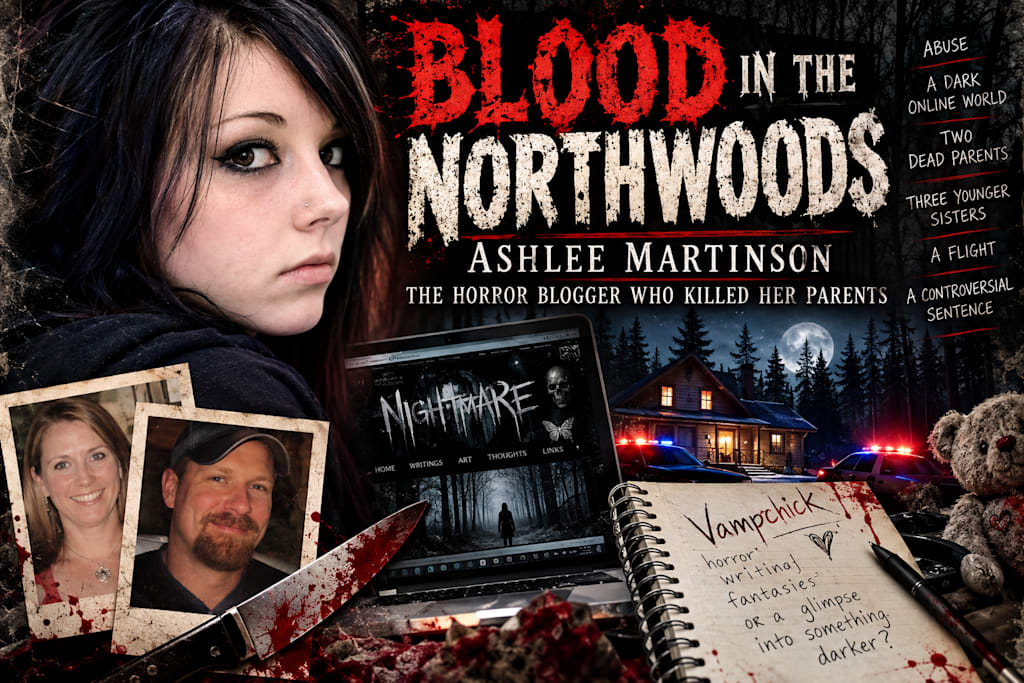
BLOOD IN THE NORTHWOODS: Ashlee Martinson, the Horror Blogger Who Killed Her Parents
Miss Lil’s look at a Wisconsin family tragedy, a teenage girl’s dark online world, and the uncomfortable question of where trauma ends and criminal responsibility begins.
By Miss Lil | True Crime & Criminal Justice
Some criminal cases leave you with more questions than answers. Not because the evidence is missing, but because the circumstances surrounding the crime force us to confront things we'd rather keep neatly tucked away.
What happens when a teenager grows up in a home she describes as frightening and abusive? What happens when anger, desperation, mental illness, and access to deadly weapons collide? And when that teenager kills the very people at the center of her troubled home life, how much should her circumstances matter when the law decides her punishment?
Wisconsin's Ashlee Martinson case is a grim reminder that a family tragedy can contain multiple layers of suffering without making the loss of human life any less devastating.
This is the story behind the headlines. And trust me, there is a whole lot more to it than a shocking crime scene.
A TEENAGER WITH A DARK ONLINE PERSONA
Ashlee Martinson was 17 years old in March 2015. She lived with her mother, Jennifer Ayers, her stepfather, Thomas Ayers, and her three younger stepsisters in the Rhinelander area of northern Wisconsin.
Away from the family home, Martinson reportedly cultivated an online identity associated with horror, disturbing imagery, and violent fiction. She used the name “Vampchick,” and an online blog called Nightmare became part of the media attention surrounding the case.
Some of the material attributed to the blog contained graphic fantasies involving torture and killing. News reports highlighted those writings after the deaths of Martinson's parents, prompting the public to scrutinize her online presence.
But let's get one thing straight: writing horror fiction is not proof that someone will commit a violent crime. Plenty of people enjoy dark stories, gruesome movies, and fictional monsters without ever harming another person.
The significance of Martinson's online persona lies in the questions it raised alongside the other evidence. What did she write before the killings? What did she say privately to people she knew? And what, if anything, could those communications tell investigators about her state of mind?
Her online world became one piece of a much larger and more complicated investigation.
THE DAY BEFORE: AN ALARMING MESSAGE
One of the most important pieces of evidence discussed in the criminal proceedings was a message Martinson sent to her boyfriend on March 6, 2015, her seventeenth birthday.
In that message, she described her stepfather allegedly beating her mother and expressed fear about the situation at home. She also wrote that she wanted to kill him.
That message matters because it predates the killings. It shows that, whatever else was happening inside the household, Martinson was expressing extreme anger and violent thoughts before the fatal confrontation.
It also became central to the prosecution's position that she had made choices leading up to the killings, rather than acting without any opportunity for control.
Her defense, however, would argue that the message had to be understood in the context of the abusive circumstances she said she had endured.
And there is the first major conflict at the heart of this case: a disturbing expression of intent on one side, and a history of alleged abuse and psychological distress on the other.
Neither part of that story can simply be erased because the other exists.
MARCH 7, 2015: TWO PEOPLE DEAD
The following day, the family confrontation turned deadly.
According to the criminal proceedings, Martinson shot her stepfather, 37-year-old Thomas Ayers, and killed him. She then fatally stabbed her mother, 40-year-old Jennifer Ayers, more than 30 times.
The killings occurred at the family residence in the Town of Piehl, near Rhinelander.
Martinson's account, as discussed in court records, was that she had initially intended to kill herself with a firearm. When Thomas confronted her outside her bedroom, she shot him. She later described a confrontation with her mother, who was reportedly distraught over what had happened and approached her with a knife. Martinson said she wrestled the weapon away and stabbed her mother.
These details formed part of her account and the defense's explanation. They should not be confused with an independent finding that every aspect of her version was established as fact.
The central facts were not in dispute by the time the case reached sentencing: two people were dead, and Martinson had pleaded guilty to killing them.
But the circumstances surrounding those deaths remained crucial to the arguments over how she should be punished.
THREE YOUNGER GIRLS LEFT INSIDE THE HOUSE
There was another deeply disturbing part of the case that deserves attention.
After the killings, Martinson's three younger stepsisters remained in the house with their parents' bodies. The girls were children, including one who was only two years old.
According to accounts presented in the case, Martinson confined the girls in a bedroom before leaving the residence. They eventually escaped and contacted emergency services.
Think about that for a moment.
Three children were left to navigate the aftermath of a double homicide involving the adults responsible for their care. Whatever Martinson believed she was escaping or reacting to, her younger stepsisters were also vulnerable children caught in the middle of the catastrophe.
Their experience is an essential part of this story. The case was not solely about Martinson's suffering or the deaths of her parents. It also involved the safety of three children who had to live through the consequences.
Her boyfriend traveled with her as she fled to Indiana, where the two were subsequently apprehended. He was not charged in connection with the killings, according to contemporary reporting.
THE ABUSE QUESTION: WHAT THE DEFENSE ARGUED
Here is where the case becomes especially difficult to discuss responsibly.
Martinson's defense presented evidence of an allegedly abusive home environment and argued that the trauma she had experienced affected her mental state and her ability to make rational decisions.
Court records describe evidence concerning abuse in the household, including allegations of violence by Thomas Ayers against family members. The sentencing judge acknowledged that Martinson had lived in an ongoing abusive environment and that those circumstances had come to a head in March 2015.
The defense also emphasized Martinson's young age, mental health difficulties, and lack of a prior criminal history. It argued that the circumstances amounted to substantial provocation.
Those arguments mattered legally. Martinson's original charges included two counts of first-degree intentional homicide. Under a negotiated plea agreement, the charges were amended to two counts of second-degree intentional homicide based on the mitigating circumstance of adequate provocation.
She pleaded guilty to both counts in March 2016.
That distinction is important. The case did not end with a jury deciding whether she was guilty of first-degree murder. Instead, the prosecution and defense reached an agreement that reduced the charges, and Martinson admitted guilt to the lesser offenses.
The abuse evidence helped explain the defense's position and the plea agreement. It did not make the deaths any less real, nor did it automatically excuse the killings.
There is a difference between understanding the circumstances in which a crime occurred and deciding that the crime should carry no consequences.
WAS THIS A CASE OF SELF-DEFENSE?
This question frequently comes up when people discuss Martinson's account of the confrontation.
The short answer is that the case was not resolved through a finding that the killings were justified self-defense.
Martinson's description of the events was relevant to the defense's arguments about provocation and her mental state. But the negotiated convictions were for second-degree intentional homicide, and the sentencing court imposed a substantial prison term.
The legal issue was not simply whether Martinson felt threatened. It was whether the evidence and applicable law justified reducing the charges and how the court should weigh the mitigating circumstances when determining punishment.
The distinction matters because self-defense, adequate provocation, and mental illness are different legal concepts. They do not automatically produce the same outcome.
A person can have experienced genuine trauma and still be held criminally responsible for a violent act. Likewise, acknowledging criminal responsibility does not require pretending that the person's history had no bearing on what happened.
This case sits in that uncomfortable space between those truths.
THE SENTENCE: 23 YEARS BEHIND BARS
On June 10, 2016, Martinson, then 18, was sentenced to 23 years of initial confinement in prison, followed by 17 years of extended supervision.
The prosecution had requested 40 years of initial confinement. The defense had argued for a substantially shorter prison term, recommending eight years of confinement followed by extended supervision.
The sentencing judge faced competing considerations: the extraordinary seriousness of killing two people, Martinson's youth, her mental health, and the abusive circumstances described in the proceedings.
The court recognized the difficult environment in which she had lived but concluded that the gravity of the crimes demanded a significant sentence.
The judge also rejected the argument that Martinson's circumstances meant she had no meaningful choice in the killings.
That decision became the focus of a subsequent legal fight.
THE APPEALS: COULD HER SENTENCE BE REDUCED?
Martinson challenged her sentence, arguing that the sentencing court had improperly considered her ability to choose whether to kill her parents, given the legal standard associated with adequate provocation.
In February 2019, the Wisconsin Court of Appeals upheld the judgment and rejected her argument that the sentencing court had improperly exercised its discretion. The court considered the sentencing record and the judge's treatment of the circumstances surrounding the crimes.
The Wisconsin Supreme Court subsequently declined to review the case in June 2019.
But the legal story did not end there.
In 2025, Martinson sought a reduction of her sentence. An Oneida County judge denied that request in September 2025, according to reporting by WXPR.
That means the latest major development identified in the reporting reviewed for this article is that her attempt to obtain a reduced sentence was unsuccessful.
The case remains a sobering example of how difficult it can be to revisit a sentence after a defendant has pleaded guilty, received a punishment, and exhausted earlier avenues of appeal.
THE PUBLIC'S OBSESSION WITH THE MONSTER
There is a reason the Martinson case attracted such intense attention.
A teenager associated with horror writing. A family home in rural Wisconsin. Two brutal killings. Three younger children left behind. Allegations of abuse. A boyfriend. A flight across state lines. And a criminal case that forced a court to weigh trauma against accountability.
It is the sort of story that practically invites the public to turn a person into a character.
Some people see the online writings and conclude that Martinson was a monster waiting to emerge. Others focus on the alleged abuse and see a desperate teenager who reached a breaking point. Still others look at the evidence of violent intent before the killings and argue that the outcome was not simply an impulsive response to a single confrontation.
But people are rarely understood accurately through a single label.
The blog posts cannot tell us everything about Martinson's mind. The allegations of abuse cannot, by themselves, explain every decision she made. And the fact that she was young cannot erase the lives that were lost.
We can examine all those elements without turning the case into a simplistic tale of either a born killer or a blameless victim.
There is no need to invent a supernatural explanation when the documented human circumstances are already devastating enough.
THE PEOPLE WHO CAN NO LONGER TELL THEIR SIDE
One of the most troubling aspects of a homicide case is that the victims cannot respond to the accusations, explanations, or narratives that emerge after their deaths.
Thomas and Jennifer Ayers were not merely names in a court file. They were people whose lives ended violently. Their surviving family members were left to deal with the loss, the circumstances of the killings, and the public scrutiny that followed.
The court record includes allegations of abuse and evidence presented by the defense. Those matters deserve careful consideration. But it is equally important not to treat every allegation in a criminal case as though it were independently proven in every detail.
The dead cannot correct the record. The surviving children must live with the consequences. And the public often moves on long before the people closest to a tragedy have had the chance to process it.
That is one reason responsible true-crime reporting must be careful with its language. Accuracy matters more than a dramatic headline, even when the truth is already shocking.
MISS LIL'S FINAL THOUGHTS: TRAUMA IS NOT A SIMPLE ANSWER
So, what should we take away from the Ashlee Martinson case?
First, allegations of abuse in a household should never be brushed aside simply because the person making them later commits a crime. Violence within a family can leave profound consequences, and children deserve protection before a crisis becomes a tragedy.
Second, a history of trauma does not automatically absolve someone of responsibility for killing another person. The justice system must examine both the circumstances and the acts themselves.
Third, disturbing fiction and an online horror persona should not be treated as automatic proof of criminal intent. The evidence that matters is the evidence connected to the actual case, evaluated carefully rather than sensationalized.
Finally, we need to remember everyone caught in the wreckage: the two people who died, the three younger girls who survived, and the young woman whose choices resulted in a lengthy prison sentence.
There is no satisfying ending here. There is no clever twist that makes the loss easier to understand.
There is only a family destroyed, a criminal case shaped by competing accounts of trauma and responsibility, and a reminder that the darkest stories are sometimes the ones in which the people involved are painfully, frighteningly human.
And that, dear readers, is the part of this case that deserves more than a headline.
Because understanding how a tragedy happens is not the same as excusing it. And holding someone accountable does not mean we must stop asking how things went so terribly wrong.
SOURCES & FURTHER READING
Wisconsin Court of Appeals: State v. Martinson (2019)
The appellate decision discussing the convictions, adequate provocation, and sentencing arguments.Wisconsin Court of Appeals opinion, official court document
The court's discussion of the sentencing judge's reasoning and the evidence presented.WXPR: Judge rejects sentence modification for Ashlee Martinson (September 17, 2025)
Reporting on the denial of Martinson's request for a sentence reduction.FOX6 Milwaukee / Associated Press: 23 years in prison for Wisconsin teen convicted of killing her mother and stepfather
Contemporary reporting on the sentence imposed in June 2016.
About the Creator
Lilithea Adasia
I dig where others look away. 🖤 True crime, paranormal mysteries, uncomfortable truths, and the beautifully broken human experience. I chase the stories others bury and ask the questions others avoid. Come curious. Leave questioning.
Enjoyed the story? Support the Creator.
Subscribe for free to receive all their stories in your feed.
Comments