
A Teacher Slapped Him. He Lost His Hearing. Police Said It Wasn’t Their Case.
Two courts had to tell the police what the law already said.
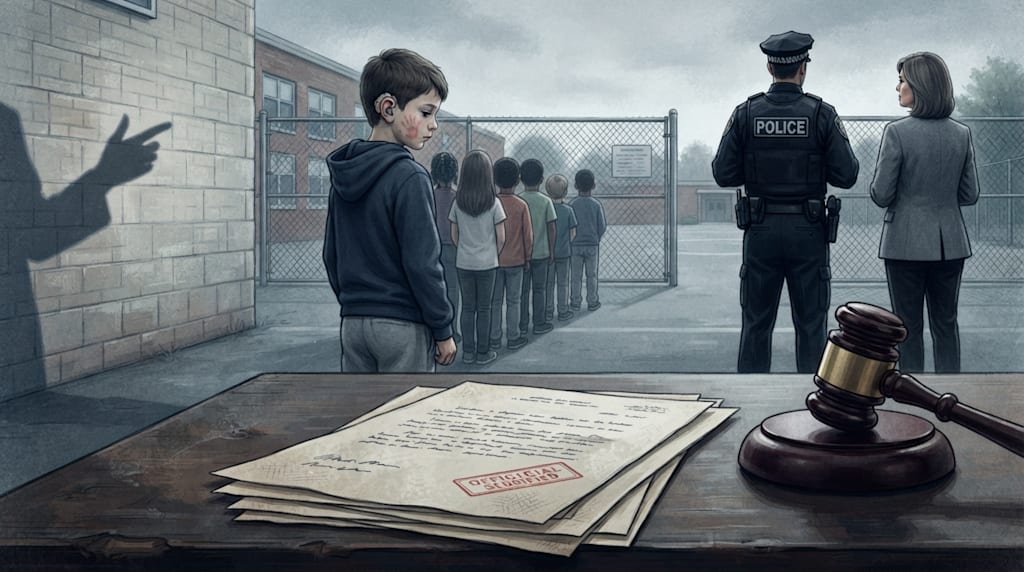
At around 4 p.m. on September 6, 2023, on a primary school playground in Guangdong, a sixth grader named Xiaoyang fidgeted while lining up for PE. Teacher Yu walked over and slapped him on the left cheek.
No warning. No words first.
Two days later, a local hospital diagnosed left ear injury and profound sensorineural hearing loss in the left ear. On September 14, Sun Yat-sen Memorial Hospital of Sun Yat-sen University diagnosed profound hearing loss in the left ear. Treatment did not restore his hearing. He now wears a hearing aid.
His parents called the police. After investigating, the local police issued a “Decision to Terminate the Case Investigation.” The reason: the case fell under the education administration department’s jurisdiction under the Teachers Law.
The parents sued. Courts at two levels both revoked the termination decision and ordered police to handle the beating again.
The courts answered a question that should not have needed a lawsuit: when a teacher beats a student and causes injury, police come first.
That answer should not require a court order.
1. The law does not give education departments exclusive control
Police cited Article 37 of the Teachers Law. That article says a teacher who corporally punishes a student and refuses to correct after education may be sanctioned or dismissed by the school or education department. If the conduct is serious enough to be a crime, criminal liability follows.
The article covers internal school discipline and criminal liability. It does not say only education departments may handle teacher assaults. It does not bar police.
Internal discipline and external legal liability run on separate tracks. An education department can sanction. Police can impose a public security punishment. Prosecutors can supervise case filing. A court can hear a civil claim. These can happen at the same time. They do not replace one another.
The Ministry of Education’s Rules on Educational Disciplinary Punishment in Primary and Secondary Schools (Trial) are clearer. Article 12(1) bans corporal punishment that directly causes physical pain, including “striking” and “pricking.” Article 15(2) says that when corporal punishment or disguised corporal punishment harms a student and violates law or constitutes a crime, police handle it.
A slap to the face that causes profound deafness is not improper discipline. It is an alleged assault.
General law also applies. Article 43 of the Public Security Administration Punishments Law, in force at the time, punishes beating or intentionally injuring another person with detention and a fine. Beating someone under 14 carries a heavier punishment. A sixth grader is usually under 14. If the injury reaches minor injury or above, Article 234 of the Criminal Law may apply as suspected intentional injury.
Article 27 of the Law on Protection of Minors requires school staff to respect minors’ dignity. It bans corporal punishment, disguised corporal punishment, and other humiliating treatment. Article 11 requires units in close contact with minors to report immediately to police, civil affairs, education, and other departments when they discover harm, suspected harm, or danger to a minor.
Schools have close contact with minors. When a teacher beats a student, the school must report. Police must accept the case.
Jurisdiction is not murky:
Public security violations or crimes: police.
Administrative sanctions, dismissal, loss of teaching credentials: education departments and schools.
Civil compensation: the school may be liable as employer and may later seek recovery from a teacher who acted intentionally or with gross negligence.
Minor protection: civil affairs, the Communist Youth League, the Women’s Federation, prosecutors, and others may intervene.
The termination decision collapsed parallel tracks into one internal track. It replaced police duty with education department exclusivity. That move avoids a legal duty.
2. Why downgraded handling keeps happening
This is not an isolated case. In many places, when a teacher has injured a student through corporal punishment, police have labeled it an internal education matter, transferred it, or terminated the investigation. Parents have sued. Courts have repeatedly revoked those termination decisions and ordered new handling.
Several forces keep producing the same result.
First, gaps between laws let frontline officers choose the easiest path. Article 37 of the Teachers Law does not mention public security punishment. The Ministry of Education rules are departmental rules, lower than statutes. That gap gives room to pass the buck. In a hard case, an officer can choose the low-risk option: no case, no punishment, terminate the investigation, let the school handle it. Whether the law requires action becomes secondary.
Second, the “internal education matter” habit is strong. For years, teachers hitting students has been treated as excessive discipline. A school sanction closes the matter. Even when the injury is serious, police may still see an education dispute, not an assault or a potential crime.
The same slap on a stranger would not be called an education matter. Special status cannot become legal exceptionalism.
Third, accountability is weak. A court can revoke a termination decision and order new handling. The officers and unit that made the wrong decision rarely face discipline. For police, the lawsuit often means starting over, not suffering a real consequence. When error has no cost, correction depends on luck.
Fourth, difficulty of medical proof becomes an excuse not to investigate. In Xiaoyang’s case, linking the slap to deafness and grading the injury may be technically hard. Hard is not impossible. Police should keep investigating and weigh all evidence. They should not treat “cannot yet appraise” as “cannot handle” and then terminate on jurisdiction.
An investigator’s job is to find facts, not to quit when facts are hard.
Fifth, stability and mediation thinking can override law enforcement. In some places, campus cases become “home-school disputes.” The priority is mediation, calm, and keeping things quiet. Cases that police should accept and punish get pushed back to schools and education departments. That may look stable. It sacrifices legal authority and the rights of a child.
Sixth, parents face high costs. Reporting, giving statements, applying for appraisal, administrative reconsideration, administrative litigation, civil litigation: each step takes time, money, and energy. Many parents give up. Some officers bet on that. Xiaoyang’s parents sued and won. Their persistence should not be the required process for every family.
3. A court order does not fix the system
In Xiaoyang’s case, two courts revoked the termination decision and ordered new handling. That is judicial correction. It confirms the legal floor: police cannot dismiss a teacher assault case by saying education departments own it.
After the judgment, the system can still stall.
If police still delay, refuse to file, or refuse to punish, parents must seek reconsideration and sue again. The loop continues. Courts decide cases, not systems. Without real accountability for inaction, termination decisions will return with new reasons.
Breaking the loop requires at least several steps:
The Ministry of Public Security and the Ministry of Education should issue joint guidance. Teacher assault cases that injure students should go to police for initial investigation. Police should not refuse or terminate them as internal education matters.
Schools should follow mandatory reporting. When a student is injured by corporal punishment, the school reports to police immediately. It does not “coordinate” internally first.
Prosecutors should supervise case filing. If police should file but do not, prosecutors should demand reasons. If the reasons fail, they should order filing.
Departments should hold pass-the-buck inaction accountable. Law enforcement quality reviews should include these cases. Officers and units that illegally terminate investigations or refuse statutory duties should face discipline and legal consequences.
Courts should track enforcement of re-handling orders. A judgment that orders new handling should not become a piece of paper.
Parents need real support: legal aid, psychological support, and lower costs for pursuing rights.
The law is simple. Enforcement is the hard part.
4. Discipline is not a cover for violence
This case also requires a clear line between school discipline and corporal punishment.
School discipline aims to correct behavior and teach rules. It can include criticism, self-reflection, extra service tasks, or standing for one class period. It must have a proper purpose, necessary means, appropriate degree, and fair procedure.
Corporal punishment, especially striking, pricking, and slapping, directly causes physical pain. The Ministry of Education rules ban it. Hits to the head or face are especially dangerous. Deafness, eardrum perforation, and brain injury can happen in a second.
Yu’s act was not improper discipline. It is suspected of being illegal and possibly criminal. A slap does not become “excessive discipline” just because it happened at school between a teacher and a student.
Schools are not outside the law. Teachers are not outside the law. Discipline has limits. Violence has legal consequences. The goal of discipline is education, not permanent harm.
5. The hearing aid
Xiaoyang still wears a hearing aid.
It is a medical device. It is also part of his day. He wears it to class. He wears it at home. He wears it outside. The playground is still a playground. The line is still a line. He stands in it.
After one slap, the legal answer is in the judgment: when a teacher hits a student, police handle it first.
Now police and schools need to answer with action.
About the Creator
Jin
Writer of reamstories
https://reamstories.com/jin
Enjoyed the story? Support the Creator.
Subscribe for free to receive all their stories in your feed. You could also become a paid subscriber, letting them know you appreciate their work.
Comments
There are no comments for this story
Be the first to respond and start the conversation.