
A Robot Touched a Teenager in Cologne. The Real Legal Fight Is Over One Word.
German police are investigating a 16-year-old robot owner. The case turns on whether a machine can commit “physical contact” — and on who was holding the phone.
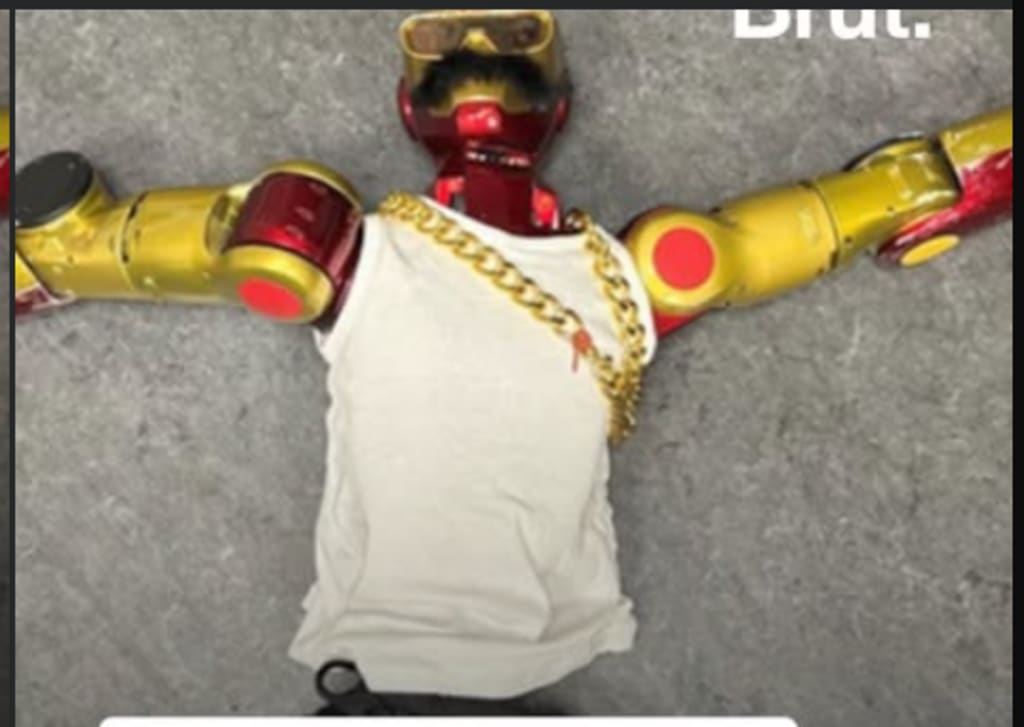
Shortly before midnight on 11 October, a 16-year-old girl stood outside a fast-food restaurant at the corner of Palmstraße and Hohenzollernring in central Cologne with two older female friends. A humanoid robot, about 1.2 metres tall, dressed in red and gold with a white vest and black trousers, approached her from behind. It touched her buttocks and made a thrusting movement towards her. The girl screamed and moved away. When she called the police, she said the person who had harassed her was a robot.
Cologne police seized the robot the following day and apprehended two suspects: the 16-year-old owner of the machine and a 19-year-old companion. The robot had been placed in the boot of a Volkswagen owned by the 16-year-old. Police also seized the robot and the two men’s mobile phones. According to the police account, the two are suspected of filming the episode and streaming it on social media with live commentary. Neither has been charged; both remain suspects. A police spokesperson, Bermel, said the force had not encountered this phenomenon before and described it as a new field.
The case has been reported as a robot molestation. The legal difficulty is narrower and more concrete. Two questions have to be separated. First, can the evidence establish a chain of control from a human instruction to the robot’s movement? Second, does a touch delivered by a machine satisfy the “physical contact” element of the German sexual-harassment offence? Cologne police have opened the investigation under §185 of the Criminal Code, the insult offence, rather than §184i, the sexual-harassment offence. That choice responds to the second question, but it does not answer it.
What is established, and what is still a working hypothesis
The public facts can be stated with reasonable precision. The incident occurred between 23:45 and midnight. The robot approached the girl from behind, touched her buttocks and made a sexualized thrusting motion. She screamed and moved away. Police found the robot in the boot of a car nearby, at Magnusstraße and Hohenzollernring. The owner is 16; the companion is 19. The two phones are in police custody. Police are examining surveillance footage from the area and the videos circulating online.
The central factual question is how the robot was operating. Was its movement pre-programmed, remotely controlled in real time, or produced by some automatic function? Local television reported that police currently lean towards real-time control. “Lean towards” is the correct description: the control method has not been established by technical evidence in public. A suspect said on TikTok that the robot was avoiding a pedestrian and accidentally collided with the girl. Longer videos circulating online are reported to show sexualized movement after the contact. That claim and those videos still need to be checked against the full recording and the robot’s operating data.
The evidential trap is simple. A video recorded on a phone shows the robot’s outward movement. It does not show where the command came from. A person standing nearby holding a phone may be streaming, controlling the robot, or doing both. The robot may have received a real-time command, executed a pre-set sequence, or malfunctioned. These possibilities carry different responsibility consequences. The phones are therefore not ancillary evidence. Investigators need to align connection logs, device-operation records, any logs stored in the robot, and the timestamps of the full video. Who connected to the device? Who triggered the movement? What did each suspect do before and after the movement? The records may be incomplete, and the robot may not contain a clean “crime log”. The aim is not to establish who owns the robot, but who exercised control at the relevant moment.
§184i: the text, the commentary, and the unresolved point
§184i(1) StGB punishes anyone who “touches another person physically in a sexual manner and thereby harasses them” with up to two years’ imprisonment or a fine. The dispute is whether “physically touches” requires direct body-to-body contact between the perpetrator and the victim, or whether contact mediated by an object can suffice.
The commentary is less uniform than the charge choice implies. At least one widely used commentary states that physical contact between victim and perpetrator is required, but that contact effected with objects is sufficient. That formulation does not treat a tool as an automatic barrier. A 2025 legal note from the Bundestag’s scientific service stressed that §184i requires direct physical contact by the perpetrator. Whether that note exhausts the commentary discussion is not clear from the public material. What is clear is that no appellate decision has settled the robotic-intermediary question. German criminal lawyers disagree about whether the current law contains a gap.
If a court accepts that object-mediated contact can satisfy the element, §184i is available in principle. The operator who directs the robot is not a lesser participant because a machine stands between him and the victim. The structure is familiar: a person who uses a stick to touch another person is not outside the offence because the stick, rather than a hand, made contact. The robot is a more complex tool, but the attribution question is the same. If a court insists on direct body-to-body contact, §184i runs into an application problem. The police choice of §185 is then a pragmatic way to avoid that risk at the charging stage. It is not a declaration that §184i is permanently unavailable.
§185: a different offence with its own threshold
§185 does not require physical contact, so the robotic intermediary creates no elemental obstacle there. But insult is not a general fallback for every unwanted sexual act. German case law and commentary require more than a sexual motive or a crude sexual gesture. The conduct must express contempt or denigration of the victim. The offence protects reputation; it does not protect sexual autonomy in the same way as §184i.
The live stream and commentary are the strongest material for §185 in this case. A bodily gesture filmed and broadcast with commentary can become a public, targeted degradation. The commentary may turn the girl into the object of a sexual joke. But that conclusion depends on what was actually said. The words have to be examined line by line. The fact that a stream took place does not by itself establish that the stream expressed contempt. Insult also requires intent, including intent to express denigration. If the operator says the movement was a prank or an accident, the proof of subjective intent becomes a contested issue.
Two further options have been discussed but are not the current charge. A more serious sexual-offence provision would apply if the conduct amounts to a sexual act committed by surprise. Its application depends on the seriousness of the act and the victim’s lack of preparedness. The stream itself can also engage §184k (unauthorised production or obtaining of images of intimate body parts) or §201a (violation of the most personal sphere through images). Those offences require separate proof: the images must capture the protected body parts or private sphere. If the stream mainly shows the robot’s exterior and the girl’s clothed appearance, those provisions may not fit. They are not automatic add-ons to a sexual insult charge.
Who is responsible, and where the robot sits
The robot has no criminal capacity. It cannot be a perpetrator or a defendant. Its legal position is that of an object seized as evidence. The responsibility analysis concerns the people behind it.
If the evidence shows real-time remote control, the operator is best analysed as a direct perpetrator. He used the robot as a tool to carry out the movement. The same analysis applies if he pre-programmed the sequence and triggered it when the girl was in position. Pre-programming does not remove responsibility. A person who prepares a sexualized movement and activates it at the victim’s approach intentionally realizes the conduct. The doctrinal label of indirect perpetration is awkward because the machine is not a person; the operator’s control is direct over the tool, and the attribution runs to him.
The 19-year-old companion’s position depends on his role. If he knew of the operator’s intent and reinforced the public degradation by filming and commentating, co-perpetration or aiding may be considered. If his involvement was mainly later distribution, image-related offences may be more relevant. The two suspects are at different points in the control chain, and their roles need separate proof.
The manufacturer is not a criminal defendant on these facts. Criminal responsibility would require evidence of a product defect and a causal link between that defect and the movement. The case as reported concerns alleged misuse, not a defective product. The forthcoming German product-liability changes for software and AI systems will not do work in this criminal investigation unless a specific defect is identified. Ownership of the robot is not enough to attribute the command.
What decides the case
The case will turn on the control chain, not on the word “robot”. If the phone records, connection logs, robot data and video timestamps establish who triggered the movement, the responsibility question becomes concrete. If a court then accepts that object-mediated contact can satisfy §184i, the sexual-harassment offence returns to the centre of the case. If the court does not, §185 and the separate image offences are the realistic routes. The interposition of a machine should not give an operator a responsibility discount, but that is an argument to be made within the existing elements, not a result that can be assumed.
The robot is in police custody. The phones are evidence. The boot of the Volkswagen is part of the timeline. The next step is technical: match the command to the movement.
About the Creator
Jin
Writer of reamstories
https://reamstories.com/jin
Enjoyed the story? Support the Creator.
Subscribe for free to receive all their stories in your feed. You could also become a paid subscriber, letting them know you appreciate their work.
Comments
There are no comments for this story
Be the first to respond and start the conversation.