
A $20 Switch, a $2,800 Bill: Why the Repair App Keeps Getting Away With It
Woodpecker has been exposed, investigated, and criticized. The pricing model still turns small fixes into large receipts.
I. Half an hour, 2,800 yuan
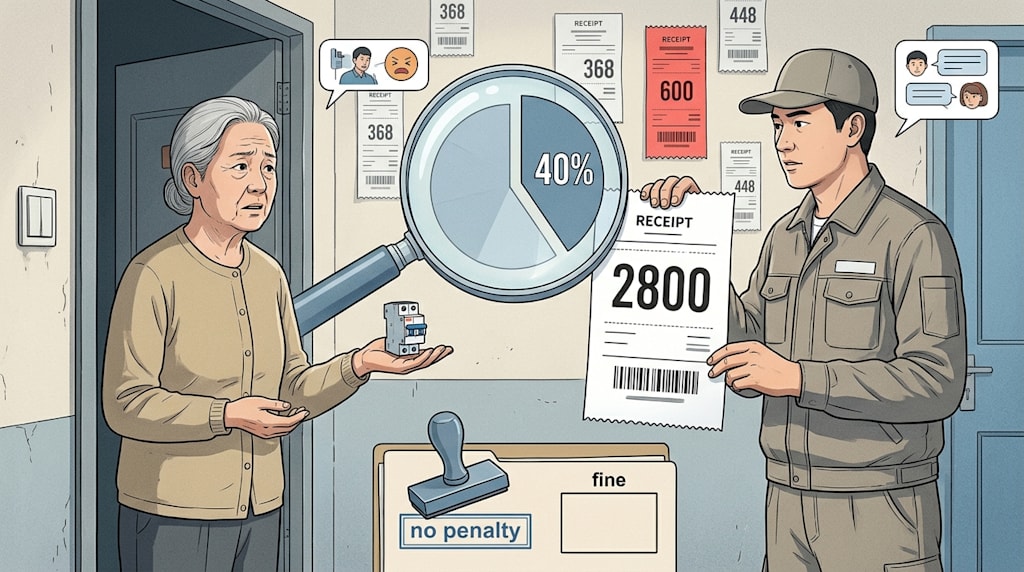
In August 2026, the circuit breaker tripped in the home of Ms. Chen, a 65-year-old woman living alone in Nanjing. A Woodpecker Home Repair worker replaced a residual-current circuit breaker. The switch sold for about 20 yuan. The platform quoted 2,830 yuan. After bargaining, the charge was 2,800 yuan. The replacement took about half an hour. A home inspector later put a reasonable fee at no more than 300 yuan.
The family complained six or seven times. The platform first offered a refund of 800 to 1,000 yuan. After media coverage and public outcry, it refunded the full 2,800 yuan and added 2,000 yuan, for a total of 4,800 yuan.
No court ordered that 4,800 yuan. Under Article 55 of the Consumer Protection Law, proven fraud calls for a refund plus triple compensation: 2,800 × 3 + 2,800 = 11,200 yuan. The platform settled an exposure that could have kept growing for less than half the statutory amount. A lawyer put it plainly: this is crisis PR, not sincerity.
II. Not an isolated case
Public reports and online complaints from 2026 show the same procedure.
In July 2026, a consumer in Jinan had three hinges replaced. The market price was about 10 yuan each. The charge was 368 yuan. In March 2026, a consumer had a refrigerator circuit-trip repair and was charged 600 yuan: 268 yuan for inspection and 332 yuan for a switch that sold online for 40 yuan. In February 2026, a consumer had a toilet unclogged in 10 minutes and was charged 448 yuan. The receipt did not match the service.
The amounts, cities, and faults differ. The procedure does not. No precise quote or capped price before the visit. After arrival, an order and a relatively low fee. Then a “discovery” that more parts need replacing or more work needs doing. A quote far above market, with a vague itemization. Black Cat Complaints lists more than 14,000 Woodpecker complaints, with new ones in the past month. In an undercover test, only two of five repair workers told the truth.
III. The 40% commission
Woodpecker’s prospectus shows the math. Revenue from 2021 to 2023 was 401 million, 595 million, and 1.011 billion yuan. Gross margins were 80.5%, 81.4%, and 84.2%. The platform takes about 40% of the total order payment. Other repair platforms generally take 10% to 20%.
When a consumer pays 1,000 yuan, the platform takes about 400 yuan first. The repair worker’s share shrinks. To keep income up, the worker’s easiest move is not to work faster. It is to push each quote toward what the consumer can bear. Reported descriptions of Woodpecker’s onboarding say training stresses “customer pricing communication” more than technical guidance. Trainees hear lines such as “if you don’t know how, look it up on Douyin” and “if you quote low, you can’t make money.” A system that teaches quoting before fixing turns the price assassin into part of the business model.
IV. Why exposure does not hurt
Woodpecker’s Hong Kong IPO prospectus, filed in January 2024, expired in July. The company filed again in September. CCTV exposure and continuing complaints raised compliance pressure and made listing harder. With the capital-market door stuck, the short-term move is to squeeze more value from existing orders. An IPO is long-term. Cash flow is daily.
High commissions are not a tacit permission. They are institutional pressure. Blaming individual repair workers misses the production end. The platform takes 40%; the worker executes the quote.
Substantive administrative penalties are absent. After the 2025 CCTV 3.15 exposure, Chongqing market regulators sent more than 80 enforcement officers to Woodpecker’s headquarters. They seized accessories without CCC certification, obtained data, and opened a case. Later reviews found the action “completed only procedural compulsory measures such as seizing items and checking materials.” It never imposed substantive penalties on systemic price fraud or business-model violations. There were no fines, no accountability, and no closed-loop rectification.
The cost of breaking the law is close to zero. A company that treats notoriety as fame can ride out a public outcry as a PR cycle. Ms. Chen got 4,800 yuan under public pressure. The 368-yuan hinges in Jinan, the 600-yuan refrigerator repair, and the 448-yuan toilet unclogging happened a year after the CCTV exposure. Exposure can save one Ms. Chen. It cannot save the next one.
V. The legal ledger
Article 20 of the Consumer Protection Law requires true and complete service information and bans false or misleading publicity. Article 55 provides a refund plus triple compensation for fraud, with a 500-yuan floor. Articles 148 and 149 of the Civil Code let a defrauded party revoke a civil act. Concealing the real fault and inducing a consumer to pay far more than a reasonable price can constitute fraud in an individual case.
Evidence is hard to get. Individual amounts are small. Litigation costs are high. To prove intent to defraud, a consumer may need repair records, quotes, market comparisons, an appraisal, and the platform’s dispatch and revenue-sharing data. Most people will not sue over a few hundred or a few thousand yuan. The platform counts on that. The 2,800-yuan case ended at 4,800 yuan because media exposure created public-opinion costs, not because the legal process worked. For ordinary orders outside the public eye, the default remains: refund part, stall, let it fizzle out.
VI. How to break the cycle
Regulators need to impose substantive penalties. Seizing accessories and pulling data are necessary. Without fines, accountability, and closed-loop rectification, companies will calculate that one exposure costs less than continued high-commission harvesting.
Commission rates and fee structures need transparency. The platform takes 40% of the order, and consumers do not know. Platforms should disclose service-fee components, commission rates, and accessory price ranges. Split charges such as “doorstep inspection fees” should be banned as disguised price increases.
Pre-visit capped quotes and itemized bills should be mandatory. Before the visit, the platform should list the service items and a capped price. Any added item needs fresh confirmation. The receipt must match the work performed. Refusing an itemized bill should count as a violation.
The platform should bear joint liability for repair workers’ pricing. It cannot take 40% and then blame individual workers for arbitrary quotes. Anyone who shares the order revenue should answer for the order’s truthfulness and reasonableness.
Consumer remedies need to cost less. For platforms with clustered complaints, regulators can bring public-interest litigation or support class actions. For older people and those living alone, complaint and advance-compensation channels should be easier to use. Consumers should not need a trending topic to get their money back.
VII. Back to the switch
Ms. Chen got her 2,800 yuan back. The 4,800-yuan settlement arrived. The 20-yuan residual-current circuit breaker is still in her distribution box. A reasonable labor fee for half an hour is no more than 300 yuan.
The next time the circuit trips, she may not know which repair worker will go easy on her. A normal repair market should not run on goodwill. A switch worth a few dozen yuan and a bill for 2,800 yuan expose a larger problem: the mechanism behind the price has not been broken.
About the Creator
Jin
Writer of reamstories
https://reamstories.com/jin
Enjoyed the story? Support the Creator.
Subscribe for free to receive all their stories in your feed. You could also become a paid subscriber, letting them know you appreciate their work.
Comments
There are no comments for this story
Be the first to respond and start the conversation.