
80,000 Yuan Gone in 7 Minutes: The Bank Says the Texts Went Out. He Says His Phone Stayed Silent.
A cancer patient’s savings vanished through 17 digital yuan transfers, a 47,000-yuan overseas payment, and a bank that wants a court to decide who pays.
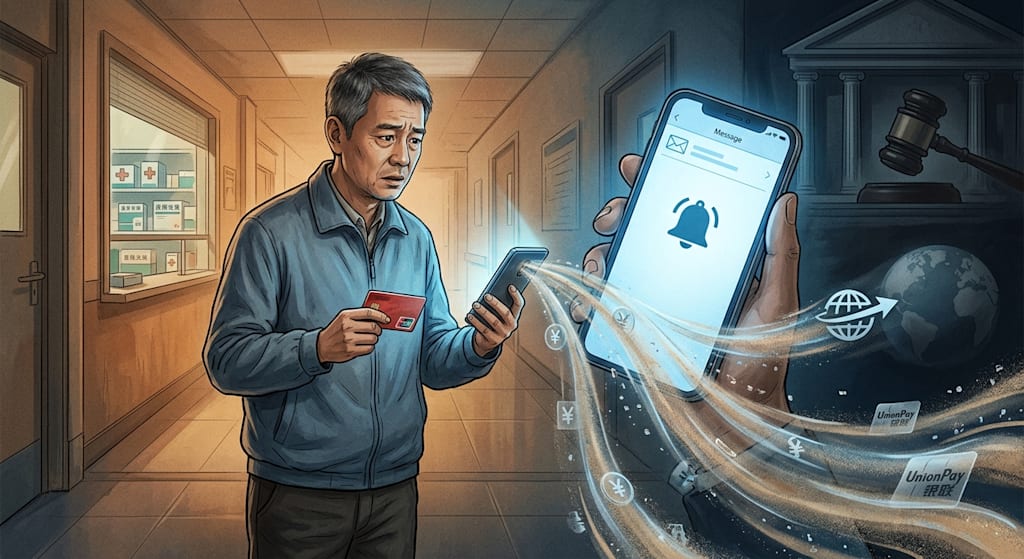
The 7 Minutes
January 24, 2026, 8:26 a.m. A 10,000-yuan transfer left Mr. Zhou’s ICBC card ending in 9492. Thirteen minutes later, digital yuan began moving out. 99.9, 199.9, 499.9, 999.9, 1,999. By 8:46, 17 transactions totaled 9,093.9 yuan. During the same window, three digital yuan purchases took 500 yuan each. Then UnionPay charges: 999.83, 957.82, 2,921.36, 1,935.18, 2,654.60.
At 0:37 a.m. the next day, a card-not-present payment of 47,232.23 yuan went through. The venue was listed as online banking. The receiving account was 3036****0963. The name on it was Moncler. An overseas account. When it was over, the balance was 3,904.33 yuan.
Mr. Zhou’s wife has cancer. She was waiting for money to buy medicine. On February 12 at noon, he checked the account. More than 82,000 yuan had become less than 4,000. He called the police. The Yunxi County Public Security Bureau accepted the case and opened an investigation. That day, the criminal investigation detachment issued a certificate: during the theft, Mr. Zhou did not transfer, pay, authorize, or disclose information involving his phone or bank cards. The money was stolen by illegal means. He was not at fault. The certificate carried an official seal.
The Bank’s Answer
The bank’s response rested on a few claims.
ICBC Xi’an Dongdajie Sub-branch issued a handling opinion. It said China UnionPay replied that six UnionPay purchases on January 24, totaling 10,468.62 yuan, and one online card-not-present payment on January 25, of 47,232.23 yuan, were all paid after verifying the customer’s mobile number. The seven transactions totaled 57,700.85 yuan. UnionPay said they did not fall under its compensation scope or the merchant’s. It told the customer to report to police.
Two digital yuan wallet payments on January 24 totaled 1,499 yuan. ICBC said the digital yuan account was opened through the unified app, and the registered mobile number belonged to the customer.
A 10,000-yuan payment on January 24 was a mobile banking cross-bank transfer to Mr. Zhou’s own China Construction Bank account, the bank said. No theft.
The 17 digital yuan payments totaling 9,093.9 yuan went to Bank of China, Agricultural Bank of China, and Industrial Bank digital yuan wallets. The customer needed to bring his ID to those banks to inquire.
A person in charge at ICBC Shaanxi Branch told reporters that the police certificate of no fault was only for criminal filing. It could not directly divide civil compensation. The police determine criminal liability, not rights and liabilities. The police saying the customer is not liable does not mean the bank is liable. A court must decide the split. If a court finds the bank liable, the bank will pay.
Mr. Zhou is charged 3 yuan a month for SMS. For more than 20 transactions, he says he received no text.
A Case I Once Handled
I once sat across from a couple. They said 80,000 yuan in life-saving money had disappeared from their card, and the bank had sent no texts. The husband said he had not transferred anything. The wife said she had not done order-brushing. I asked for the bank statement. The money had gone out in batches. The payee was a string of English. An overseas account.
I kept the husband alone. He insisted he had done nothing. I went through his phone. The browser history showed adult porn sites. The app list had a foreign-language app. After his wife stepped away, he admitted he had downloaded it from a porn site to watch videos. He thought he was only watching. He had not clicked a link, entered a password, or transferred money.
A Trojan intercepted the texts. The bank’s alerts and verification codes never appeared as pop-ups. The malware read them in the background and deleted them. The phone stayed quiet. What he saw was a bank that sent nothing. The virus took the codes, moved money in batches, and sent it overseas. The case was filed as credit card fraud.
I am not saying Mr. Zhou followed that path. His case has no phone forensic report and no evidence he installed anything. The point is simpler: not receiving a text and the bank not sending one are different claims. The first is what the phone owner experienced. The second requires system logs.
Check the bank’s SMS logs. Check the carrier’s delivery records. Check the phone’s message database. Check for malware. Only then can anyone say where the texts went.
Where the Law Stands
The bank cannot dismiss its liability by saying the verification code passed.
Article 509 of the Civil Code says parties must fully perform their agreed obligations. In a savings deposit contract, the bank must pay on maturity and safeguard the account.
Article 6 of the Commercial Bank Law says commercial banks must protect depositors’ lawful rights from infringement.
Article 4 of the Supreme People’s Court provisions on bank card civil disputes says a cardholder can provide evidence such as an effective legal document, the card’s location at the time, transaction location, account details, transaction notices, police report, and loss report. If the issuing bank or non-bank payment institution claims the transaction was by the cardholder or authorized by him, it bears the burden of proof.
Article 7 says if a counterfeit-card or online theft occurs, the debit card holder can ask the issuing bank to pay the stolen principal and interest and compensate losses. Courts should support that. If the cardholder failed to properly keep the card, password, verification code, or other identity and transaction verification information, and was at fault, the bank can argue for shared liability. Courts should support that too.
Mr. Zhou has statements, a police report, a filing notice, and the police certificate. Once he presents them, the burden shifts to the bank. If the bank claims it was him or that he was at fault, it needs evidence. The bank says the code passed. A passed code does not prove he did it. The phone could have been controlled. The text could have been intercepted. The transaction environment could have been faked.
The bank must prove the texts were sent, delivered, and not illegally intercepted. It must prove the digital yuan wallet was opened with Mr. Zhou’s real-name authentication. It must prove the device, IP, and transaction environment were normal. It must prove Mr. Zhou leaked the verification code. If it cannot, liability is hard to avoid.
Four Questions That Decide the Case
First, whose mobile number is the digital yuan wallet ending in 57? Mr. Zhou says it is not his. ICBC says the registered number is his. Check the real-name records, the opening video, the device fingerprint, the login IP. If the number is not his, the bank had holes in wallet opening, card binding, and verification. If it is his, then check who had the phone and how the code was used.
Second, were the texts sent, delivered, or deleted? Mr. Zhou pays 3 yuan a month for SMS. On January 24, the fee was charged. For more than 20 transactions, the phone gave no alert. ICBC said the seven UnionPay and online banking transactions were paid after mobile verification, but it did not explain the SMS records. A court can retrieve the bank’s SMS logs, the carrier’s delivery records, and the phone’s message database. Then the texts’ path becomes clear.
Third, does the 10,000-yuan same-name transfer count as theft? The bank says it went to Mr. Zhou’s own China Construction Bank account, so it was not theft. If someone else used his mobile banking, code, and device, it is still a theft-related loss. A same-name account is not a shield. Check the IP, device fingerprint, login logs, and facial recognition records.
Fourth, how did the 47,000-yuan overseas card-not-present payment happen? The payee was Moncler, an overseas account. The amount was 47,232.23 yuan, the largest single loss. If it went through mobile verification, the bank must prove the code was issued, delivered, and not intercepted. If it cannot, it cannot easily shift responsibility to Mr. Zhou.
How Courts Usually See It
Courts tend to look at three scenarios.
One: counterfeit-card or online theft, and the bank cannot prove the user was at fault. The bank pays all or most. Courts in many places have ordered 70% to 100%. The bank runs the payment system and is the first line of account security. It has stronger risk detection and technical defenses.
Two: the user was clearly at fault. Clicked an unknown link, installed malware, leaked a code, handed the phone to someone else. A court may find the user failed to keep identity and verification information safe, and reduce the bank’s share. In the Liao Moulin case in Pingxiang, Jiangxi, a digital wallet was opened in Liao’s name by someone else. 44,995 yuan was stolen in 18 transactions. The court found the bank’s failure to stop remote card binding and cross-regional transfers was the main cause. It ordered the bank to pay 80% and Liao 20%, because he had not kept identity information safe and took nearly 48 hours to notice.
Three: the transaction was by the cardholder or authorized. The bank does not pay. But the bank must prove it. It cannot just say the code passed.
In Mr. Zhou’s case, the police certificate helps him. The bank’s claims about mobile verification, the digital yuan wallet number, and the 10,000-yuan transfer need to be tested in court. Only then can liability be divided.
If He Sues
Mr. Zhou can file a civil suit. He should ask the issuing bank to pay the stolen principal and interest and compensate losses. The amount should include digital yuan exchange-outs, digital yuan purchases, UnionPay purchases, and the overseas card-not-present payment. If the 10,000-yuan transfer was not his, he should include it too.
His evidence should be complete: case receipt, filing notice, no-fault certificate, bank statements, digital wallet screenshots, SMS records, call records, loss report, messages with the bank, phone purchase receipt, and any forensic report.
He can ask the court to retrieve key records: bank SMS logs, verification code issuance records, digital wallet opening authentication, transaction IP, device fingerprint, and UnionPay transaction details. These sit with the bank, UnionPay, and digital yuan operators. He cannot get them alone. A court can.
The bank does not have to be the only defendant. The issuing bank is first. Depending on what emerges, he can ask to add UnionPay, digital yuan operators, the receiving bank, and the overseas merchant. After paying, the bank can seek recovery from the actual wrongdoer. For Mr. Zhou, suing the issuing bank first is the most direct route.
Criminal and civil cases can run at the same time. Police have filed the case. Criminal investigations can take years or stall. Mr. Zhou does not need to wait for a criminal verdict before suing. A court can decide the theft and liability from the evidence it has.
He can also complain to financial regulators. He can ask them to examine the bank’s security obligations, SMS notifications, and digital wallet opening review. A complaint does not directly produce compensation, but it can push the bank to review the case.
3 Yuan a Month
Mr. Zhou is charged 3 yuan a month for SMS.
On January 24, the fee was still charged. For more than 20 transactions, the phone stayed quiet. The balance was 3,904.33 yuan. His wife was waiting for medicine. The case is under investigation. The bank says to wait for court. Until a court rules, the money is not in Mr. Zhou’s hands.
About the Creator
Jin
Writer of reamstories
https://reamstories.com/jin
Enjoyed the story? Support the Creator.
Subscribe for free to receive all their stories in your feed. You could also become a paid subscriber, letting them know you appreciate their work.
Comments
There are no comments for this story
Be the first to respond and start the conversation.