
Why We Romanticize the Past
The Psychology Behind Nostalgia and Memory
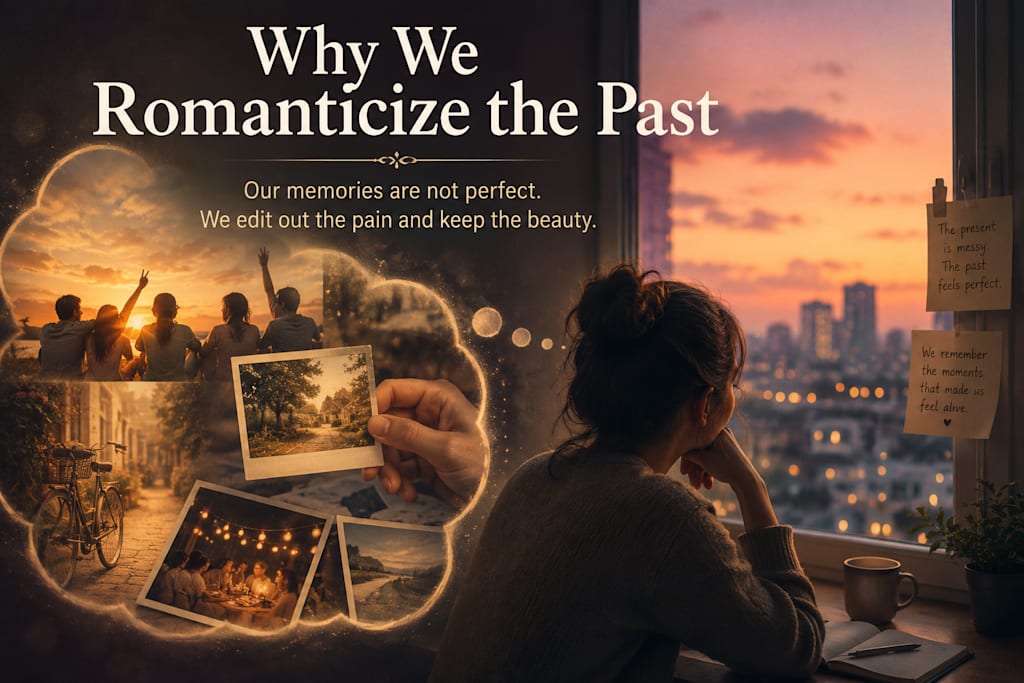
We tend to look back at the past through a soft lens, where even ordinary moments feel meaningful and difficult periods seem simpler than they really were. This tendency is known as nostalgia or romanticizing the past, and it shapes how we think about ourselves, our memories, and even our present decisions. While it can bring comfort, it can also distort reality and influence how satisfied we feel with life today.
At its core, romanticizing the past is a psychological filtering process. The human brain does not store memories like a video recorder. Instead, it reconstructs them each time we recall them. Over time, emotional details are emphasized while factual accuracy fades. This means strong emotions—especially positive ones—become more dominant in memory than mundane or negative details. As a result, past experiences can feel warmer and more meaningful than they actually were.
One major reason for this happens is something called “fading affect bias.” Negative emotions associated with past events tend to fade faster than positive ones. A breakup that once felt devastating may, years later, be remembered more as a learning experience than emotional pain. Difficult school years might be recalled with affection for friendships rather than stress from exams. The emotional sharp edges blur, leaving behind a smoother and more pleasant version of events.
Another reason is that memory is closely tied to identity. We don’t just remember events; we remember ourselves within those events. As people grow older or change circumstances, they often look back at earlier versions of themselves with curiosity or affection. The past self feels simpler, more carefree, or more authentic. This comparison can create the illusion that life was better then, even if objective conditions were not necessarily improved.
Social comparison also plays a role. The present often feels more complex and demanding because we are constantly exposed to others’ achievements through social media and modern communication. When life feels overwhelming, the mind searches for contrast. The past becomes a mental refuge where comparisons are limited and expectations were lower. This selective contrast strengthens the belief that earlier times were more peaceful or satisfying.
Cultural influences also reinforce nostalgia. Many movies, songs, and advertisements idealize earlier decades, presenting them as more genuine or emotionally rich. Childhood in particular is often portrayed as a time of innocence and freedom. These repeated narratives shape how people interpret their own memories. Even if someone did not personally experience a “golden era,” cultural storytelling can implant the idea that such a time existed.
Another important factor is stress. When people are under pressure, the brain naturally seeks emotional relief. Nostalgic thinking acts as a coping mechanism. It allows the mind to temporarily escape current responsibilities by revisiting moments associated with safety or happiness. This is why people often think more about the past during periods of uncertainty, change, or emotional fatigue.
However, romanticizing the past is not always about escape. It can also reflect a search for meaning. As life becomes more routine or demanding, people may look backward to identify moments that felt significant. The mind highlights memories that seem meaningful in hindsight, even if they were not recognized as special at the time. A simple summer afternoon, a conversation with a friend, or an old habit can gain symbolic importance when viewed through a reflective lens.
Memory distortion also increases with time because of reconstruction. Each time we recall an event, we slightly modify it based on current beliefs and emotions. Over years, these small changes accumulate. If someone is currently dissatisfied, they may unconsciously adjust past memories to appear more favorable. The contrast makes the present feel more disappointing and the past more ideal.
There is also a biological aspect. The brain prioritizes emotional memory because it helps with survival and learning. Positive emotional memories encourage repetition of beneficial behaviors, while negative ones warn against danger. But this system is not designed for accuracy; it is designed for efficiency. Over time, the brain keeps emotional meaning but drops contextual detail, which can lead to idealized recollections.
Romanticizing the past often increases during transitional life stages. Adolescence, early adulthood, and midlife are common periods where people reflect heavily on earlier years. During transitions, identity is unstable, and the brain seeks continuity. The past provides a sense of stability and coherence. Remembering “who we used to be” helps anchor identity during change, even if the memory is slightly idealized.
Technology also contributes to this phenomenon in unexpected ways. Digital archives such as old photos, videos, and social media memories allow constant revisiting of earlier moments. While this can preserve history, it also encourages selective viewing. People usually revisit positive or visually appealing memories more often than negative ones, reinforcing a biased emotional archive.
Despite its distortions, nostalgia has benefits. It can improve mood, increase resilience, and strengthen social bonds. Thinking about meaningful past experiences can remind people of their capabilities and relationships. It can also provide motivation during difficult times by reinforcing the idea that happiness has been experienced before and can be experienced again.
However, problems arise when nostalgia becomes a comparison tool rather than a reflection tool. If someone constantly measures present life against an idealized past, dissatisfaction increases. This creates a psychological imbalance where the present is always perceived as lacking. In extreme cases, this can prevent people from engaging fully with current opportunities because they are emotionally anchored in memory.
The key difference lies in interpretation. Healthy nostalgia acknowledges that the past had both good and bad moments, while romanticized nostalgia filters out complexity. One offers perspective, the other creates illusion. Recognizing this distinction helps maintain emotional balance.
Understanding why we romanticize the past also reveals something important about human nature: we are meaning-making beings. We do not experience life as raw data; we experience it as stories. Over time, those stories are edited by memory, emotion, and identity. The past becomes not just what happened, but what it means to us now.
Ultimately, the past often feels better not because it truly was better, but because it is complete. It has already been resolved, interpreted, and emotionally processed. The present, by contrast, is unfinished and uncertain. It contains unresolved challenges, unknown outcomes, and ongoing effort. Naturally, the mind gravitates toward what feels settled.
Romanticizing the past is therefore both a flaw and a feature of human cognition. It can distort reality, but it can also provide comfort, meaning, and emotional stability. The challenge is not to eliminate nostalgia, but to understand it. When used wisely, it can enrich the present rather than replace it.
About the Creator
Enjoyed the story? Support the Creator.
Subscribe for free to receive all their stories in your feed.
Comments
There are no comments for this story
Be the first to respond and start the conversation.