
The Surgeon Stopped Mid-Operation. What He Did Next Changed Everything
The operating room fell silent when one of the hospital’s most respected surgeons suddenly stopped in the middle of a life-saving operation. A young doctor had noticed something no one else had seen — a tiny blood vessel that could mean the difference between life and death. Speaking up could have cost her career. Instead, it saved a patient and taught an experienced surgeon a lesson he would never forget.
The Surgeon Stopped Mid-Operation. What He Did Next Changed Everything
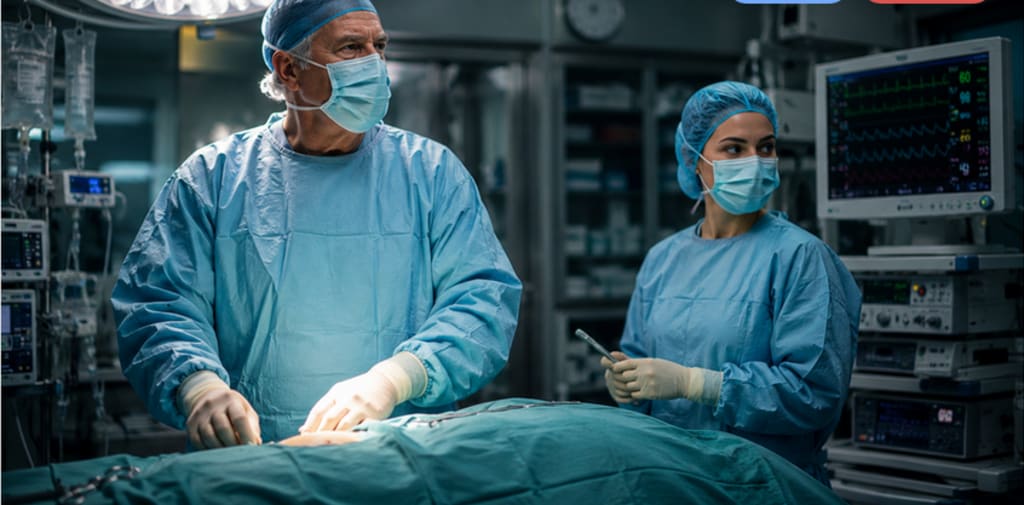
The operating room was almost unnaturally quiet in the middle of the night.
The only sound was the steady beeping of the monitors tracking the patient's vital signs.
Robert Kral, the senior vascular surgeon in charge, was considered one of the best doctors at the regional hospital. His colleagues knew his hands for their precision, speed, and remarkable steadiness. Even during the most complicated procedures, he rarely seemed to hesitate.
That night, however, he was facing one of the most difficult operations of his career.
An elderly patient had been rushed into surgery with a dangerously damaged abdominal aorta. Without immediate intervention, he could suffer massive internal bleeding and die within hours.
Everything had gone according to plan.
The surgical team moved around the operating table with the quiet efficiency of people who had worked together many times before. Everyone knew what to do. No one needed to raise their voice.
Then, in the middle of a critical step, Robert suddenly stopped.
The instrument in his hand remained motionless.
For several seconds, nobody said a word.
Then a young doctor standing beside him quietly spoke.
"Wait."
Lucie was a junior physician still early in her surgical career. She pointed toward the ultrasound monitor.
There was something unusual.
A tiny blood vessel in the rear section appeared to branch in a way that had not been visible during the patient's preoperative examination.
The room seemed to hold its breath.
Everyone knew what Lucie had just done.
Questioning Robert Kral in the middle of an operation was not something people did lightly. He was the head of the department, a surgeon with decades of experience and a reputation for being almost impossible to shake.
Lucie could easily have kept quiet.
Perhaps she even wondered, for a split second, whether she had misunderstood what she was seeing.
But she had spoken.
Robert looked at the monitor.
Then at Lucie.
Then back into the open surgical field.
And suddenly he understood.
She was right.
He had missed the tiny anatomical detail.
He had been working for hours, and fatigue had dulled his attention just enough to overlook something almost microscopic.
If they continued without correcting it, the problem might not become apparent until much later — possibly after the patient had been closed up and was recovering.
By then, it could be too late.
Robert knew exactly what had happened.
And he also knew what his position demanded of him.
He could pretend nothing had happened.
He could continue with the operation, correct the problem quietly and make sure nobody ever knew he had missed it.
After all, he was the senior surgeon.
He was supposed to be the person everyone else trusted.
Admitting a mistake in front of the entire team would mean admitting that, for one brief moment, the young doctor beside him had seen something he had not.
His pride told him to protect his reputation.
Something else told him to do the opposite.
Robert put down his instrument.
He stepped away from the operating table.
Then he looked directly at Lucie.
"I missed it," he said.
The room remained silent.
He told the team that Lucie had spotted the problem and that her observation might have saved the patient's life.
Then he did something that surprised everyone even more.
He asked Lucie to take over that part of the procedure.
The young doctor stepped forward.
The operation continued.
This time, under her careful guidance, the dangerous anatomical variation was dealt with properly.
Several hours later, the patient was stable and recovering in the intensive care unit.
Only then did the tension finally begin to disappear from the hospital corridors.
The operating room was empty.
The instruments had been cleaned and put away. The bright surgical lights had been switched off.
In a small doctors' changing room, Robert sat down beside Lucie.
She looked exhausted.
He handed her a cup of coffee.
For a moment, neither of them said anything.
Then he thanked her.
Not as her superior.
Not as the head of the department.
Simply as a doctor whose patient had been protected by another doctor's attention.
He told her something she would remember for the rest of her career.
The most dangerous moment in a surgeon's professional life is not necessarily when a procedure becomes difficult.
It is the moment when a surgeon begins to believe he cannot be wrong.
Because the moment you stop listening to the people around you, you stop seeing what they can see.
Lucie had been brave enough to speak when everyone else was silent.
And Robert had been experienced enough to listen.
That night, the young doctor gained something far more valuable than praise.
She gained confidence.
And the experienced surgeon was reminded of a lesson that even decades in the operating room could never make unnecessary:
A great doctor is not someone who never makes a mistake.
A great doctor is someone who is willing to recognize one — especially when recognizing it can save a life.
AI Disclosure
AI was used to assist with the English translation and language editing of this article. The original article was written by the author in Czech. The English version was reviewed, edited and adapted by the author before publication.
About the Creator
Enjoyed the story? Support the Creator.
Subscribe for free to receive all their stories in your feed.
Comments
There are no comments for this story
Be the first to respond and start the conversation.