
The Sinkhole Committee
When Good Intentions Need a Fire Extinguisher

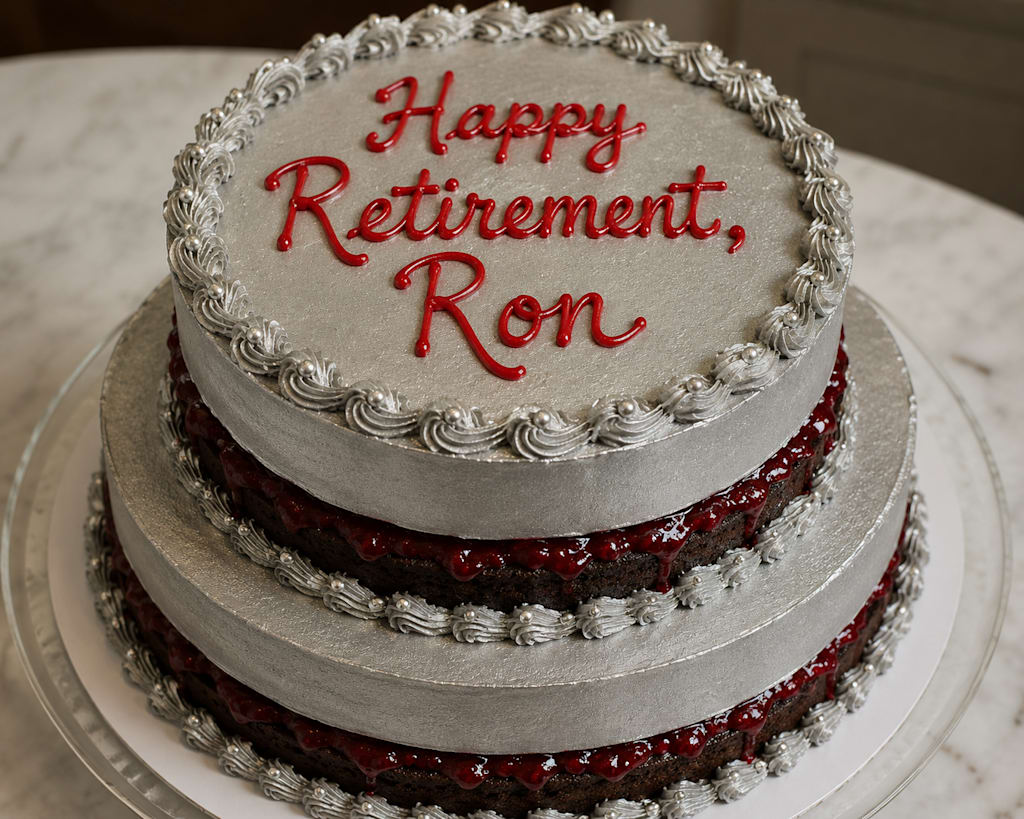
The first thing that went wrong was the birthday cake.
I had ordered it from a bakery whose name sounded expensive enough to be trustworthy, and I had been very clear on the phone. I wanted vanilla cake, lemon filling, white frosting, and the words Happy 70th Birthday, Mom, written in blue.
What I got was a two-tier chocolate cake with raspberry filling, silver frosting, and the words "Happy Retirement, Ron" written across the top in confident red script.
My mother’s name is not Ron.
She was not retiring.
She is allergic to raspberries.
I discovered this at 3:12 p.m., exactly forty-eight minutes before the party, standing in my kitchen with a plastic cake box open on the counter and my husband, Peter, watching me with the calm terror of a man who knows his wife is about to solve a problem.
“Maybe we can scrape it off.”
This was his mistake. The first to speak in a crisis often assumes responsibility for the direction it takes.
“Scrape off what?”
“The words.”
“And the silver?”
He looked at the cake. “Maybe silver is festive.”
“It looks like a retirement party for an astronaut.”
Peter nodded carefully, as if considering whether astronauts retired.
I had planned everything. The lilac tablecloths. The framed photos of my mother from each decade. The playlist no one would hear once Aunt Linda started talking about her hip. I had handwritten place cards because my mother loved “a proper table,” even though our family had never once behaved properly.
The cake mattered because it was the final thing.
If the cake was wrong, the party was wrong. If the party was wrong, I had failed to honor my mother. If I had failed to honor my mother, my brother, Daniel, would arrive fifteen minutes late with a grocery store bouquet still in its plastic sleeve and somehow be forgiven because “he’s so busy.”
So I decided to fix it.
I got a butter knife.
Peter said, “I don’t think that’s the right tool.”
“No one asked you to supervise the cake.”
He lifted both hands and backed away.
The frosting was thicker than it looked. It had the texture of drywall compound and clung to the knife in metallic clumps. I scraped away the Happy Retirement, Ron, but the red dye had bled into the silver frosting beneath, leaving a pinkish scar across the top tier. It looked less like an erased message and more like evidence.
“That’s okay,” I said.
Peter said nothing.
I scraped more.
A small canyon formed in the frosting. Then a deeper one. Then, because the cake had been refrigerated, the top layer cracked. Not a charming crack. Not a rustic one. A geological event.
Peter whispered, “Maybe stop.”
I did not stop.
I thought, as I often do at the very moment I should stop, that the problem was not that I had gone too far. The problem was that I had not gone far enough.
I removed the top tier.
This is where the confession begins, because until that moment, what happened could still have been blamed on the bakery. Afterward, it was mine.
The top tier came away badly. A section of the lower tier came with it, clinging to the cardboard base like a mudslide. Raspberry filling seeped out, dark and glossy, pooling in the silver frosting. I made a sound I did not recognize.
Peter said, “We could just serve cupcakes.”
“What cupcakes?”
“I could go get some.”
“At 3:20? For thirty-eight people? From where, the Cupcake Reserve?”
He blinked.
I turned the damaged cake toward me and tried to see it not as a disaster but as material.
This is one of my faults. A broken dish becomes a mosaic. A bad haircut becomes “layers.” A ruined cake becomes a themed dessert installation.
My mother loves gardening. Or rather, she loves saying she loves gardening while pointing out what other people should do differently with their gardens. I looked at the cracked silver frosting, the exposed chocolate, and the raspberry filling oozing through the middle, and I had an idea.
A garden cake.
Not a beautiful garden cake. A symbolic one.
“Do we have Oreos?” I asked.
Peter closed his eyes.
We had Oreos. I crushed them in a plastic bag with a rolling pin until they looked like dirt. I spread the crumbs over the damaged sections of cake. This covered the red dye, the silver frosting, the fissures, and most of the shame.
Then I went outside and cut sprigs from the herb pots on the patio. Mint, rosemary, thyme, and basil. I washed them and arranged them on the cake like miniature shrubs. It was not perfect, but from a distance it looked like a tiny edible landscape.
Peter leaned in. “Is that oregano?”
“Basil.”
“Should there be basil on a cake?”
“There should not be ‘Happy Retirement, Ron’ on a cake either, but here we are.”
My cousin Marcy arrived early, carrying a casserole and the energy of someone already preparing to recount what she witnessed later.
“Oh,” she said, looking at the cake.
“It’s a garden theme,” I said.
“For your mother?”
“She loves gardening.”
Marcy looked at the rosemary sticking up from the chocolate crumbs. “Does she?”
“She loves criticizing gardens.”
Marcy nodded. “That’s close.”
The party began.
At first, the cake sat in the center of the dining room table like a secret I had hidden in plain sight. People admired the photos and said the place cards were “such a nice touch.” My mother arrived in a lavender pantsuit and cried when she saw the photo of herself at twenty-three, leaning against my father’s first car with her hair in a scarf.
For an hour, I’d succeeded.
Then my uncle George asked why the house smelled like spaghetti sauce.
“It’s the basil,” Peter said.
I kicked him under the table.
My mother approached the cake.
I watched her face, waiting for the softening expression of a woman seeing her daughter’s effort. Instead, she tilted her head.
“Is that mulch?” she asked.
“It’s Oreo crumbs.”
“On the cake?”
“It’s a garden.”
She studied it. “Is the theme decay?”
My brother Daniel, who had arrived late with a grocery-store bouquet still in its plastic sleeve, began laughing.
This annoyed me so deeply that I grew reckless.
“It was supposed to be meaningful,” I said. “You love gardens, right?”
“I love flowers,” my mother said. “I hate dirt.”
Everyone laughed harder.
I could have let it end there. That would have been embarrassing but survivable. We would have cut the cake. My mother would have taken a small, polite bite and whispered to my aunt Linda that the rosemary was “a choice.” Years later, someone would mention the dirt cake, and we would all laugh because time launders humiliation into family folklore.
But I had not yet learned the day's lesson.
Instead, I defended the cake.
“That’s actually the point,” I said.
The room quieted as rooms do when people sense a speech forming.
I told them the cake represented my mother’s life. The chocolate was the richness of her years. The Oreo crumbs were the soil of memory. The herbs were the growth she had nurtured in all of us.
This was not true. None of it had occurred to me before that second. But once spoken, it sounded almost intentional, and I felt the dangerous thrill of improvisation.
My mother touched a sprig of rosemary. “Which one is Daniel?”
I should have said, “The basil.”
I should have said, “The one still in plastic.”
Instead, I said, “Daniel is the mint because mint spreads everywhere and is impossible to control.”
Daniel stopped laughing.
The room let out that little intake of breath people make when a joke lands too close to an old bruise.
Daniel and I had not been getting along. That was nothing new. We had spent most of our adult lives in an argument that shifted topics every few years without ever changing shape. He thought I took everything too seriously. I thought he escaped responsibility by being charming. He thought I judged him. I did.
He looked at the cake and said, “What are you, then? The dirt?”
I smiled because everyone was watching me.
“No,” I said. “I arranged it.”
That was the wrong answer.
My mother sighed, and that sigh was worse than shouting. “Can we just have cake?”
I went to get the knife.
While I was in the kitchen, I decided to ease the tension.
You would think the pattern would have been clear by then. Something breaks. I interfere. The damage expands. But people like me do not see patterns as warnings. We see them as invitations to be more careful next time.
I found Daniel by the drinks table, pouring lemonade into a plastic cup.
“I was kidding,” I said.
He nodded without looking at me.
“It was just a garden metaphor.”
“Great metaphor.”
“You know what I meant.”
“I do. That’s the problem.”
I felt panic rise in me, sharp and hot. The party was slipping. My mother’s birthday was turning into a family argument. I could not let it become a family argument, because then it would be another story in which I tried too hard and made everyone uncomfortable.
So I said, “I’m sorry.”
He looked surprised.
I should have stopped there.
I did not.
“I’m sorry you took it that way.”
His face changed.
Even as the words came out, I knew they were wrong. They had the slippery sheen of an apology-shaped object. Not an apology. A decoration placed over a hole.
Daniel laughed once. “There it is.”
“No, wait. That’s not what I meant.”
“You never mean it.”
“I mean, I’m sorry I made the comment.”
“Then say that.”
“I just did.”
“No, you didn’t.”
From the dining room, someone called, “Cake!”
I panicked harder.
“Fine,” I said. “I am sorry that I called you mint.”
Daniel stared at me.
That sentence should not be in any family archive, but now it is.
When we returned to the dining room, I carried the cake knife like a ceremonial weapon. My mother stood behind the cake as everyone sang. She smiled through it, but her eyes kept flicking toward me and Daniel.
Then came the cutting.
The first slice collapsed.
Not dramatically. Worse than dramatically. Slowly. It leaned, sagged, and folded into itself like a wet book. Raspberry filling, which I had forgotten was still inside, oozed out beneath the Oreo crumbs. The herbs slid sideways. A rosemary sprig lodged upright in the slice, giving it the look of a small grave.
My aunt Linda said, “Well, that one can be mine.”
I loved her for that.
Then my mother said, “I can’t eat raspberries.”
Silence.
I had forgotten.
No, that is too gentle. I had known. I had known, and then, in the fever to fix the frosting, I had filed the allergy away under Later. Later had arrived.
Peter said, “We have ice cream.”
“What kind?” my mother asked.
I looked at him.
He looked at me.
“Raspberry ripple,” he said.
This was not his fault. I had bought it because it was pink and matched the napkins.
My mother sat down.
“I’m fine,” she said, her voice suggesting no one would be fine for some time.
And then, because I could not bear the sight of everyone standing around the ruined symbolic garden cake while my mother sat without dessert at her own birthday party, I decided to bake something.
From scratch.
At 5:07 p.m.
For thirty-eight people.
“I can make lemon bars,” I announced.
Peter turned his whole body toward me slowly, like a security camera.
“No,” he said.
“Yes,” I said. “Mom loves lemon.”
My mother said, “Honey, don’t.”
But she said it softly, and that softness sounded to me like permission.
I went to the kitchen. Marcy followed because witnesses follow disasters. I pulled butter from the fridge, flour from the pantry, and lemons from the bowl on the counter. I had made lemon bars once, in 2009. They had been too loose in the middle, but people had eaten them because people are polite when dessert is free.
Marcy said, “Do you need help?”
“No.”
This is another confession: I almost always need help precisely when I claim I do not.
I mixed the crust too quickly. The butter was too cold. The flour puffed out of the bowl and coated the front of my dress. I pressed the dough into a pan, put it in the oven, then began the filling. Eggs, sugar, lemon juice, zest. I zested one lemon down to the bitter white pith because I was angry with the lemon.
From the dining room came my mother’s voice, then Daniel’s, then a hush. I could not hear the words, which made them even worse.
I poured the filling over the hot crust, then slid the pan back into the oven.
Then the smoke alarm went off.
Not because of the lemon bars.
Because I had placed the plastic cake container on the back burner and someone had leaned against the stove knob.
The container was melting.
It softened first, slumping in the middle. Then the corner blackened. Then it released a smell so chemical and final that everyone in the house knew something unnatural had happened.
People rushed in.
Peter turned off the burner. Marcy opened the windows. Uncle George waved a paper plate beneath the smoke alarm. My mother stood in the doorway, hand over her mouth, staring at the kitchen as if it were a crime scene.
“I’m fixing it,” I said.
No one answered.
That was the moment I heard myself.
Not the words. The belief beneath them.
I had been saying it all day, in one form or another. I’m fixing it. I’m saving it. I’m making it meaningful. I’m correcting the misunderstanding. I’m rescuing the party. I’m restoring proof that I love my mother properly.
But every fix carried the same hidden demand: everyone had to agree that the thing was fixed.
No one was allowed to be disappointed until I finished rearranging the disappointment into something else.
The lemon bars burned at the edges and remained liquid in the center.
We did not eat them.
In the end, my mother had a cup of coffee with whipped cream on top, because whipped cream was the only sweet thing in the house I had not altered. She sat at the table as my relatives ate pieces of the forbidden cake around her, scraping off herbs and politely avoiding the raspberry streaks.
Daniel brought her the whipped-cream coffee.
I watched him do it. No speech, no metaphor, no announcement. He simply made it, set it beside her, kissed the top of her head, then sat down.
She smiled at him.
I hated him for half a second.
Then I hated myself for hating him.
Later, after everyone left, the house looked as if a children’s party had been held in a kitchen fire. There were Oreo crumbs in the carpet. Melted plastic on the burner. A lemon bar pan cooling on the counter like a failed science experiment. The garden cake had collapsed so completely that the herbs lay flat across it, exhausted.
My mother stayed to help me clean up.
This was unusual. Usually, she allowed people to clean around her while offering advice from a chair. But that night, she stood at the sink, rinsing forks.
“I’m sorry,” I said.
She kept rinsing.
“I really am.”
“I know.”
“No, I mean, I’m sorry about the whole thing. The cake. The speech. The lemon bars. The smoke.”
She turned off the water, then looked at me.
“You know what the worst part was?”
“The plastic?”
“No.”
“The mint comment?”
“That was bad.”
“The raspberry?”
She leaned against the sink. “The worst part was that you wouldn’t let it be wrong.”
I did not answer.
She softened then, which made it harder.
“Things go wrong,” she said. “A party can have a bad cake. A daughter can be tired. A mother can be disappointed but still feel loved.”
This seemed impossible to me.
She must have seen that.
“You do this because you care,” she said. “But sometimes caring turns into control.”
I wanted to defend myself. I wanted to explain that I had ordered the right cake, that I had tried to spare her feelings, that Daniel had laughed first, that Peter had bought the wrong ice cream even though I had bought it, and that everything had moved too quickly.
Instead, I said, “I know.”
It was not entirely true yet, but it was closer than anything else I had said that day.
A week later, the bakery called.
They had found my cake.
It had gone to a retirement party for a man named Ron, who apparently received a vanilla lemon cake with Happy 70th Birthday, Mom written in blue frosting.
According to the woman on the phone, Ron loved it.
“He said it was the best cake he’d ever tasted,” she told me.
I pictured him standing in a break room somewhere, surrounded by coworkers with paper plates, accepting a cake meant for my mother without making any effort to correct it. Perhaps Ron was wise. Perhaps Ron understood that not every wrong thing needs to be repaired. Perhaps Ron had simply retired from caring.
I never found out.
For my mother’s seventy-first birthday, I bought a sheet cake from the grocery store with yellow roses on it. The words were plain. The frosting was too sweet. The corners were dented from the car ride.
When I set it on the table, the top had shifted slightly, leaving one yellow rose smeared against the plastic lid.
I saw it immediately.
So did Peter.
He looked at me.
I looked at the cake.
Then I put it down and walked away.
About the Creator
Carla Paton
Author of "The Memory Trigger:365 Flash Memoir Writing Prompts Designed to Unlock the Stories You Forgot You Had." Writing daily on Rapid Reads Press.
Enjoyed the story? Support the Creator.
Subscribe for free to receive all their stories in your feed. You could also become a paid subscriber, letting them know you appreciate their work.
Comments
There are no comments for this story
Be the first to respond and start the conversation.