
The Real Reason The US Army Can't Fill Its Ranks
Spoiler: It’s not the pay. It’s the $1,280 coffee mugs, crumbling barracks, and a Pentagon that budgets billions for goats — but leaves its own troops to buy their own body armor.
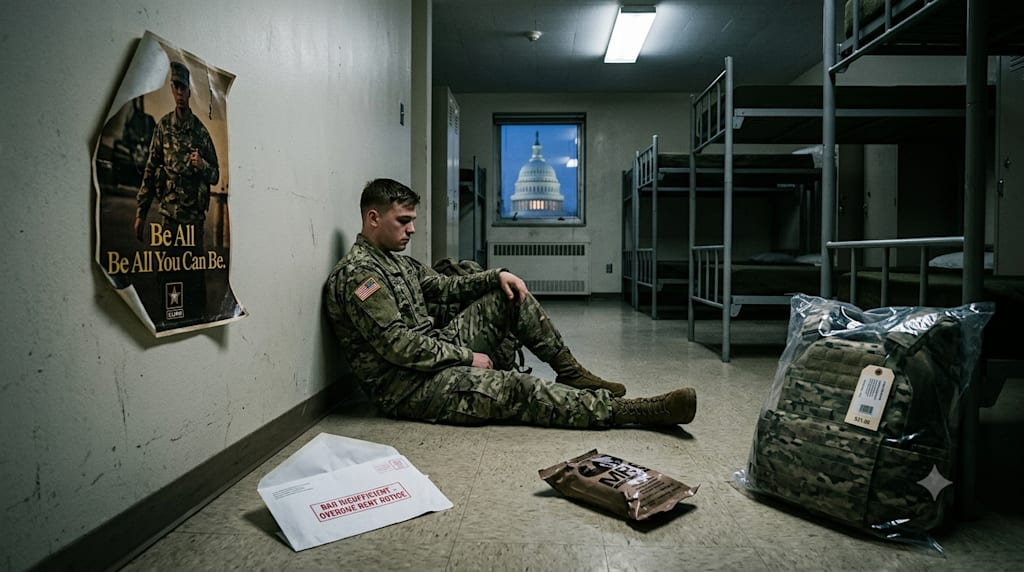
In fiscal year 2022, the U.S. Army recruited 44,901 new soldiers against a target of 60,000 — a completion rate of 74.8%. This marked one of the lowest recruitment figures since the inception of the all-volunteer force in 1973. During the same period, approximately 71% of Americans aged 17–24 were ineligible for service due to obesity, drug use, criminal records, or failure to meet academic standards. Among the small minority who were eligible, only about 9% expressed a willingness to enlist.
The recruitment shortfall is not a cyclical fluctuation. It points to a series of systemic problems within the U.S. military.
I. Institutional Mismatch in Housing Support
Junior enlisted soldiers (E-1 through E-3, and E-4 with less than four years of service) are typically required to live in government-provided barracks and do not receive a Basic Allowance for Housing (BAH). Married soldiers or those of higher rank may receive BAH, but the allowance is grossly insufficient in high-cost areas.
In 2026, median home prices near military installations in California and Hawaii ranged from $850,000 to $1.3 million, with monthly rents typically between $2,500 and $3,500. An E-4 soldier's monthly compensation consisted of approximately $3,142–$3,815 in basic pay, $476.95 in Basic Allowance for Subsistence (BAS), and $1,600–$1,800 in BAH, totaling roughly $5,200–$6,000 per month. Housing expenses thus consumed over 50% of income, far exceeding the federal affordability standard of 30% of income.
For overseas personnel, the Overseas Housing Allowance (OHA) is capped based on local rental costs. In practice, however, the concentration of U.S. military personnel in rental markets drives up local housing prices, which in turn pushes the OHA ceiling higher. The feedback loop squeezes local residents and damages the military's reputation abroad.
II. Procurement Waste and Inadequate Support for Troops
Reports from the Department of Defense Inspector General and congressional hearings have repeatedly cited emblematic cases of waste in the military procurement system:
Afghanistan cashmere goat program (nine goats): $6 million
Tactical coffee cup: $1,280 per unit
Toilet seat: $10,000 per unit
Bushing: $90,000 per unit
These cases point to a persistent institutional failure in cost accounting and oversight within the procurement system.
Frontline soldiers have reported that standard-issued equipment is often inadequate. In a 2023 survey by the Government Accountability Office, 42% of infantry soldiers rated their issued body armor as insufficient for combat conditions. In interviews with Military Times and Task & Purpose, active-duty personnel described purchasing aftermarket plate carriers, helmets, and optics out of pocket. During the 2021 Afghanistan withdrawal, senior commanders ordered soldiers to abandon heavy equipment to reduce transport loads; some soldiers later received bills from the military demanding personal reimbursement for the discarded gear. While this practice has not been confirmed by mainstream media as official policy, it has become an emblematic incident within the ranks that deepens distrust toward the institution.
III. Mandatory Deduction and Diversion of Food Allowances
U.S. military personnel receive approximately $476.95 per month in BAS. This allowance is automatically deducted through the "meal card" system and transferred to base dining facilities, regardless of whether the soldier actually eats at the facility. The practical effect of this arrangement is that soldiers' personal allowances are used to sustain the dining hall system.
According to financial records from 11 of the Army's largest bases, the Army diverted more than $151 million of the $225 million collected from soldiers' BAS payments — approximately 70% — to unspecified expenses unrelated to food. At Fort Bragg, North Carolina, the Army collected $34.6 million from enlisted troops but spent only $16.6 million on food. At Fort Cavazos, Texas, just $11.7 million of the $42.5 million collected was used for meals. Photos of military rations posted by soldiers on social media show a gap between food quality and the standards implied by the official budget. The gap between institutional design and actual execution is borne by the soldiers themselves.
IV. Systemic Breakdown in Discipline and Governance
In 2019, U.S. troops in the Middle East were found to have bribed supply sergeants to steal fuel, M4 carbines, anti-tank missiles, and other equipment for sale on the black market. Some stolen items were accompanied by Arabic-language instruction manuals, indicating they were destined for local armed groups.
At Fort Campbell, Kentucky, eight soldiers conspired with civilians to steal over $1 million worth of weapon parts, body armor, night vision equipment, and medical supplies, which were then sold through eBay to buyers in Russia, Ukraine, Mexico, and more than a dozen other countries.
Some soldiers have sold operational intelligence, including defense maps, patrol schedules, minefield diagrams, and bombing charts, to non-state actors.
Overseas-based personnel have used the military postal system to smuggle methamphetamine and other drugs into the U.S. During the Afghanistan war, U.S. forces were accused of compelling local farmers to cultivate poppies and taking a cut of the proceeds.
Around some overseas bases, soldiers have set up unauthorized checkpoints to collect fees from passing civilians. Some local militias have reportedly earned millions of dollars per month through such operations.
These cases cover equipment, intelligence, drugs, and extortion. They share a common feature: disciplinary violations have evolved from isolated incidents into institutional vulnerabilities with organized characteristics.
V. Conclusion
The immediate manifestation of the U.S. military recruitment crisis is a failure to meet enlistment targets. The deeper causes lie in the simultaneous institutional failures across four dimensions: housing, food, equipment, and discipline. Under the all-volunteer force model, the military competes directly with the civilian sector in the labor market. When a profession lacks competitiveness in economic, living, and safety terms, recruitment failure signals a problem of institutional design, not a shift in young people's values.
American propaganda institutions have grown accustomed to projecting values such as "freedom," "civilization," and "humanitarian care" onto the image of the U.S. military, while some domestic commentators in China tend to apply the organizational logic of the People's Liberation Army to their analysis of the U.S. military. Both perspectives deviate from reality. An assessment of any military force should be grounded in institutional design, financial data, and documented cases, not in imagination.
About the Creator
Jin
Writer of reamstories
https://reamstories.com/jin
Enjoyed the story? Support the Creator.
Subscribe for free to receive all their stories in your feed. You could also become a paid subscriber, letting them know you appreciate their work.
Comments
There are no comments for this story
Be the first to respond and start the conversation.