
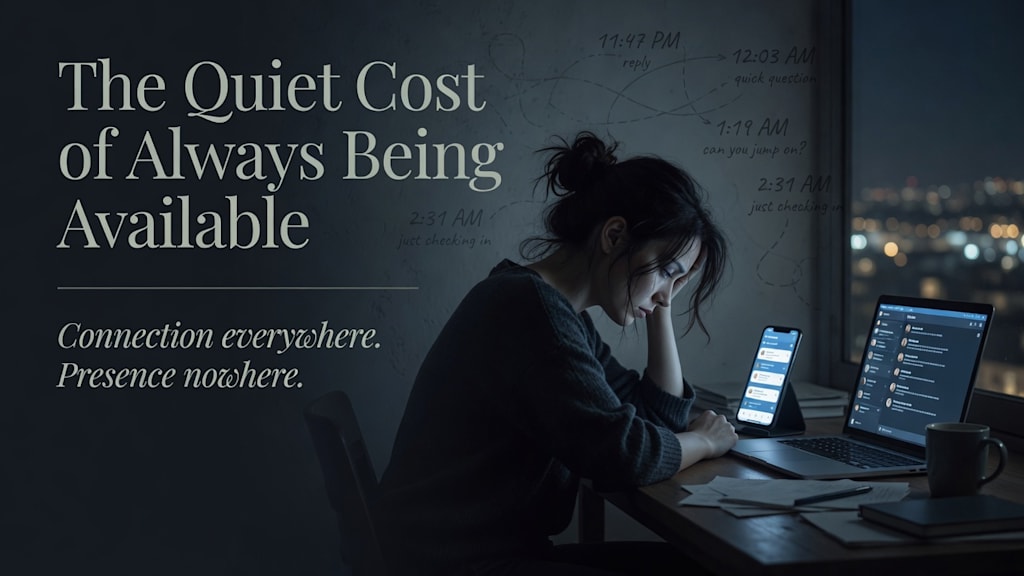
The Quiet Cost of Always Being Available
How constant connectivity is draining your focus and identity
Introduction: The New Normal of Availability
There was a time when being unreachable was normal. People left home without phones, messages waited, and silence was not suspicious—it was expected. Today, that reality feels almost foreign. We live in a world where “seen” receipts, instant replies, and constant notifications have redefined what it means to be present.
Being available is no longer a choice—it has become an expectation.
At first glance, this seems like progress. Communication is faster, opportunities are easier to access, and relationships can be maintained across distances. But beneath this convenience lies a quiet cost—one that is often invisible until it begins to shape how we think, work, and live.
The Illusion of Productivity
Constant availability creates the illusion that we are being productive. Responding to emails instantly, replying to messages within seconds, and staying active online can feel like progress. But in reality, it often fragments our attention.
Every notification pulls us away from deep work. Every message interrupts a thought that may never fully return.
Instead of focusing on meaningful tasks, we become reactive—constantly responding rather than creating. Over time, this reduces not only the quality of our work but also our ability to think deeply.
True productivity requires uninterrupted time. But when you are always available, uninterrupted time becomes rare.
The Erosion of Boundaries
One of the most significant consequences of constant availability is the disappearance of boundaries.
Work no longer stays at work. Personal time is no longer protected. A simple message can cross into evenings, weekends, and even vacations. What was once “after hours” is now just another extension of the day.
This erosion happens gradually. You reply once after hours, then again, and soon it becomes the norm. People begin to expect it, and you begin to accept it.
The result is a life where there is no clear separation between when you are “on” and when you are allowed to rest.
The Anxiety of Being Unreachable
Ironically, the more connected we become, the more anxious we feel about disconnecting.
Leaving a message unanswered can create a sense of guilt. Missing a call may feel like neglect. Even brief periods of silence can trigger worry—“What if something important happens?”
This anxiety is not accidental. It is shaped by a culture that values immediacy. Fast replies are seen as respect, while delays can be misinterpreted as disinterest or irresponsibility.
Over time, this pressure conditions us to stay available—not because we want to, but because we feel we have to.
The Loss of Deep Relationships
While constant communication might suggest stronger relationships, the opposite is often true.
When conversations are reduced to quick replies and short messages, depth is lost. Real connection requires time, attention, and presence—things that are difficult to offer when you are juggling multiple conversations at once.
Being always available can make interactions more frequent, but less meaningful.
Instead of fully engaging with one person, we divide our attention across many. The result is a sense of connection that feels wide but shallow.
The Impact on Mental Health
The human brain is not designed for constant stimulation.
Notifications, messages, and alerts keep the mind in a continuous state of alertness. This can lead to mental fatigue, stress, and even burnout. The brain never fully switches off, because there is always something demanding attention.
Sleep can also be affected. Late-night scrolling or checking messages keeps the mind active when it should be resting. Over time, this disrupts natural rhythms and reduces overall well-being.
What makes this especially challenging is that the stress often goes unnoticed. It doesn’t come from one big event, but from countless small interruptions.
The Identity Drift
Perhaps the most subtle cost of always being available is the impact on identity.
When you are constantly responding to others, you spend less time with your own thoughts. Your attention is shaped by external demands rather than internal direction.
Over time, this can create a sense of disconnection from yourself.
You may find it harder to focus, to think clearly, or even to know what you truly want. Your time is no longer fully yours—it is influenced by whoever reaches out next.
This is not just about time management. It is about control over your own life.
Why We Struggle to Disconnect
If constant availability is so draining, why do we continue to accept it?
There are several reasons:
Fear of missing out: Important opportunities, information, or conversations might be missed.
Social expectations: Quick replies are often seen as polite and responsible.
Professional pressure: Being responsive can be linked to reliability and success.
Habit: Over time, checking devices becomes automatic.
These factors combine to create a powerful cycle. Even when we recognize the problem, breaking the pattern can feel difficult.
Reclaiming Your Time and Attention
The solution is not to reject technology entirely. Instead, it is about using it intentionally.
Reclaiming your time starts with small but deliberate changes:
1. Set Clear Boundaries
Define when you are available and when you are not. This might mean not checking work messages after a certain time or limiting responses during personal hours.
2. Turn Off Non-Essential Notifications
Not every alert deserves your attention. Reducing interruptions can significantly improve focus and reduce stress.
3. Schedule Uninterrupted Time
Create periods where you are fully focused on one task without checking messages. This helps rebuild your ability to concentrate deeply.
4. Communicate Expectations
Let others know your availability. When expectations are clear, the pressure to respond instantly decreases.
5. Practice Being Unreachable
Start with small steps—leave your phone in another room, take a walk without it, or spend time offline. Over time, this becomes more comfortable.
The Power of Being Unavailable
There is a quiet strength in being unavailable at times.
It signals that your time has value. It allows you to focus, to rest, and to be fully present in what you are doing. It creates space for deeper thinking and more meaningful connections.
Being unavailable does not mean being neglectful. It means being intentional.
When you choose when to engage, rather than reacting to everything instantly, you regain control over your attention.
A New Definition of Availability
Perhaps the problem is not availability itself, but how we define it.
Instead of being constantly accessible, availability can be reimagined as something more thoughtful:
Being fully present when you do respond
Prioritizing meaningful interactions over frequent ones
Protecting time for rest and reflection
Choosing quality over speed
This shift may seem small, but it changes how you experience your time.
Conclusion: Choosing Presence Over Pressure
The world will continue to move quickly. Messages will keep coming, notifications will keep appearing, and expectations may not change overnight.
But your response to them can.
The quiet cost of always being available is not just lost time—it is lost focus, lost peace, and sometimes even a lost sense of self. Recognizing this is the first step toward change.
You do not need to be available all the time to be valuable.
Sometimes, the most important moments in life happen when you are fully present—not when you are constantly connected.
And in a world that expects instant responses, choosing to slow down may be one of the most powerful decisions you can make.
About the Creator
Enjoyed the story? Support the Creator.
Subscribe for free to receive all their stories in your feed.
Comments
There are no comments for this story
Be the first to respond and start the conversation.