
The Productivity Illusion
Why Being Busy Doesn’t Mean You’re Moving Forward
Introduction
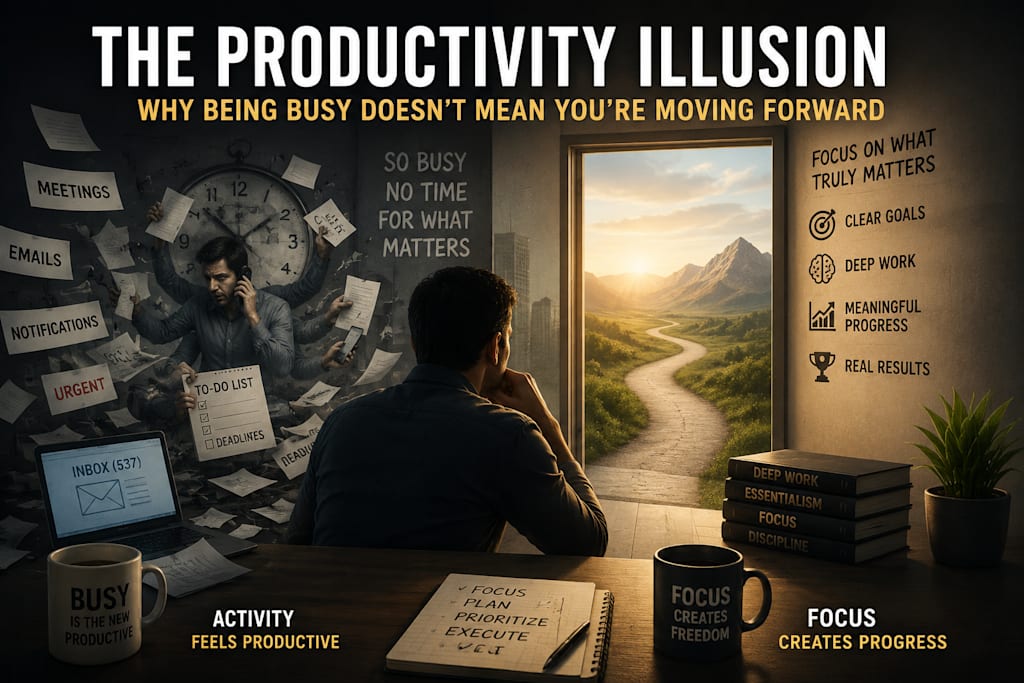
In today’s fast-paced world, productivity has become a badge of honor. Packed schedules, endless to-do lists, and constant motion are often seen as signs of success. People proudly say, “I’ve been so busy,” as if busyness itself is proof of progress. But beneath this cultural obsession lies a quiet truth: being busy is not the same as being productive.
The productivity illusion tricks us into believing that activity equals achievement. It convinces us that as long as we’re doing something—anything—we’re moving forward. In reality, many of us are stuck in cycles of motion without direction, effort without impact, and work without meaningful results.
The Rise of Busyness Culture
Modern life rewards visible effort. Responding quickly to emails, attending multiple meetings, juggling tasks—these behaviors signal commitment and dedication. Social media amplifies this further, showcasing “hustle culture” where constant work is glorified.
But this creates a dangerous standard:
If you’re not busy, you’re not working hard enough
If you’re resting, you’re falling behind
If you’re not overwhelmed, you’re not ambitious
This mindset shifts the focus from outcomes to appearances. Instead of asking, “What did I achieve?” we start asking, “How much did I do?”
Activity vs. Progress
At the heart of the productivity illusion is a simple confusion: activity is mistaken for progress.
Consider these examples:
Answering emails all day feels productive—but did it move your goals forward?
Attending back-to-back meetings feels important—but were they necessary?
Organizing your workspace feels useful—but did it create value?
Activity is visible and immediate. Progress is often slow, quiet, and uncomfortable.
True productivity is measured by results, not motion.
Why We Fall Into the Trap
The illusion persists because it satisfies several psychological needs:
1. Instant Gratification
Small tasks provide quick wins. Checking items off a list releases a sense of accomplishment, even if those tasks are low-value.
2. Avoidance of Difficult Work
Deep, meaningful work is often challenging and mentally demanding. It’s easier to stay busy with simple tasks than to confront complex problems.
3. Social Validation
Busyness is socially rewarded. People admire those who appear constantly occupied, even if the work lacks substance.
4. Fear of Slowing Down
Stillness can feel uncomfortable. It forces reflection, which may reveal misalignment between effort and purpose.
The Cost of Fake Productivity
While busyness may feel productive, it comes at a significant cost:
1. Burnout Without Results
Constant activity drains energy. When that effort doesn’t lead to meaningful outcomes, frustration builds.
2. Lack of Direction
Without clear priorities, time gets scattered across tasks that don’t contribute to long-term goals.
3. Reduced Creativity
Being constantly occupied leaves no space for thinking, reflecting, or generating new ideas.
4. False Sense of Achievement
You feel productive—but your goals remain unchanged.
The Role of Distractions
Distractions play a major role in maintaining the illusion. Modern tools designed to increase efficiency often do the opposite.
Notifications interrupt focus
Multitasking reduces quality
Constant switching fragments attention
These distractions keep us busy but prevent deep, meaningful work. The result is a cycle of shallow productivity—doing more, achieving less.
Deep Work vs. Shallow Work
To break the illusion, it’s important to distinguish between two types of work:
Shallow Work
Easy to perform
Requires minimal focus
Often reactive (emails, messages, routine tasks)
Creates the feeling of productivity
Deep Work
Requires intense focus
Creates real value
Moves long-term goals forward
Often uncomfortable and mentally demanding
Most people spend the majority of their time on shallow work because it feels easier and more rewarding in the short term.
But progress lives in deep work.
The Myth of Multitasking
Multitasking is often praised as a productivity skill, but in reality, it’s a performance killer.
When you switch between tasks:
Your brain takes time to refocus
Mistakes increase
Efficiency drops
What feels like doing more is actually doing less—just in a more scattered way.
True productivity requires focus, not fragmentation.
Rethinking Productivity
To escape the illusion, we need to redefine what productivity means.
Instead of asking:
“How busy am I?”
Ask:
“Am I working on what truly matters?”
Real productivity is:
Intentional – aligned with clear goals
Focused – prioritizing important tasks
Measured by outcomes – not effort
The Power of Prioritization
Not all tasks are equal. Some create massive impact, while others barely move the needle.
A simple shift can change everything:
Identify the one or two tasks that matter most each day
Focus on completing those before anything else
Treat everything else as secondary
This approach reduces noise and increases meaningful progress.
Learning to Say No
One of the biggest drivers of busyness is overcommitment. Saying yes to everything leads to a schedule filled with low-value tasks.
Saying no is not a weakness—it’s a strategy.
By protecting your time, you create space for what truly matters.
Embracing Stillness
In a world obsessed with motion, stillness feels unnatural. But it’s essential for clarity.
Taking time to pause allows you to:
Reflect on your goals
Evaluate your progress
Identify what’s truly important
Stillness is not the absence of productivity—it’s the foundation of it.
Building a System That Works
Breaking free from the productivity illusion requires structure:
1. Define Clear Goals
Know what you’re working toward. Without direction, effort is wasted.
2. Plan with Purpose
Create a daily plan focused on high-impact tasks.
3. Limit Distractions
Reduce interruptions to protect your focus.
4. Track Outcomes, Not Effort
Measure success by results, not hours worked.
5. Schedule Deep Work
Dedicate uninterrupted time for meaningful tasks.
The Role of Discipline
Motivation is unreliable. Some days you feel driven; others, you don’t. Discipline ensures consistency regardless of mood.
But discipline isn’t about doing more—it’s about doing what matters, even when it’s difficult.
A Shift in Mindset
Escaping the productivity illusion requires a mental shift:
From busy → to effective
From doing more → to doing what matters
From activity → to impact
This shift is uncomfortable at first. It forces you to confront how much of your time is spent on low-value tasks. But it also creates clarity and direction.
Real-Life Reflection
Think about your last few days:
Were you constantly busy?
Did you complete many small tasks?
But did you make real progress toward your goals?
If the answer is no, you’re not alone. Most people operate within this illusion without realizing it.
The good news is that awareness is the first step toward change.
Conclusion
The productivity illusion is powerful because it feels real. It rewards motion, celebrates busyness, and hides inefficiency behind constant activity. But beneath the surface, it keeps people stuck—working hard without moving forward.
True productivity is not about filling your time. It’s about using your time wisely. It’s about focusing on what matters, eliminating what doesn’t, and measuring success by meaningful outcomes.
In the end, the goal is not to be busy—it’s to be effective.
Because a life full of activity but empty of progress is not productive at all.
About the Creator
Enjoyed the story? Support the Creator.
Subscribe for free to receive all their stories in your feed.
Comments
There are no comments for this story
Be the first to respond and start the conversation.