
The Myth of Overnight Success
Why Slow Growth Builds Strong Foundations
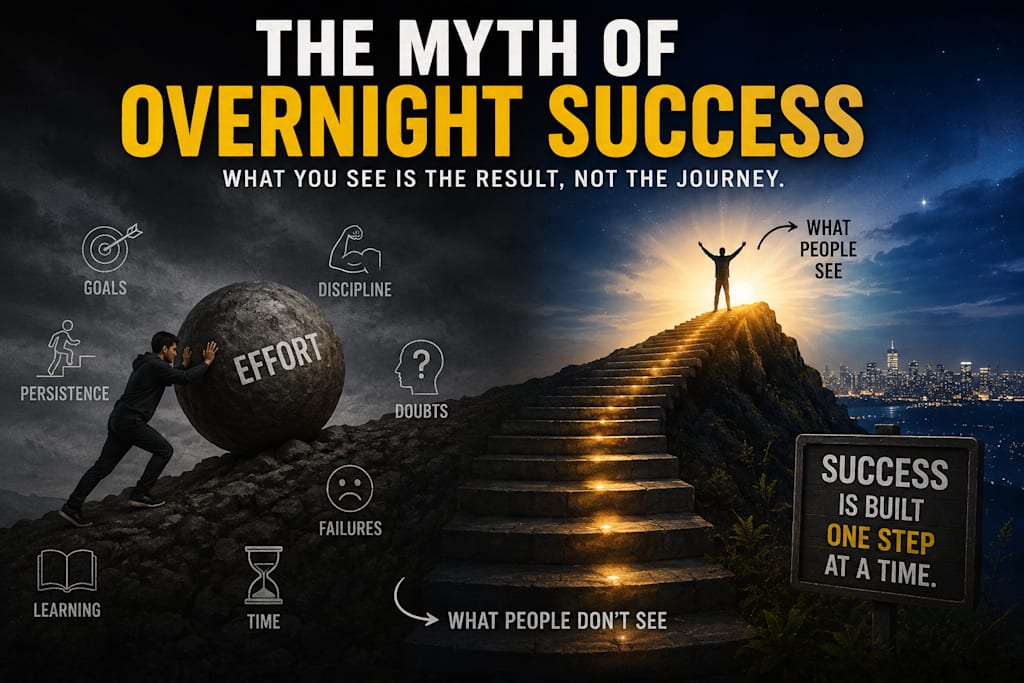
In a world driven by instant gratification, the idea of “overnight success” has become one of the most seductive and misleading narratives of modern life. Social media, headlines, and viral stories often highlight individuals who appear to rise from obscurity to fame in a matter of days. These stories are packaged neatly, stripped of context, and presented as proof that success can happen quickly—almost magically.
But this version of success is, more often than not, an illusion.
The Allure of Instant Achievement
The human brain is wired to seek quick rewards. When we see someone achieve massive success seemingly overnight, it triggers a mix of admiration and impatience. We begin to wonder: Why not me? This comparison creates unrealistic expectations, leading many to believe that if success doesn’t come quickly, something must be wrong.
The problem is not ambition—it’s the timeline.
Success, in reality, rarely follows a straight or rapid path. What appears sudden is usually the result of years of unseen effort, failure, learning, and persistence. The “overnight” moment is simply when the world starts paying attention.
What You Don’t See Behind Success
Every success story has a hidden chapter—often several—that goes unnoticed. These chapters include:
Years of Practice: Countless hours spent honing skills when no one is watching
Repeated Failures: Attempts that didn’t work, lessons learned the hard way
Doubt and Uncertainty: Moments of questioning whether the journey is worth it
Consistency: Showing up every day, even when motivation is low
These elements are rarely highlighted because they are not glamorous. They don’t make for exciting headlines. Yet, they are the true foundation of lasting success.
The Danger of the “Overnight” Mindset
Believing in overnight success can be harmful in several ways:
Unrealistic Expectations: People expect quick results and become discouraged when progress is slow
Lack of Patience: The willingness to endure long-term effort diminishes
Shortcut Mentality: Individuals start looking for hacks instead of building real skills
Burnout: Trying to achieve rapid results often leads to exhaustion and frustration
This mindset shifts focus away from growth and toward immediate outcomes, which ultimately weakens the journey.
Success Is a Process, Not an Event
True success is not a single moment—it’s a process built over time. It’s the accumulation of small actions repeated consistently. Each step may seem insignificant on its own, but together they create momentum.
Think of success as a structure. A building cannot stand tall without a strong foundation. The deeper and more solid the foundation, the higher the structure can rise. Slow growth allows that foundation to form properly.
When success happens too quickly without preparation, it often becomes difficult to sustain. Skills, discipline, and resilience take time to develop—and without them, success can be fragile.
The Role of Consistency
Consistency is one of the most underrated factors in achieving success. It’s not about doing something extraordinary once; it’s about doing something meaningful repeatedly.
Small, daily actions compound over time. Writing a few hundred words each day, practicing a skill regularly, or improving incrementally may not feel impressive in the moment. But over weeks, months, and years, these actions lead to significant results.
Consistency builds:
Mastery: Deep understanding and skill development
Confidence: Trust in your own abilities
Discipline: The ability to keep going regardless of mood
Momentum: Progress that fuels further progress
Unlike overnight success, consistency is sustainable and reliable.
Failure: The Hidden Ingredient
Failure is often seen as the opposite of success, but in reality, it is a crucial part of it. Every setback provides valuable information. It shows what doesn’t work, highlights weaknesses, and forces adaptation.
Those who achieve lasting success don’t avoid failure—they learn from it. They treat it as feedback rather than defeat.
The myth of overnight success hides these failures, creating the false impression that successful people didn’t struggle. This distortion can make others feel inadequate when they face challenges, even though those challenges are normal and necessary.
The Comparison Trap
One of the biggest consequences of believing in overnight success is the tendency to compare your beginning with someone else’s peak. This comparison is inherently unfair.
What you see in others is often the result of years of work condensed into a single visible moment. Without understanding their journey, it’s easy to misjudge your own progress.
Instead of comparing timelines, it’s more productive to focus on your own path. Growth is not a race—it’s a personal journey shaped by individual goals, circumstances, and efforts.
Redefining Success
To break free from the myth, success needs to be redefined. Instead of viewing it as a sudden breakthrough, consider it as:
Progress over time
Improvement in skills and mindset
Resilience in the face of challenges
Commitment to long-term goals
This perspective shifts the focus from immediate results to meaningful development.
When success is seen as a journey, each step becomes valuable. Even small wins contribute to a larger purpose.
Why Slow Growth Is Powerful
Slow growth may not be exciting, but it is powerful. It allows time for learning, adaptation, and strengthening. It creates depth rather than superficial achievement.
Some advantages of slow growth include:
Stronger Foundations: Skills and knowledge are deeply rooted
Sustainability: Success becomes easier to maintain
Adaptability: Experience with challenges builds flexibility
Confidence: Earned through consistent effort
Slow growth also reduces pressure. Instead of chasing immediate results, the focus shifts to steady progress.
The Role of Discipline Over Motivation
Motivation is often associated with success, but it is unreliable. It comes and goes, influenced by mood, environment, and circumstances. Discipline, on the other hand, remains steady.
Those who rely on motivation may start strong but struggle to continue. Those who develop discipline are able to persist even when they don’t feel like it.
Discipline transforms effort into habit, and habits drive long-term success.
Patience: The Missing Skill
In an age of speed, patience has become a rare skill. Yet, it is essential for meaningful achievement. Patience allows time for growth, mistakes, and improvement.
Without patience, people tend to quit too early—often just before progress becomes visible.
Success often follows a delayed curve. Efforts may not show immediate results, but over time, they accumulate and lead to breakthroughs. Those who remain patient long enough are the ones who experience this shift.
Building Your Own Path
Breaking free from the myth of overnight success requires a shift in mindset:
Focus on daily actions, not distant outcomes
Embrace failure as part of learning
Avoid comparing your journey to others
Commit to long-term consistency
Value progress over perfection
Each step forward, no matter how small, contributes to your growth. The key is to keep moving.
The Reality Behind “Overnight” Stories
If you look closely at most so-called overnight successes, you’ll find a long history behind them. Entrepreneurs spend years building businesses before a breakthrough. Artists practice for decades before gaining recognition. Writers face countless rejections before publishing their work.
The “overnight” moment is simply the tipping point—the result of accumulated effort finally becoming visible.
Understanding this reality removes the pressure to achieve quickly and replaces it with a commitment to grow steadily.
Conclusion
The myth of overnight success is appealing, but it is misleading. It simplifies a complex journey into a single moment, ignoring the effort, struggle, and persistence required to reach that point.
Real success is not instant—it is built over time through consistency, discipline, and resilience. It is shaped by failures, strengthened by patience, and sustained by continuous growth.
Instead of chasing quick wins, focus on building a strong foundation. Invest in your skills, embrace the process, and commit to steady progress.
Because in the end, the most meaningful success is not the one that happens overnight—it’s the one that lasts.
About the Creator
Enjoyed the story? Support the Creator.
Subscribe for free to receive all their stories in your feed.
Comments
There are no comments for this story
Be the first to respond and start the conversation.