
The Longing Gap
Reality TV taught me to edit my love life. All I got was a cold latte, a dead notification light, and a carrot cake nobody ate.
He deleted, letter by letter, the message he had typed: “Want to hit Smorgasburg this weekend?” He replaced it with a photo he’d taken on a whim—the old streetlamp outside his apartment building, fine rain drifting through the glow. Three minutes and twenty seconds later, she wrote back: “Nice mood.” He stared at those two words for a long time. It reminded him of a girl on the show named Chloe, how she had received a心动短信 and flipped her phone face‑down on the beach lounger, the corner of her mouth lifting slowly, like someone who had just been handed a gift with no name attached. The livestream comments had scrolled a single line in all caps: SHE KNOWS. Back then he thought that smile was charming. Now, those two words felt like an unopened piece of candy, and he couldn’t tell what flavor was inside.
I have a friend who does post‑production for reality TV. In his editing suite in Los Angeles, he once showed me how it’s done. They take a “good night” text sent at two in the morning and stitch it right next to a “good afternoon” sent at noon the next day. The ten‑plus hours in between get sliced out clean, leaving only a rising electronic heartbeat that makes the audience hear a continuous, breathless waiting, not one person sleeping until eleven and the other scrolling TikTok all night. He calls it “manufacturing the longing gap,” and he does it as casually as a bartender shaking a cocktail that looks simple but hits you hard later. In real life, though, you roll over in the morning, check your phone, see a “good afternoon,” and your first thought isn’t a flutter. It’s that the coffee machine still needs descaling and the milk expired yesterday. You stand barefoot on the cold floor, figuring he probably just woke up too.
But there’s always someone who tries to move that TV script into a real life where the kitchen floor still has last night’s pizza grease.
Liam and Emma met at a taqueria in the Lower East Side. Liam got there fifteen minutes early and leaned against the iron railing out front, thumb moving fast over his phone. Emma had actually arrived even earlier. She stood by the window of the Blue Bottle across the street, holding a latte that had gone cold, watching Liam’s silhouette reflected in the restaurant’s neon sign. She waited until the minute hand landed exactly on the agreed time, then crossed the street, pushed open the glass door, and said, “Sorry, the F line was messed up again.” Liam flipped his phone over onto the table and smiled. “No worries, I just found parking.” Both of them felt they hadn’t lost that round. They ordered carne asada burritos and loaded nachos with extra guac; Liam clocked the two‑dollar upcharge. Steam from the burritos rose between them while they talked about how packed the ferry to Governors Island had been last weekend, how a mutual friend’s newly adopted cat kept clawing the sofa at three in the morning, and whether that new Star Wars series actually sucked or not. Neither asked: Why were you still online on Instagram at 3 a.m. last night? Later, neither of them could remember how the food tasted. Liam only recalled the tortilla chip crumbs stuck in the table gap. Emma’s napkin was balled up, and the guacamole had oxidized to an unappealing brown.
I used to make commentary videos about these dating shows. The channel was called “Love Decode,” just over twenty‑seven thousand subscribers. Late one Friday night, I was in Final Cut Pro, dragging back and forth over a three‑second clip from Love Island, a girl named Ava, the moment the guy she liked chose someone else. She was holding a glass of white wine, her mouth still holding a perfectly decent smile, but the fingers around the stem tightened, knuckles going pale. I enlarged that clip to two hundred percent and added a caption: “Defensive contraction: point deduction in a push‑pull game.” I spent a while adjusting the kerning so it looked like a diagnosis on a medical chart. When the render bar finally finished, it was 2:14 a.m. I opened DoorDash and ordered half a dozen cinnamon sugar donuts and a hot chocolate from a twenty‑four‑hour spot. In the notes I wrote: “Extra two sugar packets, rough night.” When the hot chocolate arrived, a skin of milk had already formed on top. The donut glaze stuck to the paper bag. My first bite sent a dusting of sugar into the gap around the spacebar. I wiped it away with my thumb and suddenly couldn’t remember what color Ava’s eyes were.
Once, drinking beer on a friend’s rooftop in Brooklyn, the night sky dyed a dirty orange by the Manhattan lights. A guy named Chris took a swig of his IPA and said he’d met a girl on a dating app who was “insanely good at this, sent me three messages in a row yesterday, then today just vanished. Had me checking my phone all morning like I’m watching a stock ticker.” He was spinning the bottle cap between his fingers, talking like someone replaying a chess game with no board. Someone else stretched out on a deck chair and said, “Isn’t that better? No fun without a challenge.” I looked down, picking corn chips from a cardboard box, the dip already tasteless, and thought about my friend Sophie. Sophie liked a coworker named Daniel. She planned to ask him on Friday to see that new A24 indie film; she had even shared the trailer link in their chat window, her thumb hovering over send. Then she scrolled onto a TikTok where a girl with sharply drawn lips spoke into the camera: “Never be the first one to ask for a second date. That’s the iron rule.” She deleted the entire draft, pressing her thumb against the screen like snuffing out a match. Later, Daniel posted a selfie with another girl at the Alamo Drafthouse, both holding a popcorn bucket, movie credits rolling behind them. Sophie shoved her phone under the couch cushion and muttered, “Whatever.” The two advance tickets sat on her nightstand. Before they expired, she used them as coasters for beer bottles. The side of the ticket printed with the date slowly bloomed a water stain.
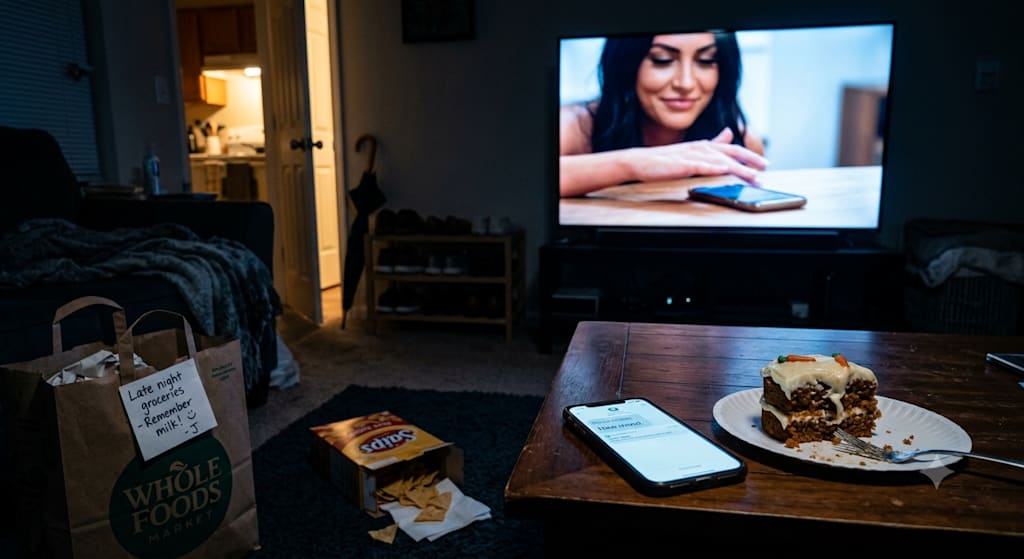
That kind of calculation is so light, so easy, it tricks you into thinking you’ve got a cheat code. I’ve been there. Last year on my birthday, an ex texted me: “Happy birthday, hope everything’s good,” sent at 9:40 a.m. I left my phone next to the keyboard, watched the notification light up, and kept editing. Ate a microwaved lasagna. Rewatched a whole season of Stranger Things. Ran the laundry through the dryer three times. Not until 11:58 p.m. did I type back: “Thanks, just saw this.” When I hit send, my heart beat fast, like I’d just sprinted up a flight of stairs, not because she still mattered, but because I had executed a flawless “pullback,” exactly the way the playbook draws it. On the table that day was a mini carrot cake from Whole Foods. I’d eaten barely a third. The rest, box and all, sat in the trash can. The cream cheese frosting had started to sour, giving off an over‑sweet, fermented smell. I stared at that trash can for a while, suddenly unsure what I’d actually won.
Search “push‑pull techniques” on YouTube and dozens of videos pop up, thumbnails shouting in bold letters: “The Hot‑and‑Cold Rule to Make Them Addicted,” view counts in the hundreds of thousands. Someone in the comments writes, “Used this move and he totally came back,” with a smug emoji. These videos wrap love up like an exclusive game requiring emotional intelligence, a certain posture, and precisely calculated response times to clear the levels, as if only those who can resist texting back instantly deserve a ticket. But they forget one thing: most actual people, when they receive “hot and cold,” don’t feel a thrill to chase. They mute notifications, open Uber Eats for a spicy chicken sandwich, and swing by Trader Joe’s for a frozen pizza. Nobody likes being steeped in uncertainty for a long time, just like nobody re‑watches a Netflix show that never gets a final season, no matter how soft the lighting is on every frame.
A guy who used to work in the post‑production team for The Bachelor told me they have a piece of slang in the editing bay: “sugar mining.” It means taking hours (sometimes days) of flat footage, the single locked gaze, the one time fingertips accidentally brush when passing a drink, the lone line of dialogue with a little semantic blur, and pulling them out of the scrap pile. They stretch the frame, slow it down, lay a Lana Del Rey track underneath, and turn it into a ten‑second clip called “a moment.” Viewers binge these clips on TikTok and Reels and believe the whole relationship was built on that density of heartbeats. They never see the hour‑plus of silence outside the frame: one person waiting for a delivery and scrolling, the other slumped on the sofa clicking the remote, two mismatched socks on the carpet. In real time together, all those hours of silence, blank staring, and separate phone‑scrolling: that’s the nine‑tenths of daily life. The sugar is just the dusting of cinnamon on top.
I once wrote an analysis script for a media channel covering Love Is Blind, breaking a guest’s push‑pull arc into three acts: “Probing Advance, Strategic Retreat, Reversal Recovery,” each stage paired with a case study, like I was breaking down the offense‑to‑defense transition in a basketball game. The day the video went live, the comments were lively. Some said, “Real knowledge, taking notes,” and others slammed me: “Someone who dissects feelings into formulas has probably never really loved.” I read both kinds of comments. I left them both on unread, without reaction. At dinner, my mom called. She said she’d made a whole tray of lasagna with extra ricotta and asked if she should drive half over. I covered the mouthpiece and yelled toward the kitchen, “Yes, yes, yes,” then went back to refreshing the back end. In my DMs lay an unread message from someone with a cartoon cat avatar. It read: “I watched your video and then deliberately left him on ice for three days. Now he says I’m too cold and it seems like he doesn’t want to talk anymore. How do I recalibrate the push‑pull rhythm?” I screenshotted that DM and sent it to a friend who works as a therapist. A moment later, she sent back a voice note, her voice carrying that particular calm of someone who has heard too many versions of the same story: “Push‑pull can never build security because its foundation is the manufacture of insecurity. You build a house with wobbling materials, you can’t expect it to stand through the first storm.” I listened to that sentence three times and finally didn’t put it into any video. It was too complete, too plain. It had no hook you could highlight, couldn’t hold a rising drumbeat, couldn’t be compressed into a sixty‑second Short.
Last night before sleep, I scrolled onto another clip, this time from Too Hot to Handle. A girl in the final confession moment said to the boy, “You just take one step forward, and I’ll walk the other ninety‑nine.” The sunset behind her shattered the sea into a sheet of flowing gold leaf. The comments were flooded with broken‑heart and crying emojis. I turned off the phone screen. The room sank into darkness. The ring‑shaped indicator light on the Amazon Echo by my bed glowed a quiet blue, like some small aircraft on standby. On the coffee table sat half a glass of kombucha, all the fizz long gone. Under the glass was a note from my roommate, torn from a Whole Foods brown paper bag, written in ballpoint: “Borrowed your black umbrella. Rain tomorrow. Umbrella on the shoe rack by the door.”
That line hadn’t been edited. No slow motion, no music behind it. They’d even misspelled “tomorrow” as “tomorow,” then scratched it out and rewritten it, the trace still on the paper. But it made me think about the credit card bill due tomorrow, and the box of blueberries in the fridge with three days left before they go bad.
The plastic lid on the blueberries was open a crack. The kitchen light had been left on, the glow spilling through the doorframe, landing right on the tip of the umbrella on the shoe rack.
About the Creator
Jin
Writer of reamstories
https://reamstories.com/jin
Enjoyed the story? Support the Creator.
Subscribe for free to receive all their stories in your feed. You could also become a paid subscriber, letting them know you appreciate their work.
Comments
There are no comments for this story
Be the first to respond and start the conversation.