
The Loneliness of Being “Fine”
When You’re Struggling but No One Notices
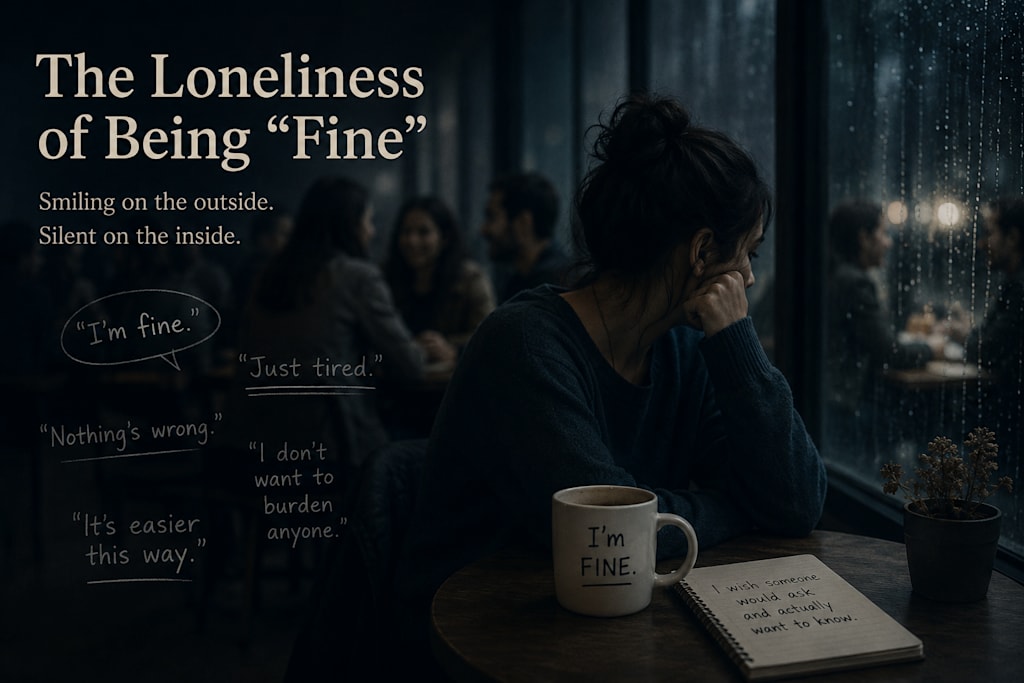
There’s a particular kind of loneliness that doesn’t look like loneliness at all. It doesn’t cry for attention, doesn’t show up in dramatic breakdowns, and rarely gets asked about. It sits quietly behind a familiar word: “fine.”
At first glance, “fine” seems harmless. It is the default answer in conversations, a social shortcut, a way to keep things smooth. But over time, it can become something heavier—a mask that fits so well it starts to feel like a second face. And behind that mask, many people carry a quiet emotional distance from themselves and others.
The comfort of “fine”
“Fine” is safe. It avoids questions, prevents awkward pauses, and keeps expectations low. In a world that often demands performance—productivity at work, positivity in relationships, stability in appearance—being “fine” is socially efficient. It signals that nothing is wrong enough to interrupt anyone else’s day.
But safety has a cost. When “fine” becomes the only acceptable emotional state, it narrows the space for honesty. Over time, feelings that don’t fit inside “fine” don’t disappear; they simply go underground.
People learn this early. A child says they are upset and is told to be strong. A teenager expresses confusion and is told to “get over it.” An adult admits exhaustion and is told everyone feels that way. Slowly, emotional expression becomes edited, trimmed, and reshaped until only the acceptable version remains: fine.
The quiet gap between words and reality
One of the most isolating experiences is speaking a word that doesn’t match what is actually happening inside. Saying “I’m fine” while feeling overwhelmed creates a subtle internal split. Outwardly, life continues normally. Inwardly, something is left unacknowledged.
That gap doesn’t always feel dramatic. It can be almost unnoticeable at first—just a small sense of distance from conversations, or a feeling that interactions are happening slightly above the surface. But the longer it continues, the more it builds a sense of internal disconnection.
People often mistake this for boredom, fatigue, or stress. In reality, it is often emotional unexpressed experience accumulating without an outlet.
Why “fine” spreads so easily
Part of the reason “fine” is so common is because it is rewarded. Most social environments are not designed for emotional depth. Workplaces want efficiency, not emotional complexity. Casual conversations prefer lightness. Even close relationships can fall into routines where deeper feelings are only occasionally discussed.
When someone does try to go beyond “fine,” they may be met with discomfort, quick solutions, or redirection. Not always out of neglect, but because many people are not trained to hold emotional complexity without trying to fix it.
So people adapt. They learn that “fine” keeps things smooth. It avoids burdening others. It avoids vulnerability that might not be received well. And slowly, it becomes the default response not just to others, but to oneself.
The loneliness inside emotional neutrality
Loneliness is often imagined as absence—no friends, no connection, no one around. But there is another kind that exists even in crowded rooms and active group chats. It comes from being emotionally unseen, even while being socially present.
When someone is always “fine,” they become difficult to truly know. Not because they are empty, but because they are hidden. Others can only interact with the surface version. Over time, relationships can become strangely hollow—not because of lack of care, but because of lack of access.
This creates a paradox: the more someone maintains emotional neutrality, the less likely they are to receive meaningful emotional response from others. And the less response they receive, the more they rely on neutrality. It becomes a cycle.
The internal cost of staying “fine”
The most significant impact of constantly being “fine” is not just social—it is internal.
Emotions that are consistently unspoken do not remain static. They shift. They compress. They often reappear in indirect ways: irritability, numbness, sudden fatigue, or a sense of detachment from things that used to matter. Sometimes they appear as physical tension or restlessness that has no clear source.
The mind tries to maintain balance by holding back what is not being expressed. But holding back takes energy. Over time, that energy drain can feel like emotional exhaustion without a clear reason.
This is why some people describe feeling “nothing” rather than sadness or anger. “Nothing” is often not the absence of feeling, but the result of prolonged containment.
The illusion of independence
Being “fine” is sometimes associated with strength. It can appear composed, self-sufficient, and stable. But there is a difference between healthy independence and emotional isolation.
Healthy independence allows space for both self-reliance and connection. Emotional isolation replaces connection with self-containment. Everything must be handled internally, without disruption to others.
This can create an identity built around not needing anyone. But humans are not designed for complete emotional self-containment. When needs are consistently denied expression, they do not disappear—they become quieter, more abstract, harder to name.
And what cannot be named is harder to share.
Moments when the mask slips
Even the most practiced “fine” eventually has cracks. It might appear in unexpected moments: when someone asks a simple question and it suddenly feels too heavy to answer lightly, or when a small inconvenience triggers an outsized emotional reaction.
These moments are often misunderstood as overreaction. In reality, they are often delayed responses to feelings that were never given space earlier.
The mask doesn’t break because of one event. It weakens because of accumulation.
The fear of honesty
Behind “fine” there is often a fear that honesty will create discomfort, distance, or burden. Many people worry that if they express what they truly feel, they will be seen differently—or that others will not know how to respond.
So they simplify. They smooth out complexity. They present a version of themselves that feels easier for others to receive.
But this creates a quiet emotional trade-off: acceptance in exchange for authenticity. Over time, that trade-off can feel increasingly costly.
What connection actually requires
Real connection is not built on constant positivity. It is built on recognition. Being understood does not mean being fixed or advised—it means being seen accurately.
When someone moves beyond “fine,” even slightly, it opens space for that recognition. Not always immediately, and not always perfectly, but enough to shift interaction from surface-level exchange to something more real.
This is also where many people feel uncomfortable. Depth requires attention, patience, and emotional presence. But it is also where loneliness begins to soften.
The difficulty of starting
Moving away from “fine” does not require dramatic confession or constant vulnerability. It often begins with small adjustments in language—allowing slightly more accuracy in responses, even if only to oneself.
Instead of defaulting to “fine,” there might be hesitation. Or a more honest but still simple alternative: tired, overwhelmed, distracted, uncertain.
These small changes matter because they break automatic patterns. They introduce variability into what was previously fixed.
At first, it may feel unfamiliar. But unfamiliarity is not the same as danger.
Learning to tolerate being seen
One of the deeper challenges behind emotional honesty is not speaking—it is being witnessed. When someone expresses something real, there is a moment of exposure. That moment can feel vulnerable because it cannot be controlled in the same way as “fine.”
But being seen is also what interrupts loneliness. Not because everything is suddenly solved, but because internal experience is no longer fully contained.
Connection does not require perfect understanding. It requires presence without withdrawal.
The quiet relief of truth
There is a subtle shift that happens when someone stops defaulting to “fine.” It is not immediate happiness. It is something more grounded: relief.
Relief comes from reduced internal contradiction. What is felt begins to align more closely with what is expressed. The gap narrows. Energy previously used to maintain the mask becomes available for actual experience.
This does not eliminate difficult emotions. It simply removes the added weight of hiding them.
The loneliness that was never obvious
The loneliness of being “fine” is not dramatic. It is not always sad or obvious. It is steady, quiet, and often mistaken for normal life.
But its effect is cumulative. It shapes how people relate to themselves, how they connect with others, and how much emotional space they believe they are allowed to take up.
Recognizing it does not require rejecting “fine” entirely. Sometimes “fine” is accurate. But when it becomes the only permitted answer, it starts to limit emotional reality.
And what is limited for too long begins to feel like distance—from others, and from oneself.
About the Creator
Enjoyed the story? Support the Creator.
Subscribe for free to receive all their stories in your feed.
Comments
There are no comments for this story
Be the first to respond and start the conversation.