
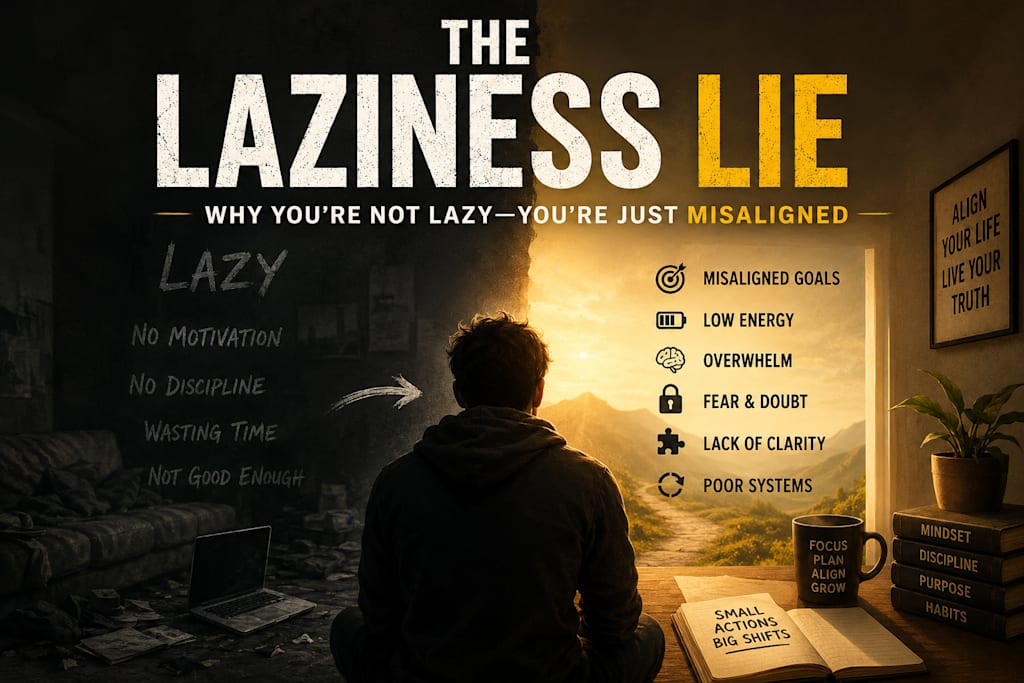
The Laziness Lie
Why you’re not lazy—you’re just misaligned
Introduction: The Label That Holds You Back
“Lazy” is one of the most casually used—and most damaging—labels people assign to themselves. It’s often thrown around when things don’t get done, when motivation dips, or when goals remain untouched. But what if laziness isn’t the real problem?
What if it’s a misdiagnosis?
The idea that people are inherently lazy is not only misleading—it’s limiting. It shuts down curiosity, discourages self-reflection, and replaces understanding with judgment. Instead of asking why something isn’t happening, we settle for the simplest explanation: “I’m just lazy.”
But human behavior is rarely that simple.
The Origin of the Laziness Myth
The concept of laziness is deeply rooted in culture. From school systems to workplaces, productivity is often equated with worth. If you’re not producing, achieving, or progressing, something must be wrong.
This mindset creates a binary:
Productive = Good
Unproductive = Lazy
But this ignores the complexity of human psychology. It assumes everyone operates under the same conditions, motivations, and energy levels—which simply isn’t true.
What we call laziness is often:
Lack of clarity
Emotional resistance
Burnout
Fear
Misaligned goals
In other words, it’s not laziness—it’s friction.
Misalignment: The Real Issue
At its core, the “laziness lie” is about misalignment.
When your actions don’t match your values, goals, or natural tendencies, resistance appears. That resistance feels like laziness, but it’s actually your mind pushing back against something that doesn’t fit.
1. Misaligned Goals
Sometimes the goals you’re chasing aren’t truly yours.
You picked them because society said they matter
You’re following someone else’s definition of success
You feel obligated rather than inspired
When goals lack personal meaning, motivation fades quickly. It’s not that you’re lazy—you’re just not connected to what you’re doing.
2. Misaligned Energy
Not all hours are equal.
You might be trying to:
Do deep work when you’re mentally exhausted
Be creative when your energy is low
Focus when your environment is chaotic
Your body and brain operate in rhythms. Ignoring them leads to frustration, not productivity.
3. Misaligned Systems
Relying on motivation alone is a losing strategy.
If your environment makes things harder:
Distractions are everywhere
Tasks feel overwhelming
There’s no structure
Then inaction becomes the default. That’s not laziness—it’s poor system design.
The Hidden Role of Fear
Fear is one of the most common drivers behind “lazy” behavior.
But it doesn’t always look like fear.
It can show up as:
Procrastination
Avoidance
Endless planning without action
Why? Because taking action exposes you to:
Failure
Judgment
Uncertainty
So your brain protects you by delaying the task.
From the outside, it looks like laziness.
From the inside, it’s self-preservation.
Burnout Disguised as Laziness
Another major factor is burnout.
When you’ve been:
Overworking
Stressed
Constantly pushing yourself
Your system eventually shuts down.
You stop caring. You avoid tasks. You feel drained.
And then you call yourself lazy.
But burnout isn’t laziness—it’s exhaustion. It’s your mind and body demanding recovery after prolonged strain.
Pushing harder in this state doesn’t fix the problem. It makes it worse.
The Motivation Trap
Many people believe they need to feel motivated before they act.
This creates a cycle:
Wait for motivation
Motivation doesn’t come
No action happens
Guilt builds
You label yourself lazy
But motivation is unreliable. It’s a feeling, not a system.
Action often comes before motivation, not after.
Once you start—even in a small way—momentum builds. And momentum creates motivation.
The Power of Clarity
One of the simplest reasons people don’t act is lack of clarity.
Vague goals like:
“Be successful”
“Get fit”
“Work harder”
Don’t translate into action.
Your brain doesn’t know where to begin.
Clear goals, on the other hand:
Define specific actions
Reduce decision fatigue
Make starting easier
Clarity removes resistance. And when resistance drops, action follows.
Identity Matters More Than Effort
If you constantly tell yourself:
“I’m lazy”
“I lack discipline”
You reinforce that identity.
And your actions will match it.
But when you shift your identity:
“I’m someone who follows through”
“I take small steps daily”
Your behavior begins to align with that belief.
This isn’t about blind positivity—it’s about direction. Identity shapes action more than effort alone.
Small Actions, Big Shifts
One of the biggest mistakes people make is thinking they need to do a lot to make progress.
This creates overwhelm.
Instead, focus on:
Starting small
Reducing the barrier to entry
Building consistency
For example:
Write one paragraph instead of a full article
Exercise for 5 minutes instead of an hour
Start the task, not finish it
Small actions bypass resistance. And once you begin, continuing becomes easier.
Designing an Aligned Life
If laziness isn’t the problem, alignment is the solution.
Here’s how to create it:
1. Align with Meaning
Ask yourself:
Why does this matter to me?
Would I still care about this without external pressure?
If the answer is no, reconsider the goal.
2. Align with Energy
Notice your natural patterns:
When are you most focused?
When do you feel drained?
Schedule tasks accordingly.
3. Align with Environment
Make good behavior easier:
Remove distractions
Prepare your workspace
Set clear boundaries
Environment often beats willpower.
4. Align with Simplicity
Break tasks into:
Clear steps
Manageable chunks
Complexity creates resistance. Simplicity creates action.
Stop Fighting Yourself
When you label yourself lazy, you create an internal conflict.
Part of you wants to act.
Another part resists.
Instead of forcing action through guilt, try understanding the resistance.
Ask:
What feels difficult about this?
What am I avoiding?
What would make this easier?
This shift—from judgment to curiosity—changes everything.
The Truth About Discipline
Discipline is often seen as the opposite of laziness.
But real discipline isn’t about harsh self-control.
It’s about:
Reducing friction
Creating structure
Showing up consistently
It’s less about forcing yourself to act and more about making action natural.
Reframing Laziness
Next time you feel “lazy,” pause and reframe:
Instead of saying:
“I’m lazy”
Ask:
Am I tired?
Am I overwhelmed?
Am I unclear?
Am I afraid?
Does this even matter to me?
This simple shift turns a dead-end label into a useful insight.
Conclusion: You Were Never Lazy
Laziness is a convenient explanation—but it’s rarely the truth.
Behind inaction is always a reason:
Misalignment
Fear
Burnout
Lack of clarity
Poor systems
When you address the real cause, the behavior changes naturally.
So stop calling yourself lazy.
Start asking better questions.
Because the moment you replace judgment with understanding, you stop fighting yourself—and start moving forward.
About the Creator
Enjoyed the story? Support the Creator.
Subscribe for free to receive all their stories in your feed.
Comments
There are no comments for this story
Be the first to respond and start the conversation.