
The Illusion of Control
Why letting go might be your greatest strength
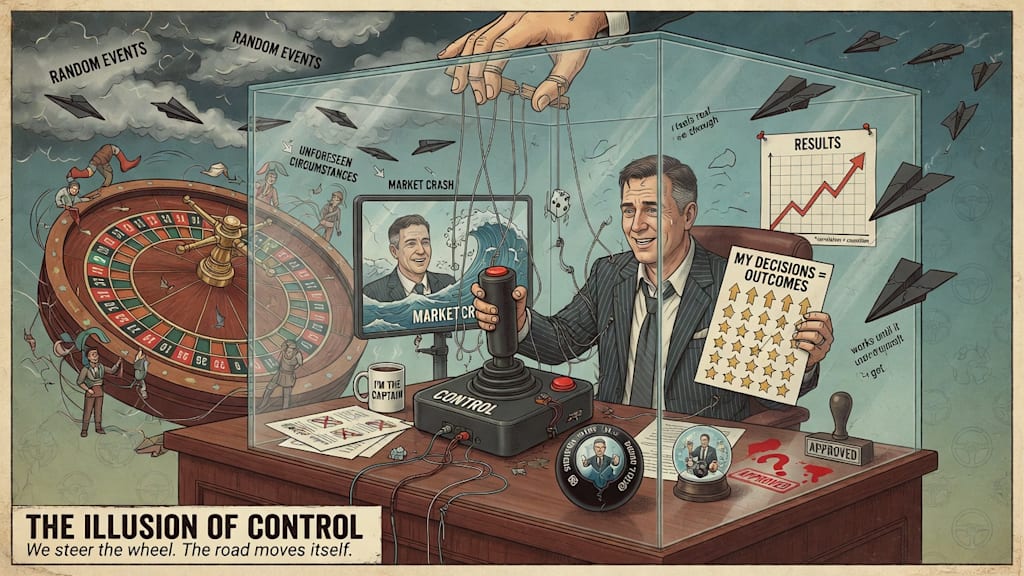
We live under a comforting assumption: that we are in control. Control over our decisions, our outcomes, our futures. It feels grounding to believe that if we plan carefully, work hard enough, and make the “right” choices, life will unfold according to our expectations. But beneath this belief lies a quiet truth—much of what we think we control is, in reality, uncertain, unpredictable, and often beyond our reach.
This is the illusion of control. And understanding it doesn’t weaken you—it frees you.
The Comfort of Control
Control gives us a sense of stability. It helps us navigate a chaotic world by creating order in our minds. We build routines, set goals, and create strategies, all in an effort to manage outcomes.
We plan our careers to secure success
We manage relationships to avoid conflict
We structure our days to maximize productivity
These behaviors are not inherently wrong. In fact, they’re necessary. But the problem arises when we start believing that these actions guarantee results.
Because they don’t.
You can do everything right and still fail. You can follow the plan and still end up somewhere unexpected. Life doesn’t operate on a fixed equation, yet we treat it as if it does.
Where the Illusion Begins
The illusion of control often starts early. We are taught that effort equals reward, that discipline leads to success, and that careful planning eliminates risk. While these ideas hold partial truth, they overlook a critical factor: randomness.
Consider this:
Two people work equally hard—one succeeds, the other doesn’t
A well-prepared plan collapses due to unforeseen events
Opportunities arise not from effort alone, but from timing and chance
We tend to attribute success to skill and failure to lack of effort. Rarely do we acknowledge luck, timing, or external forces.
This creates a distorted worldview—one where we overestimate our influence and underestimate uncertainty.
The Hidden Cost of Control
Clinging to control comes at a price. It creates stress, anxiety, and frustration when reality doesn’t align with our expectations.
When you believe you’re in control, every setback feels personal.
If something fails, you blame yourself
If plans change, you feel destabilized
If outcomes differ, you question your ability
This mindset turns life into a constant battle against unpredictability. You try harder, plan more, and tighten your grip—yet the more you try to control everything, the more exhausted you become.
Because control, in many cases, is an illusion you’re trying to maintain.
The Fear Behind Control
At its core, the need for control is driven by fear.
Fear of uncertainty
Fear of failure
Fear of losing direction
Control becomes a coping mechanism. It gives you the illusion that you can prevent bad outcomes or guarantee good ones.
But here’s the paradox: the more you try to eliminate uncertainty, the more anxious you become.
Why?
Because deep down, you know you can’t fully control what happens.
What You Actually Control
Letting go of control doesn’t mean giving up responsibility. It means understanding the difference between what you can control and what you cannot.
You control:
Your actions
Your effort
Your attitude
Your response to situations
You do not control:
Other people’s behavior
Outcomes of your efforts
External events
Timing and luck
This distinction is powerful. It shifts your focus from trying to control everything to mastering what’s truly yours.
The Freedom in Letting Go
Letting go of control is not weakness—it’s clarity.
When you release the need to control outcomes:
You reduce unnecessary stress
You become more adaptable
You make decisions with less fear
You accept uncertainty as part of life
Instead of forcing life into a rigid structure, you start flowing with it. You still act, plan, and work—but without attaching your identity to the results.
This creates a healthier relationship with success and failure.
Effort Without Attachment
One of the most powerful shifts you can make is this: focus on effort, not outcome.
Do the work, but release the expectation
Make the plan, but accept change
Set goals, but stay flexible
This doesn’t make you passive—it makes you resilient.
When outcomes are no longer your only measure of success, you stop fearing failure. You start learning, adapting, and growing without the weight of constant pressure.
Control vs. Influence
A helpful way to reframe your mindset is to think in terms of influence instead of control.
You don’t control outcomes—you influence them.
Your effort increases the chances of success
Your attitude shapes your experience
Your choices guide your direction
But none of these guarantee results.
This shift keeps you proactive without being rigid. You stay engaged in life without trying to dominate it.
The Role of Uncertainty
Uncertainty is often seen as something negative—something to avoid. But it’s also what makes life dynamic and full of possibility.
Without uncertainty:
There would be no surprise opportunities
No unexpected success
No growth through challenge
The same unpredictability that creates setbacks also creates breakthroughs.
When you accept uncertainty instead of resisting it, you open yourself to both.
Letting Go in Practice
Letting go of control is not a one-time decision—it’s a daily practice.
Here’s how you can start:
1. Notice your need for control
Pay attention to moments when you feel anxious or frustrated. Often, it’s tied to something you’re trying to control.
2. Ask: “Is this within my control?”
If the answer is no, shift your focus to what you can influence.
3. Accept outcomes without over-identifying
Success and failure are events—not definitions of who you are.
4. Embrace flexibility
Plans are guides, not guarantees. Adjust when needed.
5. Practice patience
Not everything unfolds on your timeline—and that’s okay.
Why Letting Go Makes You Stronger
It might seem counterintuitive, but releasing control actually makes you stronger.
You become less reactive to change
You handle setbacks with more calm
You take risks without fear of failure
You trust yourself more in uncertain situations
Control tries to protect you from life. Letting go prepares you to face it.
A Different Kind of Power
True power is not about controlling everything—it’s about navigating anything.
It’s the ability to:
Stay grounded when things change
Keep moving when plans fail
Adapt without losing direction
This kind of strength doesn’t come from control. It comes from acceptance, awareness, and resilience.
Final Thought
The illusion of control is seductive because it promises certainty in an uncertain world. But chasing that certainty often leads to frustration and exhaustion.
Letting go doesn’t mean you stop caring. It means you stop trying to control what was never yours to begin with.
You still show up. You still try. You still build, plan, and act.
But you do it with a lighter grip.
And in that space—between effort and acceptance—you’ll find something unexpected:
Peace.
About the Creator
Enjoyed the story? Support the Creator.
Subscribe for free to receive all their stories in your feed.
Comments
There are no comments for this story
Be the first to respond and start the conversation.