
The Happiness Trap
Why Chasing Joy Too Hard Often Backfires
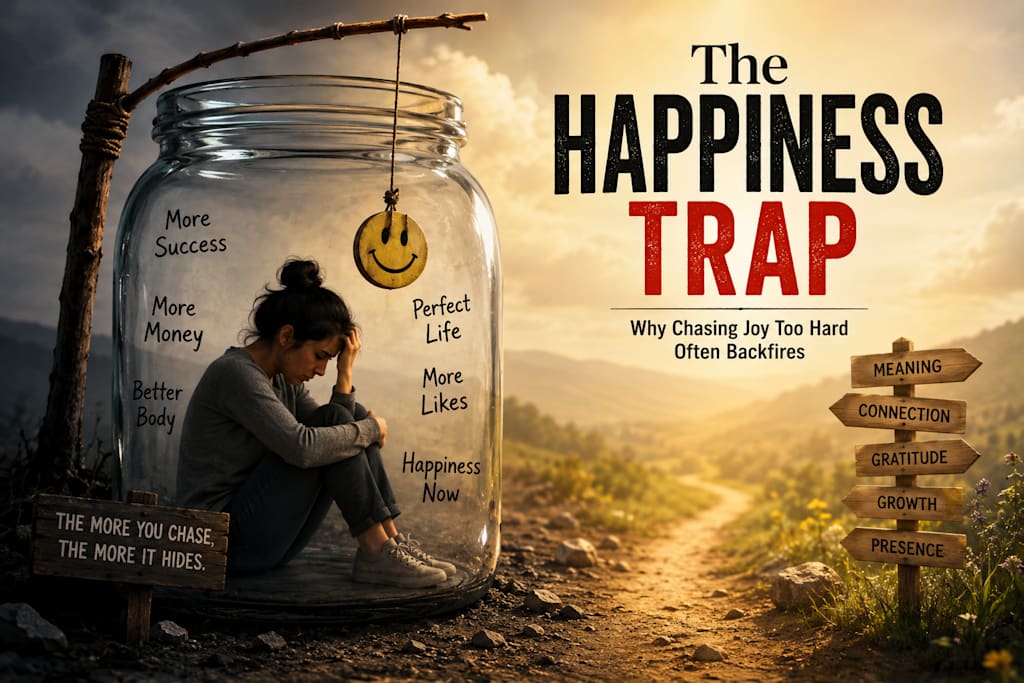
For most of us, happiness feels like the ultimate destination. We are told to pursue it, protect it, and measure our lives by how much of it we experience. From childhood onward, we hear phrases like "Do what makes you happy," "Life is about happiness," and "Follow your bliss." Social media celebrates smiling faces, motivational speakers promise permanent positivity, and advertisements suggest that the next purchase, vacation, or achievement will finally unlock lasting joy.
Yet despite living in an age of unprecedented convenience and opportunity, many people feel more anxious, dissatisfied, and emotionally exhausted than ever before. It raises an uncomfortable question: What if the relentless pursuit of happiness is actually making us less happy?
This paradox is often called the happiness trap—the idea that chasing happiness too intensely can prevent us from experiencing it naturally. Happiness is not something that can be forced or constantly maintained. Instead, it tends to appear when we stop treating it as a goal and begin treating it as a byproduct of living a meaningful life.
The Pressure to Be Happy
Modern culture has transformed happiness into an expectation rather than an experience.
Open almost any social media platform, and you'll find carefully edited snapshots of joyful moments. Vacations look perfect. Relationships appear effortless. Careers seem exciting. Everyone seems to be thriving.
Of course, these images rarely show the full story. Behind every smiling photo are ordinary struggles, disappointments, and moments of uncertainty that never make it online.
Still, constant exposure to idealized lives creates the impression that happiness is the normal state of successful people. When we compare our messy reality to someone else's highlight reel, our own lives inevitably seem inadequate.
Ironically, the more we believe everyone else is happy, the more we feel something must be wrong with us whenever we're not.
Happiness Was Never Meant to Be Constant
Human emotions exist for a reason.
Joy encourages us to repeat beneficial experiences. Fear keeps us safe. Sadness helps us process loss. Anger motivates us to address injustice. Anxiety prepares us for uncertain situations.
Trying to eliminate every uncomfortable emotion is like trying to remove warning lights from a car dashboard. The lights aren't the problem—they're information.
Expecting ourselves to feel happy all the time ignores the complexity of being human.
Life naturally includes disappointment, grief, boredom, frustration, and uncertainty. These emotions are not failures. They're evidence that we're fully engaged with life.
Why Chasing Happiness Makes It Harder to Find
Imagine trying to fall asleep.
The harder you force yourself to sleep, the more awake you become. Sleep arrives when you stop chasing it.
Happiness often works in a similar way.
When we constantly ask ourselves questions like:
"Am I happy yet?"
"Why don't I feel happier?"
"Shouldn't this success make me happier?"
we begin evaluating every moment instead of experiencing it.
Our attention shifts from living to monitoring our emotional state.
Instead of enjoying dinner with friends, we wonder whether we're enjoying it enough.
Instead of appreciating a vacation, we worry about making every moment perfect.
Instead of celebrating achievements, we immediately move to the next goal.
Constant evaluation interrupts genuine enjoyment.
The Hedonic Treadmill
Psychologists often describe a phenomenon known as the hedonic treadmill.
Humans quickly adapt to positive changes.
The new phone becomes ordinary.
The dream job becomes routine.
The bigger house simply becomes home.
The salary increase soon feels normal.
Every achievement provides a temporary emotional boost before becoming our new baseline.
This isn't because we're ungrateful.
It's because the human brain is remarkably adaptable.
Unfortunately, many people interpret this natural adaptation as evidence that they simply haven't found enough happiness yet.
So they chase another promotion.
Another purchase.
Another relationship.
Another milestone.
The cycle repeats endlessly.
Social Media's Happiness Illusion
Social media has intensified the happiness trap.
People rarely post their lonely evenings, financial worries, relationship conflicts, or moments of self-doubt.
Instead, platforms reward positivity, beauty, excitement, and success.
As a result, everyone becomes both an audience and a performer.
We compare our behind-the-scenes life with everyone else's carefully edited highlight reel.
The comparison becomes impossible to win because we're comparing reality to presentation.
Even people who appear happiest online often admit struggling privately with anxiety, depression, or burnout.
The lesson isn't that social media is fake.
It's that happiness cannot be measured by appearances.
The Problem with Positive Thinking
Positive thinking has value.
Optimism helps people recover from setbacks, maintain motivation, and build resilience.
But positivity becomes harmful when it turns into denial.
Sometimes people feel pressured to:
Always look on the bright side.
Never complain.
Stay positive no matter what.
Ignore painful emotions.
This approach is sometimes called toxic positivity.
Real emotional health doesn't mean feeling positive every moment.
It means allowing ourselves to experience difficult emotions without believing they'll last forever.
Suppressing sadness doesn't eliminate it.
Ignoring anxiety doesn't solve it.
Accepting emotions often reduces their intensity.
Happiness Is a Byproduct
Many of life's happiest moments happen unexpectedly.
Laughing uncontrollably with friends.
Watching a sunset.
Helping someone in need.
Reading a fascinating book.
Getting absorbed in creative work.
Playing with children.
These moments rarely happen because we intentionally set out to "be happy."
They happen because we were fully present.
Happiness often emerges while we're focused on something meaningful rather than ourselves.
The Importance of Meaning
Research consistently suggests that meaningful lives aren't always the happiest in the short term.
Parenting can be exhausting.
Building a business can be stressful.
Caring for aging parents can be emotionally draining.
Learning difficult skills requires frustration.
Yet these experiences often create deep fulfillment.
Meaning provides something happiness alone cannot: purpose.
People who pursue meaning instead of constant pleasure often experience richer emotional lives because they accept both joy and hardship as part of growth.
Accepting Emotional Diversity
Imagine listening to music with only one note.
Even if the note were beautiful, it would quickly become boring.
Life works similarly.
Joy gains depth because sadness exists.
Relief feels powerful because anxiety preceded it.
Success feels meaningful because failure taught valuable lessons.
Trying to eliminate every negative emotion removes much of what gives happiness its significance.
Our emotional lives resemble seasons rather than permanent climates.
Winter eventually becomes spring.
Storms eventually clear.
No emotion lasts forever.
Gratitude Without Pressure
Gratitude is often promoted as a shortcut to happiness.
While gratitude can genuinely improve well-being, it shouldn't become another obligation.
You don't need to pretend everything is wonderful.
Instead, gratitude means noticing what is already good without denying what is difficult.
A difficult day can still include:
A kind conversation.
A warm meal.
Fresh air.
A supportive friend.
A quiet evening.
Recognizing small blessings doesn't erase pain.
It simply prevents pain from becoming the entire story.
The Freedom of Lower Expectations
One surprising path toward greater happiness is lowering unrealistic expectations.
Not lowering standards.
Lowering impossible expectations.
Life doesn't need to be exciting every day.
Relationships don't need to be perfect.
Careers don't need to provide constant fulfillment.
People don't need to agree with us.
When we stop demanding perfection from life, ordinary moments begin to feel extraordinary.
A peaceful morning.
A good conversation.
Finishing a difficult task.
These become enough.
Presence Beats Pursuit
Many people spend their lives preparing for happiness.
"I'll be happy when I graduate."
"I'll be happy when I get promoted."
"I'll be happy when I buy a house."
"I'll be happy when I retire."
But every milestone simply creates another destination.
Life becomes an endless waiting room.
Presence offers a different approach.
Instead of postponing happiness, we notice today's experiences.
Not because today is perfect.
Because today is real.
The future matters.
Planning matters.
Goals matter.
But life only happens in the present moment.
Building a Life Instead of Chasing a Feeling
Rather than asking:
"How can I be happier?"
Perhaps better questions are:
"What kind of person do I want to become?"
"What relationships deserve my attention?"
"What work feels meaningful?"
"What values guide my choices?"
When our lives align with our values, happiness becomes a welcome companion rather than a demanding destination.
It arrives unexpectedly.
It leaves naturally.
And it returns again.
Embracing the Full Human Experience
The happiest people are not those who never experience sadness.
They are often those who understand that sadness belongs.
So do uncertainty.
Fear.
Disappointment.
Grief.
Hope.
Wonder.
Love.
Life becomes richer when we stop dividing emotions into "good" and "bad."
Instead, we recognize each one as part of the human experience.
Happiness doesn't disappear because we feel pain.
It becomes more meaningful because we've known both.
Conclusion
The happiness trap isn't that happiness is bad. It's that we often demand too much from it. We expect it to be permanent, constant, and entirely within our control. When reality doesn't match those expectations, we conclude that something is wrong with our lives—or with ourselves.
But happiness was never meant to be a permanent destination. It is a fleeting, beautiful emotion that comes and goes, just like every other feeling we experience. The more tightly we try to hold onto it, the more easily it slips away.
A fulfilling life is not one free from sadness, stress, or disappointment. It is a life filled with purpose, meaningful relationships, personal growth, curiosity, kindness, and moments naturally finds space in such a life, not because it was relentlessly pursued, but because it was allowed to emerge on its own.
Perhaps the secret isn't to chase happiness at all. Perhaps it's to build a life so rich in meaning, authenticity, and presence that happiness occasionally drops by—and when it does, we welcome it without trying to make it stay forever.
About the Creator
Enjoyed the story? Support the Creator.
Subscribe for free to receive all their stories in your feed.
Comments
There are no comments for this story
Be the first to respond and start the conversation.