Stream of Consciousness
How Celvim Collagen Naturally Boosts Skin Elasticity and Hydration
So here's the thing - three years ago, if you'd told me I'd be banging on about collagen supplements, I would've rolled my eyes so hard they'd have fallen out of my head. I was that person who thought it was all just expensive marketing nonsense for people with too much money and not enough sense.
By David Anejaabout a year ago in Confessions
The Night I Found Out My Father Had Another Family
I was reaching for the lasagna when my mother’s voice cracked like a whip across the kitchen. “Don’t touch that. We’re waiting for your father,” she snapped, eyes glassy with something that wasn’t just impatience.
By Ava Writes Truthabout a year ago in Confessions
How I Lost \$3,000 to a Scam (And Almost My Mind)
💬 It started with a message. Late one night, as I was scrolling Instagram with my usual cocktail of boredom and insomnia, a DM notification lit up my screen. > “Hey, you’d be perfect for a remote job I just started. Easy work, good pay. Lmk if interested!” It was from a college acquaintance — not someone I spoke to often, but someone real. Her page was still filled with selfies, memes, and graduation photos. Verified, active, human. I replied. She told me she was working with a new e-commerce platform that paid people to “test payment systems.” All I had to do was receive money via check, deposit it into my bank, and wire it to a "verification account" to prove the system worked. They’d even pay me a \$500 bonus per transaction. It sounded weird. But also — kind of legitimate? I mean, why would she lie? e check arrived two days later. It looked real. Official bank logo. Watermark. All the bells and whistles. It was made out to me — for \$2,500. > “Deposit it today, send the funds to the testing wallet, and keep \$500 as your cut,” she texted. I deposited the check using mobile banking. No red flags. It cleared “pending” in less than 24 hours. I wired \$2,000 using Western Union to a name I now realize doesn’t exist. I even messaged her a photo of the receipt. And then everything exploded. Three days later, I got an email from my bank. Subject line:“Returned Check — Fraudulent Deposit.” The check had bounced. The money I thought I had never actually existed. And now, I was \$2,000 overdrawn. Frantic, I reached out to her — or, I thought I did. The account was gone. Vanished. Her Instagram had been hacked. The scammer had been impersonating her the whole time. I had wired real money out of my account based on a fake check, to a fake name, under fake pretenses. - I spiraled. For the next few hours, I stared at my bank app like it could undo itself. I felt nauseous. I replayed everything: the check, the DMs, the moment I told my roommate, “This could be a cool side hustle.” I wanted to throw up. That night, I barely slept. The shame — more than the money — consumed me. How could I, someone educated, digitally literate, aware of scams, get duped like this? The truth behind the scam (and why it works) Later, I learned that this type of fraud is called an “overpayment scam.” It’s shockingly common — especially on platforms like Instagram, Facebook, Telegram, and LinkedIn. Here’s how it works: A scammer gains access to a real person’s account (often someone you loosely know). They send realistic job offers or payment gigs that involve checks or wire transfers. The check bounces days after you’ve already sent real money. Your bank holds you liable — because you authorized the wire. > The FTC reports thousands of these cases annually, and victims often lose between \$500–\$5,000. Most never recover the funds. --- I tried to fix it. The damage was already done. I reported everything: ✔️ To my bank (they said I was liable) ✔️ To the police (they took a report and wished me luck) ✔️ To Instagram (they never responded) ✔️ To the FTC (just to feel like I was doing something) My account sat at -\$2,031.46 for three weeks. I had to borrow money from my older brother to get out of the hole. That conversation still haunts me. --- But this story isn’t just about money. It's about how shame keeps people silent. I didn’t want to tell anyone I got scammed — not even my best friends. I feared they’d laugh. Judge me. Say “How could you fall for that?” But as soon as I opened up, I learned something shocking: Almost everyone I know has had a close call. Some had clicked phishing links. Others nearly fell for crypto “giveaways.” One friend was almost catfished by a fake job recruiter. The only thing that saved them? Dumb luck. --- Here’s what I learned — the hard way: 1. Just because it looks real doesn’t mean it is. Scammers use real names, logos, banks, even hacked accounts of people you know. 2. A check isn’t really “cleared” just because your bank app says so. It can take 5+ days to bounce back as fraudulent. 3. Banks won’t protect you from this. You’re responsible if you send money based on a fake check — even if you were tricked. 4. If it sounds too good to be true, it is. Real jobs don’t ask you to wire money first. Ever. --- I lost \$3,000. But I gained clarity. This scam took my money and my peace of mind. But it also made me more cautious, more outspoken — and more compassionate. If you’ve been scammed, or almost scammed, please know this: You are not stupid. You are not alone. And you can survive this. I did. Resources if this happened to you: ∆ [ReportFraud.ftc.gov](https://reportfraud.ftc.gov/) ∆ [IC3.gov (FBI Internet Crime Reporting)](https://www.ic3.gov) ∆ [Western Union Fraud Support](https://www.westernunion.com/us/en/fraud-awareness.html) ∆ Call your bank immediately and ask to speak with a fraud specialist. If this story helped you feel seen or protected, consider sharing it. We don’t talk enough about scams because we’re too ashamed. But silence protects scammers. Stories protect each other. ❤️ Thank you for reading. Want more real stories, writing tips, and cautionary tales? subscribe for free right here on Vocal. Every read counts. --
By E. hasanabout a year ago in Confessions
I Walked Away From My Best Friend—And I Don’t Regret It
I didn’t send a long text. I didn’t write a letter. I didn’t even say goodbye. One day, I just stopped replying. I muted the messages. I ignored the calls. I walked away from someone I once called my best friend—and honestly, I haven’t regretted it once.
By Hamad Haiderabout a year ago in Confessions
I Cut Off My Best Friend Without Warning — And I Don’t Regret It
I never imagined I would ghost someone I once considered my soulmate in platonic form. It felt brutal, unnecessary—until it wasn't. The reality is, I didn’t wake up one day and decide to abandon my best friend. The truth is more painful and layered than that.
By Hamad Haiderabout a year ago in Confessions
I Quit Social Media for 30 Days — Here’s What Really Happened
I used to think I wasn’t addicted to social media. After all, I wasn’t posting every day. I didn’t do TikTok dances. I wasn’t one of those people constantly checking in at restaurants or bragging about their vacations.
By Irfan Khanabout a year ago in Confessions
The Power in the Crackle. AI-Generated.
"I used to believe my voice had to be polished to be powerful—until I realized my vocal fry was saying more than I ever dared to." --- I used to replay my voice messages like an editor with a red pen. Every “um,” “like,” or low, creaky end-of-sentence made me wince. Was I lazy? Unprofessional? Unclear? That’s what I’d been told about vocal fry—that low, drawn-out rasp made infamous by pop culture, criticized by professors, mocked in media. But that voice was mine. It wasn’t just some tic I picked up from a friend or a bad habit I needed to train out of myself. It was how I naturally spoke, especially when I was tired, comfortable, or vulnerable. And in a strange twist of self-acceptance, I started recording myself—not to fix, but to listen. Just listen. --- 🎙️ The First Time I Heard My “Real” Voice It happened during a 2 a.m. audio diary I made on a whim. I was restless and emotional, the kind of night when your thoughts won’t stop spinning unless you say them out loud. I hit record on my phone and let my thoughts pour out—no script, no filters, no pressure to perform. What came out surprised me. My voice dropped into its natural register—lower, raspier, more intimate. And there it was: the vocal fry. That slight crackle at the end of my words, that soft grumble in my throat. The result? Real. Raw. Weirdly… beautiful. Instead of deleting it, I played it back. Then again. And again. And something shifted. That low hum—the infamous fry—wasn’t a flaw. It was a fingerprint. --- 🧠 Where the Pressure Came From We’re taught to speak clearly, project, enunciate. To be articulate. To “use your voice” the right way. Especially for women and queer folks, the pressure is compounded: sound strong, but not aggressive. Confident, but not arrogant. Warm, but not childish. Sound “put together”—whatever that means. As a result, sounding “perfect” became a prison. I spent years obsessing over my tone, intonation, cadence. I’d re-record voice notes five, ten, twenty times until I sounded polished enough to hit send. I wanted to sound like someone worth listening to. But in the process, I lost something. Authenticity. Ironically, social media—where real voices often thrive—made this worse. Between podcast hosts with buttery-perfect delivery and TikTokers whose voices were always either hilariously performative or motivationally crisp, I felt like there wasn’t room for the messier textures of a voice like mine. The quirks. The cracks. The creaks. --- 🔄 Reframing Vocal Fry So I started researching. I needed to understand what was happening in my voice—and why I’d been taught to hate it. Turns out, vocal fry isn’t some bizarre glitch. It’s a natural register in speech, used by both men and women, and increasingly common in younger generations. In English, especially American English, it’s become part of the linguistic landscape. Celebrities like Kim Kardashian, Zooey Deschanel, and even Scarlett Johansson have famously used vocal fry. And while they’ve been mocked for it—often harshly and unfairly—it hasn't stopped people from using it. It hasn’t even made it disappear. In fact, linguistic studies show it’s often used when we’re being reflective, emotional, or trying to sound less aggressive. So the very thing I was told made me sound weak was actually signaling something deeper. It wasn’t laziness. It was intimacy. It was emotion. It was vulnerability. And suddenly, I began to hear my vocal fry differently. Not as something that needed fixing, but something that was saying: “I’m here. I’m soft. I’m thinking. I’m real.” --- 🔊 From Insecurity to Identity After that 2 a.m. audio diary, I kept going. I started recording more voice notes, not to send, but just for myself. I’d talk about my day, my dreams, my fears, my frustrations. I gave my voice room to be messy. To stumble. To drop into that low, gravelly space. And over time, my inner critic quieted. That voice I once tried to scrub clean? It stopped sounding flawed. It started sounding free. Now, I use vocal fry like a signature. It’s not every word or every sentence. It just shows up when I’m being honest or thoughtful or a little tired. And it’s part of how I express myself when I’m not performing for anyone. When I’m just being me. Not everyone loves it. That’s okay. It’s not for everyone. It’s for me. --- 💬 A New Way to Speak—And to Hear Others What surprised me most, though, was how this change made me a better listener. Once I stopped judging my own voice so harshly, I began to hear other people differently too. I started noticing the way my friends’ voices softened when they were sad, or how their speech cracked when they were trying not to cry. I heard the warmth in their imperfections—their pauses, their stutters, their sighs. And I stopped listening for what was “right” or “clear.” I started listening for what was real. There’s music in that. And power. We’re not robots. We’re not radio announcers. We’re human. Our voices carry history, emotion, exhaustion, joy. And every rasp, every catch, every little vocal irregularity is a part of that story. --- 🎤 Final Thought: Your Voice Isn’t Broken If you’ve ever cringed at a recording of yourself—especially if your voice dips, creaks, cracks, or lingers—trust me, I see you. But I want to offer you this: What if the part of your voice that you hate is actually your superpower? What if it’s not a flaw—but a feature? What if it’s not evidence of weakness—but a mark of truth? You don’t have to sound like a voice actor. You don’t have to eliminate every “um” or “like” or vocal fry. You just have to sound like you. Whatever that means, however that comes out. Your voice isn’t broken. It’s yours. And that’s not just okay. That’s your edge.
By Zubair Ahmadabout a year ago in Confessions
The Woman Crying at the Bus Stop Looked Just Like Me
It was a grey, chilly morning—the kind where even the wind feels tired. I was running late, again. My coffee was lukewarm, my mood colder. I had barely slept the night before, my mind restless with the usual mix of anxiety and guilt, though I couldn’t quite explain either. Life, lately, had felt like a series of to-do lists I couldn’t keep up with.
By MR.THOMASabout a year ago in Confessions
How a Taxi Driver Became My Unlikely Therapist
It was one of those nights — the kind that makes you feel like the world has given up on you, and you’re just too tired to care. I had missed a major deadline at work, had a fight with my best friend, and was on the verge of a quiet breakdown. When I stepped into the taxi just after midnight, all I wanted was silence and a ride home.
By shoaib khanabout a year ago in Confessions
Behind Smiles
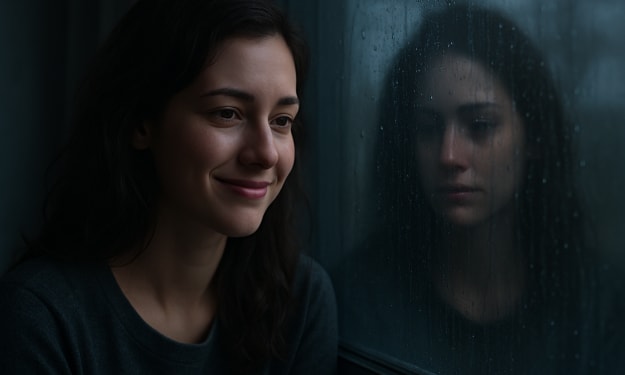
Behind Smiles You see her every day. She's the kind of person who makes others feel lighter just by entering the room. Her smile is radiant, her laugh contagious. She remembers birthdays, sends late-night encouragement messages to friends, and cracks jokes even during tense meetings. Everyone calls her "sunshine." She's the one people lean on when things go wrong. Her name is Ayesha. She's twenty-six, working at a fast-paced digital agency, always dressed in vibrant colors, always humming some old Bollywood tune. If you didn’t know better, you’d say she’s the happiest person alive. But no one sees her after the lights go out. No one sees her come home to an empty apartment, place her phone face-down, and curl up on the corner of her bed, hugging a pillow that smells like memories. No one sees the moments where she stares blankly at the ceiling, eyes open, heart heavy, wondering what it’s like to live without pretending. No one hears the silence she drowns in every night — the silence she tries to fill with noise all day long. Ayesha wasn’t always this way. There was a time she dreamed freely — of writing books, traveling solo, laughing with her mother over tea on rainy evenings. But life had other plans. Her mother passed away suddenly when Ayesha was nineteen. A year later, her elder brother moved abroad, never to return. Her father stopped speaking to her after she refused an arranged marriage, saying she had "shamed" the family. So, Ayesha became her own home. Her own family. Her own comfort. She wore her smile like armor. She began journaling daily. Page after page of affirmations, goals, gratitude — but also pain. The kind of pain too raw to share. One page read: > “Everyone thinks I’m healing. But sometimes, I think I’ve just gotten better at hiding.” Work became her escape. So did social media. Her Instagram bloomed with golden hour shots, captions about self-love, coffee aesthetics, and book recommendations. People followed her for “positivity.” They never saw the drafts folder full of unsent goodbyes. Until one Thursday, everything collapsed. Ayesha didn’t get out of bed. Her limbs wouldn’t move. Her chest felt like it had caved in. Her mind — numb. Her phone kept buzzing: meetings, reminders, voice notes. She ignored them all. By evening, a close colleague who lived nearby grew concerned and came over. When she didn’t respond, he got the landlord to unlock the door. There she was. Not hurt. Not unconscious. Just sitting by the window, her face pale, her eyes swollen from crying. On the mirror in her bedroom, written in lipstick, were the words: “I’m tired of pretending.” She was taken to the hospital. Diagnosed with severe emotional exhaustion and clinical depression. The doctor called it an “internal breakdown” — the kind no one sees until it’s too late. And the people around her? Shocked. “I never knew…” “She was always so happy…” “She checked on me last week!” That’s the thing about people like Ayesha. They give so much light, hoping others don’t see their darkness. Weeks passed. Slowly, she began to speak. In therapy, at first. Then to herself in the mirror. Then finally, to the world. She posted on Instagram — no filter, no caption aesthetics: > “To those who think smiles mean strength: they don’t. I smiled to survive. I smiled to distract. I smiled so no one would ask if I was okay. But I wasn’t. And if you're reading this, and you’re tired too — please, speak up. Pretending will kill you in silence.” The post went viral. Messages poured in. Not of pity — but resonance. “I feel seen.” “This is my story too.” “You just saved me.” Ayesha changed that day. She didn’t become weak. She became real. Now, she laughs — but not to hide. She cries — without shame. And when someone says, “You seem so positive,” she smiles softly and says, “Sometimes. But not always. And that’s okay.” She leads mental health workshops at work now. She talks about the importance of checking in on “the strong ones.” She listens more. Speaks slower. Pauses often. And sometimes, when she looks at the mirror, she still sees that old version of herself — the girl who smiled to survive. But now, she reaches out — and comforts her. Because behind the brightest smiles are often the quietest screams. And Ayesha? She’s done hiding.
By TrueVocalabout a year ago in Confessions