Friendship
The Broken Promise: How a Youth Leader Sold Out His Generation
I remember the first day I saw Tunde speak. We were gathered in the dusty courtyard of the community hall, restless and worn out from years of silence. We had all suffered — no jobs, no hope, no voice. Our leaders treated us like numbers. But when Tunde stood on that makeshift stage with nothing but a microphone and fire in his eyes, something shifted. Something awakened.
By Oguntade Hafeez Olalekanabout a year ago in Confessions
I Rewrote My Origin Story
The lie began in Dr. Aris Thorne’s office, where the smell of bergamot tea and desperation clung to the leather chairs. Tell me about your earliest memory, he’d said, steepling his fingers. Rain streaked the window behind him like claw marks.
By Muhammad Firdos about a year ago in Confessions
The Apology I Never Sent
The fractures in my bones were the only thing that remained. Not the sound of your voice when you found me crumpled at the base of the oak tree, not the smell of antiseptic in the emergency room, not even the way your hands shook as you held mine. Just the dull, persistent ache—a ghost of the fall that changed everything.
By Muhammad Firdos about a year ago in Confessions
All My Crushes Ignored Me — Until the One Who Came Back
1. The DM That Shook My Stability I’m 29 now. Life’s solid — decent job in Dubai, my own apartment, a gym routine I pretend to enjoy, and a golden retriever named Chai who thinks every human exists to throw his ball.
By Arshad khanabout a year ago in Confessions
The Quiet Room
Mira never liked silence, but lately, it was the only sound that kept her company. She lived alone in a small apartment tucked behind a grocery store, where the faint hum of distant traffic used to bring her comfort. But now, even that noise felt like it belonged to another world — one she no longer participated in. It had been six months since her last real conversation. Not the kind exchanged with a cashier or a neighbor’s polite nod — but a genuine, heart-spoken conversation. The kind that makes you feel seen. Heard. Alive. She had friends once. Plans. She used to laugh in restaurants and dance barefoot in living rooms. But life happened — people moved away, grew families, changed jobs, got too busy, or simply drifted. Loneliness didn’t arrive like a storm. It crept in like fog — slowly, invisibly, until one day she woke up and realized it had settled in. The worst part wasn’t being alone. It was feeling unnecessary. Every morning, she brewed coffee for one, scrolling endlessly through social media. Everyone seemed busy being loved — engagement announcements, travel reels, baby showers, brunch selfies. Mira tapped “like” on all of them, even though each tap felt like pressing deeper into a bruise. Her phone never rang. One evening, she noticed a dusty notebook wedged behind a pile of cookbooks. She opened it to find an old list of goals: Start a garden Learn Spanish Write a short story Call Dad She smiled bitterly. Most of it hadn’t happened. Her dad passed away two years ago. The last time she’d spoken to him, she cut the call short because she was “tired.” That word haunted her now — how tired can feel permanent when there’s no one left to wake up for. She sat down and wrote anyway. Not a story, not yet — but a letter. To no one in particular. > “Dear Whoever, Today was quiet again. The kind of quiet that presses against your ears. I watched the rain, made coffee, and thought about what it means to be missed. I think I’ve forgotten what that feels like. But I’m still here. I still wake up. I still hope someone’s thinking about me, even if it’s just the memory of me…” She filled three pages. The next day, she wrote another. And another after that. Some letters were addressed to her younger self, some to people who’d left her life. Some were just to the universe. Days passed. Her mornings began with writing. Then short walks. She started greeting the mailman with a smile. She joined an online book club. The conversations were small, even awkward — but real. One Tuesday afternoon, while watering her tiny balcony plant, she received a message from someone in the book club: > “Hey, I really liked what you said about loneliness in today’s discussion. Would you like to chat more sometime?” Mira stared at the screen. It was simple. It wasn’t love, or friendship, or a promise. But it was a bridge — a small, delicate one — stretching out of the quiet room she had lived in for too long. She typed back: > “I’d love that.” And for the first time in months, her silence wasn’t empty — it was peaceful.
By Rizwan about a year ago in Confessions
All My Crushes Ignored Me — Until the One Who Came Back
1. The DM That Shook My Stability I’m 29 now. Life’s solid — decent job in Dubai, my own apartment, a gym routine I pretend to enjoy, and a golden retriever named Chai who thinks every human exists to throw his ball. Then came that Instagram DM. > "You're still the same… just more beautiful now." I squinted at the name. Meher Siddiqui. And just like that, 2016 came crashing back — the girl I once adored, the girl who called me her “best friend” and then went to prom with someone else. The DM was simple. But it unlocked a door I’d welded shut. 2. My Degree in Romantic Rejection If rejection were a college major, I’d have graduated with honors. Every crush in college was a new assignment. And every semester? A reminder that effort doesn't equal affection. I wrote poetry for Neha. > She replied: “So sweet, bro!” Made an actual presentation for Ayesha on “Why We’d Make a Great Couple.” > She used my slides… to teach her juniors. And then — there was Meher. Late-night texts. Inside jokes. Chai breaks between classes. Spotify playlists with hidden meanings. I felt like I’d finally found someone who saw me. So I told her. > “I think I’m falling for you.” She paused. Smiled gently. > “Arman, you’re my person… but not like that.” The friend zone. Final level. No cheat codes. 3. Seven Years of Silence After college, Meher and I didn’t fight. We didn’t block or unfollow. We just… stopped. I moved on — physically, at least. New job, new city, new routines. I built myself from the heartbreak up. One gym session, one work promotion, one late-night playlist at a time. Until she popped back in. Out of nowhere. Her message carried a softness — like nothing had changed. But I had. 4. Sarcasm on Ice I typed and deleted three replies. Then finally: > "Wow. Meher remembers me. Is Mercury in retrograde?" She laughed in a voice note. > “Saw your reel randomly. You look different… in a good way. Calmer.” Her tone was playful, nostalgic — but it stirred something sharp. Part of me wanted to ignore her. The other part — the one still haunted by "what ifs" — whispered: “You need closure, Arman.” 5. Coffee and Confessions We met at a familiar café. The café. The one where we “studied” but mostly joked, flirted, and stole glances over laptops. Meher looked different — older, more grounded. Her eyes still held that mischievous spark, but her posture said she’d been through life too. After a few sips of chai and awkward small talk, she sighed. > “I owe you an apology.” > “For?” “For not choosing you. You were genuine. The others were… noise.” I stirred my coffee. Once, that confession would’ve made me leap into dreams. Now? I just nodded. > “It wasn’t your job to choose me. But it was mine to stop waiting.” 6. The Reintroduction We talked more over the next few weeks. DMs turned into calls. Calls turned into dinners. She wasn’t trying to impress me. And I wasn’t trying to win her anymore. For the first time, we were just two people — not the roles we used to play. One evening, sitting in her car, she asked: > “Do you think we could… start again?” I paused. The old me would’ve said yes in a heartbeat. But this version? > “I don’t know. I’m not chasing anything anymore. But I’m willing to listen — without expectations.” She smiled. It wasn’t enough for her. But it was enough for me. 7. Replays and Realizations Some moments felt like déjà vu. Laughing over random memes. Arguing about the best chai spots. Playing music and driving around like time hadn’t passed. But I wasn’t that lost kid anymore. I didn’t spiral into feelings with every glance. I didn’t imagine futures from fleeting gestures. One night, Meher said: > “You’re different. You don’t need me anymore, do you?” I looked at her. Long and quiet. > “I think I still care. But I love myself more now.” 8. Closure Doesn't Always Announce Itself Closure isn't a scene from a movie. It doesn’t always involve shouting or slamming doors. Sometimes, it’s a smile on a quiet street, where you realize the ache is gone. I forgave her. Not because she earned it, but because I did. She once told me: > “You’re still the same Arman… just stronger.” She was right. But I wasn’t stronger because she returned. I was stronger because I stopped needing her to. 9. A Polite Goodbye Meher still sends me the occasional message. A “Hi.” A “Congrats.” A heart on a story. I respond with a single emoji — 🙂. Not out of spite. But out of peace. I’m not the backup plan. Not the what if. I’m no longer a side character in someone else’s arc. I’m my own plot twist. Epilogue: For Anyone Waiting on a Return If someone you once loved comes back, here’s what I’ve learned: Their return doesn’t make you whole. Your healing already did that. You weren’t invisible. You were just visible at the wrong time. And now? You don’t need a perfect ending. You just need your beginning — written by you, for you, without apology. 💬 Have you ever had someone return after rejecting you? Tell your story in the comments. Let’s talk closure, confidence, and comeback arcs.
By Arshad khanabout a year ago in Confessions
The Day I Walked Away From My Best Friend
Start writing.I never thought I’d say this, but I walked away from the one person who knew me best — and I don’t regret it. Sarah and I had been best friends since the sixth grade. We did everything together: sleepovers, crying over crushes, pulling all-nighters during finals, and laughing so hard we cried. She was like the sister I never had. We promised we’d be in each other’s weddings and name our kids after one another. But people grow, and sometimes they grow in different directions. It started small. She began canceling our meetups. She’d reply to my messages after days with one-word answers. At first, I made excuses for her — maybe she was busy with work, or life was just overwhelming. But slowly, I began to notice a pattern. Whenever she needed something — advice, help moving apartments, someone to vent to — I was the first call. But when I needed her? Silence. I remember the exact moment everything changed. It was my birthday last year. I had invited just a few close people for a quiet dinner. Sarah promised she’d be there. I even saved a seat for her beside me. But she didn’t show up. No call. No message. Just a blank space where she used to be. A week later, she texted, “Sorry, I was tired.” That was it. Something inside me broke that day. I realized I was holding on to a version of her that no longer existed. I thought about all the times I’d been there for her — listening to her heartbreaks, standing by her during family problems, defending her when others talked behind her back. And now, when I needed someone to just show up, she couldn’t be bothered. It wasn’t about the birthday. It was about feeling invisible to someone I considered family. So, I made a choice. I stopped reaching out. I didn’t block her or make a scene. I just… stepped back. I stopped sending long texts. I stopped checking her stories. I stopped waiting for her to care. Weeks turned into months. And with every passing day, I felt lighter. Letting go of someone you love is painful. But loving someone who doesn’t value you is even worse. Sometimes, we hold on to people because of history. But history doesn’t guarantee a future. Today, I have fewer friends — but they’re real. They show up. They check in. They value me the way I value them. I still think of Sarah sometimes. I wonder if she ever misses me. Maybe she does. Maybe she doesn’t. But that’s no longer my burden to carry. Walking away wasn’t easy. But it was necessary.
By Arshad khanabout a year ago in Confessions
This Person is Dead
Chapter 1: The Announcement "This person is dead." Those words hit like a bullet. I was sitting right there when the doctor said it to my parents. “Your son, Ahmed… he's no longer alive mentally. His identity… his mind… has collapsed.” But I was right there. Breathing. Awake. Watching. Listening. Alive. Yet, the world had already declared me dead. --- Chapter 2: Collapse Ahmed. 23 years old. A gifted computer science student, rising content creator, thinker, writer — a young man people once looked up to. But the internet is ruthless. One night, his name flooded social media. Hashtags. Accusations. Cancel culture at its ugliest. AI-generated screenshots showed him saying things he never said. Deepfake voice notes. Fabricated conversations. It was a digital assassination. Friends distanced themselves. Teachers stopped replying. Strangers hurled abuse. "This person is dead." Not physically. But digitally. Reputationally. Spiritually. --- Chapter 3: Ghost Mode Ahmed disappeared. No status updates. No last post. No farewell. He deleted everything — Instagram, Twitter, TikTok, YouTube. And himself. He wandered far from the city, renting a decaying cottage in a forgotten village surrounded by mountains and silence. Every night, he wrote in a leather notebook by candlelight: > “If the world accepts a lie as truth, does truth die… or does it sleep?” --- Chapter 4: The Knock Three months passed. One rainy night, a knock echoed through the empty cottage. It was Asad — Ahmed’s old friend, the only one who had dared to believe he might still be alive. "You really disappeared, man," Asad whispered. "Everyone thinks you're gone." “I am,” Ahmed replied. “At least… the version of me the world knew is gone. Killed by pixels and silence.” But Asad didn’t come to mourn. He came with a plan. > “We’ll tell the world your story. But this time, we’ll fight fiction with truth.” --- Chapter 5: Ghosts Don’t Stay Quiet Together, they created a nameless YouTube channel. No face. No names. Just truth. Each video exposed the dark mechanics of digital misinformation: How AI can fabricate reality. How deepfakes blur the line between lie and life. How cancel culture crucifies the innocent without a trial. They showed digital forensics. They broke down Ahmed’s case piece by piece, not as victims — but as architects of clarity. At first, nobody cared. But then… one clip went viral. > "If a lie is well told, people kill the truth. But when truth returns, it doesn't knock — it breaks the door." --- Chapter 6: Resurrection Ahmed’s name re-entered public discourse. This time, not as a villain — but a mystery. Who was this person? Why did the story suddenly seem fake? Investigators took notice. Independent journalists dug into the original scandal. Slowly, the truth unraveled: The screenshots were fake. The voice notes were AI-generated. The people who orchestrated it had motives — competition, jealousy, revenge. Ahmed was innocent. But he wasn’t the same man anymore. --- Chapter 7: Return of the Dead He finally revealed himself on camera. The video was simple. No background music. Just his voice and his face. > “My name is Ahmed. Three months ago, the world killed me with lies. Today, I return — not to prove I’m alive… but to ask: why did truth die so easily?” Millions watched. The world paused. News channels ran specials. Legal action began against the people who faked his downfall. He was no longer a victim. He had become a movement. --- Final Chapter: The Person Who Died "This person is dead." Ahmed repeated those same words in a TED-style talk months later. “Yes, he died. The version of me who stayed quiet… who believed truth always wins on its own… he’s gone. The new me? I speak. Loud. Sharp. Clear. Because if you don’t own your truth — someone else will write your death.” --- 🔷 Closing Note > “Death isn't always in the grave. Sometimes, it’s when the world buries your truth. But if you can dig deep enough — you can come back from the dead.”
By TrueVocalabout a year ago in Confessions
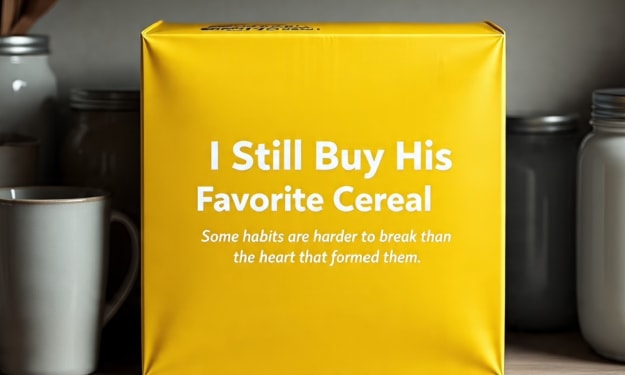
I Still Buy His Favorite Cereal. He's Been Gone for Years
I reach for it every Saturday morning—the bright yellow box with the cartoon tiger on the front. Third shelf down, second from the left. I don’t even read the label anymore. I could find it blindfolded. My hand moves before I think, before I remember. Or maybe I do remember, and that’s why I keep doing it. It’s been seven years since David died. He loved this cereal. Not in the casual way most people like breakfast food. It was a ritual for him. Saturday mornings meant sleeping in, padding into the kitchen barefoot, coffee for me, cereal for him. Always the same. He’d eat straight from the box sometimes, crouched by the counter like a kid caught red-handed. I used to roll my eyes. He’d flash that crooked smile and shrug. “You love me anyway,” he’d say, mouth half full. I did. I still do. When he was first gone, everything in the house felt haunted. His shoes by the door. The worn spot on the couch. His laugh, trapped somewhere in the walls. I couldn’t bear to throw anything out. I remember opening the pantry one day and seeing that stupid cereal box. Half full. I slammed the door shut and sobbed in the hallway for twenty minutes. But then I went out and bought another box. It made no sense. He wasn’t going to eat it. He wasn’t going to come down the stairs, sleepy-eyed and smiling. But something about seeing it there brought me a sliver of comfort. Like he wasn’t entirely gone. Like part of him might still exist in the silly, everyday choices we once made together. At first, I told myself it was temporary. A coping mechanism. Just until the worst of it passed. But the years have gone on, and the habit remains. It’s not about denial. I know he’s gone. I signed the death certificate. I scattered his ashes in the bay where we first kissed on a chilly spring evening, standing on a creaky old dock with trembling hands. I’ve done the grief counseling, read the books, sat in the quiet rooms with strangers who all wore the same hollow look I carried for so long. But that cereal box—it's more than wheat and sugar. It’s a symbol of something that once made life feel complete. And maybe, in my own quiet rebellion against forgetting, I keep buying it to remember. Last week, the cashier gave me a curious look. “Got kids at home?” she asked with a polite smile, scanning the box. I smiled back and nodded. I didn’t have the heart to explain. Because how do you tell someone that love can outlive a heartbeat? That sometimes grief lingers not as tears, but as small acts of preservation—buying their favorite cereal, keeping their mug on the shelf, hearing their voice in songs that play on the radio. The world moved on after David. My friends returned to their routines. The casseroles stopped coming. The calls slowed down. People tried their best, I know that. But grief is not a crisis to be solved; it's a companion that walks beside you, changes its shape, and whispers when no one else is listening. In time, I started to live again. I went back to work. I painted the guest room. I even went on a few dates, all of which ended with awkward smiles and the mutual understanding that I wasn’t quite ready. Maybe I never will be, not in the way people think I should. Some wounds don’t close. They simply become part of your architecture. Today, after unpacking groceries, I placed the box in the same spot on the shelf, facing forward. I paused a moment, tracing the edges of the cardboard with my fingers. It’s funny how something so ordinary can hold so much weight. I still don’t eat it. I donate most of the boxes to a local shelter every couple of months. It’s not wasteful, I tell myself. Maybe some kid will grow to love it like David did. Maybe they’ll crouch by the counter, grinning through a mouthful, and remind someone of everything beautiful about loving someone wholeheartedly. I think David would like that. He once told me, on a particularly quiet night, “It’s not the big things I’ll miss if I go first. It’s the little ones. Saturday mornings. The way you look when you’re reading. That dumb cereal.” He knew, somehow. Or maybe we all do. That in the end, it’s the tiny threads—soft, seemingly insignificant—that hold the fabric of our lives together. And so I keep buying his favorite cereal. Because love doesn’t disappear. It transforms. It lives in memory. In ritual. In the gentle, silent moments we hold onto when everything else fades.
By Azmat Roman ✨about a year ago in Confessions
I Still Talk to Him, Even Though He's Gone
I still talk to him. In the mornings, as I pour coffee into my favorite chipped mug, I tell him what kind of dream I had. Sometimes they’re weird—like the one with the talking dog and the broken escalator—and I can almost hear him laughing, that low, chest-deep laugh that used to rumble next to me in bed. I talk to him when I drive. When I'm stuck at red lights or when a song we both loved comes on. I comment out loud like he's in the passenger seat. “Remember this one?” I’ll say. “You played it on repeat until I threatened to throw your phone out the window.” Then I smile, because he would’ve dared me to. It’s been three years since he died. --- The night it happened, I didn’t know what was coming. We’d had chicken tikka for dinner, and he’d teased me about always ordering the same thing. “You’re scared of spice,” he grinned. I tossed a napkin at him and rolled my eyes. That was the last full conversation we had. He collapsed in the middle of brushing his teeth. An aneurysm, they said. No warning. No pain. Gone in seconds. My life unraveled in the time it took for a toothbrush to hit the floor. The days after were silent chaos. Family, phone calls, casseroles in foil trays. I drifted through them in a fog, unable to process that he was no longer in the world. --- But then something strange happened: I kept talking to him. Not because I believed he was still here—not in a ghost-story kind of way—but because I didn’t know how not to. The conversations started small. I’d whisper his name before falling asleep. Tell him I missed him while stirring pasta. Ask what he thought about the show I was watching, then answer for him in my head. It felt insane at first—like my grief was turning into delusion. But it also felt...right. Comforting. Eventually, I stopped judging myself for it. Talking to him didn’t mean I hadn’t accepted he was gone. It meant I still carried him with me. That the connection hadn’t ended; it had just changed shape. --- I remember the first time I really laughed again. I was at the grocery store, standing in front of the cereal aisle, and I saw his favorite: Honey Nut Cheerios. He used to hoard boxes like there’d be a global shortage. I muttered, “You’d lose your mind over this sale,” and laughed out loud. People stared. I didn’t care. He would’ve laughed too. --- Grief is not a straight line. It’s not even a winding road. It’s a tide—coming in, pulling back, coming in again. Some days I feel like I’ve moved forward, that I’m okay. Other days, a scent or a song wrecks me. But talking to him anchors me. It’s how I carry the love without being crushed by the loss. I’ve moved on in some ways. I changed jobs. I redecorated the apartment. I started dating again, carefully, respectfully. I told him about it—my nerves, my guilt, the way it felt to laugh with someone new. I asked for his blessing in a whisper one night, curled up under the blanket we once shared. I think he gave it to me, not in a dramatic sign, but in a quiet peace that settled in my chest. --- People ask me sometimes, “Does it get easier?” I never know how to answer. It doesn’t get easier. You get stronger. You learn how to carry it better. You stop expecting to "get over it" and instead figure out how to live with it. How to let grief walk beside you without letting it block the light. And sometimes that means you talk to someone who’s gone. Because love doesn’t vanish with a heartbeat. Because their absence is still full of presence. Because some conversations don’t need replies to be real. --- So yes, I still talk to him. I tell him when I’m scared. I thank him when something beautiful happens. I ask him what he thinks about things he’ll never get to see. And sometimes, in the stillness, I imagine what he might say back. Even though he’s gone, I will always have something to say to him. And I like to think he’s still listening.
By Azmat Roman ✨about a year ago in Confessions
The Day I Finally Broke Free: A Confession About Overcoming My Darkest Fear. AI-Generated.
The Weight of Fear For most of my life, fear was the silent puppeteer pulling the strings behind every decision I made. It wasn’t loud or dramatic. It didn’t shout or make demands. Instead, it whispered in the back of my mind, weaving shadows over my thoughts and coloring every step I took with hesitation and doubt. It was the fear of failure, of rejection, of being truly seen—and ultimately, the fear of never living the life I wanted.
By Pulse Scriptabout a year ago in Confessions