Family
Grandpa’s Nighttime Tale: The Thousand-Year-Old Al-Azhar
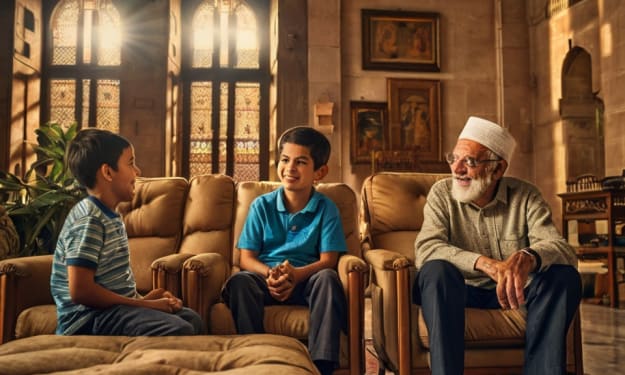
A Nighttime Tale: Grandpa’s Story About Al-Azhar BY:Ubaid “Hey children! You’re still awake?” Grandpa Aslam’s voice broke the silence of the living room. He had just walked in and found Maryam and Abdullah glued to a mobile phone, playing a video game with intense focus. His tone carried a mix of surprise and mild disapproval. “You two are usually good kids who go to bed early. What’s going on tonight?” he asked, raising his eyebrows. “Grandpa, we just can’t fall asleep,” Maryam replied quickly. “And tomorrow is a holiday, so we asked Mom and Dad if we could play some games a little longer. They said yes.” “Oh, I see,” Grandpa said with a smile. “But tell me, why must it always be games on your phone? You could read a book or a magazine instead.” Maryam shook her head. “But Grandpa, we’ve already read all the books and magazines we have.” This time Abdullah added, “Yes, we’ve finished them all. That’s why we’re playing games.” Grandpa chuckled softly. “Well then, no problem. How about tonight I tell you about a place that perhaps you’ve never read or heard about before?” The children’s eyes lit up instantly. They had grown tired of their game and loved the idea of listening to one of Grandpa’s stories. Maryam quickly put the phone aside and said with excitement, “Yes, Grandpa! Please tell us. We’re bored of playing anyway.” Both children turned their full attention to him. Grandpa adjusted his glasses, leaned back in his chair, and began. “All right then. Tonight, I’ll tell you about a thousand-year-old center of learning in the Islamic world, a place called Al-Azhar University. It’s located in Cairo, the capital of Egypt.” Maryam immediately interrupted. “Grandpa! Egypt? Isn’t that the same country where the Pyramids are? Our teacher told us that the pyramids are one of the wonders of the world.” “Yes! And Egypt has a huge river too,” Abdullah added proudly. “Our Quran teacher told us that the River Nile is even mentioned in the Holy Quran.” Grandpa nodded approvingly. “Exactly, my dear children. You both are right. Egypt is indeed the land of the pyramids and the Nile. Its history goes back thousands of years, and that’s why historians and travelers take such deep interest in its monuments and culture. Among these historical treasures is Al-Azhar, one of the greatest universities in the world.” The children leaned in closer, curiosity sparkling in their eyes. “You see,” Grandpa continued, “Muslims conquered Egypt during the caliphate of Hazrat Umar (may Allah be pleased with him) in the seventh century. Later, in the tenth century, a mosque was built in Cairo. This mosque was named Al-Azhar, after Hazrat Fatimah al-Zahra (may Allah be pleased with her), the beloved daughter of our Prophet Muhammad (peace be upon him). Alongside the mosque, a school was established, and with the passage of time, that school grew into what we now know as Al-Azhar University.” “Grandpa, what do they teach there?” Maryam asked eagerly. “Well, in the beginning,” Grandpa explained, “there were only thirty-seven teachers. They taught subjects like the Holy Quran, Islamic jurisprudence, and the Arabic language. But over the centuries, Al-Azhar expanded enormously. Today it has hundreds of professors, and students can study not only religious sciences but also modern subjects—astronomy, medicine, physics, chemistry, engineering, commerce, and many more.” Abdullah’s eyes widened. “That’s amazing! So people from all over the world study there?” “Absolutely,” Grandpa said. “Scholars who graduate from Al-Azhar are respected worldwide. Its religious rulings, or fatwas, are considered authentic and authoritative across the globe. That’s why Al-Azhar is one of the most influential universities in the Islamic world.” The children were now completely engrossed. Grandpa smiled, enjoying their attention. “And do you know?” he added. “Even non-Muslims recognize its greatness. When Napoleon Bonaparte led the French invasion of Egypt in 1798, he was astonished by the level of knowledge, discipline, and organization he found at Al-Azhar. In fact, he wrote about it in his diary, praising its teachers and students. Later, when he formed a consultative council to govern Egypt, he included Al-Azhar’s senior scholars in it. That shows you how much respect he had for this institution.” Maryam gasped in wonder. “Grandpa, can we visit Al-Azhar one day?” “Of course, my dear,” Grandpa said warmly. “Not only can you visit it as tourists, but if you wish, you can even study there. Students from all over the world come to Al-Azhar to seek knowledge.” “That’s wonderful!” Abdullah said with excitement. Maryam clapped her hands. “Thank you, Grandpa! You always tell us such amazing stories. Tonight we learned something so new and inspiring.” Grandpa smiled, his eyes twinkling with pride. “Remember, children, true knowledge is a treasure greater than any game or toy. Always value it, and never stop seeking it.” The children nodded eagerly, their earlier desire to play games long forgotten. That night, as they finally drifted off to sleep, their young minds were filled not with flashing screens but with dreams of pyramids, rivers, and the thousand-year-old halls of learning at Al-Azhar.
By Ubaid about a year ago in Confessions
The Promise That Shattered My Life
A Promise That Shattered My Life BY:Khan Every morning at seven, I arrived at the agency, ready to dive into the day’s work. One morning, around ten, the postman handed me a letter. As I opened it, I found myself reading the words of a woman who had written: “Assalamu Alaikum, son. I am a reader of your magazine. I’ve heard that you write about people’s pains and struggles. I too wish to share mine—so that perhaps others read, understand, and maybe, my sorrow becomes lighter.” The very next day, she sent me her full story. What follows is her account—raw, painful, and unforgettable. --- A Childhood of Neglect From as far back as I remember, my home was never peaceful. My parents rarely got along, and the greatest tragedy of our household was the preference for sons over daughters. Girls were treated like a burden, as though we were born only to tolerate neglect. This discrimination shook me deeply. My brothers were given importance, while I was invisible. I often wondered why our home wasn’t like others—why daughters couldn’t receive the same love as sons. Many nights, I cried myself to sleep, thinking, If only I had been born somewhere else. My mother, however, had one dream: that her children should study. She herself was denied education, and her in-laws constantly mocked her for being uneducated. Out of her insecurity, she pushed us toward books. Yet, how could a child flourish in a house full of tension? Though I was intelligent and hardworking, when it came to exams, I froze. My heart pounded, my hands shook, and the paper remained blank. Finally, my father realized I needed extra help. --- The Arrival of a Tutor Enter Buland Bakht, a young man who had just graduated and was searching for a job. To support himself, he gave tuition lessons to students—including my brothers. One day, my father asked him to also teach me. I needed more than a tutor—I needed kindness, care, and understanding. Buland Bakht became all of that. His gentle encouragement awakened my interest in studies, and slowly, he became the center of my world. What started as respect turned into affection, and soon, we crossed the threshold of love. He promised me that once he secured a job, he would speak to my parents and marry me. His words were my lifeline, and I believed him with all my heart. --- The Promise of Marriage My father admired him greatly. “He is like the son I never had,” he often said. With such praise, I was convinced that our path to marriage would be smooth. When Buland hesitated to approach my parents, I gathered courage and shared my feelings through my sister. To my surprise, my mother responded positively. “If this is true, then let him bring his parents to formally ask for your hand.” Buland looked uneasy when confronted, but eventually, his mother visited our home. To everyone’s surprise, she liked me instantly, and soon, our engagement was announced. My heart soared—I felt my dreams coming true. --- The First Betrayal But fate had other plans. Just days before the wedding, my brother spotted Buland at the railway station buying a ticket to Murree. When questioned, he casually replied, “I’m traveling with a friend.” My family laughed it off as a joke. That evening, when my mother went to his home, his parents looked worried. They explained that he had been offered a new job and had to leave immediately. “The wedding date will need to be postponed,” they said. Imagine our humiliation. Invitations had already been sent, relatives had started arriving, and suddenly, we had to call it all off. My parents faced endless embarrassment. Still, we waited patiently for him to return. --- The Shocking Truth Weeks turned into months. Each time, he gave excuses. Finally, another date was fixed. Guests gathered once more, preparations were made, and my bridal dress lay ready. But the night before the ceremony, devastating news arrived: Buland had returned—with a wife. As it turned out, while tutoring me, he had also been teaching the daughter of a wealthy businessman. He had lured her with the same promises. When her family discovered his upcoming wedding, she threatened to take her life unless he married her. Pressured and frightened, he chose her wealth and influence over his promise to me. My dreams collapsed in an instant. --- A Life Forever Changed That day marked the death of my innocence. My wedding canopy was never raised, and the yellow of my bridal henna turned into the yellow of mourning. Years passed, my hair turned white, but the scars remain as fresh as ever. Since then, I never married. Weddings now terrify me. The laughter, the music, the rituals—everything feels like a cruel reminder of betrayal. My sisters went on to live happy, stable lives. But I, being more sensitive, broke under the weight of deception. I often reflect: if my parents had given me love and attention, perhaps I wouldn’t have fallen so easily for the false affection of a stranger. --- Lessons Learned Parents often forget that not all children are the same. Some are strong; others, fragile. A tender heart needs extra care, or else it shatters. In my case, neglect at home made me vulnerable to the first person who showed me kindness. Buland Bakht—was he a coward, a fool, or a deceiver? I will never know. But what I do know is that his betrayal destroyed my chance at a normal life. Today, I wish to tell every parent: your love and harmony at home is the greatest gift you can give your children. If denied, they may seek it elsewhere—and sometimes, that search ends in tragedy.
By Khan about a year ago in Confessions
The Phone That Stole My Sister’s Life
The Phone That Stole My Sister’s Life BY:Khan Kiran woke Noor one morning with a scolding she meant as affection. “Kiran, get up — it’s morning. You stay up on your phone all night and then pretend you don’t hear the alarm. What do people even talk about on the phone all night? It’s nonsense, a waste of time.” Noor rubbed her eyes, used to Kiran’s teasing. They were only two daughters at home now; their father had died and their mother worked long hours cleaning houses to make ends meet. Kiran was restless by nature. She called late-night phone chatter “time-pass” and said it made people foolish. Noor worried about her sister — she prayed after each of the five daily prayers for Kiran’s safety. Noor kept the house in order and watched the bills while Kiran joked about romance and rebellion. “If only you had a boyfriend,” Kiran said one morning, “you’d be awake talking to him all night, whispering love vows. Life would be so much sweeter.” Noor only shook her head and asked her to eat breakfast. Two days later Kiran told Noor she would go out to celebrate a friend’s birthday and stay overnight. Noor’s eyes filled with tears. “If you don’t come back at night, I don’t want you to go at all,” she said bluntly. Kiran pushed back fiercely. “I’m not a child. This is my life and I’ll live it how I want. Please stop interfering.” Noor’s fear was not pious prudery; it was a sister’s worry. Their mother was ill and needed care. They had no brothers, no one else to rely on. Noor tried to reason, to remind Kiran that the world could be cruel, that strangers who praised could later hurt. “Once a woman’s honor is lost, it’s very hard to recover,” Noor murmured, prayers mixing with heartbreak. “If you go, be careful. Protect yourself.” Kiran laughed it off — till the night she met Samir. Samir was everything Noor had warned about: charming, well-dressed, used to winning trust and then vanishing. He was the kind of young man who courted girls on their phones, spent hours on flattery and promises, then discarded them when he was done. To Kiran, desperate for affection and excited by the secrecy, his attention felt like validation. At a five-star hotel where Kiran thought she was going to celebrate a friend’s birthday, Samir waited and smiled when she arrived. He wrapped her hand in his and whispered declarations. “You belong to me,” he told her, and Kiran, under the spell of sudden romance, believed him. They ate, they laughed, and later they left for a room where the storm outside seemed to make everything cinematic. Samir’s words were like a promise made to a gullible heart: “I’ll never leave you.” Kiran believed that, too. What happened that night was not spoken of in explicit detail, but it was enough. Samir took advantage of Kiran’s trust. He used her vulnerability and treated her like an amusement, then vanished when morning came. He left her ashamed and alone. He disconnected his number, and Kiran’s calls went unanswered. The texts stopped. It was the pattern of a predator: connect, consume, disappear. Kiran returned home with downcast eyes and a wounded conscience. Noor saw the shame in her sister’s face, but it was only when Kiran’s health began to fail that the full tragedy unfolded. Weeks after that night, Kiran grew weak and pale. She fell ill and when she was taken to the hospital, doctors discovered a pregnancy — and, shockingly, they found the baby had already died inside her. Emergency surgery was required. The surgeons warned Noor that Kiran’s life might be at risk. Noor prayed until her voice broke. She begged God to spare her sister. In the operating room, Kiran spoke with halting sincerity. “Forgive me,” she said to Noor. “This is my punishment. I ignored you. I thought I knew better. I was wrong. I am so sorry.” After hours of waiting, the surgeon emerged with the worst possible news: Kiran had not survived. The life that had caused so much grief, the girl who had been reckless and bold, who wanted to seize her freedom, was gone. Noor collapsed, grief swallowing her like an ocean. People murmured around her; she kept repeating only one thought, a single bitter, futile question: “If only she had not had a phone. If only she had listened.” The tragedy of Kiran and Noor is not just a private sorrow; it is a portrait of how social media and instant, intimate connections can be manipulated. Kiran trusted a voice on the phone and the warm glow of attention. Samir used that access to take advantage of her. Their story shows how easy it is for predators to present themselves as lovers, friends, or saviors online and then disappear when there are consequences. This is also a plea to families to talk — honestly, without shame — about risks and boundaries. Noor’s warnings were rooted in love, not control. Her sister’s defiance sprang from loneliness and a hunger for belonging. Social media, with its flattering comments and private chats, can make lies feel like truth. It can isolate the young from the protection of those who care, and it can turn a private betrayal into a catastrophe. Noor stayed behind to care for their mother, carrying the weight of loss and the bitter lesson that came too late. She became quieter, more protective of the people around her. She spoke up at neighbors’ gatherings about caution and compassion, asking families to watch their children’s late-night habits and to help rather than scold. She asked communities to teach young people how to spot false affection, how to value their bodies and choices, and how to seek help before a secret becomes a tragedy. Kiran’s story is a warning and a grief at once: the promise of connection can be a trap when it replaces real human anchors. Phones and social apps are tools — they can bring good, but in the wrong hands they can put lives at risk. Noor’s prayer did not save her sister, but her voice can still save others: speak to your loved ones, keep lines of trust open, and remember that no glowing screen is worth a human life.
By Khan about a year ago in Confessions
The Silent Widow: A Village Heiress Who Sacrificed Her Life for Others
The Untold Tale of a Village Heiress BY:Khan In the heart of a vast village during the days of the British Raj lived Raisa Khalid Ahmed, a man of immense wealth and influence. His presence commanded respect; he owned nearly half the agricultural lands of the village and two lush orchards filled with trees heavy with fruits of every season. God had blessed him with fortune, land, and prestige. Yet, despite these worldly blessings, there was a void in his life—he had no son to inherit his legacy. The village spread far and wide, its fields blooming with crops of every variety. His land alone was enough to sustain his entire family’s needs. But those were times when education, especially English education, was frowned upon by the Muslim community, more so in rural areas. Schools did not exist for boys, let alone for girls. Girls were usually taught only to recite the Quran and perform prayers. Medical facilities were equally absent—no clinics, no hospitals. Women rarely traveled to the city for treatment, for there were no proper roads, no transport. A patient often perished on the way in a bullock cart before reaching any doctor. Ahmed Sahib lived with his wife and daughters, holding tightly to the traditions of his time. He was blessed with six daughters, though tragedy struck early—four of them died in childhood. Only two survived: the elder, aged fifteen, and the younger, just nine years old. Like most men of his generation, Ahmed Sahib believed that educating girls was unnecessary. Instead, he prepared them for domestic life and looked for suitable matches when they came of age. When proposals began arriving, suitors often expressed preference for the younger daughter, but since she was too young, the proposals were politely declined. Eventually, an excellent match was found for the elder daughter. She was married into a respectable family, leaving the younger still a child at home. Not long after, another proposal came—this time for the younger daughter. It was from a wealthy family in the same village. The patriarch of that household had passed away, leaving behind vast lands and a young widow raising their only son. The boy, just fifteen, was studying in a prestigious school in the city. His mother wished for him to be married in name only, with the actual wedding delayed until he grew older. Given the wealth and honor of the family, Ahmed Sahib accepted the match, and the two children were bound together in a simple marriage contract. For a while, life went on peacefully. But fate had other plans. When the girl turned eleven, tragedy struck. Her young husband, still studying in the city, fell gravely ill and passed away. The shock reverberated through both families. The boy’s mother, devastated by the loss of her only child, soon followed him to the grave. At the very same time, Ahmed Sahib’s wife gave birth to another baby girl. Their home, once full of anticipation, was suddenly drowned in sorrow. Amid this chaos, the eleven-year-old widow could not even comprehend what had befallen her. When her bangles were broken and she was forced into white garments, she resisted in tears, screaming that she would not give up her colorful clothes or her beloved ornaments. She was too young to understand widowhood but old enough to feel its cruelty. Her mother too shared in her grief, breaking her own bangles in mourning. Life in the household grew somber. The younger sister, as she grew older, was married into a highly educated and prestigious family. Her father-in-law was a barrister trained in London, and her husband held a prominent government position. After Ahmed Sahib’s death, she took her widowed sister into her home. The young widow never remarried, for in their family, second marriages were considered improper. Instead, she devoted herself entirely to raising her sister’s children. Though she had been deprived of the joys of her own marriage, she poured her love and affection into her nieces and nephews. They grew up calling her “Ammi,” treating her with the same respect and love as their real mother. Her wealth remained intact, but she never sought luxury. Instead, she embraced a life of service and sacrifice. Her existence became a testament to quiet resilience—the story of a woman denied her own happiness yet giving boundless love to others. She lived a long life, reaching nearly ninety years of age. In 1975, she finally departed from this world. She was laid to rest from her sister’s home, the same home where she had spent decades nurturing generations that were not her own. Her story is not one of romance or grandeur, but of sacrifice, endurance, and silent strength. In an era when girls were seldom given choices, she bore the weight of her fate with dignity. While the world saw her as a wealthy heiress, in truth, she was a woman whose greatest legacy was not land or riches but the love she left behind in the hearts of those who called her “mother.” May God grant her eternal peace and the highest place in His mercy. Amen.
By Khan about a year ago in Confessions
The Art of Slowing Down: Why a Gentle Pace Can Lead to a Fuller Life
Introduction We live in an age that glorifies speed. Fast food, high-speed internet, instant replies, overnight delivery—our culture prizes immediacy. The faster we move, the more productive we appear, and the more we feel we’re keeping up with everyone else. But beneath the rush lies an uncomfortable truth: in our relentless pursuit of speed, we often sacrifice depth, connection, and fulfillment.
By Aiman Shahidabout a year ago in Confessions
The Gift of Friendship
The Gift of Friendship BY:Ubaid Daniyal Hassan Shoukat went to visit his friend Nasir at his home one afternoon. When he knocked on the door, it was Nasir’s younger brother who came out and told him politely, “Bhai isn’t home right now.” Shoukat and Nasir lived in the same neighborhood and were both students at the same college. They spent a lot of time together and shared many interests. Alongside them, there was another friend, Tanveer, who lived in a different neighborhood. However, Shoukat had been upset with Tanveer for a while, and because of that, their friendship had grown cold. Nasir, being the peacemaker of the group, had tried several times to mend the broken bond between the two, but his efforts always ended without success. On his way back home, as Shoukat turned into the next street, he suddenly saw Nasir coming from the opposite direction. They both noticed each other at the same time. After exchanging greetings and asking how the other was doing, Shoukat said, “I came to see you earlier, but you weren’t home. Where had you gone?” “I went to see Tanveer,” Nasir replied calmly. The mention of Tanveer’s name instantly changed Shoukat’s expression. His face tightened, and he looked away, but Nasir continued before he could say anything. “He’s very worried these days.” “Worried? Why, what happened?” Shoukat asked, his curiosity overcoming his irritation. Nasir hesitated for a moment and then explained, “His father is very ill. The doctors say he needs surgery, but…” His voice trailed off, and he stopped. “But what?” Shoukat pressed. “They don’t have the money,” Nasir finished with a sigh. Shoukat’s face grew serious. “How much will it cost?” Nasir told him the amount, and Shoukat simply said, “Oh… may Allah make things easier for him, InshaAllah.” “Yes, and you should also pray for him,” Nasir added. “May Allah improve their condition.” With that, the two friends said goodbye, and Shoukat walked back toward his own home. Yet, the news of Tanveer’s situation troubled him deeply. On the way, he kept thinking about his friend. Despite their disagreements, he could not ignore Tanveer’s hardship. By the time he reached his home, Shoukat had already made up his mind: not only would he reconcile with Tanveer, but he would also help ease his burden. Shoukat belonged to a well-off family. His father owned a sugar mill, and their household was blessed with wealth and comfort. His father, known to all, was a generous and kind-hearted man. The moment Shoukat stepped inside, he went straight to his father’s room and sat down beside him. “What’s the matter, son?” his father asked after noticing his worried face. “You look troubled. Is everything alright?” Shoukat told him everything—about Tanveer, his father’s illness, the operation, and the financial struggle they were going through. Finally, he explained his intention of helping their friend. After hearing the whole story, Shoukat’s father smiled with contentment. “You are doing a very good thing, my son. Stay here for a while; I’ll be back.” He walked into his bedroom, and after a short while, he returned holding a sealed envelope. Handing it to Shoukat, he said warmly, “Take this, and may Allah accept your good deed.” Shoukat held the envelope with both hands, thanked his father, and left for Nasir’s house. When Nasir opened the door, Shoukat said, “Come with me to Tanveer’s house.” Nasir’s eyes widened in surprise. “Do you mean… you want to reconcile with him?” “Yes,” Shoukat replied with a smile. “Reconciliation and charity.” “What do you mean?” Nasir asked in confusion. Shoukat then explained, “I was upset with him, that’s true. But after hearing about his problems, I couldn’t just sit and watch. I want to help him. Allah has blessed me with the chance to do something good, and I’m grateful for that. Now let’s go.” Together they walked to Tanveer’s modest home. Though Tanveer belonged to a poor family, he was dignified and hospitable. He welcomed them warmly and, with whatever little he had, tried to serve them respectfully. Shoukat noticed the worry hidden behind his friend’s smile. His eyes betrayed the burden he was trying to hide. “Tanveer,” Shoukat finally said, “I’ve come to put an end to our quarrel. I want to be friends again.” Tanveer’s face immediately lit up with joy. Being a generous-hearted person, he accepted the reconciliation without hesitation, and the three of them began talking like old times. After a while, Shoukat quietly pulled the envelope from his pocket and extended it toward Tanveer. “What’s this?” Tanveer asked in surprise. “This is some money for your father’s treatment,” Shoukat explained. Tanveer looked at the envelope, stunned. “But… how can I… I don’t know if I can accept this…” He hesitated, unable to speak clearly. “Keep it, Tanveer,” Nasir encouraged him. “Allah has given Shoukat the chance to do a good deed. Don’t refuse and let this blessing go to waste.” Tanveer hesitated again, his hands trembling. But finally, with tears brimming in his eyes, he accepted the envelope. “Shoukat, I thank Allah for blessing me with such friends,” he said, his voice breaking. As he spoke, tears rolled down his cheeks and soaked into his clothes. Shoukat, equally moved, replied softly, “I too thank Allah for granting me the opportunity to help. It is my good fortune. In this world, very few people are chosen by Allah for acts of goodness.” “You’re right,” Nasir said with a nod. After spending some more time together, Shoukat and Nasir left Tanveer’s house and made their way back home. That night, Shoukat felt a deep sense of peace in his heart. He silently thanked Allah for giving him the chance to reconcile with his friend and to serve humanity in a meaningful way. For Shoukat, the lesson was clear: true friendship was not just about laughter and shared moments but about standing beside each other in times of trial. And above all, real wealth lay not in money, but in the ability to use it for kindness.
By Ubaid about a year ago in Confessions
The House That Never Existed: A costly Lesson in Trust
I am a 33-year-old man who grew up in a small rural village. 🌾 Life in the countryside has always been simple, grounded, and connected to the earth. While many of my friends and even family members chose to move to the city in search of better opportunities, I never had the heart to leave the village. I loved the open fields, the rhythm of the seasons, and the peace of working with my hands. My work was modest—doing day labor for neighbors, farming small plots of land, and raising a handful of sheep.
By zinatabout a year ago in Confessions
The Power of Small Wins: Why Tiny Steps Lead to Big Changes
Introduction: The Myth of Overnight Success In a world that celebrates dramatic transformations, viral moments, and sudden breakthroughs, it’s easy to fall into the trap of believing that big changes come from big actions. We admire the entrepreneur who launches a multimillion-dollar startup seemingly out of nowhere or the person who loses fifty pounds in a year. What we don’t see are the countless small actions—the late nights of planning, the skipped desserts, the extra ten minutes of walking—that built up to those results.
By Aiman Shahidabout a year ago in Confessions
The Comparison Trap: How Measuring Ourselves Against Others Steals Our Joy
Introduction: The Subtle Thief of Joy In a world that runs on social media feeds, highlight reels, and constant updates, it has become easier than ever to measure our lives against the lives of others. A neighbor’s new car, a colleague’s promotion, or a friend’s picture-perfect vacation can stir feelings of inadequacy. This phenomenon—often called the “comparison trap”—is as old as humanity itself, but in our hyperconnected age, it has grown into one of the most common sources of discontent. While comparison can sometimes motivate us to improve, more often than not, it steals our joy, leaving us feeling unworthy and perpetually behind.
By Aiman Shahidabout a year ago in Confessions
Confessions of a Former Alcoholic Part 22
It is definitely a lesson for people to learn about the awful facts of life. I can honestly tell that the social experiment I performed on myself and my findings regarding the causes of alcoholism caused me a great deal of suffering.
By TheNaethabout a year ago in Confessions
Speculation Swirls
Will Donald Trump Resign Amid Mounting Political Pressure? Rumors of Donald Trump’s potential resignation have dominated political chatter in the United States and abroad, despite no official confirmation from the White House or the former President himself. The speculation, amplified by online betting markets and viral social media posts, has left both supporters and critics scrambling to interpret what it might mean for America’s political future.
By Wings of Time about a year ago in Confessions