Family
You Hid a Forbidden Love, but the Truth Cost You Everything
You were fearless once. At nineteen, the world was yours—a vibrant university student with dreams as bold as your spirit. That’s when you met him, the man who swept you off your feet with his wealth, charm, and promises of a glittering future. You married young, dazzled by his family’s prestige and the life you’d build together. The first years were a whirlwind of success—money poured in, your lifestyle soared. But beneath the surface, something was missing. His touch was cold, his words sparse. He poured himself into his business, leaving you starving for affection. You tried to fill the void, showering him with love, but it was like pouring water into a cracked vase—it never held.
By zinatabout a year ago in Confessions
Gudia’s Prayer: A Child’s Hope for Her Friend Guddu
Gudia’s Prayer BY:Khan I am Gudia. Right now, I am sitting in the long, silent corridor of a hospital. The floor beneath me is cold, and so is the air around me. It feels like the whole world has fallen asleep, except for me and the sound of my own thoughts. I know my mother must be worried at home. I never returned last night, and she must be pacing, waiting, maybe even crying. In the morning, when I finally go home, she will scold me, perhaps even beat me with the corner of her dupatta the way she does when she is angry. And I will take it silently, because I know she is worried out of love. But how can I leave? How can I go home when Guddu is lying here in this hospital, fighting for his life? Maybe you don’t know who Guddu is. How would you? Let me tell you. Guddu is not just a friend—he is my secret-keeper, my laughter, my world. He is the one who buys me small pieces of roasted corn from the street, who treats me to a kulfi when the heat becomes unbearable, who listens to me when no one else does. But let me tell you how we first became friends. One afternoon, my mother sent me to the market to buy vegetables. On the way, I saw Guddu sitting outside his house, selling candies. I wanted one so badly. I asked him, “Please give me a candy. I’ll bring the money tomorrow.” He didn’t ask questions, didn’t frown. He just smiled and handed me a candy without taking a single coin. That was the beginning. After that day, we were always together. Our neighborhood is dirty, filled with garbage dumps at every corner. The air often smells of rotting food, and stray dogs fight over scraps in the alleys. But somehow, in that ugliness, our friendship blossomed. Guddu and I would sit near the railway crossing, right by the old iron gate where trains would thunder past. He would count the coins he earned from selling candies, his small hands moving carefully as if every coin was a treasure. And I would chatter endlessly—about my school, my mother, my dreams. He would listen, smile, and sometimes laugh out loud. Life was simple, even if the world around us wasn’t. But then came the day everything changed. We were walking home together, chatting as usual, when we came across one of those garbage piles. We tried to walk carefully, stepping around it, but in the blink of an eye, something sharp hidden inside the trash pierced Guddu’s foot. He winced in pain. Blood began to flow from the wound, staining the dust beneath his feet. I quickly tore a strip from my dupatta and pressed it against his foot to stop the bleeding. Guddu tried to laugh it off, pretending it was nothing, but I could see the pain in his eyes. After that day, he was never the same. He started falling sick more often. His laughter faded, his energy drained. His mother took him to the hospital, and then came the words that no child should ever hear: “He has AIDS.” At first, I didn’t understand what that meant. All I knew was that the doctors whispered as if they carried bad news, and people began to look at Guddu differently, as if he was carrying a shadow that could spread. But I knew only one thing: Guddu was my friend. And friends don’t leave each other behind. Now I sit here on the cold floor of the hospital corridor, praying with all my heart. I press my hands together tightly, whispering every prayer I know. “Please, God. Don’t take Guddu away. Please don’t let him die.” Tears burn my eyes, but I don’t let them fall. I believe that if I keep praying hard enough, if I keep believing, then maybe a miracle will happen. Maybe Guddu will open his eyes tomorrow, smile at me, and say, “See, Gudia? I told you I won’t leave you.” I believe in that hope. I must. Because what is friendship without hope? Dear children, if you are reading my story, I want to ask you something. Please whisper a prayer with me. Say it softly, in your heart: “Gudia’s Guddu will live. He will not die.” Because when many hearts pray together, miracles can happen. I know life is cruel sometimes. Our world is full of dirt, pain, and poverty. Children like Guddu and me are often forgotten. But in the middle of all this, love still exists—love in the form of friendship, kindness, and loyalty. That is why I believe Guddu’s story will not end here. Yes, maybe the doctors have given up. Maybe the neighbors whisper that his days are numbered. But I believe differently. I believe that prayer is stronger than fear, and friendship is stronger than disease. So I sit here through the night, on the cold hospital floor, waiting for dawn. The world sleeps, but I stay awake. Because somewhere in that room, on that hospital bed, my best friend is fighting for his life. And I will not leave him alone. Not tonight. Not ever.
By Khan about a year ago in Confessions
The Letter I Never Sent. Content Warning.
There are moments in life that carve themselves into your soul, moments you carry with you long after time has passed. For me, that moment came in the form of an old letter—creased, yellowed, and hidden in the bottom drawer of my father’s desk.
By Asghar ali awanabout a year ago in Confessions
The Secret I Never Planned to Share
Secrets are strange. They start off as little shadows that you might decide to overlook. But the longer you hold on to them, the heavier they become—they speak in your ear at night, sit on your chest, and tug at your conscience. I wasn't going to share mine. For years, I even convinced myself that I would take it into the next world.
By jawad aliabout a year ago in Confessions
The Things We Do in the Dark. Content Warning.
October 12th I saw him again today. It’s stupid, really. The way my body reacts. A full-system reboot from a thirty-second interaction in a coffee line. It’s not even about the words. It’s about the space between them.
By Chahatabout a year ago in Confessions
You Chased Her Secret, but the Truth Broke You💔
You stand by the window, the gray dusk swallowing the last light of day. Your heart thumps, heavy with a question you can’t shake. Her suitcase clicks shut behind you. “I’m off for my night shift,” she says, her voice flat, like a stranger’s. The woman you once loved more than life itself brushes past, leaving only the faint scent of her perfume. Years ago, she was your everything—her smile lit up your world, her touch grounded you. You built a life together, two kids, a home filled with laughter. But now? Something’s wrong. The late-night shifts, the cold silences, the way she avoids your eyes—it’s eating at you. Tonight, you decide to follow her, to uncover the truth, no matter how much it might shatter the life you’ve built.
By zinatabout a year ago in Confessions
The Prize Hunter and the Junkyard Trick
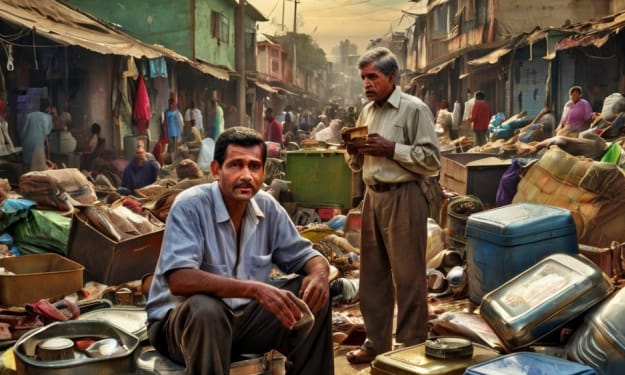
The Prize Hunter and the Junkyard Lesson BY:Khan Bashir Ahmed Bhatti, my old friend, has an unusual obsession. He is always chasing after prize schemes. Over the years, he has won several items through lucky draws—small and big prizes alike. A washing machine, a motorcycle, household appliances—he has collected them all, free of cost. The secret of his winnings lies not in luck alone but in his peculiar habit. He never throws away wrappers. Soap wrappers, tea packets, biscuit covers—even empty cigarette packs—he hoards them all in his house like a treasure trove. Whenever a company announces prizes through a lucky draw, he is the first one to pull out a stack of wrappers, scribble his name, ID card number, and mobile phone on them, and drop them into the entry boxes. Most people buy the products just to participate in the scheme, but my friend never spends a dime. He scavenges wrappers from wherever he can find them—at shops, in trash heaps, or even in the junkyard. For him, every wrapper is a lottery ticket, and the more entries he sends, the better his chances of winning. And indeed, his tactic often pays off. The companies, of course, are not blind to this trickery. They know many participants send in wrappers without purchasing the products. But since a wrapper carries no proof of whether it was bought or found, they are forced to honor the winner. A currency note works the same way: whether earned through hard work or picked up from the street, it holds its value everywhere. Similarly, a wrapper is valid as long as it isn’t torn or soiled. Still, some companies have become smarter. They now mark new products with a golden star, insisting that only star-marked wrappers qualify for the draw. Others insert coupons inside the packaging, forcing customers to purchase the item to participate. These innovations have reduced the tricks of people like my friend, but his passion remains undimmed. One pleasant afternoon, with cool breezes sweeping the city, my friend and I were strolling down a busy street. As we neared the bazaar, rows of junk shops came into view. On one side of the road stood two warehouses, and on the other, three more yards buzzing with business. Pushcart vendors were weighing scrap paper, bottles, and broken goods while the junk dealers, dressed in shabby clothes, sat lazily on their chairs, paying cash and recording tallies. Among the piles of junk, my friend’s sharp eyes caught sight of something—a shiny, almost brand-new tea tin lying on top of a mound of scrap. Its retail price would have been around 190 rupees. To him, it wasn’t just an empty container—it was a golden ticket. Without hesitation, he stepped forward, picked it up, and examined it with delight. But his small act didn’t go unnoticed. The junk dealer, sitting nearby, shouted in a harsh tone, “Uncle, please put that back. It’s not yours.” The words struck like a whip. My friend froze. All eyes turned toward him. The other junk dealers, sensing a moment of drama, began staring, eager to watch him squirm. The tin itself was worthless, but his mistake was in picking it up without permission. The dealer’s voice had exposed him, and embarrassment is heavier than any burden. For a moment, my friend looked shaken, but being clever and quick-witted, he recovered instantly. Saving face was now more important than saving the tin. He beckoned the junk dealer over with a mysterious smile. Curious, the man walked up. I, too, drew closer, wondering what trick my friend would pull this time. Holding the tea tin, my friend pointed at the printed word “Supreme.” “What does this say?” he asked. The dealer, who was literate enough, replied, “It says Supreme.” “Good,” said my friend. “Now tell me, if you remove the letters ‘Sup,’ what remains?” “Then it becomes ‘reme’—or rather ‘reme,’” the dealer answered hesitantly. “And if we add the letter K before it, what word do we get?” The dealer thought for a second. “That would make it ‘Kreme’—or ‘Cream.’” My friend leaned in dramatically. “Exactly. And cream sounds like ‘Kareem.’ Tell me, Kareem and Raheem—what are these names?” The dealer chuckled. “Kareem was my father’s name. Raheem was my uncle’s.” “Wrong!” my friend declared firmly. “No ordinary human is named Kareem or Raheem on their own. These are sacred names—attributes of Allah Himself. That is why our parents always prefix them with ‘Abdul,’ making them Abdul Kareem, Abdul Raheem. Without ‘Abdul,’ they belong only to God.” The dealer scratched his back nervously. “Yes… yes, you are right. My father’s real name was Abdul Kareem, and my uncle was Abdul Raheem.” My friend pounced on the moment. “So you see, this word on the tin—‘Supreme’—contains the sacred letters that form the word Kareem. And here you are, letting it lie in the dirt among scrap and filth. Do you realize what a grave sin that is? Words connected to the divine should be kept in a clean, elevated place, not tossed onto a junk heap.” The dealer’s eyes widened. He folded his hands apologetically. “You are absolutely right. I have made a big mistake. Please, take this tin and place it somewhere respectful. I don’t want to be guilty of disrespect again.” My friend nodded gravely. “Good. Learn from this. Never let sacred words fall into dishonor again.” He shook the dealer’s hand, tucked the tin under his arm, and walked away with me. Once we were at a distance, I turned to him and asked, half amused, half amazed, “What was that all about? You turned a scolding into a sermon and walked away with the prize.” He grinned slyly. “If I had simply put the tin back, I would have lost face. The dealer wanted to embarrass me, but I outsmarted him. And besides,” he winked, “I didn’t lie. Respect for sacred words is indeed our duty.” I couldn’t help but laugh. That was my friend—always cunning, always ready with a trick, and forever chasing prizes, even if it meant turning a junkyard lesson into a theological debate.
By Khan about a year ago in Confessions
The Date
Passing the time, looking around and looking for a soul to accompany to follow, she continues to walk towards the dark small alley. So many feelings to hold, to resist, to procrastinate so no one will know how she feels. She continued to look, to see if she could find the smell, the shadow left by that man.
By Lasha Deselaabout a year ago in Confessions
The Digital Detox Movement: Why Unplugging is Becoming the New Luxury
Introduction: The Age of Always-On We live in a world that never sleeps. Notifications buzz, emails flood in at midnight, and social feeds refresh endlessly. Being "always available" has become the cultural norm, but it comes with hidden costs—rising stress levels, declining focus, and an erosion of genuine human connection. Out of this environment, the digital detox movement has emerged. For some, unplugging feels like deprivation. For others, it has become the ultimate form of luxury: time, attention, and presence reclaimed.
By Aiman Shahidabout a year ago in Confessions
Unsent, Unforgotten
We all have sentences inside us that were never spoken. Words that sat at the edge of our lips, waiting for courage, waiting for the right time—a time that never came. For me, those words weren’t just sentences. They were an entire letter.
By Shehzad Anjumabout a year ago in Confessions
The Gift of Presence: Why Being Fully There Matters More Than Doing More
Introduction: The Age of Distraction We live in an era where productivity is celebrated, busyness is worn as a badge of honor, and multitasking feels like the only way to keep up with life’s demands. Our phones ping with constant notifications, work follows us home through emails, and social media steals hours of our time in endless scrolling. In the midst of this hyper-connected world, we’ve never been more disconnected—from ourselves, from the people we love, and from the simple joys of living.
By Aiman Shahidabout a year ago in Confessions
A House Divided: When a Father’s Betrayal Shattered a Family
A House Divided BY:Khan Khalid Mahmood Ashraf’s life took a turn the day his wife, Bushra, fell seriously ill. For years, she had been the heart of their home — the mother of five daughters and two sons, the anchor of a bustling household. But this time, when she was admitted to the hospital after her third heart attack, the doctors shook their heads grimly. “Pray for her recovery,” they told the family, “the rest is in God’s hands.” For three long months, Bushra lay in the hospital bed, her children constantly at her side, whispering prayers into the sterile air. Ashraf, however, was not as steadfast. Behind the façade of worry, he had already begun weaving a new plan for himself. Believing Bushra would not survive, he secretly married Salma, a distant relative — a divorced woman with a daughter from her previous marriage. He justified his decision by telling himself that his children needed a mother. But fate had other plans. Bushra survived. By what the family called nothing short of a miracle, she was discharged from the hospital and returned home. The children’s prayers had been answered. Yet, her recovery shattered Ashraf’s secret dreams. He had imagined welcoming a new bride into the house, but Bushra’s unexpected return meant his plans fell apart. From then on, peace left the home. Ashraf, a man with a weakness for women, found himself frustrated. Small arguments with Bushra turned into daily battles. The children, already traumatized by their mother’s illness, grew weary of their parents’ endless fights. One evening, when Bushra’s married daughters and their husbands came to visit, they confronted Ashraf. Why did he keep fighting with their mother? At first, he resisted, but then he blurted out the truth. “I want to divide this house into two parts,” he declared coldly. “Bushra will live in one part with her children. And Salma, my wife, will live in the other part with her daughter. I married Salma because I thought Bushra would not survive. I did this for the children, to give them another mother. And I gave shelter to a helpless woman. Now Bushra is standing in my way.” The room fell silent. His daughters and sons were stunned. They could neither oppose their father openly nor ignore the pain of their mother. His betrayal had already taken root, and there was no turning back. Tensions escalated until tragedy struck. Ashraf’s younger son, unable to bear the humiliation and family turmoil, consumed poison and ended his life. The loss devastated Bushra, who collapsed into a coma after her son’s funeral. A year later, she too passed away, unable to recover from her grief. The family home, once filled with love and laughter, became a place of sorrow. Yet Ashraf, hardened and obstinate, remained unchanged. He brought Salma openly into the house, dividing it as he had always wanted. But his eldest son, Javed, could no longer focus on his studies. Dropping out of school, he began driving a pickup truck to provide for his younger sisters. The burden of responsibility fell squarely on his young shoulders. Ashraf, unsympathetic, had further plans. One day, he summoned Javed and delivered an ultimatum: “If you want to stay in this house, you must marry Salma’s younger sister. If you refuse, you will be thrown out and cut off from my inheritance. Decide wisely.” Javed was horrified. To him, Salma was the reason his mother and brother were gone, the root of his family’s destruction. The thought of marrying her sister was unbearable. But Ashraf’s authority was ironclad. Resistance meant losing everything. For months, Javed stalled, avoiding his father’s demand. But eventually, under relentless pressure, he surrendered. With his sisters’ futures in mind, he reluctantly married Salma’s younger sister. His sacrifice was silent, but it tore at his soul. Life moved on. Javed devoted himself to supporting his sisters and caring for his new wife. Surprisingly, she turned out to be kind-hearted, and though he never loved the circumstances, he treated her with respect. In time, she too became a partner in his struggles. But Ashraf’s selfishness did not end there. With Salma by his side, he continued to control the family. Javed, however, grew stronger. He worked tirelessly, saving every rupee he could. Finally, he convinced his wife to demand that Ashraf transfer the house into Javed’s name. Desperate to appease them, Ashraf agreed. The day the papers were signed, Javed wasted no time. He tore down the dividing wall of the house. With tears streaming down his face, he remembered his mother and brother. The family wept together, grieving the home that had once been whole. A short while later, Javed sold the house. He gathered his sisters and wife and moved to the city, determined to build a new life away from his father’s shadow. Ashraf begged him not to go. “My job is here. My life is here. Don’t leave me alone,” he pleaded. But Javed’s heart had hardened. “When you were strong, you thought only of yourself,” he told his father. “Now that you are weak, you expect us to care for you? You must learn what helplessness feels like.” And so, Ashraf was left behind, an old man surrounded by silence. Even Salma eventually left to live with her daughter and son-in-law in the city. Ashraf, once proud and domineering, now faced the twilight of his life alone, haunted by the ruins of the family he himself had destroyed.
By Khan about a year ago in Confessions